
 Matzav
Supreme Court Strikes Down Trump’s Birthright Citizenship Order in Major Setback
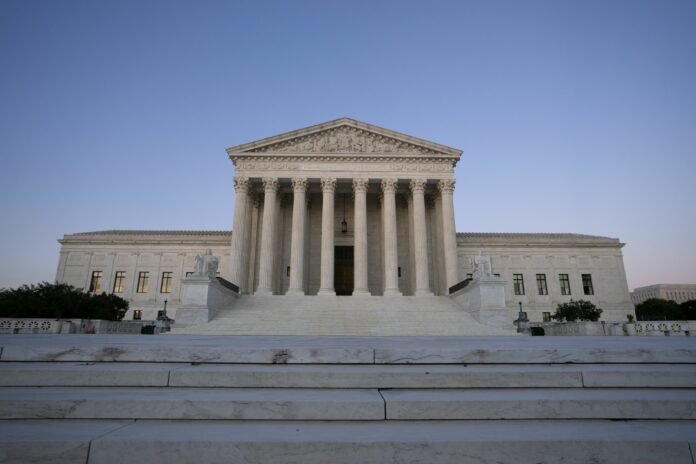
President Donald Trump suffered another major legal defeat Tuesday after the Supreme Court invalidated his executive order seeking to deny automatic U.S. citizenship to children born to illegal immigrants and foreign visitors, ruling that the policy conflicts with the Constitution.
The executive order, signed on Trump’s first day back in office, had been tied up in the courts for months amid arguments over whether it violated the Citizenship Clause of the 14th Amendment, which provides: “All persons born or naturalized in the United States, and subject to the jurisdiction thereof, are citizens of the United States and of the State wherein they reside.”
In a narrow 5-4 decision, the justices concluded that the constitutional guarantee extends to children “born in the United States to parents unlawfully or temporarily present,” meaning the policy cannot be changed through executive action and would instead require a constitutional amendment.
Writing for the majority, Chief Justice John Roberts stated, “If Congress intended to limit American citizenship to the children of those domiciled in the United States, nothing in the succinct language of the Citizenship Clause conveyed that design.” He continued, “Words appearing frequently in the Executive Order—’mother,’ ‘father,’ ‘lawful,’ ‘temporary’— are absent from the Clause. For a simple reason: they did not matter.”
Earlier this year, Trump made history by becoming the first sitting U.S. president to attend oral arguments before the Supreme Court when the justices heard the case on April 1.
Legal observers had largely predicted that the administration faced an uphill battle, with many constitutional scholars questioning whether a president has the authority to redefine birthright citizenship through executive order alone.
A central issue throughout the case was the Supreme Court’s landmark 1898 decision in US v. Wong Kim Ark, which involved a man born in the United States to Chinese immigrant parents who were legally residing in the country but were barred from obtaining citizenship themselves under the Chinese Exclusion Act of 1882.
In that ruling, the Court held that nearly everyone born on American soil automatically acquires U.S. citizenship, with only limited exceptions, including children of hostile occupying forces, foreign diplomats and rulers, or births aboard foreign vessels in U.S. waters.
During the oral arguments, Solicitor General John Sauer argued that Wong Kim Ark involved immigrants who were lawfully present and permanently domiciled in the United States, making it distinguishable from today’s immigration landscape. He also contended that the dramatically higher levels of illegal immigration today transform the issue into one involving national security, placing it within the president’s constitutional authority.
The latest ruling follows another Supreme Court decision last year that curtailed the ability of lower federal courts to issue nationwide injunctions blocking presidential policies. Although that ruling involved litigation related to the birthright citizenship order, the justices made clear that nationwide relief could still be granted in properly certified class-action lawsuits.
The case, Trump v. Barbara, was brought on behalf of three families who argued that Trump’s executive order unlawfully denied citizenship to their American-born children.
One of the plaintiffs, identified only as Barbara, is a Honduran asylum seeker whose child was born in October of last year. Another plaintiff, Susan, is a Taiwanese citizen studying in the United States whose daughter was born in April 2025 while her passport application was pending. The third plaintiff, Mark, is a Brazilian permanent residency applicant whose son, born in March 2025, had initially been issued a U.S. passport.
Proceeding under pseudonyms, the plaintiffs argued that the executive order illegally stripped their children of American citizenship and the legal rights and government benefits that accompany it, including eligibility for Social Security, Medicaid, and food assistance.
A federal judge in New Hampshire previously granted a preliminary injunction blocking enforcement of the order and certified the plaintiffs’ children, along with others in similar circumstances, as members of a nationwide class.
The ruling marks the second time in six months that the Supreme Court has rejected one of Trump’s signature policy initiatives. In February, the Court also ruled that the administration could not rely on the International Economic Emergency Powers Act to impose customized tariffs on foreign countries at the president’s discretion.
{Matzav.com}