
 Vos Iz Neias
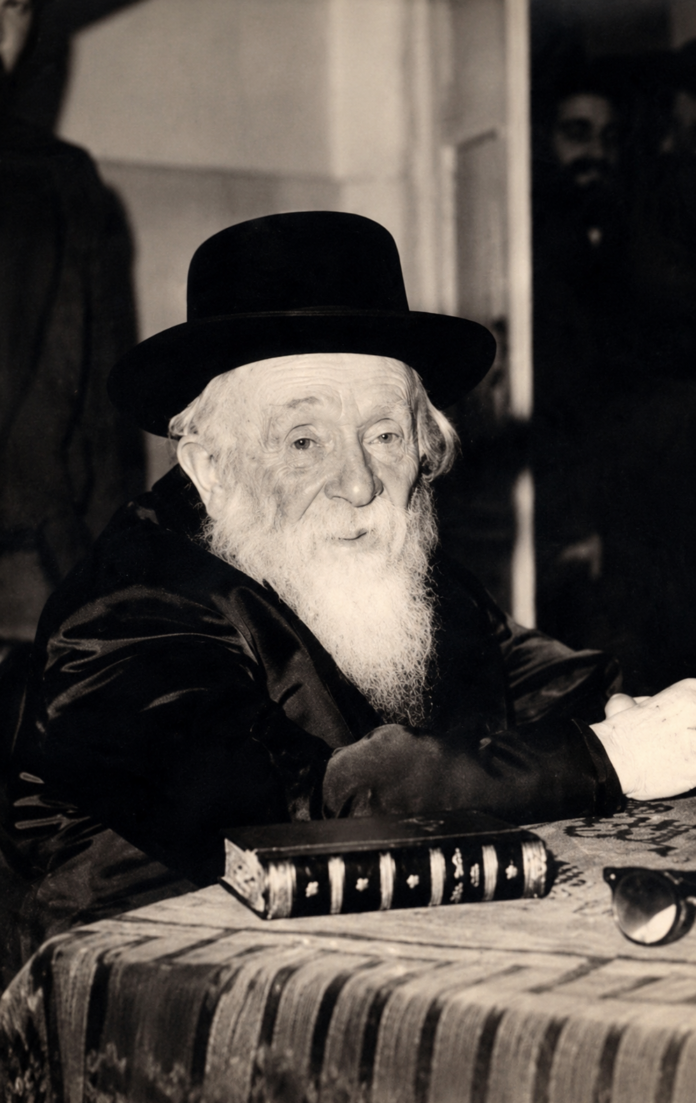
The Kapischnitzer Rebbe, Rav Avraham Yehoshua Heschel zt”l on his Yartzeit
New York (VINNEWS/Rabbi Yair Hoffman) The sixteenth of Tammuz marks the yahrtzeit of the Kapischnitzer Rebbe, Rav Avraham Yehoshua Heschel zt”l, a man who became a legend in his own lifetime for the pain of others that he insisted on carrying as though it were his own.
Rav Aharon Kotler zt”l, once called him “the Gadol Hador in tzedakah and chesed.” These are the words of the Litvishe Torah world’s foremost figure, spoken about a Chassidic Rebbe of the Ruzhiner tradition. The Kapischnitzer Rebbe stood at a place where the ordinary boundaries of the Torah world dissolved, because the quality he embodied — unbounded ahavas Yisroel — belonged to no camp and answered to no label.
A Name and a Legacy
He was born on the fifteenth of April 1888 in Husiatyn, a small town in Galicia on the Zabrotz River, which then marked the border between Austria and Russia. He was named for the Apter Rav, the Oheiv Yisroel of Apta, his direct ancestor and the founder of the Apt-Zinkov-Kopischnitz dynasty — and the name proved prophetic. Like his namesake, whose entire avodah was captured in the two words oheiv Yisroel, this Rav Avraham Yehoshua would make the love of a fellow Jew the organizing principle of an entire life.
His maternal grandfather was Rav Mordechai Shraga of Husiatyn, a son of the holy Ruzhiner. When the boy was six, his grandfather passed away and the family moved to Kapischnitz, where his father, Rav Yitzchok Meir, opened a Beis Midrash and, though he had inherited no Chassidim of his own, drew a following by the sheer force of his tzidkus. Of his son the father used to say, “You can trust my Avraham. He never lets anything leave his hand that is not in perfect order.”
Vienna: The Making of a Baal Chesed
When the First World War erupted in 1914, the family fled to Vienna, where thousands of Jewish refugees had lost everything. It was there that the young Rav Avraham Yehoshua’s character revealed itself. Each day he went to the train station to meet the newcomers, lifting their heavy trunks onto his own shoulders and carrying them to their lodgings. He noted their addresses and afterward slipped money and food beneath their doors so quietly that they would never know who had provided for them.
He made himself a rule from which he would not deviate for the rest of his life: he would not go to sleep until he had given away every penny he owned. When his money ran out, he borrowed; and when he was already deep in debt, he borrowed still more, and gave that away too.
On the first day of Rosh Hashanah 5696 (1936), his father passed away and Rav Avraham Yehoshua was crowned Rebbe. Everyone assumed the weight of leadership would compel him to curtail his chesed.
It did the opposite.
Two lines now formed at his door — one of those come to give him a pidyon and receive a brochah, and one of those come to receive money. Often the second line was the longer of the two.
Under the Nazi Boot
He had been Rebbe for only two years when, in 1938, Germany annexed Austria and Jewish life in Vienna was shattered. The Rebbe was seized and forced to scrub the streets while soldiers jeered. His Chassidim arranged, at the cost of a large bribe, to substitute another Jew in his place — and the Rebbe forbade it. “Should I save myself by putting another Jew in my place? Chas v’shalom!” When a German officer came to shear his beard, the Rebbe extended two fingers and said, “Cut off my fingers instead, but do not touch my beard.”
The astonished officer withdrew.
Years later, in America, he explained the deeper logic of his own conduct through the Akeidah. The test, he said, was not whether Avraham Avinu would obey — who would refuse a direct command from Hashem? “Had Hashem asked Avraham to give up his own life, that would have been no great surprise. The real test was that he was asked to offer up another, to watch someone else suffer. That is true mesirus nefesh.” And then he added the sentence that is the key to his entire biography: “When I was under German rule, I accepted all my own suffering with love. But the suffering of others — that I could not bear.”
His escape carried its own test. A wealthy Chassid gave him money for the passage to America; the Rebbe, unwilling to break his lifelong practice of holding no money overnight, gave it all to tzedakah. On the very morning of departure, with no funds for tickets, a couple came to say farewell, and the woman sold her jewelry on the spot to pay the fare. After the war, the Rebbe sought that couple out and repaid every cent.
America: The Ocean and the Debt
Sailing from Le Havre, he arrived in New York on the twenty-first of February 1939 and settled on the Lower East Side, opening his Beis Midrash on Henry Street, filing his declaration of intention to become a citizen that July. He had barely unpacked before he was back out the door working to rescue the Jews he had left behind. Riding in a car one day, he caught sight of the ocean and wept: “We sit safely on this side of the sea. Who knows what is happening on the other side?” When a gadol wrote urging him to eat properly, he replied that he had undertaken to eat no meat during the week until Hashem had mercy on His people — “I tremble when I think of the suffering of our brothers.”
After the war he traveled to Eretz Yisroel to give thanks, and there he founded Beis Avraham, a home for orphans and refugees in Petach Tikva, taking its upkeep upon himself. It endures to this day. He would visit Eretz Yisroel ten times, and each time returned buoyant. When a fellow traveler once bemoaned the spiritual decline he claimed to see there, the Rebbe answered gently, “Strange — I was just there, and saw only new yeshivos, new shuls, new mikvaos. Every visit, I come home happier than the last.” It was the same eye that refused to see the worst in a person, refusing now to see the worst in a nation being rebuilt.
The Partnership with Rav Aharon Kotler zt”l
Together with Rav Aharon Kotler, the Rebbe was among the founders of Chinuch Atzmai, the independent religious school network for Israel’s children. Rav Aharon said openly that without the Kapischnitzer Rebbe he could never have borne the burden. The Rebbe himself claimed he did not deserve a seat on the Moetzes Gedolei HaTorah, and joined its deliberations only because, being obligated to heed the gedolim, he could not refuse their request.
He was a man of almost no public words. But when Rav Aharon pressed him to speak, he would rise, and the words came from so deep a place that no one in the room was untouched. Once he said simply: “I am an old man, and I will soon be called before the Heavenly Court and asked whether I did everything I could to save the children of Eretz Yisroel. I have no strength left. But you are young — you can still do it, Rabbosai! What will become of me? What am I going to say?” — and he broke into tears, and the donations poured in.
The Torah of a Whole Heart
The stories that survive him are not incidental color; each is a compressed teaching. When a poor man needed a hat and refused to accept the Rebbe’s newer one, the Rebbe pressed it on him with a piece of a key hashkafah: “The mitzvos a man does in this world become his garments in the next. I would rather wear the old hat here, and the new one there.” When his family begged him not to donate blood in his frail old age, he answered that he would gladly spend a few days in bed afterward. When they enlisted Rav Aharon Kotler zt”l himself to stop him from attending yet another fundraiser, he said: “Do you not all need air to breathe? A mitzvah is to me like air. If I cannot do mitzvos, why do I need to live?”
The same warmth was the whole of his method in bringing Jews closer, and one episode preserved in the name of the Skulener Rebbe zt”l captures it. The Rebbe fell into conversation with a Jew who had drifted far from mitzvos. He did not rebuke him; he spoke to him b’lev shalem, heart to heart, and in the natural course of the conversation arrived gently at the mitzvah of tefillin. He asked the man to agree to put them on even a single time. Then, rather than lend a pair, he pressed his own tefillin upon him as an outright gift — a matanah — and after a long and loving exchange the man consented, embraced the Rebbe, and took the tefillin home as a present from his hand. The Rebbe understood that a Jew is not argued back to his Father; he is loved back, one warm word and one gift at a time.
Once, an unstable regular at his tish grew so disruptive that he was physically thrown out of the shul. The Rebbe, learning of it, cried out: “All my life I have labored to reach v’ahavta l’reiacha kamocha, and now, in my old age, a Jew is cast out of my shul!” A Chassid protested that there was no mitzvah to love such a man. The Rebbe answered: “About whom did the Torah command us to love? Not a Jew like the Chofetz Chaim — for such a Jew the command would be unnecessary. The Torah commands us to love the one who has nothing to recommend him except this alone: that he is a Jew, a child of Hashem. It is precisely about him that the Torah says v’ahavta l’reiacha kamocha.”
He refused to make Kiddush until the man was found, brought back, and begged forgiveness.
This is the intellectual core of his avodah – stated plainly. Loving the lovable requires no Torah at all. The Mitzvah exists precisely because the human heart resists loving those who offer it nothing. The Rebbe understood the mitzvah not as a warm sentiment but as a discipline aimed exactly at the point of greatest resistance — and he trained himself against that resistance until it broke.
The Final Day
In 1964 he transferred his court to Boro Park, to the shul on 55th Street, and there — as on the Lower East Side — he did not rest until a mikvah was built, as he had helped build mikvaos across Eretz Yisroel. He had long davened that he might remain active until his very last day, and the prayer was granted.
On the sixteenth of Tammuz, 5727 (1967), he asked for the Ramban’s Sha’ar HaGmul, which speaks of the eternal reward awaiting those who keep Hashem’s mitzvos in this world. As he sat learning it, his neshamah departed to receive the reward the sefer described.
His sudden petirah shocked the community; thousands streamed to the shul on 55th Street, and the gedolim and Rebbes of the generation walked in silence behind his casket, which was brought to its rest in the ancient cemetery of Tiberias, on the shore of the Kinneret. He was succeeded by his son, Rav Moshe Mordechai — “Rav Moshele” — a true oheiv Yisroel in his father’s image, until his own sudden passing in 5735 (1975).
The Ponovezher Rav, Rav Yosef Kahaneman zt”l, used to say that from the day the Chofetz Chaim left this world, he had not had a Rebbe — until he found the Kapischnitzer. It is a startling admission from one of the giants of the yeshiva world, and it points to a deep insight that the Ponovezher Rav grasped – that the highest reaches of Torah are measured not only in the sharpness of a sevara but in the width of a heart. Zechuso yagein aleinu.
The author can be reached at [email protected]