
 JBizNews
China’s Factories Return to Growth in June, Lifted by an AI Export Surge
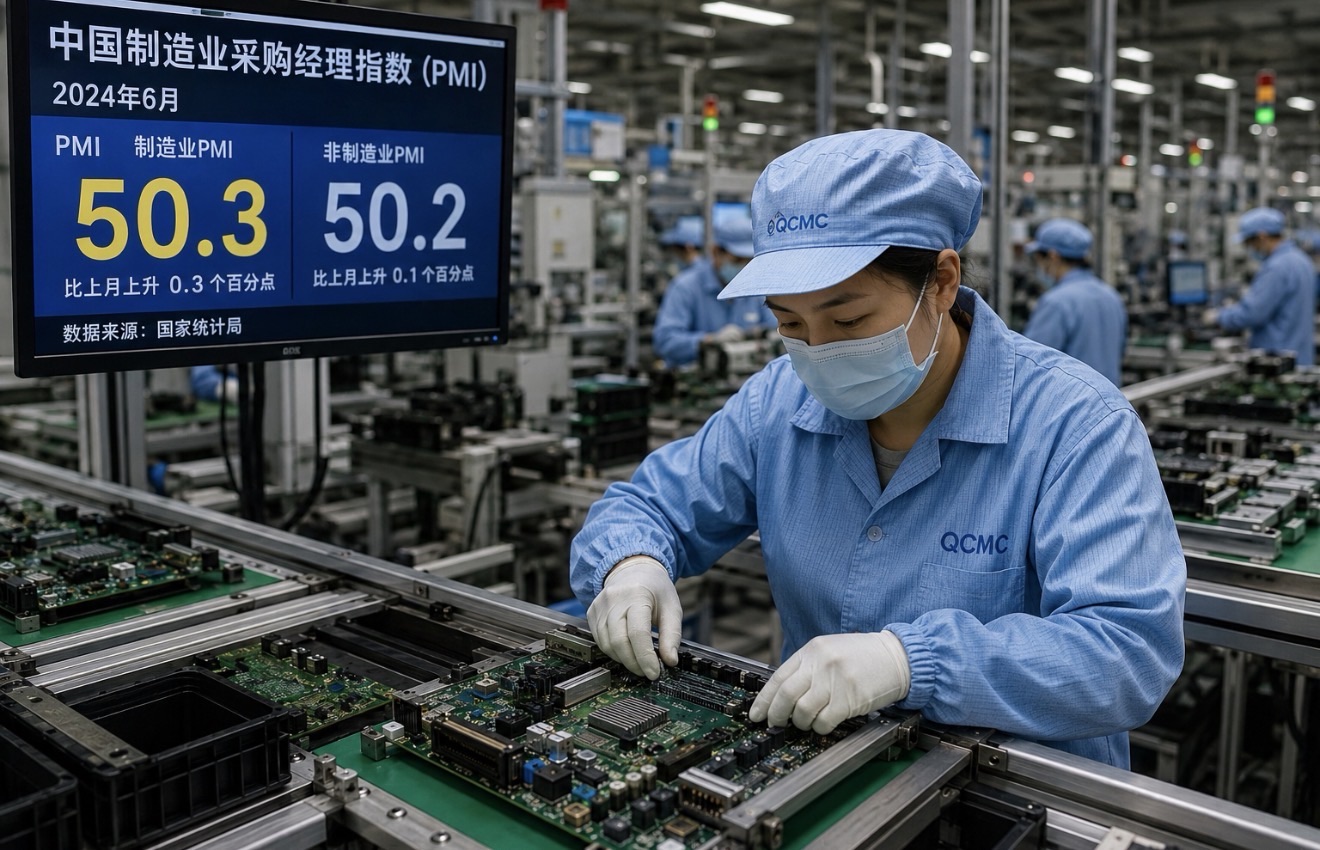
China’s manufacturing sector returned to growth in June as booming demand for high-tech exports tied to the global artificial-intelligence boom offset stubbornly weak demand at home. The official Purchasing Managers’ Index (PMI) edged up to 50.3 in June, beating economists’ forecast of 50.1 and moving back above the key 50-point threshold that separates expansion from contraction, according to data released by China’s National Bureau of Statistics. The index stood at 50.0 in May.
The PMI is one of the world’s most closely watched measures of manufacturing activity, surveying factory managers on new orders, production, employment and supplier deliveries. June’s reading marked China’s first clear return to expansion after months of sluggish factory activity.
A separate non-manufacturing PMI, which measures activity across China’s services and construction sectors, also improved, rising to 50.2 from 50.1 in May.
Much of the improvement came from one powerful source: exports tied to artificial intelligence. Chinese factories continue to benefit from soaring global demand for semiconductors, servers, data-center equipment and other AI-related hardware as governments and companies race to expand computing capacity.
Exports of automated data-processing equipment surged more than 60% from a year earlier, while shipments of chips, semiconductors and other advanced technology products continued to support factory production. The strength of those exports has helped offset concerns that geopolitical tensions in the Middle East would slow global trade.
The export boom has prompted several economists to raise their outlook for China. Bank of America increased its forecast for China’s export growth this year to 15%, citing continued investment in artificial intelligence, renewable-energy equipment and electric vehicles. Strong exports also helped China’s roughly $20 trillion economy outperform expectations during the first quarter.
Despite the encouraging headline numbers, the broader economy remains uneven.
Factories producing technology exports continue to perform well, but domestic demand remains weak. Retail sales have struggled, the country’s prolonged property downturn continues to weigh on household confidence, and more traditional manufacturing industries remain under pressure. Furniture exports, often viewed as a gauge of broader consumer demand, rose only 1.9%.
“The hope of rebalancing is fading,” Helen Qiao, China economist at Bank of America Global Research, said, pointing to the growing divide between strong exports and weak domestic consumption.
That imbalance could create new challenges later this year. Economists expect inflation pressures to weaken once higher energy prices fade, raising the risk of renewed deflation. Persistent deflation can discourage consumer spending and reduce corporate profits, making economic recovery more difficult.
There is another reason economists remain cautious.
Part of June’s strength appears to reflect companies accelerating shipments ahead of possible U.S. trade actions.
“We spotted trade frontloading in June,” said Xu Tianchen, senior economist at the Economist Intelligence Unit. “Exporters accelerated shipments due to U.S. trade policy uncertainty. Late July will be a big moment because new U.S. Section 301 tariffs are expected to take effect.”
If those tariffs are implemented, some of the current export strength could fade during the second half of the year.
Meanwhile, Beijing has largely resisted launching major stimulus measures aimed at boosting domestic demand. Officials have set a 2026 economic growth target of 4.5% to 5%, below last year’s pace, while economists see little chance of aggressive near-term policy easing. Reports indicate China’s central bank has encouraged commercial banks to expand lending, highlighting continued weakness in credit demand across the economy.
For the global economy, China’s June manufacturing rebound sends mixed signals. The world’s largest manufacturing base continues to benefit from the artificial-intelligence investment boom, supporting global supply chains and technology exports. At the same time, much of that growth remains concentrated in one fast-growing sector while domestic demand continues to lag.
Whether China can broaden its recovery beyond AI-driven exports and revive consumer spending remains one of the most important economic questions facing the global economy in the second half of the year.
JBizNews China Desk
© JBizNews.com All Rights Reserved. Reproduction or distribution without written permission is prohibited.