
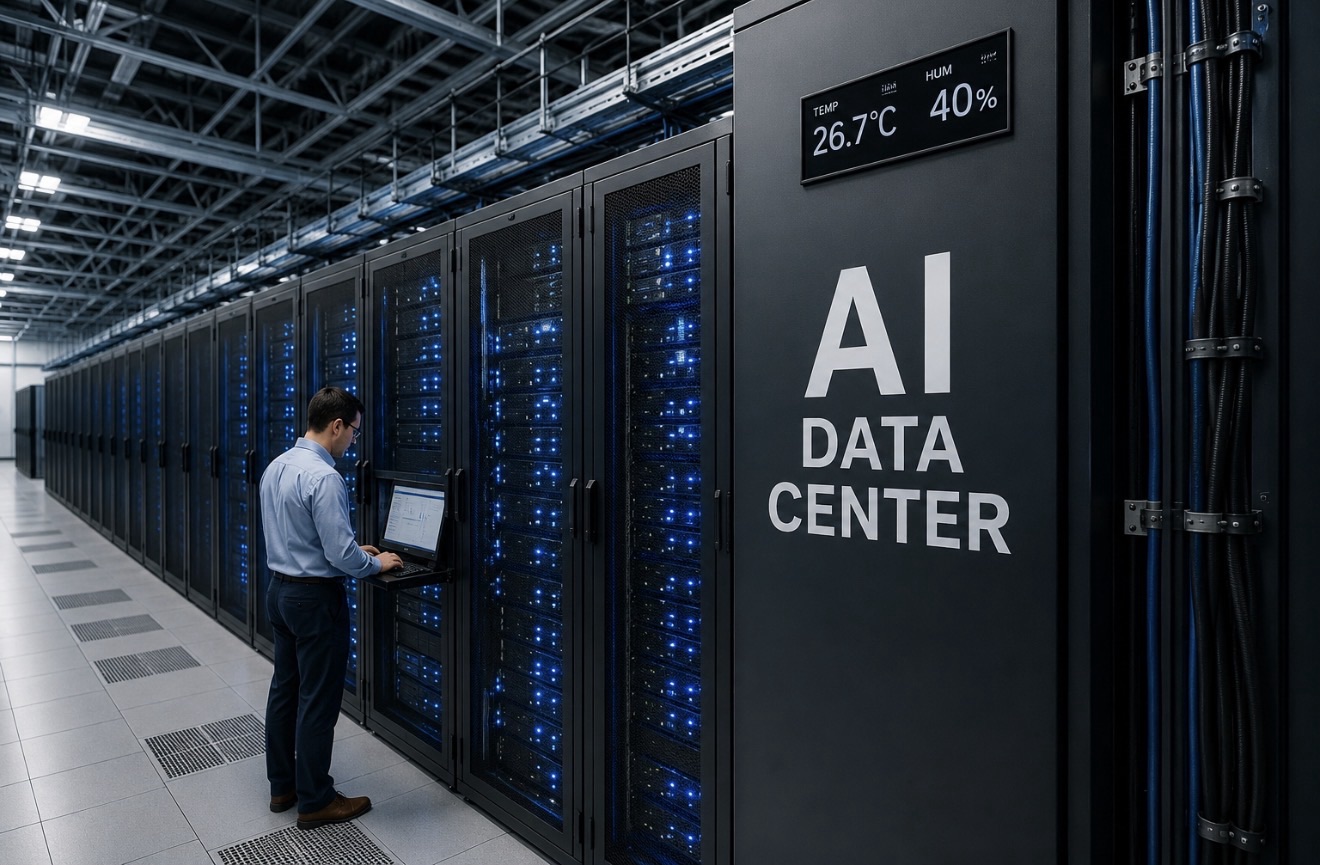

Extreme heat and severe weather have become one of the biggest financial risks facing the data centers powering the artificial-intelligence boom, insurers and operators are warning, as a record heatwave bakes Europe and strains power grids worldwide. According to insurance company Zurich, severe weather has become the leading cause of losses within its U.S. data center builders’ risk portfolio over the past three years, now accounting for roughly one-third of its losses in the sector.
“Severe weather is no longer something that can be treated as a background exposure,” said Patrick McBride, Zurich’s head of international construction. “It is one of the first things we and the owners we work with look at.” His comment captures a shift in how the industry views the weather: not as an occasional disruption, but as a core threat to a buildout costing hundreds of billions of dollars.
The trouble with extreme heat is that it hits twice. Cooling accounts for roughly 40% of a data center’s energy use even under normal conditions, and that share rises during heatwaves—precisely when air conditioners are already putting enormous pressure on electric grids.
“Data centers need the most energy exactly when the grid has the least available to give,” said Mishal Thadani, chief executive and co-founder of AI software platform Rhizome, which helps utilities identify climate vulnerabilities. He pointed to Turin, Italy, where temperatures approaching 100 degrees Fahrenheit placed underground power cables under thermal stress and contributed to repeated blackouts before additional AI facilities that each consume as much electricity as roughly 100,000 homes are even connected.
Compounding the challenge is where the industry is building. This year, 64% of global data center capacity under construction is located outside traditional hubs such as Northern Virginia, moving instead into rapidly growing markets including West Texas, Tennessee, Wisconsin, and Ohio. Land and electricity are often less expensive in those areas, but many also face elevated risks from tornadoes, hail, high winds, flooding, or wildfires.
The scale of the exposure is enormous. Climate-risk analytics firm First Street found that 79% of global data center capacity faces elevated risks from acute climate hazards. A separate analysis by MS Amlin estimated that 56% of planned U.S. data centers—representing nearly $800 billion in investment—are located in states highly exposed to hurricanes, severe storms, earthquakes, or winter weather.
For businesses, the risk ultimately comes down to money. Weather-related disruptions increase insurance claims, construction costs, repair expenses, and operational downtime. If insurers become less willing to underwrite large concentrations of expensive infrastructure in climate-vulnerable regions, premiums could rise significantly or coverage could become harder to obtain.
“It’s not a matter of if climate risks will impact the digital infrastructure revolution,” said Joe Macejak, U.S. property digital infrastructure leader at Marsh Risk. He warned that unmanaged climate risks “pose a threat to the capital stacks that are fueling the AI-driven data center revolution.”
Technology companies are responding by redesigning their facilities. Microsoft says it engineers its data centers to operate reliably across a wide range of environmental conditions through careful site selection, redundant systems, and real-time monitoring. Nvidia said its latest AI servers can operate with cooling liquid temperatures of 45 degrees Celsius, and that increasing chiller temperatures by just one degree can reduce cooling-energy costs by about 4%. Engineers are also developing more efficient liquid-cooling systems that move heat away from advanced AI chips more effectively.
The implications extend far beyond the technology industry. Modern AI infrastructure increasingly supports hospitals, banks, manufacturers, communications networks, retailers, and government agencies. A major outage caused by extreme weather can quickly ripple across the broader economy.
The artificial-intelligence boom may be creating unprecedented demand for computing power, but at its foundation the industry remains dependent on physical infrastructure—buildings, transmission lines, water, cooling systems, and reliable electricity. As climate risks intensify, the weather is becoming one of the biggest tests of whether that infrastructure can keep pace with the AI revolution.
JBizNews Technology Desk
© JBizNews.com All Rights Reserved. Reproduction or distribution without written permission is prohibited.