
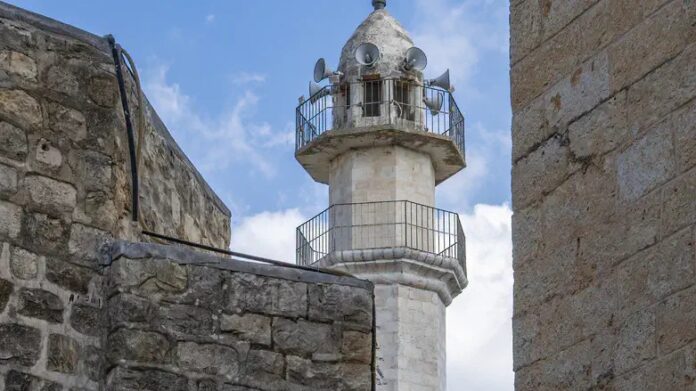

The Knesset gave preliminary approval on Wednesday to legislation that would significantly tighten regulation and enforcement of loudspeaker systems used at mosques, marking a major step forward for a proposal championed by National Security Minister Itamar Ben-Gvir and Knesset National Security Committee Chairman MK Tzvika Foghel.
The bill passed its preliminary reading by a vote of 50-36. Despite recent threats to withhold support over the ongoing dispute surrounding the conscription law and Basic Law: Torah Study, Shas backed the measure. The opposition also contributed votes, with Yisrael Beytenu supporting the proposal.
Under the legislation, no public address system could be installed or operated without first obtaining an official permit. Authorities would evaluate permit applications based on several factors, including the system’s volume, available noise-reduction measures, the mosque’s location, its distance from nearby homes, and the expected impact on local residents.
The proposal also grants police expanded enforcement authority. Officers would be empowered to order the immediate cessation of unauthorized or non-compliant broadcasts, and if those orders are ignored, they could confiscate the loudspeaker equipment.
Violators would face substantial financial penalties. Installing or operating a public address system without the required permit could result in fines of up to 50,000 shekels, while operating a system in violation of permit conditions would carry fines of up to 10,000 shekels.
Unlike previous attempts to regulate mosque loudspeakers—which primarily sought to restrict the hours during which they could be used and contained broad exemptions with relatively weak enforcement—the current proposal establishes a comprehensive licensing system, assigns direct responsibility to the operator, significantly expands enforcement powers, and strengthens penalties. It also creates a mechanism directing revenue collected from fines toward public projects.
According to the bill’s explanatory notes, “Noise is a public health hazard, and although enforcement campaigns have been conducted in the past, there is currently no law that provides sufficient tools to address the phenomenon. Therefore, a clear regulatory framework is proposed, including a default prohibition, an explicit permit mechanism, the appointment of a person responsible for operation, and significant fines. The bill seeks to restore peace and quiet and improve residents’ quality of life through effective and clear enforcement.”
Ben-Gvir welcomed the bill’s advancement, saying, “In many places, the muezzin’s call constitutes unreasonable noise that harms residents’ quality of life and health. This is a phenomenon that cannot be accepted. During my tenure, the Israel Police began addressing this intolerable problem for the first time, and now we are providing it with additional dramatic tools to eradicate the phenomenon. I thank Minister Idit Silman for her cooperation, Coalition Chairman Ofir Katz, and the members of Otzma Yehudit, who remain faithful to our election promises and are working hard to fulfill them one by one.”
Foghel also defended the legislation, arguing that its purpose is not to interfere with religious practice but to address excessive noise affecting nearby communities. “The muezzin broadcast at excessive volume is not a religious issue; it is a matter of harm to public health and quality of life. It is unacceptable for residents to continue suffering from systematic violations of the law. That is why I submitted this bill—to enable firm, clear, and decisive action against this phenomenon.”