
 Vos Iz Neias
Vance Under Fire From Right And Left For Defending Both The War And Negotiations
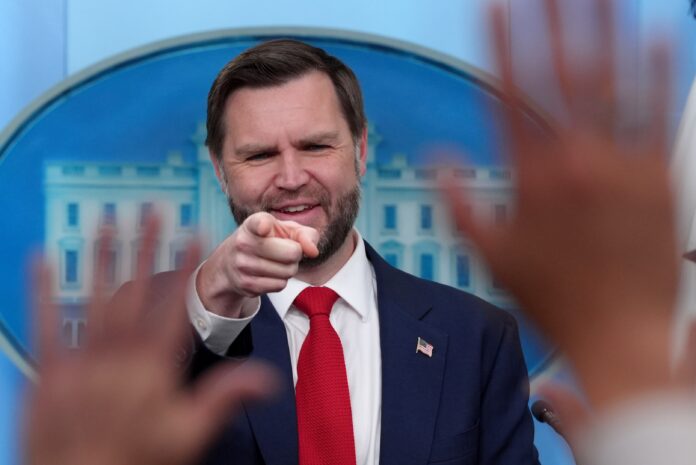
NEW YORK (VINnews) — During a speech delivered on Wednesday evening to active-duty service members at the Naval Air Station Oceana in Virginia Beach, Virginia, U.S. Vice President J.D. Vance stood firmly behind President Donald Trump, offering a public defense of both the war against Iran and the diplomatic efforts that have since begun. Vance, who has faced sharp criticism over his role in the negotiations, told the troops that their military strength was intended to give Trump leverage to achieve peace “through strength,” according to The New York Times.
In his remarks, Vance criticized domestic opponents, arguing that the current diplomatic negotiations are only possible because of the offensive operations carried out by U.S. forces:”Today, as I sit here, there are people in this country who want you to keep fighting and fighting and fighting, who are attacking the President of the United States for using the leverage that you gave him to engage in negotiations.”
He continued by explaining the administration’s strategy:”And why are we negotiating? Because of you. It’s not out of weakness, it is out of strength.”
Vance, who served as a Marine Corps combat correspondent during the Iraq War, drew on his own military experience to explain why he believes the current conflict differs from the failures of the early 2000s: “Some people learned the lesson that we should never use our military again. But that is not the right lesson.”
He went on to criticize previous administrations: “Others learned an equally mistaken lesson, that the solution to the problems we faced in the early 2000s was simply to ask you to do more and more and more without ever giving you a clearly defined objective.”
Despite praising the troops, the vice president declined to provide a timeline for withdrawing forces or ending the fighting. He did, however, acknowledge the extraordinary burden placed on American service members over the past 18 months: “These men and women have done more over the last 18 months than I think any group of service members has ever been asked to do by a President of the United States. And yet, you did it.”
Vance’s decision to become one of the administration’s leading public defenders of the war against Iran represents one of the most politically challenging moments of his career and underscores the ideological shift he has undergone since entering the White House.
Before becoming vice president, Vance built his political reputation as a sharp and uncompromising critic of Washington’s national security establishment. As a former Marine who served during the Iraq War, he repeatedly denounced America’s “forever wars,” arguing that U.S. leaders were dragging the country into bloody overseas conflicts without clear strategic objectives.
However, after taking office under Trump, Vance aligned himself with the president’s more interventionist and militant approach, including Trump’s decision to launch military strikes against Iranian military and nuclear targets.
Over the past year and a half, the Trump administration has carried out a series of large-scale attacks against Iranian infrastructure, which rapidly escalated into a full-scale war. The administration says it has achieved “clear objectives,” including dismantling Iran’s nuclear program, crippling its military, and destroying much of Tehran’s defense industry. Nevertheless, the peace talks now taking place behind the scenes under Trump’s leadership have not yet produced a final agreement.
The current conflict has also created a two-front political battle for the Trump administration at home. Democrats accuse Trump and Vance of dragging the United States into a dangerous and unnecessary regional war that could spiral out of control.
Meanwhile, the hawkish wing of the Republican Party is angry over the emerging negotiations. These lawmakers argue that the proposed peace agreement is too lenient toward the Iranian regime and lacks ironclad guarantees that would permanently prevent Iran from developing nuclear weapons in the future.