
 JBizNews
B-2 Stealth Bombers and Fighter Jets Headline Washington’s Biggest July 4 Flyover
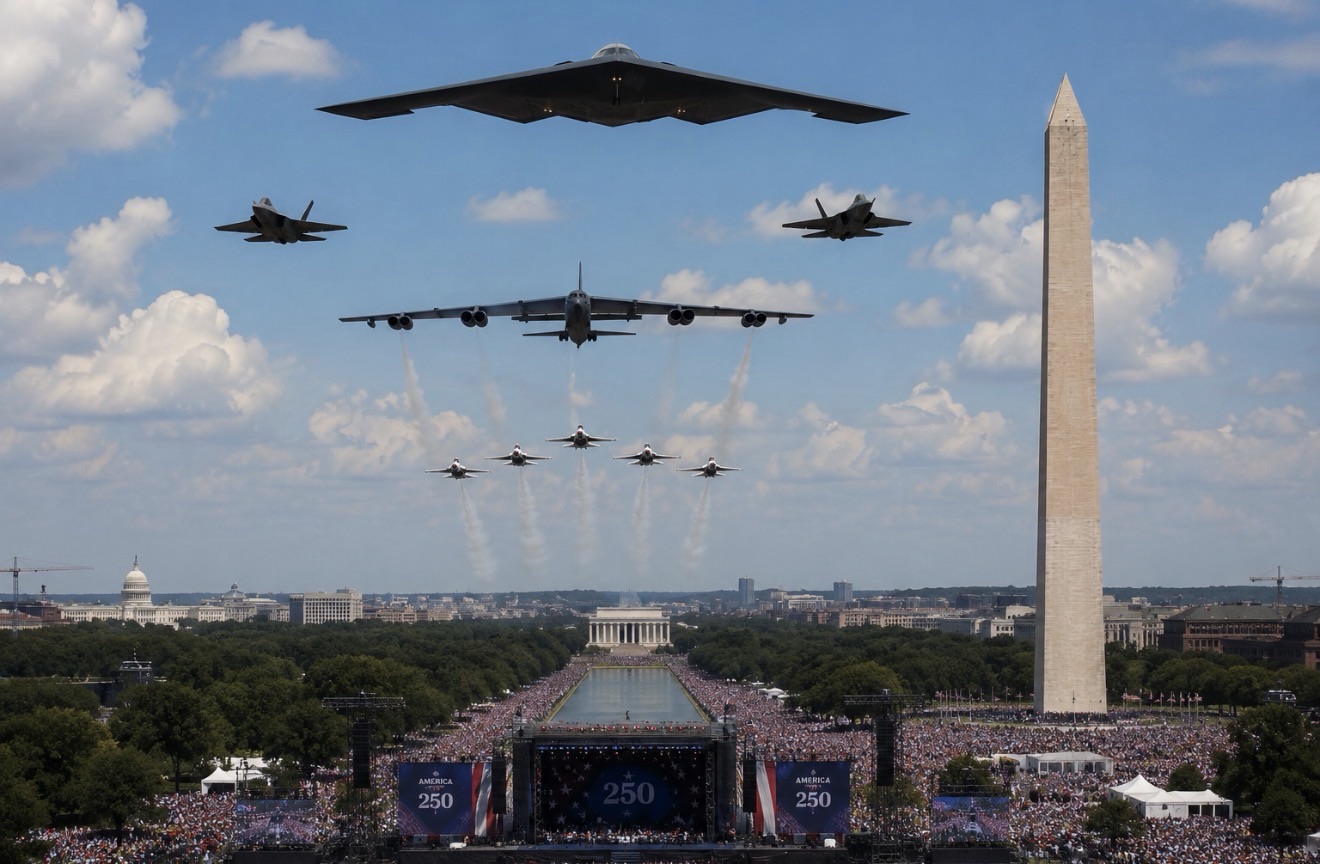
Hundreds of military aircraft thundered over the National Mall on Saturday in what organizers billed as the largest aerial celebration in American history, turning the sky above Washington into a live showcase of the nation’s most advanced combat aircraft — and, with them, the defense contractors that build them. According to Freedom 250, the nonprofit coordinating the country’s 250th birthday celebrations, military flyover demonstrations began at 1:15 p.m. and ran roughly every hour as part of a nine-hour program leading up to a planned fireworks display.
The centerpiece was a rare gathering of American airpower spanning seven decades. The U.S. Air Force assembled a Tri-Bomber Formation bringing together the B-2 Spirit stealth bomber, the supersonic B-1B Lancer, and the long-serving B-52 Stratofortress in a single pass, a formation last flown over a civilian audience at the 2021 Super Bowl. A dedicated stealth segment featured the fifth-generation F-22 Raptor and F-35 Lightning II, while the U.S. Air Force Thunderbirds performed over Washington’s monuments for the first time in the team’s 73-year history—a milestone that required a temporary waiver of the strict flight restrictions that normally seal off the capital’s airspace.
The spectacle carried a clear commercial subtext. Nearly every aircraft overhead traces back to one of the three prime contractors that dominate American military aviation. Boeing builds the B-1B Lancer and B-52 Stratofortress, as well as the newly renovated presidential aircraft that made a ceremonial flyover. Northrop Grumman builds the B-2 Spirit and is developing the next-generation B-21 Raider. Lockheed Martin builds both the F-22 Raptor and F-35 Lightning II and originally developed the F-16 Fighting Falcon flown by the Thunderbirds. For an industry that rarely markets its products directly to the public, a crowd of hundreds of thousands gathered on the National Mall represented an unusually large audience.
The timing comes as federal defense spending continues to climb. In March 2025, the U.S. Air Force awarded Boeing the contract to build the F-47, the sixth-generation fighter designed to replace the F-22, in a deal reported at more than $20 billion. The One Big Beautiful Bill Act, signed in July 2025, added $400 million to accelerate F-47 production, and the Air Force requested roughly $2.6 billion for the program in fiscal 2026. General David Allvin, the Air Force Chief of Staff, has described the F-47 as the world’s first sixth-generation fighter, and Defense Secretary Pete Hegseth stood alongside President Donald Trump when the contract award was announced.
The Boeing victory reshaped the competitive landscape. Lockheed Martin, long considered the leading builder of stealth fighters, was passed over for the F-47 and had earlier been eliminated from the Navy’s separate next-generation carrier fighter competition, the F/A-XX, leaving Boeing and Northrop Grumman as the remaining finalists. Industry analysts have described Boeing’s fighter win as critical to the company’s future in military aviation after years of losses on fixed-price defense contracts and delays involving the Air Force One replacement program that drew public criticism from the president. The award also spreads advanced combat aircraft production across all three major defense contractors, a move industry officials argue strengthens the nation’s defense industrial base as the Pentagon pushes to produce more aircraft at a faster pace.
Not all of Saturday’s program went as planned. Severe thunderstorms rolled toward Washington during the early evening, prompting organizers to order the evacuation of the event grounds shortly after 7 p.m. The move forced the cancellation of the remaining flyovers scheduled for later that night, including a dedicated U.S. Stealth Airpower formation and planned afterburner passes by the F-22 Raptor and B-1B Lancer. The afternoon and early-evening demonstrations, including the Thunderbirds and the Tri-Bomber Formation, had already been completed before the storms arrived.
The event also underscored how much of the aerial program serves as recruiting and public outreach for the U.S. military. The U.S. Navy Blue Angels and the U.S. Air Force Thunderbirds, both taxpayer-funded flight demonstration teams, anchored many of the day’s most popular performances, while the U.S. Army Golden Knights and the U.S. Navy Leap Frogs parachute teams had opened the broader Great American State Fair festivities earlier in the week. For the Pentagon, the flyovers offered a rare opportunity to showcase both military hardware and service members before a massive domestic audience at a time when the armed forces are competing for both funding and recruits.
Whether the storm-shortened finale ultimately reduced the event’s impact remains unclear. The vast majority of the marquee aircraft completed their demonstrations, the images were broadcast nationwide and shared widely online, and the defense contractors behind them are entering a multiyear period of rising budgets and major procurement programs. For companies whose largest customer is the U.S. government, a nationally televised Independence Day flyover before one of the largest audiences of the year is the kind of exposure that money alone cannot easily buy.
JBizNews Desk | Washington
© JBizNews.com All Rights Reserved. Reproduction or distribution without written permission is prohibited.