
 Matzav
Bereaved Father Says Leading Gedolim Agreed With Him Privately but Feared Speaking Out on Draft Debate
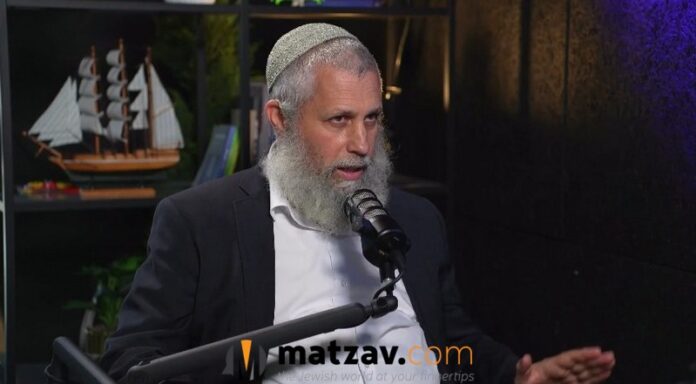
Rav Tamir Granot, whose son was killed while serving in the IDF, says he spent months quietly meeting with leading gedolim after his loss, hoping to bridge the divide between the chareidi and religious Zionist communities over military service. In a wide-ranging interview, he claimed that while some senior rabbinic leaders privately agreed with aspects of his message, they were unwilling to express those views publicly.
The interview opened with interviewer Moshe Mansa recounting a conversation with a chareidi educator who described Rav Granot as one of the most influential—and, in his view, dangerous—figures in the current debate.
“The voice is the voice of Yaakov, but the hands are the hands of Esav. He looks like one of us. He speaks our language of Torah learning. We can’t simply dismiss him because he sacrificed the most precious thing in the world—his son. Instead of going through the rabbanim, he’s trying to reach our yeshiva bochurim directly and persuade them to enlist.”
Rav Granot said he understands why some perceive him as a threat but believes those fears stem from deep anxiety.
“Whether something is dangerous depends on how much fear you live with. When your world is filled with anxiety, even things that are not threatening—even things that are positive—appear dangerous. Some people are afraid of growth. Some are afraid of greater love of Heaven because they fear it will change them.”
He said the events of October 7 transformed what had once been an ideological debate into an urgent national issue.
“We’re all in the same boat. From the standpoint of the existential threat, there’s no difference between Bnei Brak and Tel Aviv. We all have to fight. But not all of us are burying our loved ones, and not all of us are serving hundreds of days in reserve duty. My cry comes from that reality. It comes from my own family, from my students, from the thousands of wounded in Tel Hashomer, from reservists who desperately need relief, and from the students in my yeshiva who missed half the summer zeman while their counterparts in Mir and Ponevezh were not sharing that burden.”
Rejecting the notion that one group’s Torah study is inherently more valuable than another’s, Rav Granot said:
“Is their Torah worth more in Heaven? Anyone is entitled to think so, but in my opinion that has no place before the Ribbono Shel Olam. The Torah of Ponevezh is not worth more than my Torah. If we’re truly concerned with Torah rather than ego, then the responsibility has to be shared.”
One of the interview’s most striking moments came when Rav Granot described what he did immediately after completing the shivah for his son.
“For an entire year I didn’t speak to the media. The very first thing I did was meet privately with the gedolei Yisrael. I wanted them to hear my cry.”
According to Rav Granot, the responses he received generally fell into three categories.
Some, he said, remained unwavering in their position.
“I spoke about pikuach nefesh, about defending the Jewish people from those who seek to harm them. The response remained the same: ‘Nar Torah’—only Torah. ‘This is our world. This is how we preserve it.'”
Others listened sympathetically, offered words of encouragement and blessings, but took no public action.
The most surprising conversations, he said, came with senior rabbinic figures who privately expressed agreement but felt unable to speak openly.
“They told me, ‘You’re completely right. One hundred percent right.’ I asked them, ‘So why don’t you go out into the public square and say that?’ One of them looked me in the eyes and said, ‘If people find out that I listened to you for ten minutes without throwing you out of the room, I’m finished.'”
The discussion also turned to one of the chareidi community’s central concerns about military service—that it poses serious spiritual dangers for young men.
Mansa observed that someone wearing a black yarmulke generally belongs to a community with clearly defined standards and expectations, while the religious Zionist community encompasses a broader range of religious observance.
“When someone wears a black yarmulke, there are established codes. He doesn’t go to the movies. His children attend cheder. When someone wears a knitted yarmulke, he can be completely non-observant and still be considered religious Zionist. Our communal codes protect us, even if they come with a price.”
Rather than dispute that assessment, Rav Granot said he believes the difference reflects two distinct social structures.
“Chareidi society is first and foremost a society. Religious Zionism is first and foremost a worldview. A tightly knit society has significant advantages in preserving its framework. The chareidi world protects the community, even if that sometimes creates a gap between outward appearance and inner reality.”
To illustrate his point, he recounted a story he said he had heard from a security official at a government office.
“He told me that when people pass through the metal detector, the average person takes out one cellphone. A chareidi takes out two—one kosher phone and one smartphone. In the religious Zionist world there’s greater openness. People aren’t pretending. Parents know who their children really are.”
At the same time, Rav Granot acknowledged that the religious Zionist community accepts greater risks, including higher rates of young people leaving religious observance.
“We’re like a startup nation. Many startups fail, but the ones that succeed transform the world. The individual in the religious Zionist community has room to grow, choose, and change society and the economy. We’ve chosen to accept that price as Jews.”
Toward the end of the interview, Rav Granot discussed his new book, Al Sfas HaBris, explaining that it is not focused specifically on the chareidi community but on the broader challenge of strengthening unity among the Jewish people.
Referring to the Torah’s placement between Har Gerizim and Har Eival, he said the Torah must serve not only as the bond between man and Hashem but also as the force that unites the different segments of Klal Yisrael.
“The Torah does two things: it connects us to the Ribbono Shel Olam, and it should connect the different parts of the Jewish people. That’s a shared mission for us and for the chareidim—to make the Torah into something that unites all of us.”
Asked how dialogue is possible when one side refuses to engage, Rav Granot concluded with a somber response.
“I don’t know what I can do with him… other than daven for him.”
{Matzav.com}