
 Vos Iz Neias
Enabling Mass Murders: the Flawed Characters of Rudolf Kasztner and Flavius Josephus
New York (VINNEWS/Rabbi Yair Hoffman) Rezső (Rudolf) Kasztner was a Hungarian Jewish lawyer, journalist, and Zionist activist. In the years before World War II, he was known as a clever and ambitious man, deeply involved in Jewish political life. When the war reached Hungary, he became one of the leaders of a small group in Budapest called the Relief and Rescue Committee. Its goal was to help Jews escape the Nazis. He began trying to save Jews, but he ended his activities during the war enabling the Nazis to achieve one of the swiftest mass murders in human history. And yet, to this day, he remains controversial, notwithstanding near air-tight evidence carefully researched by Paul Bogdanor in his book entitled Kasztner’s Crime (Routledge, 2016).
For most of the war, Hungary was allied with Germany, and its large Jewish community—about 800,000 people—was battered but still alive. That changed on March 19, 1944, when Nazi forces occupied the country. Along with the troops came Adolf Eichmann y”s, the SS officer in charge of organizing the murder of Europe’s Jews.
His mission in Hungary was simple and monstrous: to deport every Jew he could reach to the death camp at Auschwitz, as fast as possible.
In only about eight weeks, more than 437,000 Hungarian Jews were shipped to Auschwitz, where most were gassed on arrival. Kasztner understood what was coming almost from the start. As he later testified, the German occupation was “like a death sentence” for the Jews of Hungary.
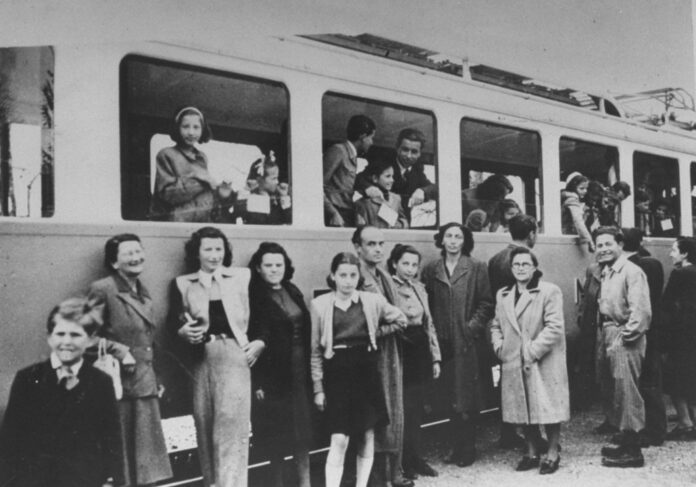
Instead of calling for revolt or mass escape, Kasztner chose to negotiate. He met with Eichmann and other SS officers and initially tried to buy Jewish lives with money and goods. Out of these talks came one real result: a single train (pictured above). In late June 1944, that train carried 1,684 Jews out of Hungary. After being held for a time in a camp, they were eventually released to safety in Switzerland. Ever since, it has been called the “Kasztner Train,” and the people on it owed their lives to his dealings with the SS.
After the war, Kasztner moved to the new State of Israel and became a government official. But his wartime choices followed him. In the 1950s, an elderly man named Malkiel Grünwald publicly accused him of having collaborated with the Nazis. Kasztner, actually the Israeli government (because he was part of the government), sued for libel.
The trial that followed became one of the most explosive court cases in Israel’s history. In 1955, Judge Benjamin Halevi ruled largely against Kasztner, saying he had “sold his soul to the Devil.” The verdict caused a political earthquake and helped bring down the Israeli government. Kasztner appealed to the Supreme Court, but he never lived to hear its decision. In March 1957, he was shot outside his home in Tel Aviv by and eventually died of his wounds.
That, in outline, is his life. The harder question is how to judge it. To his defenders, he was a brave rescuer. He managed to pull 1,684 Jews out of Adolf Eichmann’s hands and send them to safety, including the Satmar Rebbe zt”l – even as half a million of his fellow Jews were being killed. To his accusers, he was something far darker—a man who helped the Nazis destroy his own people. Paul Bogdanor’s book Kasztner’s Crime gathers the evidence behind that darker view—and the evidence is quite damning.
Before turning to that evidence, it helps to see that Kasztner’s kind of choice is not new. Nineteen centuries earlier, another learned Jewish leader faced something painfully similar. His name was Yosef ben Matityahu, aka – Flavius Josephus.
Josephus was a scholar and a soldier from a priestly family. At the start of the great Jewish revolt against Rome, he was put in charge of the Galilee. He fortified a hilltop town called Jotapata (Yodfat) with his own hands, because he knew the Romans were coming.
The Romans came. For forty-seven days they besieged the town. Then the walls broke, and the Roman soldiers poured in. Almost everyone inside was killed. But Josephus did not die with them. He surrendered, his life was spared, and he spent the rest of the war in the Roman camp. He advised the very army that had just destroyed the town he built. Later he moved to Rome, lived in the emperor’s old palace as a Roman citizen, and wrote the history of the war—a history that carefully defended his own choices.
In the 1990’s archaeologists excavated Jotapata. They found the Roman siege ramp on the north side of the hill—the one weak spot Josephus himself said was the only way in. They found the stone ballista balls and the iron arrowheads from the Roman assault.
They found the bones of the slaughtered in the town’s cisterns. As Hershel Shanks and the excavators reported in Biblical Archaeology Review, the physical evidence matches Josephus’s account of the battle almost stone for stone. And here lies the hard question the evidence raises: the man who designed those defenses ended up in the enemy’s camp. It is difficult not to suspect that he helped the Romans understand how to break the very walls he had built. The Rav of Yeshiva University, Rav J.B. Soloveitchik, used to remark to his students that Josephus was the ultimate traitor to Klal Yisroel.
When a person in a leadership position decides that his people’s cause is already lost, and then makes his own private deal with the enemy, what is he? Is he a realist who saved what little could be saved? Or is he a traitor who made the killing easier?
Historians have argued about Josephus for quite some time and never fully settled it. The same is true regarding Rezső Kasztner.
What Is Documented: The Deception
No one seriously doubts that the Nazis lied to hide what they were doing. Able-bodied Jews were told they were being sent to work. Families were told they would stay together. The Nazis even invented a fake work-site called “Kenyérmező”—Hungarian for “bread fields.” In truth, the trains went to Auschwitz. Here is what Bogdanor proves pretty clearly: Kasztner, knowing the truth about Auschwitz, didn’t just fail to expose this lie – in many cases, he helped spread it.
One survivor from Kolozsvár told this story. A man went to the local Jewish council chairman and asked whether he should escape to Romania. He was told to forget the idea and enter the ghetto instead. He was warned that Jews who tried to cross the border were being shot. Another leader, the former head of the Orthodox community, climbed onto a tree-stump and calmed the crowd. He told them they would be taken to Kenyérmező to work, and that families would stay together. The ghetto guards had approved his speech. Soon after, he was allowed to leave for Budapest, where he helped write up the list of people for the Kasztner Train.
Bogdanor also quotes a survivor who described Kasztner’s own words:
Kasztner was well aware that the young people wanted to escape and he spread it among the people that they should not escape and cause trouble for their families, that they would all be sent to southern Hungary (Kenyérmező) and families would remain together and work in agriculture.
The lie was deadly, because people believed it. Survivor after survivor said they boarded the trains calmly because they thought they were going to Kenyérmező. Yechiel Shmueli remembered the ghetto leader promising that all Hungarian Jews would be kept together until the war ended. When Shmueli reached Auschwitz, his wife, mother, daughter, and grandchild were murdered.
Dr. Lily Zamir told an even sharper story. Her father phoned Kasztner himself, just forty-eight hours before the deportation, and asked whether he should flee to Romania through the mountains. The answer he got was this: as sure as the sun shines every morning, no harm will come to you. Two days later, her father, his wife, and their nine-year-old daughter were on the train to Auschwitz.
The lie did not only trap those who might have run. It also killed the weakest. In one ghetto, a policeman offered to protect a Jewish family’s child and raise the boy as his own. The family did not know what was coming, so they refused to give up their seven-year-old. He was gassed a few weeks later.
The lie even reached the most famous survivor of all. In Máramarossziget, the young Elie Wiesel and his family were begged by their former servant to hide in a shelter she had prepared. They said no. As Wiesel later wrote, “well-informed” Jewish leaders in Budapest had assured everyone that the trains were staying inside Hungary. Wiesel’s mother and youngest sister were sent straight to the gas chamber.
The “Rescue Secret”
The most damning line in the whole record is Kasztner’s own. He was explaining why only a few Jews in Kolozsvár knew they had places on a special transport. He wrote that “the ‘rescue secret’ had to be kept.”
Bogdanor draws out the logic hiding in that phrase, and it is chilling. If the people being rescued could not be told they were being rescued, then the people being murdered could not be told they were being murdered. You cannot warn the many while keeping a secret from the few. If the doomed majority had understood that the trains led to the gas chambers, they would have fought desperately for the few open seats. So keeping the rescue a secret meant keeping the murder a secret too. The lie had to cover everyone.
This is the turning point of the whole case. Kasztner’s defenders say his sin was only silence—that he simply “failed to warn” people. But this makes it something worse than silence. His silence was not passive. It was the very thing that made the rescue possible, and it depended on everyone else walking quietly to their deaths.
What Kasztner Knew, and When
Some might defend Kasztner by saying he did not know the truth. But Bogdanor’s timeline destroys that defense. By late April 1944, before the mass deportations even began, Kasztner already had proof. He had confirmation that a test transport had been seen rolling past Bratislava, headed for the death camp. He had reports that Jews were being packed into ghettos. He had news of plans to send train after train to Poland. He had even received a warning that described how the victims were being gassed and their bodies burned. At his own trial, under oath, he admitted: “I knew then the meaning of deportation to Auschwitz.” The judge asked the obvious question. Did Kasztner really believe that 168,000 Jews would still be alive in Auschwitz two weeks after the deportations started?
Kasztner also blocked other people’s warnings. A brave courier named Hannah Ganz made several dangerous trips to Kolozsvár. But Kasztner gave her no real information about the Nazi plans, so she arrived knowing almost nothing beyond vague rumors. After the war, Kasztner claimed he had sent messengers urging people to flee and resist. But his own words at the time tell a different story. In mid-July 1944, only about a week after the deportations ended, he spoke with the SS officer Kurt Becher. He said this:
I’ve wondered many times whether, instead of the negotiations, it wouldn’t have been better to call on the Zionist youth and rally the people to active resistance to entering the brickyards and the wagons.
A man who had actually urged people to flee and fight does not, weeks later, wonder out loud whether he should have. That remark is the confession of someone who chose the opposite path, and knew it.
The most revealing evidence of all comes from Yoel Palgi. Palgi was a Zionist paratrooper sent from Palestine to organize resistance. When he met Kasztner in late June 1944, he wrote down how Kasztner described the disaster:
Hundreds of thousands of Jews were led astray by the words of their leaders who promised them that they were being taken to labor camps inside Hungary’s borders with decent conditions. These leaders knew full well the fate awaiting those taken, but hoped to save their own lives in this way. So the Hungarian Jews went to the slaughter without even raising their voices in protest.
Kasztner meant this as an attack on other leaders. But word for word, it describes exactly what he himself did. It is also his own estimate of how many people died simply because they did not know the truth. The quiet, unresisting march to death that he describes—Jews going “without even raising their voices”—was precisely the result Himmler’s secrecy was designed to produce.
The Inference: Why He Did It
Up to now, we have dealt with proven facts. Now we move to what the evidence lets us conclude but cannot flatly prove. Bogdanor never found a document where Kasztner wrote, “they will die anyway, so I will keep them calm to prevent a revolt.” No such confession exists. What Bogdanor does show is the whole structure of motive around Kasztner. And that structure makes the following theory very believable.
Bogdanor shows that Heinrich Himmler was terrified of a repeat of the Warsaw Ghetto uprising. He feared that people who knew they were doomed would explode into resistance and slow down the German war effort. Eichmann testified that his own orders to disguise the killing came straight from this fear. The entire deportation machine depended on the victims not knowing the truth. So the Nazi reason for total secrecy is beyond dispute. A second Warsaw Uprising was exactly what they were determined to prevent.
Bogdanor shows that the SS moved the families of Jewish leaders to safety on purpose—not out of kindness, but as leverage. One Jewish leader, Fülöp Freudiger, later understood the trick: “A person cares about his nearest and dearest and it’s more horrible to kill his family.” Those who were spared, Bogdanor writes, were useful to the Nazis as hostages. Kasztner’s own wife and relatives were among the people whose safety depended on his cooperation. So the price of turning against the SS was not abstract. It was his family’s lives.
Now let’s put the three proven facts together. First, the Germans needed secrecy to prevent a Warsaw-style revolt. Second, Kasztner’s cooperation was locked in by the threat to his family. Third, Kasztner knew the deportations meant death.
A man who knows the masses are doomed, whose family will die if he resists, and who serves a machine that demands silence, has every reason to rationalize the quiet death of the doomed is in their best interests anyway and he gets the added benefit of saving close to 1700 souls. The “they will die anyway” thinking is not a quote from Kasztner. It is this author’s conjecture of the reasoning that best explains everything he did- the knowledge, the blocked warnings, the remark to Becher, and above all the “rescue secret” admission. Bogdanor’s evidence makes that a very heavy load to carry.
The Lives That Were Saved
Fairness requires looking at the other side of the ledger, because it is real. The Kasztner Train carried 1,684 Jews to safety. They were not just numbers. Among the roughly 126 Orthodox passengers was the Satmar Rebbe, Rav Yoel Teitelbaum, along with some of his followers. And there is a bitter irony here that Bogdanor does not miss. The Satmar Rebbe was one of the most passionate anti-Zionists of his time. Yet his place on the train was arranged using Palestine immigration certificates. In fact, after the war, one of the charges against Kasztner in Kolozsvár was that he had discriminated against local Zionists—by handing their certificates, and their seats, to others.
The Mishnah teaches that whoever saves a single life is regarded as if he saved an entire world. The Satmar Rebbe went on to rebuild a movement that today numbers in the tens of thousands. But the moral math of this case does not let the rescue of the few wash away the fate of the many. The train and the lie were two parts of one bargain.
That is what makes this case so painful. One cannot simply weigh the saved against the lost as if they sat on opposite sides of a scale. They were tied together in a single arrangement.
The Distinction That Matters
One important point must be made, and it is Bogdanor’s own. Many of the local men who spread the Kenyérmező lie in the ghettos were themselves under threat. Their own families’ lives were on the line. A court of law would recognize that as duress. They were trapped in a terrible choice: sacrifice their community to save their families, or sacrifice their families to save part of their community.
Kasztner was the head of the national rescue committee. He turned that committee from an underground network into an organization protected by the SS. He disobeyed the Jewish Agency’s orders to run a campaign of warning and resistance. And he worked to shut down the young Zionists who tried to warn people anyway. If his agents in Kolozsvár were acting under pressure, Kasztner was the one applying that pressure. Whatever excuses the men on the ground, it does not excuse the man who built the system they served.
Conclusion
The worst part of this case is not really in doubt, given Bogdanor’s evidence. Kasztner knew the trains went to Auschwitz. He kept the secret. He discouraged escape and blocked warnings. And people who might have fled or fought instead boarded the trains and died. All of this is documented—in survivor testimony, in trial records, and in Kasztner’s own words.
Whether he actually spelled out the calculation in his own mind—they are doomed anyway, so keep them quiet, save my family, and prevent a second Warsaw—is something the record lets us infer but not quote.
The facts convict him. The motive, rebuilt from those facts, explains him. And the explanation that fits everything Bogdanor lays out is the darkest one: a man who chose the silence of the many as the price of saving the few, and told himself the many were already lost.
Sources and Notes
The evidence below is mostly drawn from Paul Bogdanor, Kasztner’s Crime (Abingdon: Routledge, 2016), and follows the primary sources cited in that work’s apparatus. Section numbers (“s.”) refer to the Kasztner Trial verdict of Judge Benjamin Halevi (Jerusalem District Court, 1955).
1. On Josephus (Yosef ben Matityahu): his command in the Galilee, the 47-day siege of Jotapata (Yodfat), his surrender, and his later role advising the Romans while urging Jerusalem’s defenders to give up: Flavius Josephus, The Jewish War, Book 3; see also Biblical Archaeology Society, “The Histories of Flavius Josephus” and “Titus Flavius Josephus and the Prophet Jeremiah,” biblicalarchaeology.org.
2. On the archaeology of Yodfat confirming Josephus’s account—the Roman siege ramp on the northern approach, ballista balls, iron arrowheads, and the remains of the slain in the town’s cisterns: reporting in Biblical Archaeology Review (Hershel Shanks, ed.), 23:06 (Nov/Dec 1997); excavation work of Mordechai Aviam, “Yodefat/Jotapata: The Archaeology of the First Battle,” in Andrea M. Berlin (ed.), The First Jewish Revolt (Routledge). Josephus’s own statement that Jotapata could be approached “only on the north side” appears in The Jewish War, Book 3.
3. Background on Kasztner and the German occupation of Hungary: the Nazis occupied Hungary on March 19, 1944, bringing Eichmann’s SS unit to organize the deportations; Kasztner testified at Nuremberg that the occupation was “like a death sentence for about 800,000 Jews” (Veesenmayer Trial testimony, March 19, 1948). Veesenmayer reported that 437,402 Jews were deported in roughly eight weeks (Bogdanor, ch. 13). On Kasztner’s role in the Relief and Rescue Committee, the negotiations with Eichmann, and the train of 1,684 released via Switzerland: Bogdanor, Kasztner’s Crime, Introduction and chs. 1–2, 6.
4. “Sold his soul to the Devil” / the trial and its aftermath: the libel case grew out of Malkiel Grünwald’s accusation; Judge Benjamin Halevi’s 1955 verdict found Kasztner had collaborated with the SS; the ruling helped collapse the Israeli government; the verdict was under appeal to the Supreme Court when Kasztner was assassinated by right-wing extremists in Tel Aviv in March 1957: Kasztner Trial verdict (Halevi, J.), 1955; Bogdanor, Introduction.
5. The rescue-committee total of 1,684 and Eichmann’s two-week deportation of the first 200,000 Jews during Brand’s mission: R. L. Braham, The Politics of Genocide, Vol. 1, 673.
6. The Kenyérmező hoax (“bread fields”) as a Nazi camouflage for Auschwitz, and the advice to the would-be escapee to enter the ghetto because border-crossers were being shot: testimony of Avram Feuerman regarding Judenrat chairman Fischer; cf. Kasztner Trial verdict, s. 50.
7. Zsigmond Léb’s tree-stump speech reassuring the crowd about Kenyérmező, authorized by the ghetto guards, followed by his departure for Budapest to help compile the transport list: testimony of Anna Nussbächer; Kasztner Trial verdict, s. 50.
8. “Kasztner was well aware that the young people wanted to escape…”: survivor letter, Makor Rishon, August 9, 2002.
9. Yechiel Shmueli’s deportation (first Kolozsvár train, May 25, 1944, 3,130 persons) and the ghetto leader Dr. Endre Balázs’s Kenyérmező announcement; Shmueli’s family murdered on arrival at Auschwitz: Shmueli testimony (as reproduced in Bogdanor, ch. 7).
10. Dr. Lily Zamir’s father telephoning Kasztner 48 hours before deportation from Huszt and being told “as sure as the sun shines… no harm will come to you”: email from Lily Zamir to Eli Reichenthal, January 14, 2011.
11. The gendarme’s offer to raise a Jewish child, refused by the unwitting family; the child gassed weeks later: survivor testimony, Marosvásárhely (Bogdanor, ch. 8).
12. Elie Wiesel’s family declining their servant’s offer of shelter because Budapest notables assured them the convoys stayed inside Hungary: Elie Wiesel, All Rivers Run to the Sea (New York: Schocken Books, 1995), 69–70; cf. DEGOB Protocol 91.
13. “The ‘rescue secret’ had to be kept”: Rezső Kasztner, Der Bericht des jüdischen Rettungskomitees aus Budapest 1942–1945 (Basel, 1946), 46.
14. The analysis that keeping the rescue secret required keeping the extermination secret—because one could not inform the many while deceiving the few without provoking “murder in the ghetto”: Kasztner Trial verdict, ss. 43–44, 59; cf. A. Beit-Zvi, Post-Ugandan Zionism on Trial, Vol. 2, 115 (Halevi and Beit-Zvi differ on whether Eichmann made the terms explicit).
15. Kasztner’s late-April 1944 confirmation that the trial transport had passed Bratislava toward Auschwitz, and his contemporaneous knowledge of ghetto concentration, the Poland negotiations, and the gassing/cremation warning: Bogdanor, ch. 3.
16. “I knew then the meaning of deportation to Auschwitz”: Kasztner Trial testimony, March 1, 1954; the judge’s incredulity that 168,000 could still be alive after two weeks: Kasztner Trial verdict, s. 53; Kasztner Appeal, Silberg verdict, s. 13.
17. Hannah Ganz sent to Kolozsvár without specific information, so that she could warn no one effectively: testimony of Hillel Danzig, Kasztner Trial; Bogdanor, ch. 3.
18. “I’ve wondered many times whether… it wouldn’t have been better to call on the Zionist youth… to active resistance”: Kasztner-Becher minutes, July 15, 1944, Dinur Archive.
19. “Hundreds of thousands of Jews were led astray… without even raising their voices in protest”: Yoel Palgi, in Magen Baseter [Secret Shield], ed. Zerubavel Gilad (Jerusalem: Jewish Agency, 1948), Kasztner Trial defense exhibit 40, 416.
20. Himmler’s obsession with a repeat of the Warsaw Ghetto uprising, and Eichmann’s testimony that his camouflage orders flowed from the fear of revolts weakening German defenses: Eichmann Trial testimony, July 21, 1961; Bogdanor, ch. 3.
21. The SS use of leaders’ families as hostages, and Freudiger’s realization – “A person cares about his nearest and dearest and it’s more horrible to kill his family”: Kasztner Trial testimony of Fülöp Freudiger, August 12, 1954; cf. Freudiger Report, 37.
22. The Satmar Rebbe (Rav Yoel Teitelbaum) and the Orthodox group of 126 among the passengers; the postwar Kolozsvár accusation that Kasztner diverted Zionists’ Palestine certificates to others: Ladislaus Löb, Dealing With Satan (London: Jonathan Cape, 2008), 117–18; Kasztner Trial testimony (on the composition of the passenger list).
23. The distinction between the duress-bound agents in the ghettos and Kasztner as head of the national committee—who converted an underground network into a client institution under SS protection and disobeyed the Jewish Agency’s resistance instructions: Bogdanor, ch. 7 (“If Kasztner’s men in Kolozsvár were under duress, he was the vehicle for the duress”).