
 Vos Iz Neias
Juvenile Assailant Who Stabbed Zurich Jew 17 Times Faces Just One Year In Jail
NEW YORK (VINnews) — A 17-year-old Muslim is currently on trial in Zurich for the antisemitic stabbing of an Orthodox Jewish man on March 2, 2024. The teenager is accused of carrying out an antisemitic attack and attempting to target additional victims.
The Juvenile Prosecutor’s Office has charged him with multiple counts of attempted murder but is seeking a prison sentence of only one year because Swiss law does not allow lengthy prison terms for juvenile offenders.
Among other things, the judge sought to understand why the teenager identified with the terrorist organization Islamic State (ISIS), how he planned the attack, and what his current thoughts were regarding the victim. However, the 17-year-old refused to answer any questions, repeatedly responding simply, “No comment.”
Because the defendant remained silent, the judge referred to his earlier statements in the case. According to those statements, the teenager intended to be killed by police after the attack so that he could die as a “martyr” and “go to paradise.”
According to the indictment, the teenager became radicalized following Hamas’s October 7, 2023 massacre. In January 2024, he searched online for information about ISIS and bomb-making. He later purchased a knife, went to a synagogue in Zurich, and began a livestream before carrying out the attack. The livestream recorded audio but not video.
The teenager described himself as a fighter for the Islamic State and declared his intention to attack a synagogue and kill as many Jews as possible. On March 2, he attacked the victim from behind and stabbed him repeatedly. The victim narrowly survived the assault. The 50-year-old man suffered 17 stab wounds and required prolonged hospitalization.
The attacker intended to broadcast the massacre he had planned to as many people as possible. He urged viewers to record the footage and share it online.
“The entire incident was recorded on a mobile phone, but he had placed it in his pocket. That’s why there is only an audio recording,” the judge said during the trial.
The recording reportedly captures the attacker complaining that the synagogue door was locked. He then announced that he would simply wait for someone to come outside. Moments later he says, “Now I’ve got one.” The recording then captures the sound of running, the attack itself, repeated cries of “Allahu Akbar,” and finally the arrival of paramedics.
Juvenile criminal proceedings in Switzerland are generally held behind closed doors. However, due to the significant public interest in the case, members of the media were permitted to attend the hearings, as well as the delivery of the verdict and sentencing.
The indictment states that the attacker spent weeks planning “to kill as many Jews as possible.” Online, he exchanged information with another like-minded individual about the best way to manufacture explosives and searched for suitable methods to carry out the attack.
After determining that building a bomb was too complicated, the indictment says he decided instead to use a knife. The day before the attack, he purchased a butcher’s knife at a shopping center in Zurich. On social media, he searched: “What time do the Jews gather?” His intention was to kill Jews while they were praying in a synagogue.
The attacker, who was 15 years old at the time of the crime, attacked the victim from behind and repeatedly stabbed him. He initially targeted the victim’s neck and head and ultimately attempted to slit his throat. In total, he inflicted 17 stab wounds.
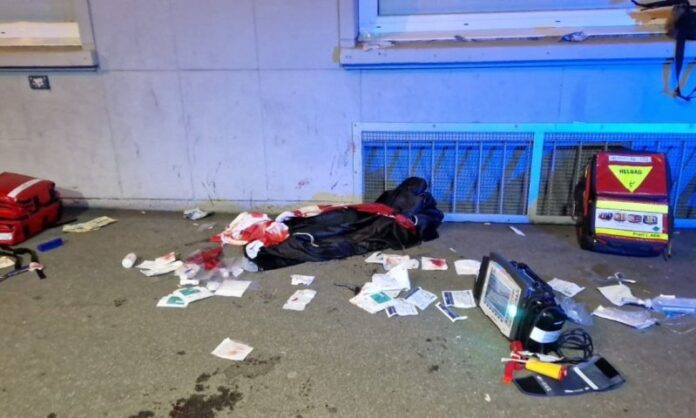
The victim managed to escape several meters into the street, but the attacker chased him. As the victim desperately cried for help, the assailant continued stabbing him and refused to stop. A struggle eventually broke out between the attacker and the victim on the hood of a car stopped at a red traffic light. Passersby succeeded in overpowering the attacker. The victim collapsed with critical injuries, including multiple lung wounds, and required emergency surgery.
The attacker, a Swiss-Tunisian citizen, faces a sentence of one year in prison for multiple counts of attempted murder and other offenses, the maximum sentence available for someone who was 15 years old at the time of committing the crimes. The defense is seeking acquittal on the attempted murder charges and instead requests a sentence of six months’ imprisonment. The verdict is scheduled to be delivered on Tuesday, July 7, at 1:30 p.m. local time.
The relatively light sentence the young terrorist is expected to receive has generated considerable concern. Under Swiss law, juvenile offenders are generally subject to rehabilitation and special treatment rather than lengthy imprisonment, based on the principle that they should be rehabilitated through education and reform. The maximum penalty the attacker can receive is one year in prison or placement in a secure educational institution until the age of 25 in an effort to rehabilitate him. Swiss lawmakers have begun promoting legislation that would impose significantly harsher penalties if an offense is classified as terrorism. However, given the pace of the Swiss legislative process, such a law could take considerable time to pass, if it passes at all.
Swiss law provides that an adult who seriously injures another person can receive up to ten years in prison. Murder carries a maximum penalty of life imprisonment. However, because the attacker was only 15 years old at the time of the offense, prosecutors could not seek a harsher sentence. The court does, however, have the authority to revoke the attacker’s Swiss citizenship, after which he could be deported to his country of origin, Tunisia.
Why is Switzerland’s juvenile criminal law more lenient than its adult criminal law?
According to Jan Ege, Associate Professor of Criminal Law and Criminal Procedure at the University of Zurich, two considerations are decisive.
“The goal is not to punish for the crime itself, but to prevent young people from reoffending,” he explained. Studies have shown that lengthy prison sentences have only a limited deterrent effect.
Secondly, neurological research shows that adolescents have a reduced ability to control their behavior compared with adults.
“Therefore, the legislature assumes that adolescents, to a certain extent, have diminished criminal responsibility,” Ege said.
The antisemitic terrorist attack shocked Swiss society. The fact that the perpetrator may serve only one year in prison is likely to be met with disbelief by many members of the public.
According to Ege, while one can argue for harsher penalties in the name of justice, “Stricter punishments do not lead to fewer crimes—proper treatment and rehabilitation do.”
Last year, Swiss lawmakers proposed increasing the maximum prison sentence for 16-year-olds from four to six years, and for 15-year-olds from one year to two years. However, for the time being, there has been no progress on legislation that would impose substantially tougher penalties on juveniles who commit serious crimes such as murder.