

 Matzav
SPELLING DEBATE: טבריא או טבריה? Eida Chareidis Issues Definitive Halachic Ruling
The Badatz of the Eida Hachareidis has issued a formal ruling on a question that has recently generated discussion among the city’s rabbanim: Should the city’s name be written as “Tiveria” ending with an alef or “Tiveriah” ending with a hei? During the same gathering, the Badatz also released a sharply worded public proclamation protesting what it described as serious breaches of kedushah in areas near the city’s beaches and the tziyun of Rabi Meir Baal Hanes.
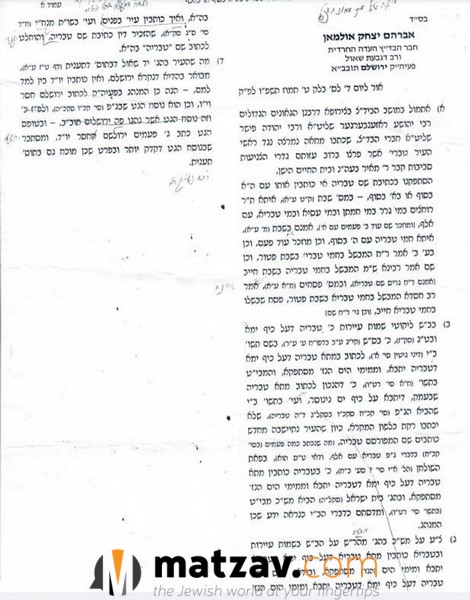
The special session was led by Rav Avrohom Yitzchok Ullman, a member of the Badatz and Rav of Yerushalayim’s Givat Shaul neighborhood. After reviewing the matter, the beis din ruled that the proper spelling is “Tiveriah,” ending with a hei. Rav Ullman based the decision on the teshuvos of the Minchas Yitzchok, which he cited as the authoritative source for the ruling.
The question is not merely academic. The spelling of a city’s name carries practical halachic significance, particularly in the preparation of gittin and kesubos. As a result, many had sought guidance from leading poskim regarding the correct form to use.
The issue has become increasingly relevant as the city’s chareidi population continues to grow amid Israel’s housing shortage. In recent years, communities affiliated with Toldos Aharon and Satmar—both under the umbrella of the Eida Hachareidis—have established a presence in Tiveriah, joining longstanding communities such as Sanz and Karlin, which have maintained educational institutions in the city for many years.
The meeting was convened following a delegation of rabbanim and community leaders from Tiveriah, including the local representative of the Toldos Aharon Rebbe, who appeared before the Badatz to express alarm over what they described as increasing michsholim near the city’s waterfront, particularly in the vicinity of the kever of Rabi Meir Baal Hanes.
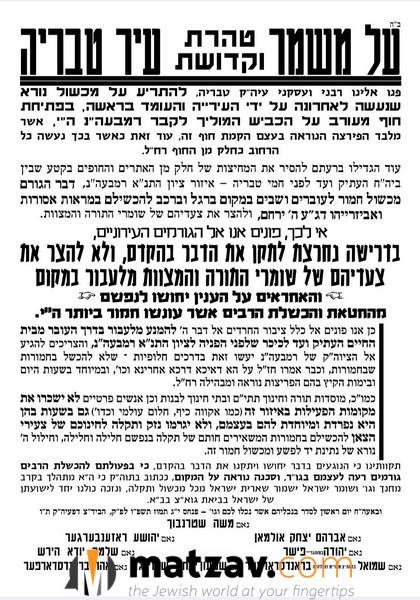
Following the presentation, the members of the Badatz, under the leadership of Rav Moshe Sternbuch, issued a strongly worded kol korei addressed to the Torah-observant public.
The proclamation stated, in part: “The rabbanim and community leaders of the holy city of Tiveriah approached us to warn of a terrible stumbling block recently created by the municipality and its leadership through the opening of a mixed beach on the road leading to the grave of Rabi Meir Baal Hanes, may he protect us. Beyond the severe breach involved in establishing such a beach, the entire roadway has effectively become an extension of the beach, rachmana litzlan.”
The statement continued: “They have further worsened the situation by removing the partitions from portions of the recreational sites and beaches between the ancient cemetery and the Tiveriah hot springs, in the area surrounding the tziyun of the tanna Rabi Meir Baal Hanes. This creates a grave stumbling block for pedestrians and motorists alike, exposing them to forbidden sights and matters related to giluy arayos, while making it increasingly difficult for those who observe Torah and mitzvos.”
The members of the Badatz called on municipal officials to rectify the situation immediately, warning that “those responsible should fear the consequences of causing the public to sin, for the punishment for leading others astray is exceedingly severe.”
They also instructed the chareidi public to avoid traveling on the road stretching from the ancient cemetery to the traffic circle near the turnoff to the tziyun of Rabi Meir Baal Hanes, recommending alternative routes “so as not to stumble in the gravest of prohibitions… especially during the daytime and throughout the summer months, when the pritzus is especially shocking and severe, rachmana litzlan.”
The kol korei further warned Torah institutions, Talmudei Torah, and girls’ schools not to hold activities at attractions in the area, including Aqua Kef and Halom Olami, even during hours designated for separate use. According to the Badatz, doing so could undermine the spiritual development of young students and constitute a chilul Hashem by lending legitimacy to what they view as a serious michshol.
{Matzav.com}