
 Vos Iz Neias
The Chief Rabbi of New York, Rabbi Yaakov Yoseph zt”l on His Upcoming Yahrtzeit 24 Tammuz
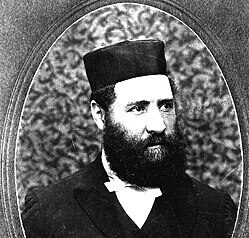
New York (VINNEWS/Rabbi Yair Hoffman) On the seventh day of July, 1888, a ship docked at Hoboken, New Jersey, across the Hudson from lower Manhattan, and a crowd surged forward to catch a glimpse of one man. By some accounts a hundred thousand people had gathered. The immigrant masses of the Lower East Side — Jews who had fled the villages and cities of the Russian Empire’s Pale of Settlement for the chaos of the treifah medinah — had, for one shining moment, their own gadol. Rabbi Jacob Joseph, the Vilna Maggid, “Rav Yaakov Charif,” had come to be Chief Rabbi of New York.
A Talmid of the famed Rav Yisroel Salanter zt”l, and the Rav of whom the RJJ Yeshiva would be named after, he would tragically pass away fourteen years later on the 24th of Tammuz, paralyzed and penniless at the age of sixty-two.
His levaya would draw more than fifty thousand mourners — and end in a riot, with debris hurled from a factory window onto the heads of Jews who had come to honor him. Between those two crowds lies one of the most heartbreaking, and ultimately most instructive, stories in American Jewish history.
From the Pale to the Yerushalayim of Lita
Rav Jacob Joseph was born in 1840 in Krozhe (Kražiai), a town in the province of Kovno (Kaunas), in what was then Czarist Russia and is today Lithuania. This was the heartland of Litvishe Yiddishkeit — a region of dense Torah scholarship where the misnagdisha tradition of rigorous, intellectual Talmud study reigned. He drank deeply from its wellsprings, studying in the Nevyozer Kloiz under Rav Yisrael Salanter zt”l, the father of the Mussar movement, and in the great yeshiva of Volozhin under the Netziv. In Volozhin his brilliance earned him the title by which he would forever be known — “Rav Yaakov Charif,” Rabbi Jacob the Sharp.
The Mussar Maggid
What is often forgotten is that Rabbi Joseph was not merely a brilliant lamdan but a devoted disciple of the mussar movement. Around 1875, he established a yeshiva in Kovno built on the mussar model of his rebbe, Rav Yisrael Salanter, gathering young men and laboring to plant in their hearts refined middos and yiras Shamayim. He would infuse mussar into his talmidim gently — b’ketzev u’v’hagbalah, in measure and with restraint — never overwhelming them, but drawing them steadily toward good character and upright conduct. His whole approach, mind and heart together, remained thorough mussar, and the bond he formed with Rav Yisrael Salanter would shape him for the rest of his life.
He served as rav in a succession of Lithuanian communities — first in Vilon, then for several years as rav and av beis din in Yurburg (Jurbarkas), a town of dense Jewish population on the banks of the Neman River near the Prussian border, and afterward in Zhagory (Žagarė), whose community actively sought him out.
Everywhere he went, his fame as a darshan and a baal mussar spread.
But there is a detail in his years of rabbanus that is as revealing as it is heartbreaking. Rabbi Joseph was a man of overflowing acharayus and generosity of spirit — who could not bear to see the poor of his community suffer. Time and again he would borrow money from the local parnasim against his own future salary in order to relieve the needy. He did this in Vilon, in Yurburg, in Zhagory, and later in Vilna — and the debts followed him from town to town, growing heavier with the years. “Yaakov sought to dwell in tranquility,” as the phrase from the parsha goes; but tranquility never came. His own kindness kept him perpetually in the red, so that even before he ever set foot in America he was, in a sense, a rav who had impoverished himself for his people.
Maggid of Vilna
In the summer of 1883 came the appointment that would define him. The holy community of Vilna — a city so exalted in Torah that it was called the “Yerushalayim of Lita,” the Jerusalem of Lithuania — selected him as its maggid, its official preacher. Because Vilna, out of its own reverence, had famously appointed no official chief rav, enormous spiritual authority devolved upon the maggid, who addressed the entire community on fixed occasions. Rabbi Joseph succeeded in this role the renowned Rav Yaakov Dovid Wilovsky, later known the world over as the Ridvaz. His derashos in Vilna were legendary — a rare fusion of penetrating lomdus, machshavah, and mussar, delivered with a power that could move an entire congregation to teshuvah. Crowds of scholars would stand pressed together to hear him, and even his opponents conceded the force of his words.
The Parable of the Stones
Not everyone in Vilna welcomed his appointment; some rose in opposition. In his very first derashah, rather than answer them with rebuke, Rabbi Joseph told a mashal that captured his whole approach to conflict. If a man hurls a stone at a heap of ordinary stones, he said, he does no more than add to the heap — or damage it. But when a person who is whole and at peace within himself is struck with insults and abuse, those very stones become, to him, precious gems.
A man full of shalom is not diminished by what is thrown at him; he transforms it into something valuable. It was a philosophy of leadership he would need, more than he could then have imagined, in the years ahead.
Why America Needed Him — and Why He Almost Didn’t Come
To understand what drew New York’s Jews to a Rav and maggid in distant Vilna, one must understand the political and demographic earthquake underway. In the aftermath of the assassination of Tsar Alexander II (among whom’s assassin was a pregnant Jewish female anarchist) – there were massive anti-Semitism and pogroms. Between 1881 and 1924, driven by pogroms, the May Laws, and grinding economic persecution in the Russian Empire, some two and a half million Central and Eastern European Jews would flee to the United States.
They poured into the tenements of the Lower East Side of Manhattan — and they arrived into a spiritual vacuum. There was no organized kehillah, no chief rabbinate, no communal self-discipline of the kind that had governed Jewish life in Europe.
Unlike in Britain, where the Chief Rabbinate enjoyed official government recognition, the American First Amendment guaranteed that no government would ever appoint or empower a rabbi. Order, if it came, would have to come from the community itself.
The Association of American Orthodox Hebrew Congregations — a federation of eighteen synagogues headed by the Beth Hamedrash Hagadol on Norfolk Street, founded back in 1852 — set out to find such a rav. In their letters they made clear they were not seeking a preacher merely, but a scholar who was a gaon in Torah, a master of upright middos and yiras Hashem, beloved and respected by all who knew him, who could with Hashem’s help restore Torah to their land.
Rabbi Joseph was not so eager to leave Vilna.
It was well known that America was a treifah medinah, and that it was largely the less observant of the European masses who had emigrated there. But seeing also the significance of building Torah in a new land, he accepted. His own Rebbe, Rav Yisroel Salanter had left Kovno and had settled in Koenigsberg Germany, precisely for that reason as well, and Rav Yaakov Yosef would follow suit. Indeed, it was in Koenigsberg that Rav Salnter had first anonymously published the Tomer Devorah with an anonymously penned “Igeres HaMussar” that was eventually re-published by Rav Yitzchok Blahzer with some changes.
His reply was a model of humility: he protested that he was unworthy of such honor, and davened that Hashem grant him success in the holy work. In one letter he wrote movingly that he was taking the position not “for bread and salt” — not for parnasah — but only to teach Torah and to spread it, invoking the words of Dovid HaMelech, “the way of Your mitzvos I will run, for You have broadened my heart.” Other gedolim who had been approached — among them the son of Rav Yitzchak Elchanan Spektor and Rav Tzvi Hirsch Rabinovitch — hesitated to make the journey; it was Rabbi Joseph who ultimately answered the call.
When word spread through Vilna that its beloved maggid would cross the sea to serve as chief rabbi in a distant land, the city was thrown into turmoil. Delegations of the community’s most prominent laymen, together with his devoted talmidim, came to plead with him not to abandon his post. His own brother, Reb Avraham, wrote him a letter of parting so tender that it survives to this day — praising him as a man precious in their eyes, sharp of mind and full of yiras Shamayim, and lamenting that New York was drawing away the crown of Vilna’s beis midrash. Fittingly, Rabbi Joseph tied his farewell derashah to Parshas Lech Lecha — Hashem’s command to Avraham to “go forth from your land” toward an unknown destiny — and blessed the assembled kehillah before he departed.
Vilna would never quite forgive America for taking him.
The Grand Arrival
The crossing brought him on the German steamship Aller, which reached the harbor at the close of Shabbos. The Association had arranged everything through its representative, and Rabbi Joseph was lodged over Shabbos at a hotel near the waterfront, remaining there through the day. On Motzaei Shabbos the carriages of the communal delegations came for him, and the wagons of the welcoming crowds filled the streets so densely that the city itself seemed to halt.
It was a scene without precedent for an immigrant rav — the kind of reception a European Jew fleeing the Czar could hardly have imagined in the New World. He was escorted to a home provided for him at the corner of Henry and Jefferson Streets, in the heart of the Lower East Side. When he entered, the assembled dignitaries rose and waited on his words; he opened with divrei chizuk, and the parnas who headed the delegation declared that the honor was not theirs to give but Hashem’s to bestow — a chesed granted before it was even asked.
Yet the warmth was not universal.
The Reform-controlled Anglo-Jewish press mocked him as a foreigner who understood nothing of America; the New York Tribune ran a column pointedly headlined “Will He Be an Autocrat?” Even some native Orthodox spokesmen bristled at the idea of submitting to a newcomer who spoke no English.
But when he delivered his first public sermon on Shabbos Nachamu at the Beth Hamedrash Hagadol, the building was packed to bursting. Crowds who could not get in filled Norfolk Street between Grand and Broome, clamoring for a foothold in the doorway, and police had to be called just to keep order.
His oratory was of a different character than the immigrants were used to — refined, measured Ashkenazic Yiddish, weighing each word, never flailing his arms or swaying in the demonstrative manner of the Galician and Russian maggidim, but reasoning in the manner of the truly great darshanim.
The sermon was a triumph, reported favorably even by the anti-Orthodox press.
Israel and the Centennial
One episode from his early years deserves to be far better known, for it shatters the caricature of Rabbi Joseph as a foreigner incapable of embracing America. In the spring of 1889, the United States prepared to mark the centennial of George Washington’s inauguration as first president. Rabbi Joseph issued a stirring Hebrew “Kol Korei” — a public proclamation — calling upon the Jews of America to join, heart and soul, in the national celebration. The New York Herald of April 20, 1889 reported it under the headline: “Israel and the Centennial — Chief Rabbi Jacob Joseph Issues an Eloquent Proclamation, Inviting the Hebrews of America to Join Heart and Soul in the Celebration of Washington’s Inauguration.”
In it he invoked hakaras hatov — gratitude — to the country that had opened its gates to the persecuted Jews of the Old World and granted them freedom and refuge. Here was the same immigrant the Reform press had dismissed as hopelessly foreign, summoning American Jewry to patriotism and thankfulness toward their new home.
Cleaning Up the Chaos
When Rabbi Joseph arrived, New York’s kashrus was in a state of absolute anarchy. Kosher shechitah was scattered among some fifteen small butcheries, many employing shochtim of questionable learning and yiras shamayim, all beholden to the abattoir owners. In most slaughterhouses, the halachically required bedikah – the examination of the lungs was simply skipped — the owners would not spare the shochet the time.
Rabbi Joseph went to work. He tested every shochet, replaced the unqualified, and brought in thirty or forty more from Europe. He ordered that all lungs be examined. He invented the plumba the lead seals — and ordered that they be affixed to every kosher carcass and to the leg of every kosher fowl, and he appointed mashgichim to travel from slaughterhouse to slaughterhouse inspecting the chalafim – the knives.
When his system, at first confined to downtown, proved its worth, pious Jews living uptown clamored to have it extended to their neighborhoods; a meeting was held for that purpose at Bloomingdale’s Rooms on 60th Street and Third Avenue. (Only later, in 1930, would it be expanded to the full city block that it is now).
Rav Yaakov Yoseph threw himself into education as well, taking a personal role in the young Yeshiva Etz Chaim on the Lower East Side — the first yeshiva in America, forerunner of the Rabbi Isaac Elchanan Theological Seminary — visiting to farher the older bochurim himself, and helping newly arrived Talmidei Chachomim find their footing with semichah and positions.
Ties to the Gedolim of Yerushalayim
Even from across the ocean, Rabbi Joseph remained bound to the great Torah centers of the Old World. Throughout his American years he maintained a strong and constant connection with the gedolim of Yerushalayim, corresponding with Rav Yehoshua Leib Diskin — the Maharil Diskin of Brisk — and with Rav Shmuel Salant, among others.
Letters between them survive, including correspondence with the Central Committee of the Ashkenazic community of Jerusalem. The tzedakah component of his kashrus system was bound up, too, with supporting the poor and the institutions of Eretz Yisrael. He was a Lithuanian gadol transplanted to Manhattan who never severed the roots that had formed him.
For a time — and it is important to remember this — there was genuine ahavah around him. In the first period of his tenure a great love enveloped the Gaon Rav Yaakov Yosef; his derashos left a powerful impression and were the talk of the community, and admiring articles filled the Yiddish papers of New York. Had the story ended there, it would have been a triumph. But the golden hour did not last.
The Torah He Left Behind
The year he was called to New York, Rabbi Joseph had published his one sefer, L’Beis Yaakov (Vilna, 1888) — a collection of drashos and chiddushim on the parsha. It is a window into the mind of this tzaddik and Gadol, and its themes are hauntingly prophetic of the life that awaited him.
On Parshas Matos, he takes up the request of the Bnei Gad and Bnei Reuven, who came to Moshe asking to settle on the eastern bank of the Yarden. The Midrash faults them: they built pens for their flocks before homes for their children, placing their money before their souls. Rabbi Joseph, quoting the words of Koheles — “the heart of the wise man is on his right, and the heart of the fool on his left” — probes precisely how a person orders his priorities, what he treats as ikkar, the essential, and what he relegates to tafel, the secondary.
It is the question of a leader who would spend his life insisting that the community place its spiritual welfare — its kashrus, its chinuch, its Shabbos — above the convenience of cheaper meat.
On Parshas Va’eschanan, he addresses the anguished tefillah of Moshe Rabbeinu, who begged to enter Eretz Yisrael and was refused. Rabbi Joseph draws out how a tzaddik pleads for undeserved kindness — slach na — asking the Ribbono shel Olam to act not according to strict measure but with grace and mercy.
In his derashos on Parshas Lech Lecha — the very parsha he chose for his farewell to Vilna — he dwells at length on Avraham Avinu and the ideal of serving Hashem lishmah, purely for its own sake, with no thought of reward. Citing the mishnah in Avos that one should not be like a servant who serves his master in order to receive a prize, Rabbi Joseph wrestles with the paradox that Avraham Avinu, who served with utter selflessness and expected nothing, was showered with reward precisely because he sought none.
He draws, too, the contrast between mitzvos performed b’tzin’a — quietly and modestly, like the tzedakah that the Gemara says exceeds even the greatness of Moshe Rabbeinu — and the public kiddush Hashem of b’farhesya, the open sanctification of Hashem’s Name that spreads emunah and inspires a generation.
Avraham Avinu’s calling, he explains, was the latter: to publicize the Name of Hashem in the world and plant belief in the hearts of others. It is impossible not to hear, in these lines, a foreshadowing of the author’s own life — a public avodah of building visible Torah for an entire immigrant community, undertaken lishmah and rewarded, in this world, with almost nothing.
And on Parshas Shoftim, discussing why the Torah interrupts the laws of war to speak of the eglah arufah — the ceremony over an unsolved murder — he explores how acts of harshness and acts of mercy each have their proper place, and how a person’s maasim and deeds ripple outward far beyond his own intention. He writes there, too, of the tragedy of the great man whose forceful nature, meant to serve holiness, is misdirected by the world around him. Read against the life he was about to live, these derashos are almost prophetic in their foresight.
The Tragedy
His accomplishments were real and lasting. This author believes that the plumba lasted well into the 21st century – before every place bought their own plastic covering machines and printed labels.
But the office itself was doomed. To fund his hechsher – supervision, a small charge was placed on kosher meat and poultry — an arrangement that the leading gedolim of Lithuania had formally endorsed in a signed proclamation supporting a tzedakah levy for the poor.
The housewives protested the added pennies.
The butchers and shochtim, freed for the first time in years from doing as they pleased, resented the discipline. Rival rabbis, whose independent hashgacha income now dried up, joined the assault — and branded the fee “korobka,” the hated tax the Czarist government had imposed on kosher meat back in Russia. Once that emotional charge was hurled, reasoned discussion was over. The socialist and anti-religious Yiddish press — voices that opposed the very idea of a centralized Orthodox authority — pounced, painting the Chief Rabbi as a robber of the poor and even spreading false rumors about his personal life. Let’s recall this was the same media that held Yom Kippur Balls.
Then came the geographic fracture. The Jews of the Lower East Side were not one community but many — Litvaks, Poles, Galicians, Romanians, Hungarians — each carrying the loyalties of its region of origin.
Because the Chief Rabbi and his dayanim were all Litvaks, the Galician and Chassidic Jews felt shut out.
In 1889 the Sherpser Rav, Rabbi Yehoshua Segal — who had come from Galicia and commanded a wide following among Galician and Chassidic immigrants — was proclaimed a rival “Chief Rabbi” by two East Side congregations. Then in 1893 a third claimant, Rabbi Vidorowitz, arrived from Moscow and declared himself Chief Rabbi of the entire United States and Canada. The title, once a beacon of hope, curdled into a mockery. Rival batei din issued competing hashgachos on the very same slaughterhouses, and the chaos only deepened.
Through it all, the parable of the stones proved prophetic. When his own supporters tried to publicly brand his rabbinic opponents’ supervision as treifah, Rabbi Joseph stopped them. “They need their hashgacha for parnasah,” he protested.
Even bloodied and humiliated in the Yiddish press, he would not sink to attacking others in the low, vicious manner in which he was being attacked. Perhaps, the historians observe, he was simply too modest and too humble to survive the rough-and-tumble of the New World.
Nowhere was his character clearer than in his public derashos. On one Erev Yom Kippur he stood before his community and led them in a searing bakashas mechila — a request for forgiveness — pleading with them to forgive one another and to make shalom – peace. The nations of the world, he observed, live by the verse “by your sword you shall live”; but we, Klal Yisrael, seek forgiveness and pursue peace. It was the same neshamah that had told the parable of the stones in Vilna, now poured out on the shores of a new and unforgiving world.
By the mid-1890s the Association could no longer pay him; the butchers took over the payment of his salary and then, by 1895, refused to continue; and the Chief Rabbi of New York was left penniless once more — as he had so often been in Europe, though now with no community able to redeem him.
Around 1897, he fell vistim to a stroke r”l, leaving him bedridden for his final years. He was still, in name, the Chief Rabbi in the spring of 1902 when the great kosher meat boycott erupted — four hundred East Side butchers and then twenty thousand women, led by Fanny Levy and Sarah Edelson, taking to the streets, smashing shop windows and setting meat ablaze to protest a sudden spike in prices — but he lay paralyzed and largely forgotten. He passed away on the 21st of Tammuz, 1902, at the age of sixty-two, his sufferings having taken their toll.
The Honor Withheld, and Then Restored
In death came the honor that New York City had denied him. Forty rabbis gathered at his kever, each vying to deliver the hesped – the eulogy. Congregations competed for the privilege of burying him; the Beth Hamedrash Hagadol won the right, interring him in its plot at Union Field Cemetery in Ridgewood, Queens, where the graves nearest his became instantly precious. More than fifty thousand Jews escorted him — one of the largest funerals New York had ever seen.
It should have been his vindication. Instead, as the cortege passed the R. Hoe & Company printing-press factory at 504 Grand Street, workers hurled water, wood, iron, and paper down onto the mourners, and two hundred policemen came in with swinging clubs. Jewish oral tradition long blamed Irish antisemitism, though more recent research suggests the factory hands were largely German. Either way, even his funeral could not be spared tumult — stones, once more, thrown at a man of peace.
And yet his name endures. The Rabbi Jacob Joseph School — RJJ, carries his memory forward to this day, a beis medrash that would shape generations.
The “Mama Yeshiva,” as it was affectionately called by students and supporters, was created by Rabbi Jacob Joseph and Rabbi Samuel Andron in 1900. After Rabbi Joseph’s passing two years later, Rabbi Andron renamed the school for his friend. After Rabbi Joseph’s death, his son Raphael and Samuel I. Andron obtained a charter from the New York Board of Regents in 1903 to establish a school in his name. The Rabbi Jacob Joseph School was known for its rigorous Talmudic curriculum and remains open to students from nursery age through the twelfth grade.
Its founders originally established the school on Manhattan’s Orchard Street on the Lower East Side. It moved to Henry Street in 1907, and expanded to a second building in 1914. Lazarus Joseph (1891–1966), grandson of Rabbi Jacob Joseph, and New York state senator and New York City Comptroller, played an active role as a board member in the school.
A great-grandson who bore his name, Captain Jacob Joseph, gave his life at Guadalcanal as the youngest captain in the United States Marine Corps; a Lower East Side playground, bounded by Henry and Rutgers Streets, honors him still.
Rav Yaakov Yoseph writes, in his sefer L’Beis Yaakov, that the mark of a person is what he treats as ikkar and what as tafel — whether he builds pens for his flocks before homes for his children.
He then lived a life in which he placed the community’s collective neshamah above every personal comfort, and was broken for it. He explained that a person’s highest avodah is when it is done lishmah, for its own sake and not for reward — and he received, from this world, far less than his due. And he taught, in a Vilna parable that would become the story of his life, that a man of true shalom is not diminished by the stones hurled at him, but transforms them into gems.
But the ledger in Shamayim is not the ledger of those East Side butchers who destroyed him. A man is measured not by whether his mission succeeded in the eyes of the world, but by the yearning of his heart and the integrity of his conduct. By that measure — the measure of a baal mussar who impoverished himself for the poor of every town he served, who came not for money and fame but to spread Torah, who would not slander even his tormentors, who spent himself utterly for Klal Yisrael, lishmah — Rabbi Jacob Joseph, “Rav Yaakov Charif,” the beloved Chief Rabbi of New York, stands very tall indeed. Yehei zichro Boruch!
The author can be reached at [email protected]