
 Matzav
Knesset Advances Torah Study Basic Law as Lawmakers Debate Its Legal Impact
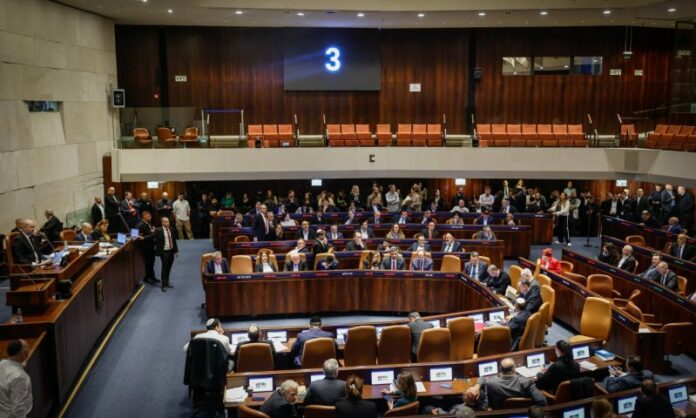
The Knesset House Committee on Sunday began preparing the proposed Basic Law: Torah Study for its second and third readings, as lawmakers debated whether the legislation would serve merely as a declaration of principle or carry significant legal consequences.
The revised bill, following comments from the Ministerial Committee for Legislation, states that Torah study is a fundamental value of the heritage of the Jewish people and the State of Israel. The legislation seeks to formally recognize Torah study as a foundational national value and establish it as a consideration alongside other fundamental values in Israeli law.
During the committee discussion, Knesset Legal Adviser Adv. Sagit Afik said it had not been made clear during earlier deliberations whether the proposal was intended to be purely declarative or to have practical legal effect.
Because the proposal is a Basic Law, Afik warned that it could have implications beyond a symbolic statement. She said the committee’s discussions ahead of the second and third readings would help define the legislature’s intent and stressed that if lawmakers do not intend for the law to have operative consequences, that should be stated explicitly in the legislation.
Deputy Attorney General Adv. Avital Sompolinsky echoed that position, saying that if the proposal is intended only as a declarative statement, it should be drafted differently.
Representatives of Israel’s Finance Ministry cautioned that the legislation could have significant economic ramifications if courts interpret it as having practical legal force.
The ministry’s legal adviser, Dudi Kopel, warned that if the law were interpreted as giving Torah study precedence over the principle of equality, it could affect military conscription policy, government spending related to those subject to the draft, and eligibility for benefits granted to Torah scholars.
Rom Brav of the Finance Ministry’s Budget Department added that the legislation could be used to justify policies that conflict with Israel’s broader economic interests, particularly regarding the integration of chareidi men into military service and the workforce.
Brav also presented economic data showing that each month of reserve duty costs the Israeli economy an average of approximately 50,000 shekels per reservist. He said the economic cost of reserve service since the beginning of the war has reached roughly 170 billion shekels, with an additional 115 billion shekels in government expenditures.
He warned that if the law were interpreted to permit draft exemptions or restore benefits to those subject to military service, it could place an even greater burden on reservists and active-duty soldiers while harming the Israeli economy.
During the discussion, MK Yinon Azulai asked whether the proposed Basic Law would itself exempt chareidim from military service. Afik responded that it would not and explained that any exemption from military service would require separate legislation.
Azulai said the purpose of the proposal was to provide judges with “another weight on the scale” when balancing the value of equality against the value of Torah study.
MK Yitzchak Pindrus said the law is intended to serve as a “signpost” for the judiciary, giving Torah study the status of a fundamental value to be weighed alongside other constitutional principles.
MK Moshe Abutbul emphasized that the Jewish people must always have “a tribe devoted exclusively to Torah study.”
“There is the sefer and there is the sword,” he said, “and both descended from Heaven bound together.”
{Matzav.com}