
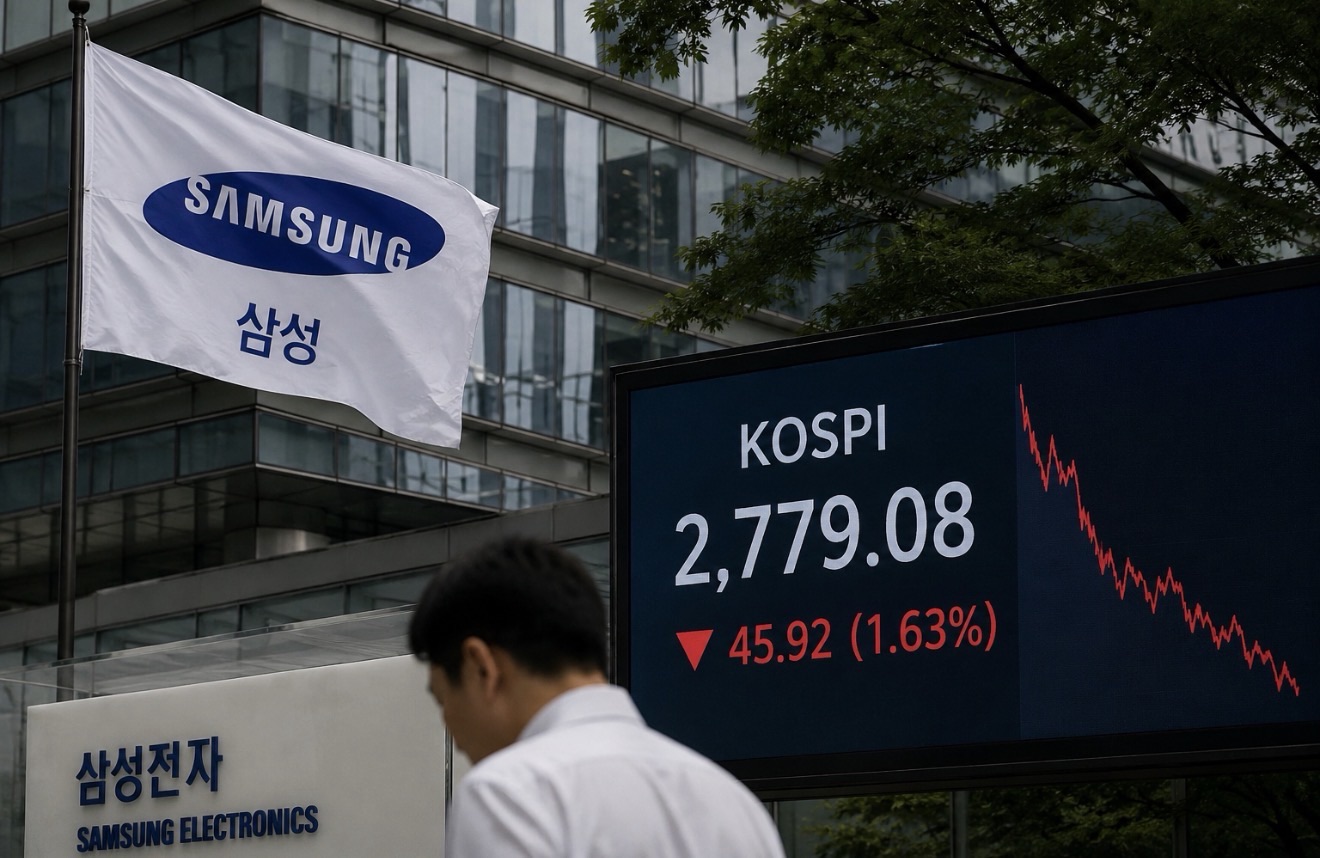

Samsung Electronics reported record quarterly earnings on Tuesday, July 7, forecasting operating profit of approximately 89.4 trillion Korean won ($58.4 billion) for the April-to-June quarter, according to the company’s official earnings guidance. The figure represents roughly 19 times the profit reported a year earlier and marks the largest quarterly operating profit in Samsung’s history, underscoring the extraordinary demand for artificial intelligence-related semiconductor chips.
Despite the historic results, investors reacted cautiously.
South Korea’s benchmark Kospi index opened sharply lower, falling about 1.6%, while Samsung shares dropped nearly 5% in early trading. The market’s response reflected growing investor concern that much of the AI-driven optimism has already been priced into technology stocks after an exceptional rally this year.
The company continues benefiting from surging demand for advanced memory chips used in artificial intelligence servers and high-performance computing. Samsung’s high-bandwidth memory business has become one of the biggest beneficiaries of the global AI boom as cloud providers and technology companies continue investing billions of dollars in new data centers.
Samsung’s projected operating profit exceeded analyst expectations of roughly 84 trillion won, while quarterly revenue reached approximately 171 trillion won, representing another significant increase from a year earlier.
The results confirm that demand for AI infrastructure remains exceptionally strong.
Memory chips have become one of the most valuable components inside AI systems, and Samsung remains one of the world’s largest producers alongside fellow South Korean manufacturer SK Hynix. Strong pricing for advanced memory products has helped offset weakness in several of Samsung’s traditional consumer electronics businesses.
Market movers
Analysts say Tuesday’s market reaction was driven less by Samsung’s earnings and more by investor expectations.
After semiconductor stocks posted enormous gains throughout 2026, many investors chose to lock in profits following the earnings announcement. The classic “sell the news” reaction has become increasingly common after major technology companies report results that, while impressive, may not significantly exceed already elevated expectations.
Several market strategists noted that Samsung’s earnings could still provide broader support for South Korea’s technology sector if investors regain confidence that AI-related spending remains sustainable.
Elsewhere in South Korea, shares of Hanwha Ocean fell sharply after Germany’s ThyssenKrupp Marine Systems was selected as the preferred bidder for Canada’s next submarine program, disappointing investors who had anticipated a major contract for the Korean shipbuilder.
Japan’s markets were more resilient.
The Nikkei 225 remained relatively stable while the broader Topix continued trading near record levels, supported by a weaker Japanese yen that continues benefiting the country’s exporters.
Wall Street also provided a positive backdrop.
On Monday, the Dow Jones Industrial Average closed above 53,000 for the first time, while the S&P 500 and Nasdaq Composite also finished higher as semiconductor shares extended recent gains. Strong performances from major U.S. chip companies helped reinforce optimism surrounding continued AI investment.
Commodities and volatility
Energy markets remained relatively calm despite ongoing geopolitical concerns.
Brent crude traded near $71.70 per barrel, while West Texas Intermediate (WTI) hovered around $68.40, close to pre-conflict levels. Lower oil prices continue easing inflation concerns for many Asian economies that rely heavily on imported energy.
Meanwhile, the Cboe Volatility Index (VIX) remained subdued, indicating investors continue viewing broader market risks as relatively contained.
What’s next
Investors now turn their attention to several major developments later this week.
SK Hynix is preparing for its planned Nasdaq listing, one of the year’s most closely watched semiconductor offerings, while markets also await the release of minutes from the Federal Reserve’s latest policy meeting under Chair Kevin Warsh.
Those developments could influence global technology stocks, interest-rate expectations and investment flows into Asian markets.
For businesses and investors alike, Samsung’s record profit highlights the enormous economic impact artificial intelligence continues having across the semiconductor industry. At the same time, Tuesday’s market reaction serves as a reminder that extraordinary earnings alone may no longer be enough to sustain the sector’s remarkable rally.
JBizNews Desk | Seoul, South Korea
© JBizNews.com All Rights Reserved. Reproduction or distribution without written permission is prohibited.