
 Matzav
Officials Say Midtown Tower Is Stable After Emergency Repairs Avert Collapse Scare
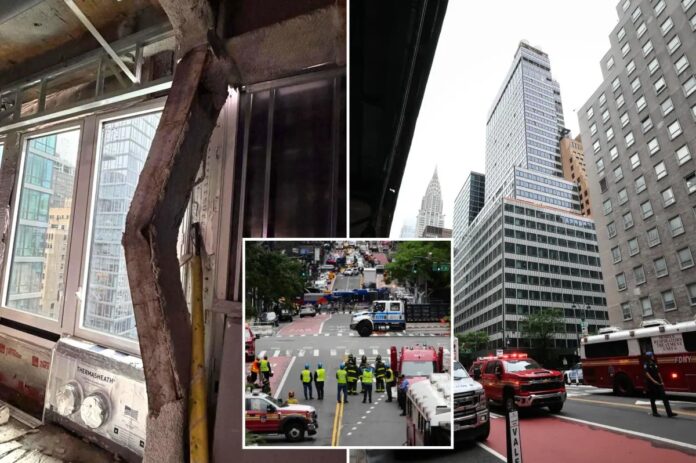
New York City officials said Tuesday night they are confident that emergency stabilization work has secured a Midtown Manhattan high-rise that prompted a massive evacuation earlier in the day after structural columns buckled, raising fears of a partial collapse.
Following hours of emergency work, Buildings Commissioner Ahmed Tigani said crews successfully installed temporary shoring and other reinforcements to stabilize the building.
“We were able to visit and get to the 21st floor this evening ourselves to inspect and look at the work that’s been done, and we are feeling confident that many of the emergency shoring measures that have been put in place as a result of extensive discussions with the building owner, the contractor, their licensed professional is stabilizing the situation,” Tigani said during a late-night press briefing.
He said additional steel supports were being installed as another layer of protection.
The commissioner explained that the new steel is “another emergency intervention,” adding that it is “creating stability and allowing workers and materials to move into place and keep the building in a stable situation.” He also noted that officials had not detected any additional movement in the compromised structure for several hours.
Earlier Tuesday, Mayor Zohran Mamdani had warned that the building remained unstable and urged New Yorkers to avoid the surrounding area. By Tuesday evening, however, city officials said the immediate danger had been significantly reduced, although they cautioned that emergency operations would likely continue for several more days.
“I can say right now the building is stable,” Tigani said. “We feel confident in the emergency plan we have now.”
The emergency began shortly before 8 a.m., when firefighters responded to reports of falling bricks at 235 East 42nd Street, where the former Pfizer headquarters is being converted into a 37-story residential tower with more than 1,600 apartments. The development, expected to be completed in 2027, has been described by its architects as the largest office-to-residential conversion project in New York City history.
According to the Department of Buildings, a safety manager reported that a steel beam on the building’s 21st floor had become compromised. Fire officials later determined that two structural support columns had buckled, causing several upper floors to sag and prompting authorities to establish a large safety perimeter stretching from East 40th Street to East 45th Street between First and Third Avenues.
By late afternoon, engineers completed their initial assessment and authorized contractors to begin installing temporary shoring to reinforce the damaged portion of the structure. Officials said the affected columns had shown no additional movement after midday, allowing stabilization work to continue throughout the evening.
New York Fire Department Chief of Department John Esposito said all construction workers were safely evacuated, no injuries were reported, and every worker was accounted for.
The emergency response also required the evacuation of nine neighboring buildings along East 42nd Street, East 43rd Street, and Second Avenue. In addition, a nearby private school with approximately 400 students was evacuated as a precaution.
MetroLoft, the developer overseeing the conversion project, said it is working closely with the city’s Department of Buildings to determine exactly what caused the structural failure.
Nathan Berman, MetroLoft’s founder and managing principal, characterized the incident as “nothing more than a typical construction mishap” during an interview with The New York Times.
“It happens unfortunately far too often on construction sites: falling cranes, people — God forbid — falling off buildings, windows falling out,” Berman said.
Berman also suggested that additional weight placed on the upper floors during construction likely caused the structural problems.
“This additional load that we put on those floors caused those two particular columns to collapse,” he told The Wall Street Journal. “Why those particular two columns and nothing else? We don’t know…we’re investigating that.”
While acknowledging the damage, Berman maintained that the problem was confined to a small section of the tower.
“I don’t know that a four-inch sag is a collapse,” he told The New York Times.
He also defended the overall engineering of the project, describing the design as “perfect,” and emphasized that the vast majority of the building remains structurally sound.
“It’s too big of a building. Ninety-five percent of the building, the structure is sound and intact…There is no way that this corner of a small extension all of a sudden topples this building,” Berman said.
Although city officials have not yet determined the precise cause of the incident, labor representatives at the site suggested the added floors may not have been supported by sufficient structural steel. Authorities have not confirmed that assessment and say the investigation remains ongoing.
The conversion project is part of New York City’s broader initiative to transform vacant Midtown office towers into residential housing as officials work to address the city’s housing shortage and reshape the neighborhood into a mixed-use community.
{Matzav.com}