
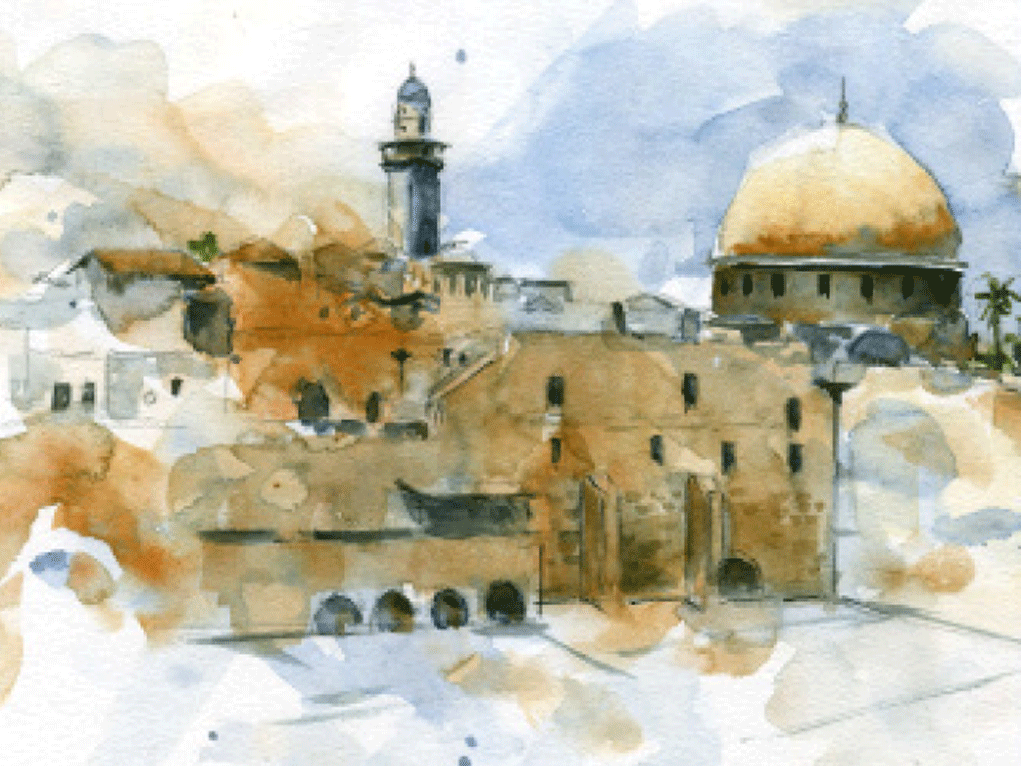

The Three Weeks, the period during which we reflect on the churban Bais Hamikdosh, is also a time to think about the churban of the Yiddishe shtub, the Jewish home, which is akin to a miniature Bais Hamikdosh.
Before we get to that, I have a couple of thoughts about the Three Weeks to share.
I don’t know if I’m allowed to say this, but I really don’t like the Three Weeks. The Three Weeks are the time of year when we are supposed to face reality and realize that we are still in golus. “Kala kayitz v’anachnu lo noshanu — The summer has ended, but we have not been saved” (Yirmiyahu 8:20).
This time of year is when we contemplate the idea that all the tzaros we experience, both collectively and individually, are ultimately rooted in the churban haBayis. When we see such difficulties unfolding in Eretz Yisroel, it isn’t because of the attorney general or the Supreme Court. It isn’t because of this party or that party. It is really about the churban.
Rav Matisyohu Salomon would often say that the difficulties we experience are all the result of the hester ponim that came about because of the churban.
All the difficult news we hear, all the agmas nefesh that Klal Yisroel experiences, both collectively and individually, is rooted in the churban.
Feeling the Pain of Your “Eigener Churban”
There is a famous vertel, said in the name of the Chiddushei Harim, that cites the Shulchan Aruch, which states that a person must feel pain and worry over the churban Bais Hamikdosh.
Someone once asked the Chiddushei Harim, “What happens if a person doesn’t feel pain over the churban?”
The Chiddushei Harim answered that he should instead feel pain and worry over his “eigener churban,” over his own personal churban, because if he doesn’t feel the pain of the churban, he has much greater problems.
In other words, if he doesn’t feel the pain of the churban, that means that there is something in his Jewish heart and neshomah that has been extinguished—and that is something he had better deal with right away.
The Guilt of Yiddishe Parents
This brings me to a very painful topic. Chazal teach us that if a chasunah is like rebuilding one of the ruins of Yerushalayim—”kol hamesameiach chosson v’kallah,” etc.—then we can derive that the opposite is also true: When a Yiddishe shtub is destroyed, it is as if part of Yerushalayim has been destroyed.
Over the past several months, or perhaps over the past year or two, I have sadly heard about several young couples who have gotten divorced.
This is not a column in which we will discuss why there may be a higher proportion of divorces in our communities today than there once was. Perhaps it is true, perhaps it isn’t. I don’t have empirical data on that. (If someone really wants to explore that topic, they are welcome to read the few columns that have appeared in these pages over the past month or two on middos and mentchlichkeit.)
Today, I want to speak from the perspective of the parents of a young man or woman who has gone through a divorce.
In my conversations with parents, what I have been hearing—aside from the sheer pain, sadness, and shame that come with the territory—is that many of them carry an overwhelming sense of guilt.
“Maybe I should have known better. Why didn’t I see the red flags? Why did I encourage her despite some of the misgivings she had? Why did I tell him to continue, assuming he would stop noticing what was bothering him? Why was I enticed by the glamour of the shidduch instead of looking beneath the surface?”
Yes, it is perfectly normal for parents to feel guilty, and far be it from me to tell people what they should or should not feel.
“Even What We Do to Ourselves Is Also From Hashem”
What I can say is that, all of a sudden, a story I heard about four years ago came back to me, and I feel it is well worth sharing with Yated readers.
I heard this story from a distinguished Yid from Beit Shemesh named Rav Osher Zelig Margulies, a prominent mashpia who is close to Rav Yaakov Meir Schechter. He heard the story directly from Rav Yaakov Meir himself.
By way of introduction, unless someone knew Rav Yaakov Meir’s circumstances, there was no way to realize that he was carrying enormous challenges, because he was always smiling, always calm, and always radiated warmth and bitachon.
In truth, however, Rav Yaakov Meir Schechter endured an extremely difficult life. His wife was ill and could not care for their large family. Several of the children faced significant challenges, and many would be classified today as having special needs. Few people knew that the entire burden of running the household—from changing diapers to preparing meals—rested on his shoulders.
He also had other children who were healthy, stable, and thriving in every way.
When the oldest of those children reached shidduchim, Rav Yaakov Meir faced a painful dilemma. On the one hand, who would want to marry into his family? Given the mother’s illness and the challenges of some of the siblings, people would naturally assume there were hereditary issues that could affect future generations.
Reluctantly, he concluded that he would have to forgo pursuing the finest shidduch for his son and instead seek a girl who came with her own “peckel.”
That is exactly what he did.
Sadly, the girl’s peckel brought with it very real difficulties. It did not take long before both Rav Yaakov Meir and his son realized that her issues were not conducive to shalom bayis. As time passed, his son concluded that the marriage simply could not continue. The only option was divorce.
A day was arranged for them to appear before bais din. Rav Yaakov Meir was walking there with his son, weighed down by tremendous anguish. He felt deeply responsible. After all, he had been the one who urged his son to settle for what he believed was a less-than-ideal shidduch, and now his son was suffering terribly and had to give a get.
As they walked, they passed the home of Rebbetzin Feige Mintche Alter a”h, the rebbetzin of the Imrei Emes and mother of the Pnei Menachem. She happened to be outside and noticed a yungerman who looked utterly broken.
“Yungerman,” she asked, “why do you look so sad, so tzubrochen?”
“I am on the way to bais din,” Rav Yaakov Meir replied, “to write a get for my son, and I feel terribly guilty that this shidduch didn’t work out. After all, it was my fault that he agreed to such a shidduch. I have buried my son with my own hands!” he concluded emotionally.
“Yungerman,” the rebbetzin exclaimed, “I have a kabbolah from my husband, the rebbe: Afilu vos men tut tzu zich alein iz oich fun der Ribbono Shel Olam—Even that which we do ourselves is also from Hashem.”
Decades later, Rav Yaakov Meir said that the rebbetzin’s words gave him tremendous chizuk and nechomah, filling him with renewed emunah. At that moment, he realized that this, too, was the Yad Hashem. Yes, he had been the shliach through whom it all came about, but, in reality, it was Hashem Who was guiding every step.
Eventually, that son remarried and built a beautiful family.
When it comes to the churban of a Yiddishe shtub, it is only natural for people to feel guilty. But the lesson that Rav Yaakov Meir Schechter learned from Rebbetzin Feige Mintche Alter is one that we should all internalize:
“Afilu vos men tut tzu zich alein iz oich fun der Ribbono Shel Olam—Even that which we do ourselves is also from Hashem.”