
 Matzav
Rahm Emanuel Blasts Netanyahu, Warns Israel-US Ties Have Reached ‘Crossroads’
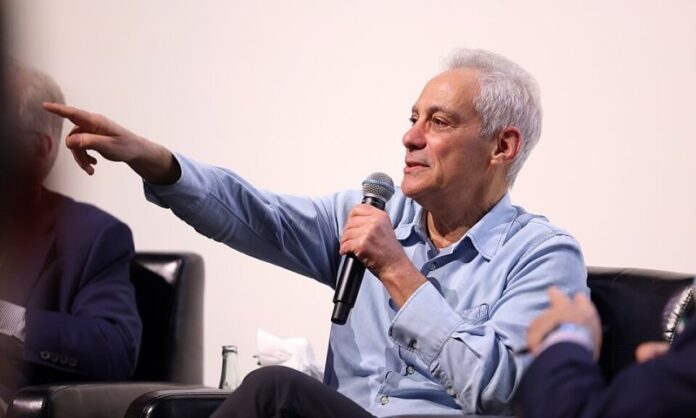
TEL AVIV – Senior Democratic Party figure Rahm Emanuel delivered a sharp rebuke of Israeli Prime Minister Binyamin Netanyahu during a speech at Tel Aviv University on Wednesday, warning that Israel’s relationship with the United States has reached what he described as a critical turning point. Emanuel argued that Israel’s current leadership has led the country into a diplomatic dead end and called for sweeping changes in both Israeli and American policy.
Emanuel, who served as White House chief of staff under President Barack Obama, represented Illinois in Congress, was mayor of Chicago, and later served as U.S. ambassador to Japan, is widely viewed as a potential Democratic presidential contender in 2028. Speaking as a guest of Tel Aviv University’s Center for the Study of the United States, he emphasized his longstanding personal connection to Israel while urging a major shift in Washington’s approach. Among his proposals were sanctions against individuals who harm Palestinians or support settlement expansion, changes to the structure of U.S. military aid, and opposition to any Israeli annexation of the West Bank.
Opening his remarks, Emanuel spoke about his family’s ties to Israel, noting that his father was born in Yerushalayim and fought in Israel’s War of Independence. He said he understands why many Israelis are skeptical of outside criticism, particularly after failed peace efforts and subsequent waves of terrorism.
Still, Emanuel insisted that Israel cannot shape its future solely through the lens of its past.
“I came from Chicago to say that things have to change if we are to continue this relationship. We are at a crossroads, and things cannot continue on the same path,” Emanuel said.
He added: “Netanyahu and his government have led Israel into a dead end.”
Emanuel argued that Israel’s global image has changed dramatically over the past five years.
“We cannot remain attached only to the past,” he said, contending that Israel has gone from being viewed as the “Start-Up Nation” to what he called “a modern Sparta.”
He further claimed that Israel has transformed “from a country offering technological solutions into a pariah state,” and urged Israelis to consider what that means for the nation’s future.
Emanuel also criticized Israel’s international standing, saying the world increasingly sees not only Palestinian casualties but also what he described as Israeli indifference to those images.
“The world sees that not only are Palestinians dying, but that Israelis are at peace with these images,” he said.
According to Emanuel, continued settlement construction, the prolonged war, and Israeli policy toward the Palestinians have weakened international support for Israel.
“You’ve lost Europe, your largest trade and research partner. Support for you in the United States is declining.”
While acknowledging Israel’s military accomplishments in recent conflicts, Emanuel argued that those victories have not translated into lasting diplomatic achievements.
“You are less secure today than you were before. Israel has failed to convert its military achievements into strategic achievements,” he said.
He added: “You have no plan for the day after in Gaza and Lebanon. Nasrallah, Sinwar, and Khamenei are dead, but Israel is more isolated than ever.”
Emanuel urged the United States to impose sanctions on Israelis who attack Palestinians, as well as on senior Israeli officials who support such violence. He also said companies involved in settlement construction should face sanctions.
“Netanyahu won’t like it, but it’s not the first time,” he remarked.
Emanuel also outlined what he called a “23-state solution,” envisioning a regional framework that would include Israel, the Palestinians, and 21 Arab nations.
He argued that a lasting peace cannot emerge solely from direct negotiations between Israel and the Palestinians.
“The Arabs must hold the Palestinians accountable and put them in their place. The two-state solution must become a 23-state solution, in which they roll up their sleeves, swallow their egos, recognize the historic connection of the Jewish people to this land, and stop encouraging violence and hatred against Israel,” he said.
Emanuel also criticized past Israeli policy toward Hamas.
“Israel must stop the cynical game of funding Hamas instead of funding partners for peace,” he said.
He argued that broader peace with the Arab world would dramatically strengthen Israel’s strategic position.
“If Israel makes peace with 21 Arab countries, it will be your sweetest dream and the Iranians’ worst nightmare,” he said.
Concluding his address, Emanuel said his criticism stemmed from concern for Israel’s future rather than hostility toward the country.
“I have spent 30 years defending Israel and have watched the window for peace grow smaller,” he said.
According to Emanuel, the obstacle is not the absence of a possible agreement but the fact that leaders on both sides “found that war is a more convenient solution than peace.”
He also took direct aim at Netanyahu, saying: “Hamas did what it did to prevent peace. Netanyahu, unfortunately, helped Hamas achieve that—not because of weakness, but because of his unwillingness to pursue an agreement for the day after.”
Looking ahead to Israel’s centennial in 2048, Emanuel urged Israelis to decide what kind of country they want to become.
“The Israel I believed in is an Israel that can make the desert bloom, but it is chaining itself,” he said.
He concluded: “In 22 years this country will be 100 years old. Will it be an Israel with more Nobel Prize winners, seen as the Start-Up Nation and contributing more to humanity than other countries? That is your choice.”