
 Vos Iz Neias
Opinion: Rahm Emanuel and the Persistent Delusion of Failed Policies
JERUSALEM (JNS/Jonathan S. Tobin) Say this for Rahm Emanuel. He may have about as much chance of being nominated for the presidency in 2028 by the Democratic Party as he does of being elected pope. But he knows how to retain the attention of the national media by manipulating contacts inside the Beltway.
That’s the only way to explain why someone who is not even being included in way-too-early polls about presidential preferences could get the kind of massive coverage he got for a speech given this week in Israel, when those far ahead of him in the contest struggle to be noticed.
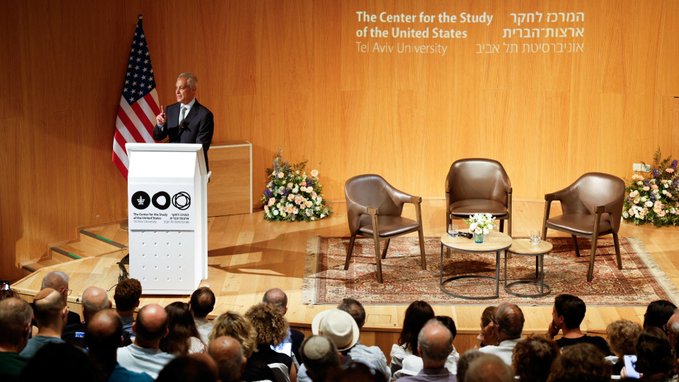
On July 7, The Washington Post devoted three full articles to previewing Emanuel’s July 8 talk at Tel Aviv University. The Post, The New York Times, CNN and the rest of the corporate press then followed up with even more coverage of the speech after the fact. Those articles not only depicted it as deeply relevant to the current debate about the U.S.-Israel relationship going on in his party, but also to the reality on the ground in the Middle East.
A rerun of failed ideas
But what made this public relations coup even more remarkable is the fact that the much-ballyhooed address consisted of little more than a recycling of the conventional wisdom of his long-past political heyday. Emanuel’s speech was more or less a rerun of what passed for foreign-policy establishment canon in 1995 and 2015, put forward as a formula for peace in the second quarter of the 21st century.
Once you strip away Emanuel’s attempts to claim both the credibility and credentials to demand that Israelis discard everything their lying eyes and ears have been telling them about their nation’s struggle to survive a multifront war launched by Iran and its terrorist auxiliaries, all you’ve got is what we might term a piece of political nostalgia.
Emanuel calls his big idea the “23-state solution” because it is based on the notion that the Arab and Muslim world can cajole the Palestinian Arabs to make peace. But that’s just window dressing for what is the same two-state solution that his former bosses, Presidents Bill Clinton and Barack Obama, foolishly expended so much political capital trying to force into being. Contrary to liberal myth, that formula was thwarted not by Israeli intransigence but by the stubborn refusal of the Palestinians—enabled by much of the Muslim and Arab worlds, in addition to Western leftists—to countenance any future but one in which Israel is erased.
The context here is the fact that the former U.S. ambassador to Japan (2022-2025), mayor of Chicago (2011-2019), White House chief of staff to President Barack Obama (2009-2010), U.S. congressman from Illinois (2003-2009), investment banker (1999-2002) and senior adviser to Clinton (1993-1998) believes that his already impressive résumé ought to be rounded out by a stint as commander-in-chief. The man renowned as a serious policy wonk, albeit one with a predilection for profanity and a notorious temper, may have much to say about a lot of different topics. Yet when it comes to Israel—a subject he claims intimate knowledge of—Rahm is nothing but a blast from the discredited past.
That’s why the truly significant aspect of the speech and the massive coverage it generated isn’t what it says about the 2028 race, efforts to prevent the Democratic Party from becoming the anti-Israel party or even the one that is comfortable with antisemitism. Rather, it points toward the fact that while Israelis have absorbed the lessons of the last 33 years of history, including the Oslo Accords disaster, the Second Intifada, the fruits of the withdrawal from Gaza and the horrors of Oct. 7, 2023, supposedly smart people, including those like Emanuel who know a thing or two about Israel, have learned nothing.
Emanuel claims to represent a rational compromise between two factions.
On the one hand, he disdains the rabid antisemites chanting for Jewish genocide (“From the river to the sea”), terrorism against Jews everywhere (“Globalize the intifada”) and their political frontmen, like New York City Mayor Zohran Mamdani, who speaks for his party’s base, if not the overwhelming majority of its rank-and-file. But he has equal contempt for those politicians who, he says, give “blind” support to Israel and its democratically elected government. Few Democrats these days, other than an outlier like Sen. John Fetterman (D-Pa.), come even close to basic support of the Jewish state, and not even the most hard-core backers like the senator and the many Republicans who share his views do so blindly.
His supposed compromise involves smearing Israeli Prime Minister Benjamin Netanyahu and his government, and placing the lion’s share of the blame for the current state of the Middle East on them. He points a finger at the supposed unconditional support that Israel has gotten from the United States. And while he also says that Palestinian Arabs bear some responsibility for their problems, this is secondary to his belief that the United States can help impose a solution on the region.
The architect of ‘daylight’
If that sounds familiar, it ought to. The same condescending tone with which Emanuel blasted Netanyahu and Israeli voters this week was the one he helped orchestrate a campaign of pressure on the Jewish state during the opening months of the Obama administration in 2009. At that time, Emanuel’s big idea wasn’t some nonsense about 23 states, but rather a belief in the value of creating more “daylight” between Washington and Jerusalem.
It’s been more than 17 years since Emanuel stage-managed the launch of that initiative. Obama snubbed Israel on his first trip to the Middle East and then gave a speech in Cairo in which he not only apologized for America’s alleged past sins committed against Muslims, but compared Israel’s treatment of the Palestinians to the Holocaust.
In the years that have followed, the world has seen that such “daylight” didn’t encourage Israel’s enemies to give up their quest for its destruction. To the contrary, it only encouraged the Palestinians and their supporters to double down on their belief that if they are only patient and brutal enough in their assaults on the Jewish state, the West will someday abandon it and acquiesce in its eradication.
Obama’s appeasement of Iran, which, instead of preventing them from achieving their nuclear ambitions, actually guaranteed that it would someday get a bomb with Western permission, illustrated the same principle.
And yet, Emanuel thinks this record of failure that dates back to his support for the folly of Oslo entitles him not merely to pose as an expert on the situation. He believes that it gives him the right to scold and dictate to Israelis.
The veteran politician has closer ties with Israel than most American Jews. His father fought with the Irgun Zvai Leumi during Israel’s War of Independence, and his mother is buried in Israel. But unlike the Israeli people whom he now lectures, he not only doesn’t share their dangers but played a not-insignificant role in increasing their peril. So, his “tough love” approach is not only unhelpful but deeply offensive.
In his Tel Aviv speech, Emanuel gave a potted recent history of the Middle East that acknowledged Palestinian intransigence, but then demanded that Israelis ignore it. With his quotes of the late Israeli Prime Minister Yitzhak Rabin and lauding Obama’s “achievements,” he showed just how rooted he is in the patent nostrums of the past.
The truth is, Israel has repeatedly attempted to trade land for peace, and as a result, received only more terror. Withdrawing from the Gaza Strip in the summer of 2005 brought into being what is now, for all intents and purposes, an independent Palestinian state in all but name.
Israel tried to live with that state. Netanyahu is ceaselessly chided by his critics, including Emanuel, for having allowed funds from Qatar to flow into Gaza in the hope that doing so, along with allowing Palestinians to work inside Israel, would cause the Strip’s Islamist rulers to think it was in their interest to keep the peace. The prime minister deserves the criticisms he gets for that, but the truth is that few of his political opponents inside Israel or his American critics thought it was wrong while that was happening. None of them would have supported an effort to push Hamas out of Gaza if Israel had sought to do so before the events of Oct. 7, 2023.
If this bribery failed to achieve its purpose, it’s not because of Netanyahu’s bad judgment. It’s because the Palestinian people and the terror groups they support, like Hamas, had no interest in peace, including merely the maintenance of the status quo. The Hamas-led massacre of 1,200 people in southern Israel on Oct. 7 bears witness to the folly of those who preached for “two states.” They also exposed the cluelessness of those who failed to understand that, unfortunately, the conflict with the Palestinians has been and remains a zero-sum game.
If Israel were to withdraw from the larger and more strategically important Judea and Samaria, as it did from Gaza, that would not only be an unconscionable abrogation of Jewish rights and the ethnic cleansing of Jews from the heart of their ancient homeland. It would also set Israel up for more Oct. 7 horrors on an even greater and more dangerous scale.
Still smearing Israel
For 100 years, the Palestinian Arabs have refused any such compromise that would involve them living in peace with a Jewish state, no matter where its borders might be drawn. The war they launched on Oct. 7 with the largest mass slaughter since the Holocaust wasn’t a response to Israel’s policies. It was, like the decades of terrorist attacks that preceded it, an expression of anger at the existence of a Jewish state in their midst, coupled with a desire to see it destroyed and its people annihilated. Emanuel claims that harping on such history is to ignore opportunities for change; however, this insight applies as much to the present situation as it does to the past.
But, as was the case back in the 1990s when Clinton was pushing the same ideas, and in the 2010s when it was Obama falsely claiming that Israelis were not brave enough to take “risks for peace,” none of that matters to Emanuel.
For him, the problem is that Netanyahu has transformed Israel into a militarized “Sparta” and international “pariah” state. But whatever you might think about Netanyahu, an observer who was less determined to double down on past failures would understand that the prime minister’s political success and the policies he has pursued were merely a response to the reality of Palestinian intransigence that a generation of Democratic policymakers like Emanuel has either downplayed or tried to wish away.
His peace formula involves America punishing Israel by cutting off aid and political pressure, matched by the Arab world doing the same to the Palestinians. This is nonsense. The Palestinians have made it clear that they cannot be bribed or persuaded to accept peace with Israel. And as long as that is true, no amount of pressure on Jerusalem will end the conflict. That is why, though Israelis disagree on much, including whether Netanyahu should remain in office, there is a broad consensus within Israel that there is no Palestinian peace partner and that withdrawal from territory, let alone the uprooting of Jews, is a non-starter.
A futile candidacy
Does Emanuel think that Israelis will listen to his stale prescriptions for policies that have already been tried and proven failures? Probably not. But his insatiable ambition and his ego have placed him under the misapprehension that his position on Israel is critical enough to satisfy Democratic primary voters. The vast majority seem to have accepted blood libels about Israel committing “genocide” and swallow toxic leftist ideas like critical race theory, intersectionality and settler-colonialism that led them to think it has no right to exist.
Emanuel epitomized the sort of establishment Democrat who ran the party under Clinton and Obama, but who is now reviled by the progressives who dominate it today. There is also the problem that during his time as mayor of Chicago, Emanuel alienated the African-American community because of various controversies over police brutality. It is a long shot for someone like Pennsylvania Gov. Josh Shapiro, who is nominally pro-Israel but critical of Netanyahu, to win the nomination of a party where hatred for the Jewish state has become normative. But the chances of someone at odds with both African-Americans and the Israel-haters in the party are about as close to zero as one can get.
Still, we should not dismiss the damage that speeches such as his do to the U.S.-Israel alliance and the dwindling chances of reviving support for Israel inside the Democratic Party.
Israelis know that it is in their long-term interests to phase out the military aid they get from Washington. That’s despite the fact that almost all of it is spent in the United States, and is part of a mutually beneficial relationship that enhances American security. Still, the idea that America can bludgeon Israelis into endangering their security to conform to outdated notions about the formula for peace that were discredited long ago is a dangerous myth. The effort to revive interest in a two-state solution that Palestinians don’t want will, as it did in the past, only encourage them to continue their century-old war on Zionism.
Bashing Israel or claiming that “bad” Israelis like Netanyahu have been the obstacles to peace isn’t just wrong. It will make it that much harder to fend off the antisemitic push to anathematic Israel that has been the hallmark of discussion about the Middle East on the left since Oct. 7. Democrats like Emanuel, who engage in such discourse, may claim that they love Israel. However, all they’re doing is making it easier for their fellow party members to demonize the Jewish state and ignore the ongoing Palestinian quest for Jewish genocide.
Jonathan S. Tobin is editor-in-chief of JNS. Follow him: @jonathans_tobin.