
 Vos Iz Neias
Gravely Ill in a Russian Prison: The Plight of Marine Veteran Robert Gilman
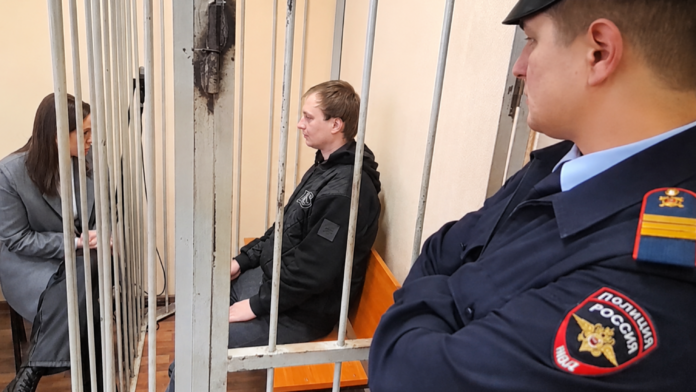
New York (VINNEWS) Robert Gilman, the United States Marine Corps veteran serving a long prison sentence in Russia, has been taken from his cell to a hospital, according to a report this week in the Russian business daily Kommersant. His lawyer, quoted by the newspaper, said Gilman was receiving treatment but that it was too early to speak of a diagnosis. Because of the unspecified illness, a court in the southern city of Voronezh postponed a hearing on a prosecutor’s appeal against his latest sentence.
The United States State Department confirmed that it is aware of the situation. A spokesperson said the Department knows that an American, Robert Gilman, is detained in Voronezh, that it is providing appropriate consular assistance, and that it continues to track his case closely. For a family that has watched from an ocean away as his fate has spiraled further from their grasp with each passing year, the report of an unnamed illness in a Russian hospital carries its own particular dread. What is he suffering from? Is he being properly cared for? These are the questions that keep a mother and father awake, and to which distance and diplomacy provide no quick answers.
There is a cruel symmetry in this latest news. As will be seen, Robert’s entire ordeal began when illness was met not with a doctor but with a jail cell. Now, years later, he lies ill again, still in custody, his condition undisclosed. To understand why that symmetry is so bitter, one must go back to the beginning.
A Life of Learning and Service
Robert Gilman, who turned thirty-two in March, grew up in Lowell, Massachusetts. He was not a drifter or an adventurer courting trouble. He was born into a family that prized service. After serving in the United States Marine Corps, he went to Europe and built a life around teaching, founding an English-instruction business in Poland to help students adapt to new environments and pursuing a Bachelor of Science in cybersecurity. His students adored him so much that they nicknamed him ‘Captain America.’ His older sister, herself an English instructor, speaks fondly of how her younger brother always cast himself as her protector. The James W. Foley Legacy Foundation, the nation’s foremost advocate for Americans held abroad, classifies Robert Gilman as a wrongful detainee.
How It Began
In November of 2021, Robert was on his way to a new teaching position in Moldova, building on the business he had already established in Poland. While transiting through Moscow, he became ill and had to pause his journey to recover. It was during that unplanned stay that he discovered his luggage and passport had been tampered with, and he found himself needing to replace missing passport pages before he could continue on his way.
Rather than let the setback defeat him, Robert made the best of it, using the delay as a chance to visit extended family outside Moscow. Then, on January 17, 2022, as he traveled back toward the city to have his passport repaired at the United States Embassy, he became violently ill once again and was accosted by a policeman at a rail station. What a sick man needs at such a moment is help. What Robert received instead was a police baton.
According to the account maintained by his supporters, the police struck him and hauled him to a station rather than to a doctor. He was vomiting and falling, most likely, they say, from a concussion. As officers tried to restrain the disoriented and gravely ill man, his leg accidentally struck one officer’s shin. That single involuntary contact, from a man who could barely stand, became the seed of everything that followed. Prosecutors took him into custody and began to build against him a series of vague and escalating charges.
He was ultimately sentenced to four and a half years, and this despite the fact that the unharmed officer himself has stated Robert should not be charged for the kick. It is worth pausing on the sheer injustice of that fact: the very person supposedly assaulted has said there should be no case, and yet the case not only proceeded but became the foundation for years of imprisonment.
A Sentence That Would Not Stop Growing
Had the matter ended with that first questionable conviction, it would already have been a hard fate. It did not end there. Since his detention began in 2022, Robert’s sentence has been extended again and again through fresh convictions for alleged assaults on prison officials, bringing his total to ten years.
His advocates describe the mechanism plainly: in prison, Robert was goaded into new confrontations through provocations, forced drugging, and outright torture, including forced exercise for sixteen hours and six months in an extreme punishment cell. Each engineered incident became the pretext for a new charge, and each new charge became the justification for keeping him locked away longer. The cell becomes a trap that manufactures its own extensions. This is a recognized tactic: draw an American into the system, then pile on unfounded charges to keep him there.
An Eerie Familiarity
Those who have followed the fate of Americans in Russian custody will feel an unsettling sense of recognition. The profile of Robert’s case bears a striking resemblance to that of Trevor Reed, another former Marine who unexpectedly blacked out and was then charged with striking a police officer, a case that many came to believe had been staged from the beginning. Reed was eventually brought home in a prisoner exchange.
The pattern, once seen, is difficult to unsee. A foreign government acquires custody of an American, escalates the charges through provocations inside the prison walls, and thereby converts an ordinary person into a valuable chip, to be cashed in at a moment of Moscow’s choosing. His advocates fear he is being sentenced toward a point where his only path out will be inclusion in some future swap between Washington and the Kremlin.
The Real Story of Americans in Russia
To understand Robert’s case, one has to understand the larger pattern into which it fits. For years, Russia has practiced what analysts openly call hostage diplomacy. The mechanism is grimly simple: Russian authorities find an American and make an arrest, and the basis for that arrest hardly matters. The names of others caught in the same machinery are by now familiar to many Americans, among them Brittney Griner, Evan Gershkovich, Paul Whelan, Ksenia Karelina, and Trevor Reed. Once a person is inside the Russian system, Moscow can add charges at will, lengthen the sentence at will, and hold the prisoner as leverage for an eventual trade with Washington.
That is precisely what has happened to Robert. The torture and the endless provocations he has endured are not random cruelties; they are the instruments by which his sentence is extended, engineered so that the only way he goes home is through a trade.
The Shadow of the Ukraine War
Two further facts about Robert’s case deserve to be understood together. The first is a matter of timing. He was arrested in January 2022, in the very weeks leading up to Russia’s February 2022 invasion of Ukraine. The James W. Foley Legacy Foundation, which tracks wrongful detentions around the world, has reported an uptick in exactly this kind of arrest in Russia beginning in late 2021 and early 2022, on the eve of the invasion. Robert appears to have been swept up in that surge.
The second fact is a matter of grim comparison. Robert is the third former Marine to be arrested in Russia. Trevor Reed was held for 985 days before his release in April 2022. Paul Whelan was held for 2,043 days before his release in August 2024. Robert has now been held for more than 1,600 days, with no end in sight.
His family’s engagements with the State Department and the National Security Council have left them with the understanding that officials on both the Russian and American sides are prepared to make an exchange, but are waiting on progress toward peace in Ukraine. In the meantime, Robert waits too. His Massachusetts congressional delegation, Senators Edward Markey and Elizabeth Warren and Representatives Seth Moulton and Lori Trahan, wrote on his behalf first to Secretary of State Antony Blinken and more recently to Secretary Marco Rubio. And still the family waits.
On this fourth anniversary of Robert’s arrest, the Gilman family’s plea is that President Trump and special envoy Steve Witkoff not make Robert’s freedom hostage to the pace of the Ukraine negotiations. As the President himself has declared, the freedom of Americans held in Russia must be a national priority. For Robert Gilman, sick and far from home, that priority cannot come a day too soon.
A Call for Compassion
Whatever one concludes about the tangled proceedings against him, the human being at the center of this story deserves to be seen as more than the sum of his charge sheet. He was a Marine, a teacher, a protector to his sister, ‘Captain America’ to the students who adored him. He has now spent years in conditions that would test the composure of any human being, watching his sentence grow rather than shrink, becoming both a prisoner and a pawn.
As the diplomatic machinery grinds on and the appeals wind through Russian courtrooms, one hopes that those with the power to bring him home will not lose sight of the person waiting at the end of all these proceedings: a sick man in a hospital bed, far from home, far from everyone who loves him, whose plight deserves not our judgment but our compassion. The Gilman family remains hopeful that Robert will not be left behind again. That hope deserves to be shared, and to be answered.