
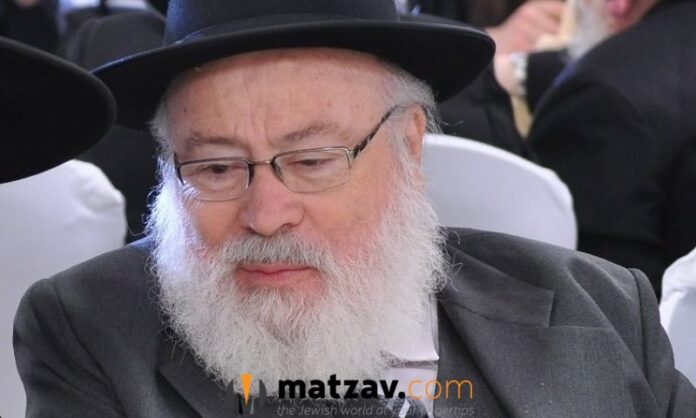

It is with great sadness that Matzav.com reports the petirah of Rav Shmuel Yehuda Kohan z”l, one of the senior and most respected members of the Belzer community, who passed away at the age of 94.
Renowned for his lifelong devotion to Torah, chesed, and taharah, he played a pivotal role in helping establish the Belzer World Center in Yerushalayim and was instrumental in building dozens of mikvaos throughout Eretz Yisroel.
Rav Shmuel Yehuda was born in Sivan 5692 (1932) in Budapest, Hungary, to Rav Yaakov Chaim z”l and Mrs. Leah a”h. Before his parents married, his father sought the guidance of Rav Yeshaya of Kerestir zt”l regarding a proposed match. Although two suitable suggestions had already been presented, the tzaddik, through his ruach hakodesh, instructed him to wait for another proposal. The following day, the Kerestirer Rebbe was nistalek, and shortly thereafter the match that ultimately led to the birth of Rav Shmuel Yehuda was arranged.
During the Holocaust, while the Belzer Rebbe, Rav Aharon of Belz zt”l, was in Budapest, Rav Shmuel Yehuda’s father obtained hadasim for the Rebbe to fulfill the mitzvos of Sukkos. In appreciation, the Rebbe honored him with a dance during the sixth hakafah on Simchas Torah. Before departing the city, the Rebbe distributed protective coins to every member of the Kohan family. Rav Shmuel Yehuda, then a 14-year-old boy, survived the horrors of the Holocaust together with his family in what they regarded as miraculous circumstances.
As the war raged, the Kohan family was relocated to so-called “protected houses” in Budapest, but safety remained elusive. Rav Yaakov Chaim was deported to the Bergen-Belsen concentration camp, while his wife and children found refuge at the Swiss Consulate, where nearly 2,000 Jews were crammed together under unbearable conditions. At one point, the Nazis marched them to the banks of the Danube River with the intention of executing them, but in a stunning turn of events they were spared at the last moment and returned to the consulate. Nine months after the war ended, Rav Yaakov Chaim returned to Budapest broken in body but alive, thanks in part to the efforts of Rav Yitzchok Shlomo Ungar zt”l, the rav of the Chug Chasam Sofer community.
Following the war, Rav Shmuel Yehuda studied in the yeshiva of the Rav of Chust before continuing his learning under Rav Shimon Yisrael Pozen zt”l of Shopron. He remained deeply devoted to his rebbe throughout his life and hosted a monthly Mishnayos shiur in his home on every Rosh Chodesh in his memory.
As Communist rule tightened its grip on Hungary in 1948, the family received permission to immigrate to Australia. On their way, they stopped in the United States, where relatives urged them to remain. They sought the guidance of the Frierdiker Lubavitcher Rebbe, Rav Yosef Yitzchak Schneersohn zt”l, who instructed them that their mission was to continue on to Australia and spread Yiddishkeit there.
Their arrival in Australia became a source of widespread admiration. Landing in Sydney just minutes before Shabbos, the family left all of their belongings at the airport and walked seven miles with six young children to reach their hotel rather than violate the sanctity of Shabbos. The remarkable display of commitment generated significant publicity in the local press and created a tremendous Kiddush Hashem. The family later settled in Melbourne, where they were among the pioneers who established the city’s first minyan and laid the groundwork for its Jewish community.
In 1960, Rav Shmuel Yehuda married the daughter of Rav Moshe Friedman z”l of Melbourne, who maintained close ties with the courts of Belz, Sanz, and Stropkov. Rav Shmuel Yehuda himself enjoyed close relationships with many of Melbourne’s leading rabbonim, including Rav Yaakov Yitzchok Neiman, Rav Betzalel Stern, and Rav Elimelech Ashkenazi.
Eleven years later, in 1971, he fulfilled his dream of settling in Eretz Yisroel, making his home in Bnei Brak. His residence became known as a welcoming destination for anyone in need. He was recognized for his heartfelt tefillos, rose before dawn each day to immerse in the mikvah, and spent hours learning in the Chug Chasam Sofer bais medrash before Shacharis.
He maintained a close relationship with Rav Elazar Menachem Man Shach zt”l, visiting the Rosh Yeshiva together with his brother, Rav Meir, before every Rosh Hashanah and Purim to receive a brocha.
Rav Shmuel Yehuda was deeply attached to the great tzaddikim of his generation, particularly the Bohusher Rebbe zt”l, whom he served with complete devotion, and, yibadel l’chaim, the Belzer Rebbe. He dedicated enormous energy to strengthening the cause of taharah, overseeing the construction of numerous mikvaos throughout Eretz Yisroel. His crowning achievement was the magnificent mikvah built as part of the Belzer World Center in Kiryat Belz, Yerushalayim. He invested extraordinary financial resources and personal sacrifice into the project and stood at the Belzer Rebbe’s side throughout its development. The first office established to oversee construction of the Belzer bais medrash operated out of the building where his brother and partner in the undertaking, Rav Meir, lived. Together, the two brothers traveled extensively overseas to raise the funds necessary to bring the vision to fruition.
At the dedication of the mikvah during Chol Hamoed Sukkos in 1991, the Belzer Rebbe delivered special remarks praising the Kohan brothers, describing them as renowned for their relentless pursuit of tzedakah and chesed. The Rebbe noted that they had built dozens of mikvaos across Eretz Yisroel and blessed them with long life and many good years.
In his later years, Rav Shmuel Yehuda retired from business and devoted himself entirely to Torah. Together with his brother, he established an evening kollel for working men at the Chug Chasam Sofer bais medrash, where participants eventually completed Shas. Six years ago he suffered the loss of his beloved brother, with whom he shared an exceptionally close bond, and four years later his wife passed away. Even during his final years, as his health declined, those around him marveled at his extraordinary nobility, graciousness, and constant expressions of gratitude toward everyone who assisted him.
The levayah departed from his home on Baal Shem Tov Street in Bnei Brak before stopping at the Chug Chasam Sofer shul, where the community’s rav, Rav Moshe Benedikt, delivered brief words of farewell. The procession then continued to the Bohusher bais medrash. In accordance with the niftar’s request, the levayah paused at the gravesite of the Bohusher Rebbe zt”l in Nachalas Yitzchok Cemetery in Givatayim before continuing to Segulah Cemetery in Petach Tikvah, where he was laid to rest.
Yehi zichro boruch.
{Matzav.com}