

A new public opinion poll released Thursday indicates that Israel’s right-wing bloc would secure a parliamentary majority if elections were held today, while Prime Minister Binyamin Netanyahu has widened his lead as the public’s preferred choice for prime minister.
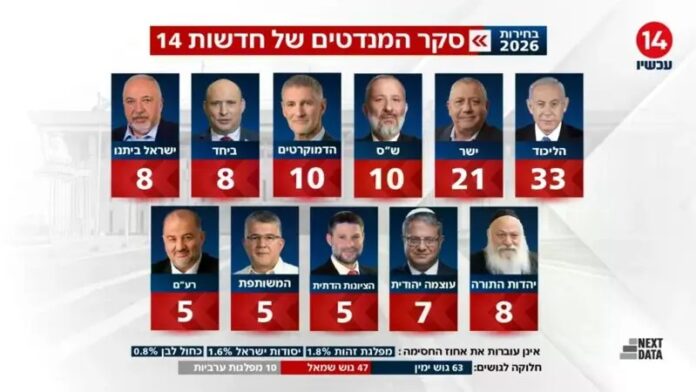
According to the survey, the right-wing bloc would win 63 seats in the 120-member Knesset, enough to form a governing coalition. The left-wing bloc would receive 47 seats, while the Arab parties would capture the remaining 10 seats.
The Likud Party remains the largest faction, polling at 33 seats. It is followed by Gadi Eisenkot’s Yashar Party with 21 seats, an increase of one seat compared to the previous poll. Shas is projected to win 10 seats, tying the Democrats with the same total.
Further down the standings, the Beyachad Party, led jointly by Naftali Bennett and Yair Lapid, is projected to receive 8 seats. Yisrael Beiteinu is also forecast to win 8 mandates, as is United Torah Judaism. Otzma Yehudit would secure 7 seats, while the Religious Zionism Party is projected to win 5. Among the Arab parties, both the Joint List and Ra’am are expected to receive 5 seats each.
Several parties would fail to cross the electoral threshold under the current polling. Those projected to remain outside the Knesset include Blue and White, Moshe Feiglin’s Zehut Party, and Yesodot Yisrael, led by Yoaz Hendel and Zvi Hauser.
The poll also found Netanyahu maintaining a commanding advantage in the race for prime minister. According to the results, 55% of respondents said Netanyahu is the most suitable candidate for the position, marking an improvement from the previous week’s survey. Eisenkot ranked second with 31%, followed by Naftali Bennett at 9%, Avigdor Lieberman at 4%, and Benny Gantz with just 1%.
The survey was conducted by NEXT DATA on July 9, 2026, among a representative sample of 752 adult Israelis. The data was analyzed by Shlomo Filber. As with all public opinion polls, the findings reflect respondents’ views at the time the survey was conducted and are not necessarily predictive of the outcome of a future election.
{Matzav.com}