

Weekly Story: It Is A Personal Request To You
by Rabbi Sholom DovBer Avtzon
Last Shabbos while I was farbrenging in Ksav Sofer, I mentioned a story that shows that when the Rebbe is speaking, he is requesting something from each one of us individually. Someone mentioned his personal story that brought it home to everyone, and I would like to share it with you.
As always, your feedback and comments are greatly appreciated and most welcomed.
It is known that the Mittler Rebbe wrote seforim for ten different type or groups of chassidim. The Imrei Binah was written for Reb Yekusiel Liepler, a chossid who after much toil and exertion was able to plumb and understand the most intricate concepts of Chassidus. Pirush Hamilos, were ma’amorim that he sent to the Chossid HaRav Yaffe, whom he instructed to move to Eretz Yisroel and promised that he will send him ma’amorim. And then there is Poikei’ach Ivrim that the Mittler Rebbe write specifically for a Ba’al Teshuvah, as the story is described in detail in the introduction to that sefer.
There were times that the Rebbe RaShaB was asked, “Rebbe, for whom was this maamar said for? “ (As the chassidim thought that it was above the ability of almost all of them to comprehend it properly.) On one occasion the Rebbe RaShaB replied, for the Tomim [Reb] Avrohom Boruch Pewzner (who was one of the chozrim then).
So, sometimes a chossid might have thought, is the Rebbe saying this Sichah for me??
Take for example the Sichos about not giving away any part of Eretz Yisroel that Hashem miraculously gave to us. Yes, the Rebbe wants that I should know and understand the proper expected response and way to look at it. For example, the way it is described in Lubavitch is “giving it away”, contrary to the way the world [which is false] presents it, as returning the “occupied lands.”
We don’t say “returning”, as it was never really theirs, and they were the illegal squatters and occupiers. As Rashi states in the first possuk of B’reishis, Hashem gave the entire Eretz Yisroel to the Jewish people.
But the listener might wonder, is the Rebbe expecting me to do something about it? He probably is talking to so and so in the government or those who are close to them and have influence on them. But simple me, what can I do?
Similarly, when the Rebbe said we should learn Rambam throughout the year and especially the 4 chapters of Yechezkel’s prophecy, the mishnayos Midos and the Rambam’s Hilchos Beis HaB’chirah during the 3 weeks, one may erroneously ask or think, is the Rebbe asking me to do that, the Rebbe knows it is beyond my capabilities?
So I will mention the following story:
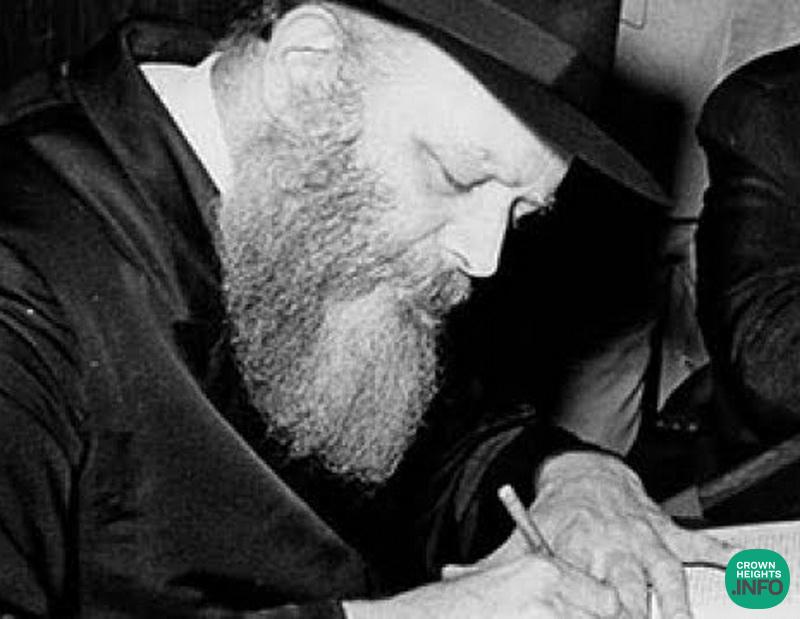
As is known, especially after Simchas Torah of 5738, when the Rebbe was recovering from the heart attack, the secretary made sure to prepare the letters for a bar mitzvah, chasunah, which are technically standard letters in separate piles, and he would give them together for the Rebbe to sign.
So, one chosson who received the Rebbe’s letter of b’rochos in honor of his upcoming wedding, wondered, did the Rebbe really mean me and my kallah personally? He signs hundreds of the same letter.
Before the wedding, the chosson had a yechidus (probably a group one of chassanim and kallahs, and when he passed by the Rebbe, the Rebbe asked him, “Did you receive my letter of brochoh in honor of your Chassunah?”
The chosson then realized that he was completely mistaken; Yes, the Rebbe means each person individually.
At that moment, Reb Pesach Laufer stood up and stated, “a similar story happened to me, at my Bar Mitzvah”.
As everyone knows, besides the name and date, it is a standard letter, a letter that the Rebbe sent to thousands upon thousands of Bar Mitzvah boys, in honor of their momentous day.
His letter is the same standard letter, just that the Rebbe corrected it in two places.
The first correction was that he added a comma after the word BaTorah. and the second one was that the secretary forgot to type the letter Yud after the samach of the word Chassidus, and the Rebbe squeezed it in.
So, you see that not only did the Rebbe personally sign it, but he checked every word and letter to whomever it was sent to, even a thirteen year old bar Mitzvah boy.
Therefore, now that we are in the three weeks, please realize that if the Rebbe checked each letter that was sent out under his name, and he meant each individual person, so obviously, when he requested and pleaded that we each learn the pesukim, mishnayos and Rambam connected to the building of the third Beis HaMikdash, it is a personal request that he is requesting from each one of us, me, that person and you.
A Taste of Chassidus הנה להבין ענין Likkutei Torah Bamidbar p. 82C
In the first maamar of Parshas Matos the Alter Rebbe presents a unique perspective on why a person may make a vow.
Generally speaking, the basic perspective of a vow is based on what our sages say (Talmud Sota 2a, quoted by Rashi, Bamidbar 6:2), that one who sees a Sota in her state of disgrace, should separate themselves from wine, as excessive drinking can cause one to conduct themselves inappropriately. In other words, a person might vow not to eat, go somewhere, or do something, in order to prevent them from being in a place or position that they may sin.
So in essence the Torah isn’t encouraging one to vow, rather it allows a person to do so as a protective safeguard. This is supported by the teaching of our sages that the reason a Nazir brings a sin offering is because he prohibited himself from something (wine) that Hashem permitted mankind to enjoy.
However, the Alter Rebbe explains that the person may vow for a different and nobler reason. That is that they realize that the source of the food is holier than their source (as will be explained below), and the person fears that he may not utilize the G-dly power that is in that item properly, so he vows to stay away from it.
The proof that the source of food (animal or vegetable) comes from a higher place than the person, is that the way Hashem created the world is that the higher thing sustains the lower thing. Such as, children are dependent upon their parents, students upon their educator and so on.
So, while in this world mankind is the highest level, and towers above the animal and vegetation, however, their source is from the supernal world of Tohu, which precedes the world of Tikun where man is, and therefore, man is dependent upon them to live.
The follow up maamar in Likkutei Torah, is an explanatory maamar on the first one, and the Alter Rebbe asks a basic question:
If we say that their source is from a higher supernal world where it is completely nullified to Hashem, how did it end up being an entity that is the antithesis to Holiness (and declares itself a self-sustaining entity, with no connection to Hashem?
He answers that this came about through שבירת הכלים.
One of the basic tenets of Chassidus is that the reason our Neshama was sent down to this world is in order to elevate the 288 sparks of holiness that fell down into this world. Chassidus then explains, being that these sparks originally were in the spiritual world of Tohu, which is higher than the spiritual world of Tikun (which we are in), therefore the higher something is, the further it can fall.
[In Mitzrayim we succeeded in elevating 202 sparks, and all that was left to elevate are the 86 remaining sparks. 86 is the numerical equivalent value of the word הטבע, which means nature as well as submerged. which tells us that we are to uncover and reveal the G-dliness that is in nature and to show that, in reality, that that which is considered nature, is essentially G-dly.
Being that Chabad demands that we comprehend Chassidic concepts to the best of our ability, and not to merely say words that many know but don’t understand its full meaning, I decided to focus this week on this point.
What exactly does שבירת הכלים – the implosion of the vessels of the supernal world of Tohu mean?
The Alter Rebbe begins by reviewing a halachah concerning carrying on Shabbos.
As is known, it is forbidden to carry a utensil or food from a private house to a public domain on Shabbos. If one does, they are guilty of transgressing this law of Shabbos, and if it was done unintentionally, the person is obligated to bring a sin offering. However, the item must be considered an item, and the food or liquid must be at least a certain measurement. [Food has to be at least the size of a dried fig, and liquid must be enough to fill up one cheek.] If the food or liquid is less than that, you are not obligated to bring a sin sacrifice.
But the interesting part of the halachah is, that if I carry a utensil with a minute amount of food or drink in it, not only am I not guilty on the food, as it is below the necessary amount of food, but I am also not guilty of carrying the full-size utensil.
The reason is that the utensil is now being utilized as a carrier to the food, meaning it is secondary. Simply saying, if you were asked what did that person carry? The response would be a drop of water, soda or wine. But then if I dropped the bottle and everything spilled out and I picked up the broken shards, since that at that moment there was no longer any liquid, I would therefore be responsible for carrying the vessel (shards) on Shabbos.
And now we can understand the concept of the implosion of the supernal vessels of Tohu.
The first thing to explain is what are they vessels of?
The Torah informs us that Hashem created the universe through the ten utterances, such as יהי אור – Let there be light. And as the Alter Rebbe states in the beginning of Shaar HaYichud Ve’HaEmunah, that these words are constantly giving life to the sun to shine and give off light.
This is when those six letters are formed into these two words in this particular sequence. However, if these letters are separate from each other, they no longer would be a vessel for this G-dly power (as the individual letters do not convey that message), and they would merely be individual and independent letters, which do not convey G-dliness.
So, when they were in the supernal world of Tohu and conveyed a message of G-dliness, at that moment they were completely nullified to Hashem. But once they are separated from each other, each letter on its own did not convey a G-dly message and they now present themselves as self-sustaining entity, which may even oppose G-dliness.
But then the question becomes, if they no longer contain or convey G-dliness, how can we say that the spark of G-dliness in them is higher than the spark that is in mankind?
However the explanation is, that just as when one drops a glass container of wine or honey, even though the wine or honey pour out, yet some sticks to the broken shards, so too here, while the G-dliness that was originally contained in those vessels is no longer there, but their residue is still connected, and it is that residue which is from the G-dliness of Tohu that we are elevating.
Rabbi Avtzon is a veteran mechanech and the author of numerous books on the Rebbeiim and their chassidim. He is available to farbreng in your community and can be contacted at [email protected].