
Community news site covering Crown Heights and the Chabad-Lubavitch community.
Community news site covering Crown Heights and the Chabad-Lubavitch community.
 CrownHeights.info2 hours ago
Lubavitcher Yeshiva is preparing to open its new Mesivta this coming Shnas Halimudim, welcoming its first Shiur Aleph with over 40 bochurim, With experienced Hanhalah and Mechanchim, and a dedicated group of Talmidei HaShluchim.
The new Mesivta will be housed at Lubavitcher Yeshiva’s Ocean Parkway campus, a building with deep roots in the history of Tomchei Temimim in America. Originally built after the Yeshiva outgrew its Bedford and Dean location, the Ocean Parkway building served for many years as the home of the Mesivta,and Beis Medresh educating generations of Lubavitcher bochurim.
Now, with the launch of the new Mesivta, the building will once again be home to bochurim learning and growing in the atmosphere of Tomchei Temimim.
In preparation for the opening, Lubavitcher Yeshiva has made a substantial financial investment into renovations and upgrades. The dormitory has been fully reconstructed, the mikvah has been renovated and expanded, and the Zal has been prepared to welcome the new Mesivta.
The Mesivta will be led by Rabbi Mendel Scharf, He will be joined by a dedicated team of Mechanchim, including Rabbi Shmuel Wagner, Rabbi Mayer Rodal, Rabbi Shmueli Matusof, Rabbi Boruch Dahan, and Rabbi Moshe Javen, each of whom has spent years guiding bochurim through these formative yeshiva years.
While the Mesivta originally anticipated opening with one Shiur Aleph class, strong interest from parents led to the creation of two classes, bringing enrollment to over 40 bochurim for the inaugural year.
The Mesivta has also drawn significant interest from outside New York, with approximately one-third of the incoming class coming from out of town, including many children of shluchim. For these families, the new Mesivta offers a unique opportunity: a focused dormitory yeshiva setting with the added benefit of being near Crown Heights, making it easier for parents and shluchim visiting for simchos, the Kinus, and other occasions to stay connected with their sons and the yeshiva.
As the Yeshiva prepares to open this exciting new chapter, the hanhalah looks forward to strengthening Tomchei Temimim and continuing to build a Mesivta where bochurim can grow העכער און העכער, both b’gashmiyus and b’ruchniyus.
 CrownHeights.info4 hours ago
How do we encourage more people to actually pick up the sefer every day and learn Rambam?
At one late-night farbrengen, that was the question. The Siyum HaRambam had already wound down. An inspiring celebration featuring music, festivities, and an impressive rotation of renowned speakers and mashpiim.
But what now?
“We were discussing that a huge deal was being made — justifiably so — about completing the study of Rambam,” recalls Mendel Shanowitz, now director of the initiative, “we felt that the regular, day-to-day study, however, was not being given the same attention”
So, we set out to change that. More than reminding people that daily study was important, we wanted to turn Rambam into a non-negotiable part of their day — and give them the tools to do so.
Looking for a natural starting point, we settled on yeshivos.
“Why yeshivos specifically?” Shanowitz explains, “Bochurim are surrounded by learning day and night, and don’t have the distractions of a working life. So, its much easier to introduce a bit more learning at that point, with the goal that this Rambam routine will follow them into their life after yeshiva.”
With no time wasted, we immediately secured funding and drafted a campaign package to be sent to yeshivos across the country. There would be organized shiurim, regular tests, and exciting incentives. Overall, the focus was clear: This was not to be a one-and-done, we were here to build lifelong habits.
Now, a year after that pivotal farbrengen, the initial results are here to speak for themselves:
Seven yeshivos, eleven raffle winners,
— and hundreds of young bochurim’s lives changed with the holy habit of daily Rambam; bochurim who now possess the tools and appreciation for the Rebbe’s initiative, enthusiastic and ready to carry it forward with them into their lives and the lives of those around them.
This success, however, is just the beginning; the template for our exponential expansion starting next year. As the Rebbe emphasizes: One who has 100, desires 200.
For now, and for the future, our deepest appreciation goes to the committed shluchim, our ‘boots on the ground’ in the yeshivos, for their dedication and heart; to the hanholos for their consistent support; and to Rabbi Chai Amar for his infectious enthusiasm for Rambam, driving the campaign forward from the very beginning. He was there the whole time with encouragement, inspiration, and crucial financial support.
And most of all: A huge thank you to all those bochurim who participated, pushing themselves to do just that little bit extra every day. Your contributions of pure effort are seen, and are most valuable above all — the foundation, pillar, and reason for everything else.
Join Us:
We’re thrilled to announce the expansion of this initiative to many more yeshivos beginning this upcoming Cheshvon zman. If you are a shliach or menahel interested in enrolling your yeshiva in next year’s campaign, please reach out to Ledas at [email protected]
 CrownHeights.info6 hours ago
The Rebbe’s letter – during this time of resentment and hatred towards Jews by an increasing number of non-Jews – is in answer to a woman who finds it difficult to understand why Jews feel so strongly that Gentiles are not well disposed towards them, as she herself does not feel that way about the Jews. In his answer – the Rebbe, interestingly, stresses what the Jews’ obligation is towards Gentiles, regardless of what may be the Gentiles’ attitude towards Jews.
By the Grace of G-d
20th of Elul, 5735
(Aug. 27, 1975)
Brooklyn, N.Y.
Mrs.
Montreal, Que.H3X267
Blessing and Greeting:
I duly received your letter and regret unavoidable delay to acknowledge same. You write that you find it difficult to fully understand why the Jewish people seem to feel so strongly that the Gentiles are not well disposed toward them, especially since you personally do not feel this way about the Jews.
May I say, first of all, that I am gratified to hear about your good feelings and I do hope that you avail yourself of every suitable opportunity to let people know how you feel in this matter, so they emulate you.
As for your question, what basis, if any, there may be for Jews to feel suspicion – or even frightened, as it seems to you – about the Gentiles’ feelings towards them – surely there is an obvious explanation of that in what happened in our time, and before our own eyes, obvious at any rate, to those who survived the holocaust in Europe and found a haven in this country. Considering that one third of the Jewish people was callously decimated by a Gentile nation and its collaborators, while the rest of the Gentile world looked (and sometimes not even as indifferent observers) – a subject too painful to dwell on, particularly in this letter, in view of your personal feelings. I mention it only by way of reply to your question – the explanation is fairly obvious, and it is surprising that it had eluded you. Moreover, seeing the attitude of the vast majority of the members of the United Nations toward the remnants of the Jewish people, it clearly reinforces the suspicion that the attitude of the Gentiles – generally speaking, for there have always been exceptions – has not changed radically.
By way of contrast, it is noteworthy that Jews on their part have a duty to encourage and help every Gentile to abide by the Divine commandments which have been given to all mankind, namely, the so-called Seven Precepts Given to the Children of Noah, which are the minimum standards of universal ethics and morality, law and order, without which no human society can long survive. This is expected of the Jew regardless of the Gentiles’ attitude toward Jews. Similarly Jews are commanded to practice charity and benevolence towards Gentiles along with Jews.
No doubt you also know the Jewish contributions to the concepts of liberty and humanitarianism and others. Even the motto of the United Nations, “Nation shall not lift up a sword against nation,” is an ideal Divinely inspired to a Jewish prophet for Jews and, through them, for Gentiles. This too, incidentally, pointedly underscores the contrast between the said ideal displayed there on the wall with what is going on there between the walls. Again, there is no need to dwell on this, as noted earlier.
With blessing,
 CrownHeights.info12 hours ago
Today’s video goes through the basics of the Mizbeach; from the general size of the Mizbeach to the size of the ramp, from their combined size to the details of the foundation of the Mizbeach. You will also see the size of the Mizbeach relative to the area inside of 770.
Thursday’s raffle winners are:
$50 Judaica World gift card – Mushka Baumgarten
$36 Judaica World gift card – Levi Presman
Link to the quiz https://ispri.ng/VZ6rZ
Link to join the WhatsApp group https://chat.whatsapp.com/JWKXQK4ucWN2w7ObrYCgUG
Today’s class & prizes are sponsored by Heshy Hoffinger, לעילוי נשמת ברוריה בת חנניה
To dedicate a class and the prizes for $186 please email: [email protected]
 CrownHeights.info13 hours ago
by Shloimy Galperin – chabad.org
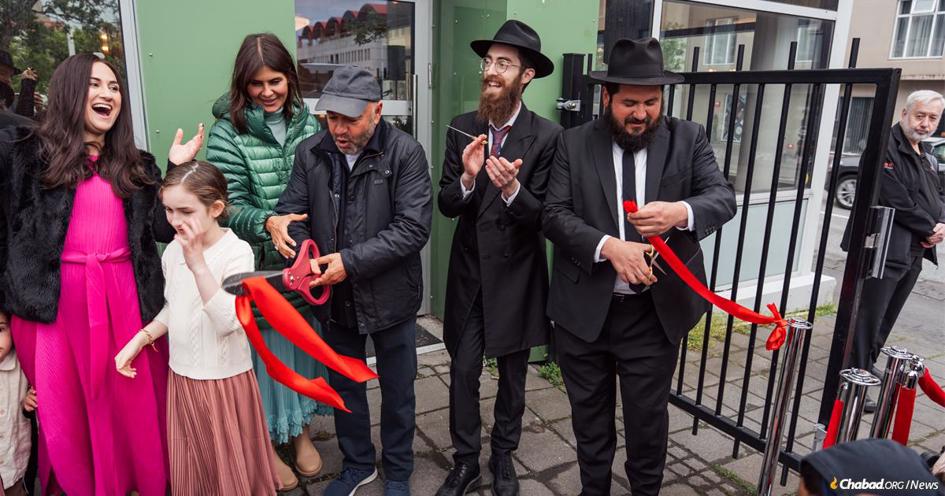
“We dreamed of this moment for years,” Rabbi Avraham Feldman told the crowd packed into the brand new center on July 7. “And now we are sitting in this dream that has become reality.”
The dream in question is the Beit Shvidler Jewish Center of Iceland, a 9,000-square-foot structure that opened that evening as the country’s first Jewish center and Jewish culture house. Three stories tall, its distinctive color and design makes the building a landmark and instantly recognizeable.
Jews have lived in Iceland for more than a century, but the community spent most of that time without a permanent rabbi or a synagogue of its own, an absence that set Reykjavik apart from every other capital in Europe.
That changed in 2018, when Rabbi Avraham and Mushky Feldman, moved to the city as Chabad-Lubavitch emissaries and opened Iceland’s first Jewish center. For the past eight years, the Jewish Community Iceland—Beit Tovah Chabad– the only active Jewish organization in the country– has been operating out of the Feldman’s home and temporary spaces. Until now.
Rabbi Avraham and Mushky Feldman. Israel Sudry
“The center is a home. It’s a place where you can walk through the door and feel comfortable,” Feldman said in his remarks. “Where you can simply be Jewish.”
Serving both Iceland’s local Jewish community and the Jewish travelers who pass through the country, the center will also have space for programming that the community’s previous, more limited quarters could not accommodate. It will house a Judaica and kosher store, as well as a stunning social hall for community events.
It is also designed to open outward: any Icelander curious about Jewish life can now walk in and encounter it directly. The center will host the Gallery of Jewish Life in Iceland, a new permanent exhibit that traces more than a hundred years of the island’s Jewish history through photographs and documents that, until now, had nowhere to be shown. Now, that history finally has a home.
“This is exactly the kind of place the Rebbe [Rabbi Menachem M. Schneerson, of righteous memory] envisioned when he spoke of ahavat yisrael, giving every Jew the chance to connect with and celebrate their Judaism.”
The distinctive 9,000-square-foot structure is the country’s first Jewish center and Jewish culture house. On top of hosting a Judaica and kosher store, as well as programming for the Jewish community, it will also host the Gallery of Jewish Life in Iceland, a new permanent exhibit inside the center that traces more than a hundred years of the island’s Jewish history. Israel Sudry
Jón Gnarr, Reykjavik’s former mayor and now a member of the Icelandic Parliament, used his remarks to talk about the country’s debts to its Jewish community, and the Jewish authors he has been influenced by. He described the new center as “a living bridge, connecting cultures, dispelling ignorance, and fostering dialogue and understanding.”
“Many Jews in Iceland have felt hesitant to say out loud that they’re Jewish,” Gnarr said. “That’s why education and dialogue are key.”
Acting U.S. Ambassador Joanie Simon, Rabbi Mendy Kotlarsky, community member Patrick Sulem and Mushky Feldman also addressed the gathering, while cantor Aryeh Leib Hurwitz brought the sound of traditional chazzanut into a room that had never held it before.
Patrick Sulem addresses the celebration.
The opening drew recognition from the highest levels of Icelandic government.
Prime Minister Kristrún Frostadóttir, a guest of Jewish community events in the past, sent a letter describing the center as “an important milestone for the Jewish community and for Icelandic society,” and expressed hope for “continued cooperation between the Jewish community and the Government of Iceland.” Þórunn Sveinbjarnardóttir, Speaker of Althingi (parliament), wrote separately to recognize the occasion.
The evening closed with thanks to the donors whose generosity built the center, among them Eugene Shvidler, whose vision, leadership and generosity helped propel the center from an idea into a building people could actually walk into and celebrate Jewish life, philanthropists Isaac and Tovah Cohen, George and Pamela Rohr, The Shmuel Isaac and Miriam Popack Foundation and Dovid and Rivka Feldman.
“Together,” Rabbi Feldman told the room, “we are writing the Icelandic chapter in the story of the Jewish people.”
 CrownHeights.info13 hours ago
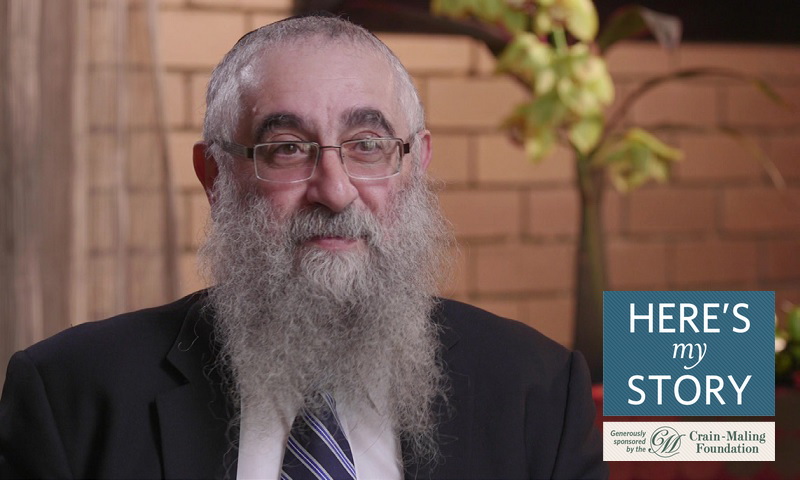
Mr. Avrohom Procel
Click here for a PDF version of this edition of Here’s My Story, or visit the My Encounter Blog.
I was born and raised in Melbourne, Australia, where my parents settled after World War Two. My father was a Holocaust survivor from Poland, while my mother emigrated from Egypt, which was then a British protectorate. Although both originally came from religious homes, they were not Torah observant, but they had strong Jewish identities.
In 1966, as my Bar Mitzvah drew near, they moved from West Preston, a predominantly non-Jewish suburb of Melbourne, to the more Jewish East St. Kilda. They did this just so that I could attend the Chabad school there and learn a little about Judaism. However, I took what I learned very seriously and, while this was not their intention, I ultimately became fully religious, as did the rest of my family.
After high school, I was accepted into the dentistry school at Melbourne University, but what I really wanted to do was study Torah at Chabad’s Yeshivah Gedolah. My parents were initially worried that I would squander a great opportunity for a higher education and a lucrative profession, but they agreed to a short deferment, and I got to learn Torah for one more year before going on to university. Incidentally, I never did become a dentist; instead, I became a fundraiser for the Yeshivah Gedolah. I like to joke that I do extractions of a different nature — pulling money out of people instead of teeth.
During the years that followed, I became a true Chabad chasid and I visited New York a number of times to see the Rebbe — I merited four private audiences with him between 1973 and 1980. But the story I’d like to relate here is what happened in 1983 while my wife, Gita, was pregnant with our second child.
Our first child, Yossi, had been delivered by C-section, what we call a Cesarean in Australia. Afterwards, the doctor told us that once you had a Cesarean, every subsequent delivery will have to be by Cesarean, which can only be done a maximum of four or five times.
Naturally, my wife and I were not happy about this news. We sought a second opinion from another obstetrician, who told us that this didn’t necessarily need to be the case. Natural delivery might be possible after all, depending on the circumstances.
When my wife became pregnant for the second time, the pregnancy proceeded normally. However, when she was ten days overdue, the doctor said that this situation could not continue. The baby was getting bigger, which meant that the chances of normal delivery were diminishing by the day. It was a Thursday, and he booked an operating room for a Cesarean on the following Tuesday.
That Thursday night, I called New York and spoke with the Rebbe’s secretary, Rabbi Binyomin Klein. I wanted him to ask the Rebbe two things — should my wife proceed with the Cesarean, and should I proceed with a tonsillectomy to remedy a recurring infection that was not responding to antibiotics.
The next day, Friday, I called Rabbi Klein again numerous times to see if there was an answer from the Rebbe. But the phone was constantly busy. I did not manage to get through until Sunday, when Rabbi Klein informed me that he had an answer from the Rebbe. The Rebbe gave us blessings but he had responded to my two questions in completely different ways. And as he often did, the Rebbe wrote in shorthand so Rabbi Klein needed to explain his words to me.
As far as the tonsillectomy, the Rebbe answered that we should act “according to the advice of the doctor.” As far as the Cesarean, the Rebbe answered, “meanwhile the Nine Days.”
We were about to start the “Nine Days” — the period of mourning for the destruction of Jerusalem which begins on the first day of the Hebrew month of Av, and which culminates on the ninth of Av — known as Tisha B’Av — the terrible date on the Jewish calendar when both the First Temple and Second Temple were destroyed by invaders. Rabbi Klein explained that the Rebbe meant that the “Nine Days” are not a good time for operations, so we should wait until they are over.
I called the doctor on Monday and informed him that I had consulted the Rebbe and he had advised to postpone the Cesarean. Both my wife and I agreed on this. Although we realized that we were putting both my wife’s life and our baby’s life on the line by listening to the Rebbe and not to the doctor, we trusted the Rebbe one hundred percent.
The doctor was very respectful of our decision, but he also said that if the baby goes into distress, it would not be possible to wait until after Tisha B’Av since, in any case, the birth was already almost three weeks overdue.
As it happened, our daughter, Rivki, was born totally naturally on the following Sunday, the seventh of Av, during the “Nine Days.” (In hindsight, I realized that the Rebbe’s words could also be understood as an allusion to this: There was no need for the Cesarean because the baby would be born meanwhile, during the “Nine Days”!)
Afterwards, the doctor said, “I want to tell you something which I didn’t tell you before. When your wife’s labor started last night, I was ninety percent sure we would be doing a Cesarean and I acted accordingly, but somehow things turned around overnight.”
The anesthetist told us something similar. He said our doctor had booked him in for the Cesarean, and then he was amazed to hear that the Cesarean had been canceled. He had never had anything like that happen before.
A few days later, I went to the hospital for my tonsillectomy.
Rivki grew up happy and healthy and is now a Rebbetzin, serving the community of Central Shule Chabad of Melbourne, alongside her husband, Rabbi Shmuel Karnowsky. As for my wife, in the years that followed — thanks to the Rebbe’s blessing — she delivered eight more children, all of them naturally.
Mr. Avrohom Procel serves as executive director of the Rabbinical College of Australia and New Zealand (Yeshivah Gedolah – Melbourne). He was interviewed in July 2016.
 CrownHeights.info14 hours ago
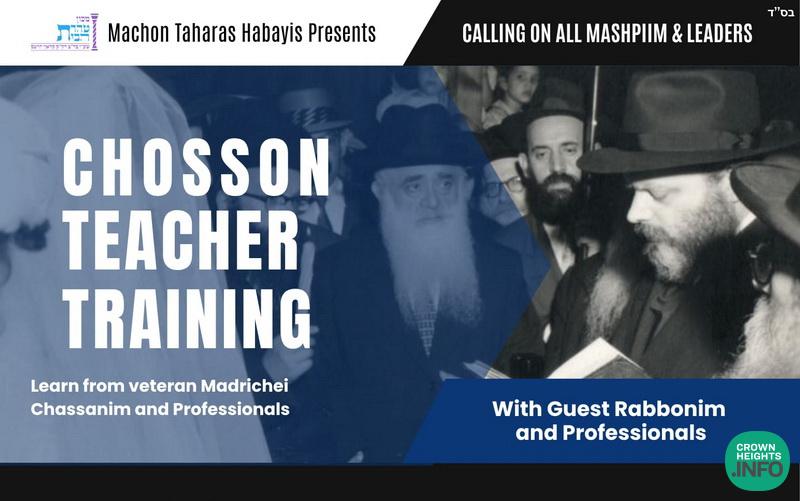
The final call has arrived. Registration is now closing for the newest Taharas Habayis Chosson Teacher Training Cohort, and this is the last opportunity for Rabbonim, mashpi’im, and qualified yungerleit to join this unique program dedicated to preparing the next generation of Chassidishe chosson teachers.
With communities around the world experiencing a growing need for knowledgeable and well-trained madrichei chassanim, the Taharas Habayis program has become a trusted address for comprehensive, practical, and halachically rigorous training. Participants receive in-depth instruction from leading Rabbonim and experienced educators, equipping them to guide chassanim with clarity, sensitivity, and confidence.
The program was launched with words of inspiration and guidance from Rabbi Sholom Ber Chaikin , senior Chabad Rav and veteran chosson teacher of Cleveland, who emphasized the tremendous responsibility and privilege of helping establish Jewish homes built on the foundations of Torah, halacha, and kedusha. Throughout the course, participants benefit from practical insight, real-life guidance, and a structured curriculum designed specifically for today’s needs.
The initiative has also received the strong endorsement of Rabbi Yosef Yeshaya Braun , Mara D’Asra of Crown Heights and member of the Badatz, who praised the importance of properly training those entrusted with teaching these vital halachos.
Applications are now in their final hours. Those who have been considering becoming a certified chosson teacher are encouraged not to delay. Once registration closes, the next opportunity may not be available for some time.
To reserve your place in this cohort and take part in this important mission of strengthening Yiddishe homes, register now as enrollment is about to close! TaharasHabayis.org/apply
 CrownHeights.info15 hours ago
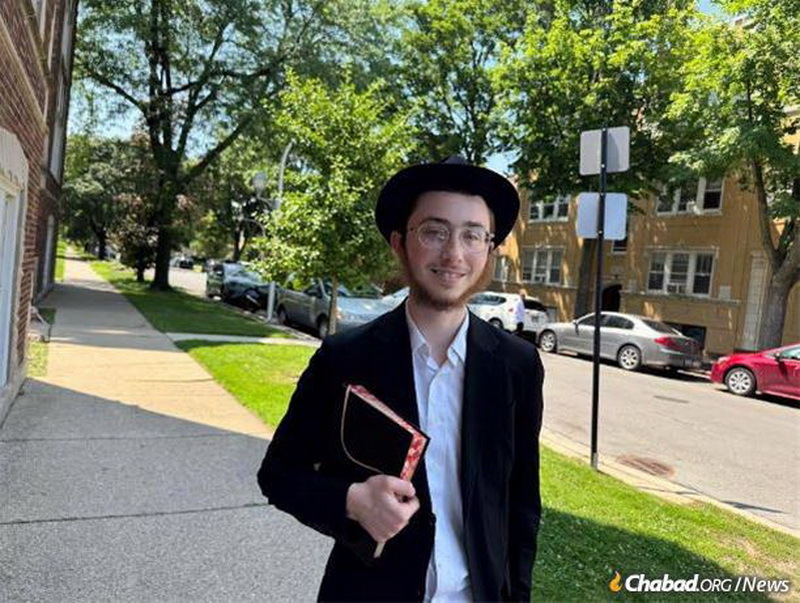
Yossi Cadaner, 17, grew up amid the peaceful cornfields of flyover country.
Heaven? No, Iowa—Bettendorf to be exact. Located on the Iowa-Illinois border, Bettendorf is smack dab between Chicago to the east and Postville to the west.
But Iowa is also famously the place where dreams come true. And for Yossi that meant studying all 2,711 pages of the Babylonian Talmud, a feat he completed this week in at the Chicago Mesivta, where he is currently a student.
His parents, Rabbi Shneur and Chana Cadaner, established Chabad-Lubavitch of Quad Cities in 2005 to serve the small pockets of Jews sprinkled across Davenport and Bettendorf west of the Mississippi, and Rock Island, Moline, and East Moline on the eastern side.
Like many smaller communities in the Midwest, a century ago the area was home to a thriving Jewish community with as many as eight Orthodox synagogues. There were Torah scholars, Chassidim, kosher butchers and every other amenity needed for Jewish life. Everything, that is, aside from a Jewish day school. That historic lack of Jewish education meant that by the time the Cadaners arrived, things had dwindled to the point that there were just two congregations, one Conservative and one Reform.
Despite there being only an estimated 1,000 Jewish souls between all five cities, the Cadaners have made it a point to provide a full Jewish experience with services on Shabbat and Sunday, a just-completed mikvah, programs for men and for women, Torah classes and a Hebrew school.
As a boy in Bettendorf, Yossi was drawn to study and committed the entire Tanya—spanning 53 chapters—to memory shortly after his bar mitzvah. Growing up with virtually no observant peers, Yossi excelled at his Judaic studies at the Nigri Shluchim Online School, where he developed the base for his Talmudic pursuits.
In a world full of distractions that too often capture the attention of young minds, the Cadaners work hard to ensure the computers and other devices in their home are used only as educational tools. This helped Yossi develop his discipline, focus and love for learning. That’s not to say he isn’t a regular teenage boy with different hobbies and interests. Yossi loves sports and music, among other things, but a healthy approach to technology helped shape him.
For eighth grade, he left home for Chicago, about a three-hour drive away, where he was finally in a brick-and-mortar school. Ready and motivated to be learning in person with yeshivah students his own age, Yossi enjoyed the transition. It was as an eighth-grader that he began learning Talmud voraciously.
Yossi Cadaner speaks at the celebration honoring his acomplishment of studying all 2,711 pages of the Babylonian Talmud.
And, as they might say in Iowa, if you build it….
“Whenever Yossi comes home, he sits and learns Talmud,” attests Rabbi Cadaner, “sometimes three or four hours in a row. There are not many people to learn with here, so he’s often learning by himself.”
For the past three years, Yossi has been a student at Yeshivas Ohr Eliyahu-Lubavitch Mesivta of Chicago. And now just weeks from graduating high school, his classmates joined him for a grand celebration: the completion of all 2,711 double-sided pages that make up the Babylonian Talmud.
“I had no idea that Yossi was even planning to finish the Talmud,” says Rabbi Cadaner. “It was his classmates who let me know that the milestone was approaching and his teacher who suggested that we come to Chicago to celebrate the accomplishment at a grand event.”
And a grand event it was. In addition to his parents and younger siblings, Yossi was also joined by his grandfather, Rabbi Shlomo Bendet, an educator from St. Paul, Minn., as well as Mesivta staff.
Yossi’s siyum was the fifth such accomplishment celebrated at the Mesivta in recent years, a testament to the school’s efforts to nurture and guide each student to maximize his potential. Yet, Mestiva staff work hard to make each siyum unique, as befitting the herculean accomplishment they celebrate.
The Rebbe, Rabbi Menachem M. Schneerson, of righteous memory, would often call for increased Torah study and continual growth in learning. In a pastoral letter addressed to the Jewish community at the conclusion of the High Holiday season in 1984, the Rebbe addressed perceived individual boundaries in Torah study. The Rebbe encouraged all Jewish men and women to systematically add new, challenging periods of study:
“…a suggestion and urgent appeal to all of you, men and women… To take upon yourselves… new (additional) shiurim (regular study periods) in Torah, each one on his/her level; especially those who do not yet have any regular Torah study periods…As for those who, seemingly, have a full schedule of Torah shiurim, surely they will wish to fulfill the rule of ma’alin b’Kodesh (matters of holiness should be on the ascendancy), which (also) implies ascendancy to an ever higher level in the quality of Torah comprehension, in greater depth and with greater enthusiasm, vitality and joy.
“We are all interconnected,” explains Yossi. “When one person pushes himself to do a bit more than he would have otherwise, others will do the same, and they will then have an effect on even more people, ultimately raising the bar for the entire Jewish people. Every person can achieve and every person can influence others in his or her own way.”
 CrownHeights.info15 hours ago
Residents of Crown Heights and the surrounding Brooklyn Community District 9 have an opportunity to play a more active role in shaping the future of our neighborhood. Brooklyn Community Board 9 is now accepting applications for Committee Resident Members, with applications due Wednesday, July 22, 2026, at 12:00 PM.
Committee Resident Members serve alongside Community Board members on committees that address many of the issues affecting daily life in our neighborhood, including housing, transportation, public safety, parks, economic development, environmental protection, youth services, health, education, and land use. Committee meetings are open to the public, and Resident Members are appointed to participate in the committee’s work and, under CB9’s bylaws, are voting members within their assigned committee.
This is an excellent opportunity for community-minded residents to ensure that the voices and concerns of the Crown Heights Jewish community are represented when important neighborhood issues are discussed. Committee recommendations often help shape the Community Board’s positions on local developments, city services, transportation projects, public safety concerns, and other matters that directly impact residents. While Resident Members do not vote at full Community Board meetings, their participation at the committee level plays an important role in developing recommendations and informing Board decisions.
Applicants will be asked to rank their first, second, and third committee preferences. Placement is based on committee needs, and applicants may not receive their first choice. Because committee members count toward quorum, those appointed are expected to attend meetings regularly. Committee Chairs may remove members for unsatisfactory attendance, though Resident Members are welcome to attend meetings of any committee as observers.
Community Board 9 encourages residents from across the district to get involved and help strengthen the community through civic engagement.
Application Deadline: Wednesday, July 22, 2026, at 12:00 PM
Resident Member Application: https://forms.gle/njibcExmwnkN3sds6
 CrownHeights.info16 hours ago
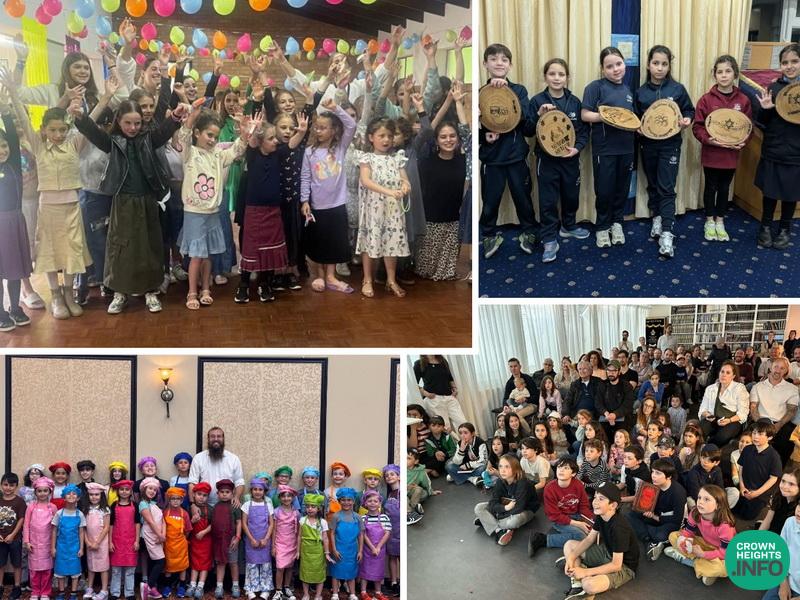
Across 30+ cities worldwide, CKids Afterschool programs offer over 1,500 Jewish public school children a daily home for Torah learning and Jewish pride.
Every day after school, in cities and towns across the world, children walk through the doors of a CKids Afterschool program and into a space built for one purpose: to make Torah learning and Yiddishkeit part of their everyday lives.
For many of these children, this is their primary connection to Jewish life. Their days are spent in public school, typically with little exposure to their heritage. But each afternoon, they step into a structured environment away from the noise of the world, where they have an opportunity to learn about Judaism, build friendships with Jewish peers, and develop pride in who they are.
“In today’s world, every Jewish child must have access to a robust Jewish education,” says Rabbi Mendy Kotlarsky, Executive Director of Merkos 302 and Chairman of CKids International. “There’s no substitute for daily exposure to Yiddishkeit, daily reinforcement of their identity, and connection to Hashem.”
In an effort to bring that vision to life, Rabbi Moshe Kotlarsky OBM stood at the Kinus HaShluchos two years ago and announced a bold goal: to establish 100 CKids Afterschool programs, where children would learn Torah and live their Yiddishkeit four days a week instead of just at Hebrew School once a week. It was Rabbi Moshe Kotlasky’s last Kinus address ever. “And in just two years,” shares Rabbi Mendy Kotlarsky, “boruch Hashem, we’re nearly a third of the way to that original goal.”
What began as a pilot program has quickly grown into a network serving more than 1,500 children in over 30 CKids Afterschool programs worldwide, with over a million dollars invested to date. From New York to Stockholm, from Johannesburg to Vancouver, children are taking time after regular school hours to bolster their Yiddishkeit. They’re learning Torah, doing mitzvos, and growing up proud to be Jewish, all week long.
Mrs. Chaya Rosenfeld of Chabad of Vancouver, British Columbia, recalled how a student from the local public school joined the afterschool program and became close friends with her daughters.
Soon, the girl was joining the family for Shabbos meals and participating in bas mitzvah classes. As she grew more connected to Jewish life, her parents also began building relationships within the community.
“What started as an afterschool activity became something much bigger,” Mrs. Rosenfeld said. “The friendship helped an entire family feel at home in Jewish life.”
Similar stories are unfolding in communities around the world. Now, six shluchim have been selected as new recipients of the CKids Afterschool Program Grant, joining the growing network of communities creating new opportunities for Jewish learning and connection.
As the Jewish community marks the 50th anniversary of the Rebbe’s landmark Mivtza Chinuch initiative, expanding access to Torah learning and engagement has never felt more urgent. The Rebbe consistently championed the need to elevate the prestige of Jewish education.
“No more once-a-week Judaism,” says Rabbi Zalman Loewenthal, Director of CKids and Associate Director of the Chinuch Office of Merkos L’Inyonei Chinuch. “A child learning secular studies every day needs to know that Judaism doesn’t live in the shadow of secular education.”
“For young couples looking for their makom hashlichus, afterschool is the new frontier,” says Loewenthal. “It’s a full-fledged shlichus opportunity in hundreds of Chabad houses around the world.”
The new CKids Afterschool grant recipients include:
 CrownHeights.info1 day ago
A talmid hashliach’s year is a busy one. He learns and farbrengs with the bochurim late into the night, runs programs and mivtzoim, and becomes the older brother a younger talmid turns to. Between it all, his own seder and growth are often the first to slip. Yeshiva L’Talmidim Hashluchim was created to change that, turning the year of shlichus into a transformative year of structured learning and growth.
That goal is not new. When the Rebbe began sending talmidim hashluchim, he was emphatic that they were going first and foremost as talmidim. In a letter from 5731, the Rebbe wrote that their purpose was to learn b’shkida v’hasmada and to serve as a living example to the bochurim around them.
The Rebbe guarded that learning closely. When the first group of talmidim hashluchim reached Australia in 5727 and a shliach proposed they give a weekly baalei batim shiur, the Rebbe refused in his own handwriting, permitting it only if it would not cut into their seder at all. Their own time to learn came first.
This Elul, Yeshiva L’Talmidim Hashluchim opens to give that principle a real structure. A new program from Merkos 302’s Merkos Torah, offers talmidim hashluchim a framework of serious learning, mentorship, and accountability across Gemara, Halacha, and Chassidus, so the year they give to others becomes a year of their own growth.
“The Rebbe sent talmidim hashluchim to be a role model, and a bochur learns the most from an older bochur who is himself invested in his own sedarim,” said Rabbi Mendy Kotlarsky, Executive Director of Merkos 302. “The yeshiva ensures that while these shluchim are giving everything to the bochurim around them, their own learning gets the same attention.”
The program grew out of conversations with yeshiva hanhalos, mashpiim, and talmidim hashluchim themselves, who kept naming the same gap: the shlichus year offers enormous opportunity, but few have a structured, measurable way to keep their own learning on track.
“We’ve put together a top-tier hanhala and built out a full curriculum across Gemara, Halacha, and Chassidus, with mentors who follow each talmid through the year,” said Rabbi Mendel Chaiton, director of Merkos Torah. “Everything is in place for these young men to have a serious, successful year of their own growth.”
Rather than imposing one model, Yeshiva L’Talmidim Hashluchim works in partnership with each yeshiva’s hanhalah, shaping the tracks and benchmarks together so the program fits the institution’s chinuch. Every participant starts with a personal intake interview that sets his goals and places him in the right track, then receives weekly follow-up, monthly progress reviews, and ongoing mentorship through the year.
The learning runs on three tracks. Gemara L’Iyun preserves serious iyun at a foundational or advanced level, with Rabbi Dov Popack and Rabbi Moshe Wolberg leading the shiurim and a weekly lomdus shiur from Rabbi Mendel Krasnjanski. The Halacha track takes participants through Hilchos Shabbos b’iyun, tracing each halacha from Gemara through Tur, Beis Yosef, and Shulchan Aruch to practical application, as the first stage of a longer semicha curriculum. Chassidus b’iyun anchors the week with structured study of foundational Chassidishe sugyos, shiurim, and farbrengens.
The program draws on a roster of well-respected mashpiim and rabbonim: Rabbi Yosef Klyne, Rabbi Osher Farkash, and Rabbi Yitzchok Kaufman in Chassidus**;** Rabbi Chaim Hillel Raskin, Rabbi Tuvia Kasimov, Rabbi Ehud Kvin, and Rabbi Berel Polityko in Halacha**;** with Rabbi Mendel Prescott on halacha from the sugya, alongside guest mashpiim and maggidei shiur.
For the rabbonim building it, the need is clear from both sides. Rabbi Shmuel Wagner, recently appointed Rosh Mesivta of the new Tomchei Temimim mesivta at Lubavitcher Yeshiva Ocean Parkway, helped develop the program and sits on its hanhala.
“As a mechanech, I see what a talmid hashliach gives our bochurim, and I see how much he can gain himself if someone helps him use the time right,” said Rabbi Wagner. “Building this means the talmidim hashluchim finish the year stronger in their own learning, not just busier.”
Through the year, each participant’s progress is shared with his yeshiva. A report also goes to the Rebbe, summing up the talmid’s learning and growth, framing the year’s work as something brought back to the one who first sent talmidim hashluchim out.
Registration is open now and closes Rosh Chodesh Elul. Talmidim and yeshivos can sign up or learn more at Yeshivath.com, or text 773-971-1342.
Download the Yeshiva brochure [HERE
](https://drive.google.com/file/d/1lVHTmlMG3eX1JJF3ScpADLBFin_ud1YF/view?usp=drive_link)—-
**Hanhala & Faculty:
Program Leadership:**
Gemara L’Iyun:
Halacha:
Chassidus B’Iyun:
Yeshiva L’Talmidim Hashluchim is a program of Merkos Torah from Merkos 302, in partnership with Igud Hamesivtos V’Yeshivos Lubavitch.
 CrownHeights.info1 day ago
A Brooklyn man is accused of hiding his dead roommate’s body beneath a pile of clothes and garbage on a couch in their apartment, authorities said.
Jose Rivera, 53, was arrested for allegedly concealing the man’s body in their residence at 1722 Union St. in Crown Heights at around 7:50 a.m. on July 2, according to the criminal complaint.
A cleaning crew member found the bones buried under clothes and debris on the living room couch and called 911, prosecutors and sources said.
Read More at Pix11
 CrownHeights.info1 day ago
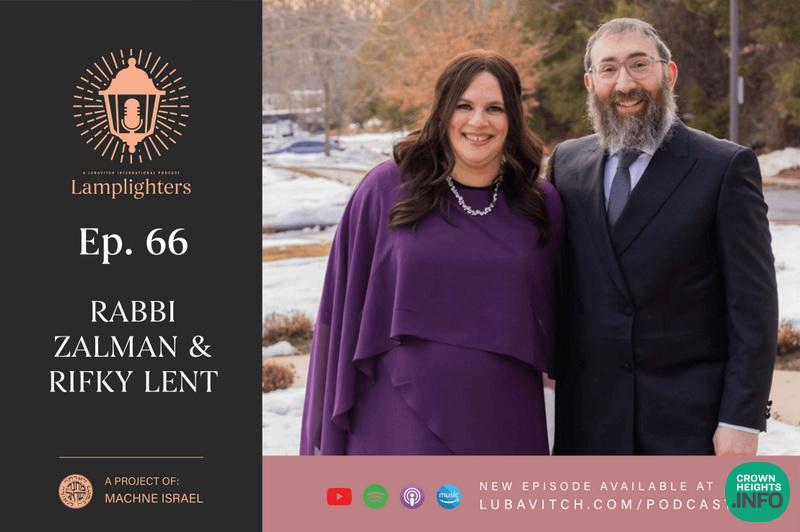
In Episode 66 of Lamplighters: Stories From Chabad Emissaries On The Jewish Frontier, reporter/producer Gary Waleik presents the story of Rabbi Zalman and Rebbetzin Rifky Lent, Chabad emissaries to Dublin, Ireland. The Lents’ Chabad House is a nexus point for Dublin’s diverse Jewish community and, with the help of their kosher deli and market, also a very popular meeting place for non-Jews.
Lamplighters: Stories From Chabad Emissaries On The Jewish Frontier is producing a series of moving, beautifully produced, sound-rich and often surprising stories of Chabad shluchim and the people they inspire in every corner of the world.
Listen and subscribe at www.Lubavitch.com/podcast and on all major podcast platforms.
To pitch a story for our podcast about Chabad emissaries or for dedication/sponsorship opportunities, email us at [email protected].
 CrownHeights.info1 day ago
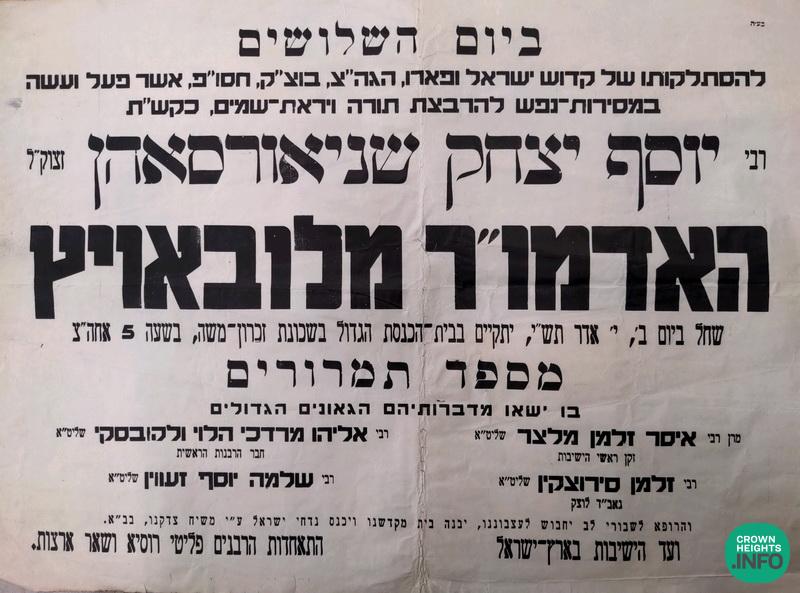
This eulogy took place on the 10th of Adar, 1950 for the Rebbe Raayatz. It took place at the large shul in the Zichron Moshe neighborhood. The people speaking were Rabbis Isser Zalman Meltzer, Zalman Sorotzkin, Eliyahu Vilkovsky and Shlomo Yosef Zevin. It mentions the Mesiras nefesh the Rebbe had for Torah.
It’s most interesting that Rabbi Meltzer was one of them, given his son-in-law, Rabbi Aron Kotler had issues with the Rebbe. Obviously, the truth is the truth and the personal issues between them had no place in memorializing the Rebbe by a leading Litvish figure-head.
Credit: Rabbi Yitzchak Stroh, Dalfin Archives, and Library of Agudas Chasidei Chabad
 CrownHeights.info1 day ago
During these days of summer vacation, thousands of children from all corners of the Russian Federation are gathering at Jewish camps in dozens of different locations. They are enjoying weeks of Yiddishkeit at all levels and for all ages, operated by the dedicated and experienced hands of hundreds of rabbis and Shluchim, featuring highly organized and deeply invested programs.
The vanguard of Russian Jewry is represented by hundreds of young Shluchim and children of community rabbis. These children grow up throughout the year in remote cities, often serving as the only observant Jewish children in their environment. The summer months are not just a break from their regular studies; they are a time for Chassidic gatherings, social bonding, and spiritual recharging ahead of the coming year of Shlichus.
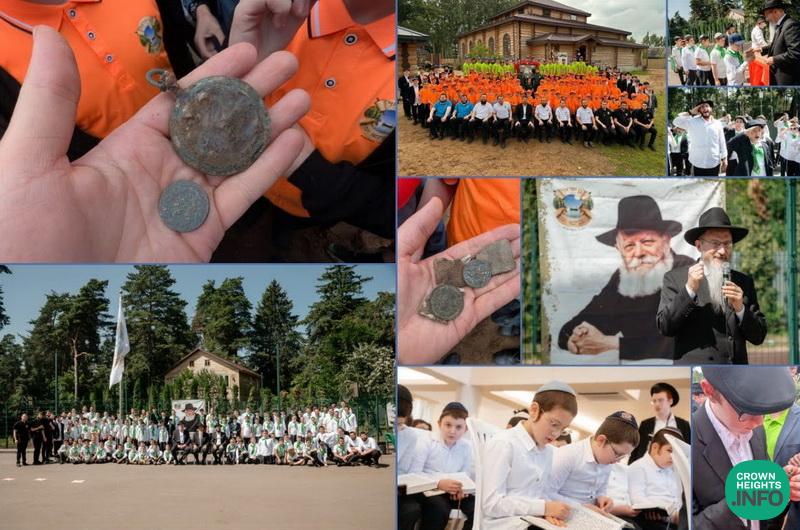
At the center of this educational endeavor once again stands the “Camp Gan Israel – Tzeirei Hashluchim,” located in the pastoral ‘Ramenskoye’ complex in the suburbs of Moscow. The camp, expertly directed by the educator Rabbi Avraham Zaks, experienced a moment of historical closure this week. This occurred during a visit by the founder of the camps, Chief Rabbi of Russia, Rabbi Berl Lazar, to the camp grounds. During the visit, Rabbi Lipsker, director of educational institutions in Moscow, presented him with a unique gift that embodies the concept of “Zeh L’Umas Zeh” (one in contrast to the other). Chief Rabbi Lazar received an original, century-old red “Pioneer” tie, which was used in the summer camps of the communist regime that attempted to uproot religion. Alongside it was a new green tie bearing the emblem of the Chassidic camp—a living testament to the victory of the Jewish spirit and tradition.
In his remarks to the campers, Chief Rabbi Lazar said that alongside their responsibilities, they must remember the immense privilege each one holds, especially as they are on Shlichus in Russia. He thanked the educational staff, adding: “The greatest success in Shlichus is when people see how we care for our children.”
The spiritual climax of the camp days was recorded when the “soldiers” set out on an emotional journey to the cradle of Chassidus: the town of Lubavitch. Following prayers and a spiritual awakening at the holy Ohel of the “Tzemach Tzedek” and his son, the Rebbe Maharash, they continued with a tour of the historical sites in the area. The campers joined a special initiative of archaeological excavation and exposure works taking place in the courtyard of our Rebbes—the very courtyard where the first “Tomchei Temimim” Yeshiva was established and founded, and the complex where several generations of Lubavitcher Rebbes lived for many years. During these works, a literal treasure from the past was suddenly uncovered: a luxurious and incredibly rare pocket watch, alongside ancient ruble coins that had been buried in the ground for decades.
The discovery sparked tremendous excitement among the children and staff, who immediately broke into sweeping Chassidic dances on the holy soil of the famous Yeshiva courtyard in the center of the town. The rare findings were reverently transferred to the hands of Rabbi Gavriel Gordon, the Shliach and director of the Chabad House in Lubavitch, who is responsible for the restoration and maintenance of the holy sites. After an initial examination of the items, Rabbi Gordon noted that the finish and luxury of the watch indicate with high probability that it belonged to a family member of the Rebbes, a fact that further elevated the spiritual upliftment among those present.
As mentioned, this camp is one of many. Particularly noteworthy is the framework for the daughters of the rabbis and Shluchim, running concurrently in the city of Nizhny Novgorod, dedicatedly directed by Rebbetzin Fradi Lerman, with the assistance of the city’s rabbi, the Shliach Rabbi Shimon Bergman, and Rebbetzin Bergman.
These events, which combine deep-rooted Chassidic education with a tangible connection to a glorious history, are expected to leave an indelible mark on the campers’ hearts. As the children return to their places of Shlichus across Russia for the upcoming school year, they will, with God’s help, carry with them the immense spiritual charge they absorbed. They will continue to illuminate their communities with Jewish pride and the dedication that characterizes the legion of the Lubavitcher Rebbe. Exactly 70 years ago during these very days, the Rebbe arrived for a rare tour of the first camp, which was founded at the initiative of the Chassid Rabbi Moshe Lazar, father of the Chief Rabbi of Russia. Since then, the name “Gan Israel” was established by the Rebbe, named after the founder of Chassidism, the holy Baal Shem Tov; a project that today spans the entire globe, educating hundreds of thousands of Jewish children during the summer months.
Photography: Levi Nazarov
 CrownHeights.info1 day ago
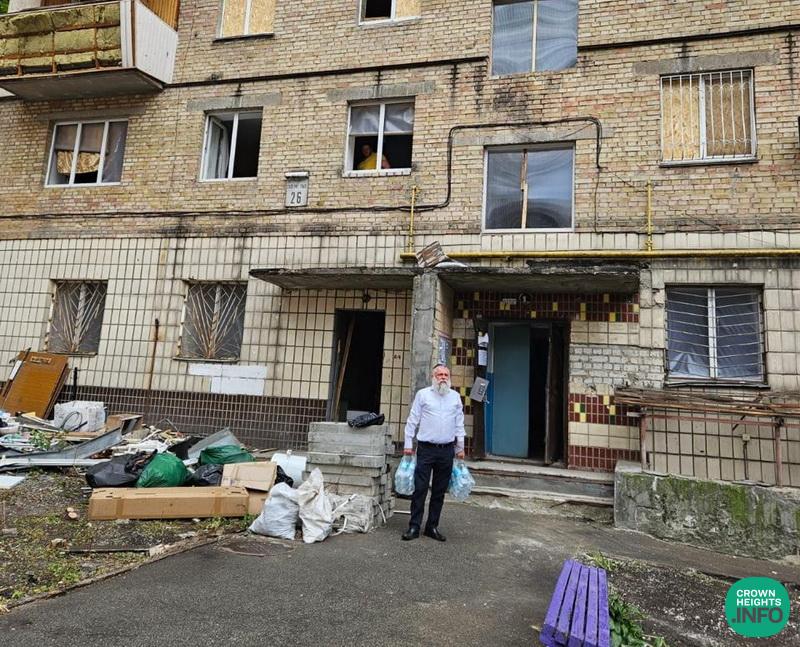
As relentless missile and drone attacks batter Ukraine’s capital, leaving dozens dead and thousands in distress, Kyiv’s Jewish community has mobilized an extensive humanitarian operation. Led by Chief Rabbi Yonatan Markovitch, volunteers are distributing food, water, clothing and essential supplies to Jews and non-Jews alike who have been affected by the bombardments.
Kyiv, Ukraine’s capital, has endured one of its most devastating waves of bombardment since the outbreak of the war. In recent days, large-scale missile and drone attacks have struck residential neighborhoods and civilian infrastructure, claiming dozens of lives and leaving many more wounded.
The scale of the destruction prompted city authorities to declare an official day of mourning, while rescue teams continue searching through the rubble for survivors and victims.
Alongside the emergency services, JCC Beit Menachem Kyiv community has mobilized to provide assistance to those affected. Under the leadership of Kyiv’s Chief Rabbi and Chabad shaliach, Rabbi Yonatan Markovitch, community volunteers have launched a broad humanitarian relief effort to aid residents whose lives have been upended by the attacks.
Over the past several days, volunteers have been distributing food, bottled water, clothing, medications, essential supplies and other basic necessities to families whose homes were damaged, as well as to the elderly, the needy and anyone requiring immediate assistance, regardless of their religion. In addition to providing material aid, volunteers are offering practical support and guidance to families left without help in the wake of the devastation.
“At a time when the air raid sirens scarcely stop, our responsibility is to be here for every person in need,” Rabbi Markovitch said. “We are distributing food, water, and essential supplies, strengthening families and giving them hope. Our mission is to bring light precisely during these darkest moments for the people of Ukraine in general, and for the residents of Kyiv in particular.”
 CrownHeights.info1 day ago
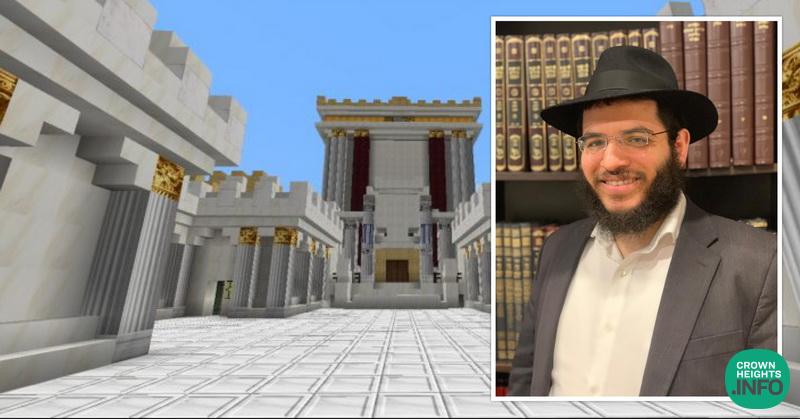
Today’s video goes through the Ezras Kohanim; from the Duchan to the Tzafon area near the Mizbeach, from the rings used to Shecht the Korbanos to the tables used to rinse the meat. You will also see the size of the Ezras Kohanim relative to the area around 770.
Thursday’s raffle winners are:
$50 Judaica World gift card – David
$36 Judaica World gift card – Yossi Baumgarten
Link to the quiz https://ispri.ng/VZ618
Link to join the WhatsApp group https://chat.whatsapp.com/JWKXQK4ucWN2w7ObrYCgUG
Today’s class & prizes are dedicated לעילוי נשמת ברוריה בת חנניה
To dedicate a class and the prizes for $186 please email: [email protected]
 CrownHeights.info1 day ago
Following the overwhelming success of An Evening of Bitachon, we are excited to announce Round Two, taking place this Sunday at 6:45 PM.
The first Bitachon Summit, held on Sunday, 9 Iyar 5786, brought together women from around the world for an evening of inspiration, practical guidance, and heartfelt encouragement. Dedicated to the memory of Rabbi Mendel Plotkin, Shneur Zalman Plotkin, and Rabbi YY Wilansky, the program was also dedicated to all those seeking their bashert, with the heartfelt tefillah that we should soon celebrate many simchos together.
The evening featured a unique lineup of speakers, each addressing a different area of bitachon that women encounter in everyday life. Topics included developing overall trust in Hashem, bitachon in matters of parnassah, navigating the loss of a loved one, shidduchim, raising a large family, facing life’s hardships, and coping with health challenges. By bringing together diverse voices and real-life experiences, participants were able to see how bitachon applies to every stage and circumstance of life.
Baruch Hashem, the response exceeded expectations. There were over 150 participants throughout the program. Since then, the replay has continued reaching even more people, with nearly 200 replay views to date. Most meaningful of all has been the steady stream of positive feedback from participants, many of whom shared how the program strengthened their perspective and inspired them to deepen their own bitachon.
Because of the enthusiastic response and numerous requests for another event, we are thrilled to present Round Two!
Join us this Sunday at 6:45 PM for another evening of meaningful talks, practical inspiration, and powerful messages from a new lineup of speakers, each sharing how bitachon can guide us through the challenges and opportunities of everyday life.
Register today: bit.ly/bitachon2
We look forward to welcoming you.
 CrownHeights.info1 day ago
President Trump said Wednesday that he believes his memorandum of understanding with Iran is dead after he ordered overnight airstrikes on 80 targets in response to Iranian attacks on commercial ships in the Strait of Hormuz.
“I don’t like them at all. And frankly, I think we wasted a lot of time with them, I think we should just do our business,” Trump said in his first public remarks after ordering the airstrikes.
When asked by a reporter if the preliminary peace deal, which Trump signed at the Palace of Versailles in France June 17, was dead, the president replied: “To me, I think it’s over. I don’t want to deal with them anymore. They’re scum.”
 CrownHeights.info1 day ago
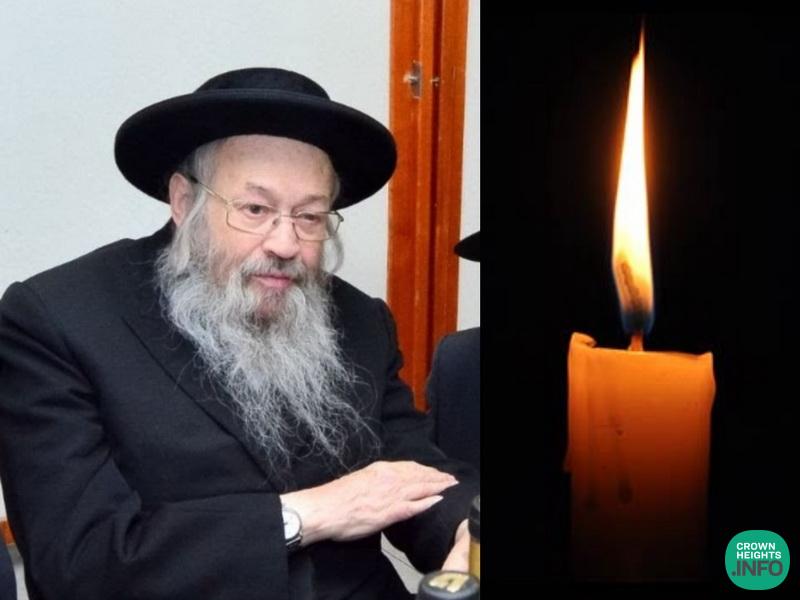
With deep sadness we report the passing of Harav Tuvia Blou OBM, one of the elder Rabbonim and Mashpiim of Chabad-Lubavitch in Eretz Yisroel and Rov of the Chabad community in Neve Yaakov. He passed away on Wednesday, the 23rd of Tammuz, 5786.
He was 90 years old.
Harav Blau was among the founders of Talmud Torah Toras Emes and Bais Chana High School for girls in Yerushalayim.
Compounding the sadness, he passed away during the shloshim for his wife, Rebbetzin Chana Frumit Blou OBM, who passed away on 2 Tammuz.
The levaya will take place today, Wednesday, the 23rd Tammuz, departing at 2:00 pm from the Shamgar Funeral Home in Yerushalayim. The procession will continue to the Chabad section of Har HaZeisim, where he will be laid to rest.
The family will be sitting shiva at the Blou home at 43/9 Harav Zevin Street, Neve Yaakov, Yerushalayim.
Boruch Dayan Hoemes
 CrownHeights.info1 day ago
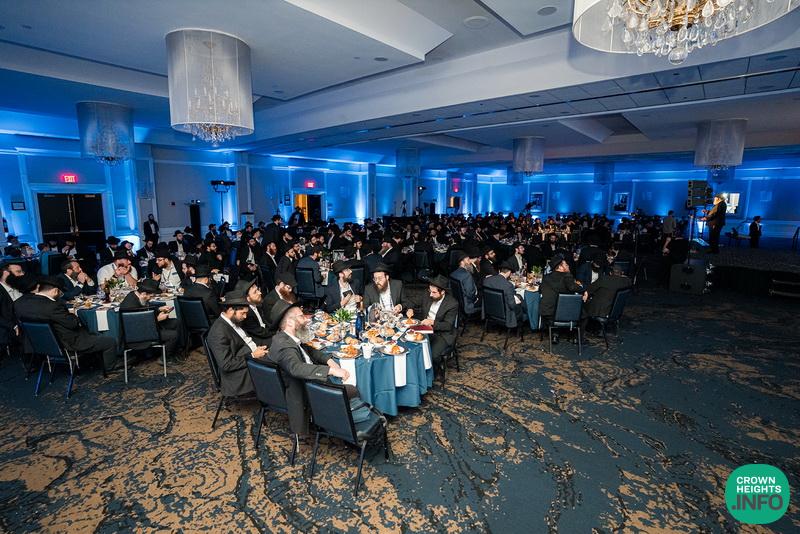
Rabbi Benjy Korf, Head of School of Lubavitch Educational Center in Miami, Florida, has been announced as the keynote speaker at the banquet of this year’s Kinus HaMechanchim.
The Annual International Kinus HaMechanchim will take place on July 28–29 / י״ד–ט״ו מנחם אב at the Armon Hotel in Stamford, Connecticut, bringing together mechanchim, principals, administrators, and school leaders from across the Chabad school network for two days of inspiration, professional development, and connection.
This year’s banquet will focus on the theme: “פרומע, ערליכע, ווארימע, חסידישע אידן — Focused on the עיקר.”
Rabbi Korf will address the central mission of Chinuch: raising students to be frum, ehrlich, warm, and Chassidishe Yidden. Drawing on his years of experience leading one of the largest Chabad schools in the country, he will speak to the heart of the mechanech’s shlichus and the responsibility of staying focused on the עיקר in today’s classroom.
“Rabbi Benjy Korf brings decades of hands-on dedication to Chinuch, focused on what matters most: raising children to be frum, ehrlich, warm, and Chassidishe Yidden,” said Rabbi Mendy Kotlarsky, General Chairman of Merkos Chinuch Office. “His message at the Kinus banquet will speak to every mechanech’s shlichus — staying focused on the עיקר and giving talmidim a strong foundation for life.”
The banquet is expected to be one of the highlights of the Kinus, bringing together hundreds of mechanchim for an evening dedicated to strengthening and celebrating the vital work of Chinuch.
Following the banquet, a special farbrengen will be led by Rabbi Yossi Paltiel, giving mechanchim the opportunity to continue the inspiration of the evening in a warm and uplifting atmosphere, with niggunim, stories, and meaningful reflections that will help carry the message of the Kinus into their daily avodah in Chinuch.
The Kinus will feature a full program of sessions, tracks, workshops, and networking opportunities designed for mechanchim, principals, administrators, and school leaders.
Stay tuned for exciting new tracks focused on AI and curriculum development.
Registration is still open.
Register now at: kinus.chinuchoffice.org
CrownHeights.info2 days agoToday’s video goes through the Ezras Yisroel; from the Lishka of the Kohen Gadol to the Lishka of the great Sanhedrin, and from the Lishka where the stored the salt to the one where the salted the leather and the one where they would draw water from.
You will also see the size of the Ezras Yisroel relative to the area around 770.
Yesterday’s raffle winners are:
$50 gift card – Yitzchok Isaac Heidingsfeld
$36 gift card – Esther
Link to the quiz https://ispri.ng/yMnv0
Link to join the WhatsApp group: https://chat.whatsapp.com/GVaB819H9hPFwL6c4DEGeg?mode=ac_t
To dedicate a class and the prizes for $186 please email: [email protected]
 CrownHeights.info2 days ago
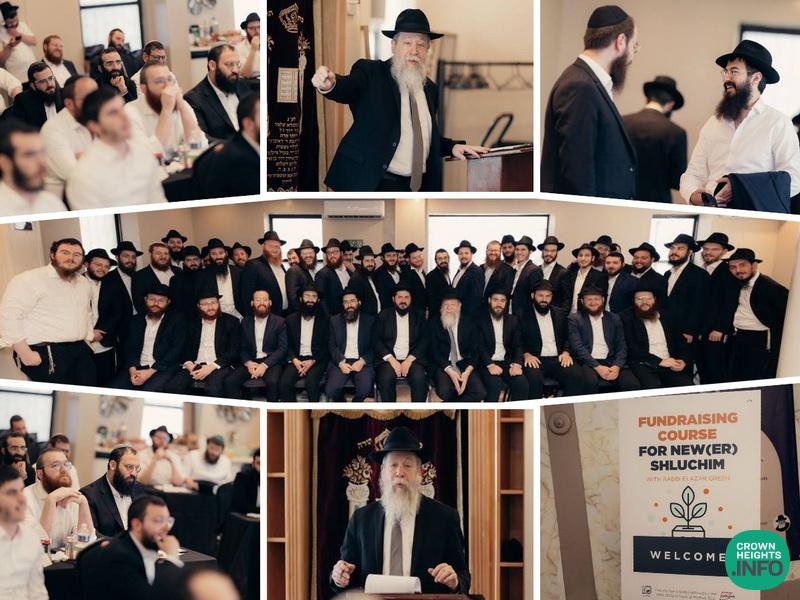
Forty-three newer Shluchim gathered in Crown Heights earlier this month for Merkos 302’s seventh annual Fundraising Seminar, walking away with a new mindset, a practical toolkit, and a network of peers to carry them through the years ahead.
The event was organized by the New Shluchim Desk at Merkos 302 and spearheaded by Rabbi Mendy Shanowitz, the Desk’s director. “Fundraising is the engine that powers a Shlichus,” he said. “We send them home with the mindset, the tools, and a network of peers to lean on from day one.”
The full-day masterclass is geared for Shluchim within their first seven years on Shlichus and was led by Rabbi Elazar Green, Shliach to Lancaster, Pennsylvania, and founder of Grow Gelt Solutions.
Rabbi Mendy Kotlarsky, Executive Director of Merkos 302, set the tone for the day. “The Rebbe’s vision for Shlichus was never about buildings or budgets. It was about people,” he said. “You cannot fundraise successfully if you don’t love your donors. You cannot build a community if you don’t love your community. When you genuinely care about them — about their family, their struggles, their simchas — they feel that. And that is what they support.”
The program covered identifying the right donor prospects, making a confident ask, and cultivating the long-term partnerships that sustain a Mosad for decades. Participants worked through the material in live role-playing exercises.
Sessions also covered setting up a Chai Club monthly giving program, navigating major gift conversations, following up on pledges with dignity, and understanding why donors stop giving.
One Shliach pointed to the “Elephant” analogy running through the day. “Seeing it from both the donor’s perspective and the fundraiser’s, and how it comes up at every step on both ends,” he said. Another described learning to find a donor’s hidden hesitation “in a straightforward and mentshlich way.” A third pointed to something more concrete: having a written budget ready to show a donor before being asked for one. “It gave me something concrete to walk out with,” he said.
All participants have access to a dedicated WhatsApp group for guidance and peer support after the seminar.
 CrownHeights.info2 days ago
by Shloimy Galperin – chabad.org
The man asked Rabbi Shlomi Tabib for one thing as he lay dying of Stage 4 lung cancer: Make sure there was a Jewish cemetery in Taiwan by the time it was going to be needed again.
Tabib couldn’t make it happen in time for the patient. The man, a longtime member of the Jewish community in Taiwan, was buried elsewhere.
“When he passed away, it was a wake-up call,” Rabbi Tabib told Chabad.org. “I knew that if we didn’t take this on and make it happen, no one else was going to do it.”
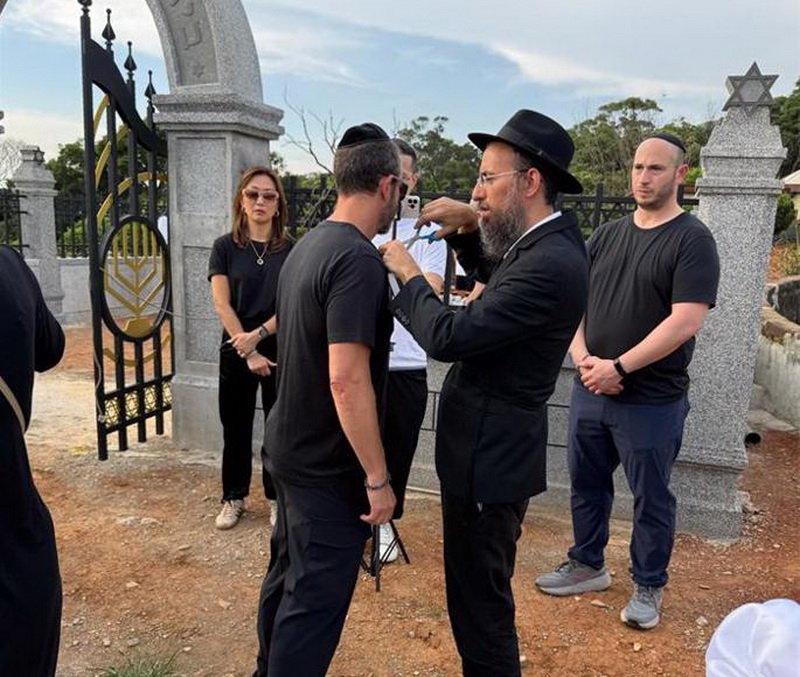
It would be three more years before the cemetery opened its gates. But finally, a few weeks ago, it did. Set in a forest about 40 minutes from Chabad of Taiwan, the island’s first dedicated Jewish burial ground held its first funeral, and the last crucial piece of Jewish infrastructure on the island was complete.
Jeffrey D. Schwartz, center, flanked by Rabbi Shlomo Tabib and Rabbi Moshe Kotlarsky at the opening of the $16 million Jewish community center in Taiwan.
Organized Jewish life in Taiwan goes back only to the 1950s, when American Jewish servicemen stationed on the island gathered for Shabbat and holidays. Rabbi Shlomi and Racheli Tabib arrived in 2011 and built on that foundation, establishing Chabad-Lubavitch of Taiwan in Taipei City, and opened the Jeffrey D. Schwartz Jewish Community Center a decade later. Funded by Taiwan businessman Jeffrey Schwartz, the $16 million complex gave the island its first permanent synagogue and kosher kitchen, along with a Judaica museum, a 300-seat ballroom and a mikvah finished with a gold-leaf ceiling.
One piece was still missing. In Taiwan, where 95% of the population is cremated, burial according to halachah, Jewish law, has never been available. Families had to send loved ones abroad, often to Hong Kong— home to the region’s oldest Jewish cemetery, dating to 1855. Shanghai’s Sephardi community opened its own in 1862. Taiwan had nothing comparable.
The Tabibs tried to negotiate space for a Jewish cemetery for years, and eventually found a private cemetery willing to set aside a section permanently for Jewish use. They then worked with rabbinic authorities to structure and fence off the area so it would function as a distinct Jewish burial ground.
The Tabibs saw the need almost as soon as they arrived, but local law didn’t allow for the permanence Jewish burial requires, and the project stalled for years. The turn came when the rabbi found a private cemetery willing to set aside a section permanently for Jewish use, a step Schwartz helped make possible. Rabbi Tabib then worked with rabbinic authorities to structure and fence off the plot so it would function as a distinct Jewish burial ground.
On June 23, the cemetery was consecrated when its first burial took place there. The deceased’s family lived outside Taiwan, and Rabbi Tabib served as their representative on the ground, and working closely with Chabad of Hong Kong and ZAKA’s international division, oversaw the arrangements. Taiwan’s burial laws, unlike those in much of North America, permit burial directly in the earth without a casket, in keeping with the most ideal halachic practice.
“I know you say it’s your job, but we don’t take it for granted,” a family member wrote to Rabbi Tabib. “You were there for us at our collectively most difficult time in our lives. What you do touches hearts.”
 CrownHeights.info2 days ago
For the first time, visitors and locals in Jackson Hole have access to a dedicated kosher pop-up grill, bringing fresh kosher dining to one of America’s most popular summer destinations. The Kosher Grill, which opened on July 5, is operating from the Chabad Jewish Center of Wyoming and is offering an exciting menu throughout the busy summer season.
While located at Chabad, the Kosher Grill is an independent venture operated by three Chabadniks from New York: Mayer Balkany, Tzvi Torenheim, and Yehudah Schultz. Chabad of Wyoming is providing the hashgacha and overseeing the kashrus.
The opening marks a significant milestone for the region, where the Jewish community is relatively small and kosher dining options have traditionally been very limited. Jackson Hole has become an increasingly popular destination for Jewish families exploring the nearby Grand Teton and Yellowstone National Parks. Until now, those seeking fresh kosher meals while in the area had few convenient options.
“One of the Rebbe’s well known mivtzoim campaigns was encouraging greater access to kosher food for Jews wherever they may be. Alongside his campaigns encouraging men to put on tefillin and women to light Shabbos candles, the Rebbe emphasized making kosher food more readily available to every Jew,” said Rabbi Zalman Mendelsohn of the Chabad Jewish Center of Wyoming. “We’re grateful that this initiative helps further that vision by making fresh, high quality kosher meals available throughout the summer.”
The seasonal Kosher Grill features a diverse menu of freshly prepared favorites, providing a new kosher dining destination in northwest Wyoming during the busy summer season. The project is especially noteworthy because it brings together three Chabadniks who traveled from New York, transporting equipment, supplies, and their culinary expertise across the country to establish the seasonal venture.
Beyond serving meals, the team is also committed to giving back to the Jewish community. Every Tuesday, the grill closes so its operators can travel throughout Yellowstone National Park and surrounding areas to connect with Jewish visitors. They will help men put on tefillin, distribute Shabbos candles, and offer opportunities for Jewish inspiration and connection, continuing the Rebbe’s vision of reaching every Jew wherever they may be. The weekly outreach reflects the team’s commitment to strengthening Jewish life alongside operating the Kosher Grill.
“We’re excited to bring quality kosher food to Jackson Hole and make it more accessible for Jewish visitors and the local community,” said Mayer Balkany. “We’ve put a great deal of thought into creating a menu that people will enjoy, and we hope the Kosher Grill becomes a welcoming place where guests can relax, enjoy a delicious meal, and connect with fellow travelers during their time here.”
The Kosher Grill is expected to operate throughout the summer, expanding kosher accessibility in one of the nation’s premier vacation destinations.
For hours, the menu, and additional information, JewishWyoming.com/Grill.
 CrownHeights.info2 days ago
At the heart of the training event for 198 Shluchhey chinuch in Eretz HaKodesh, held as part of the historic gathering of Reshet Oholei Yosef Yitzchak Lubavitch, an inspiring film was shown, presenting the moving story of Rabbi Shlomo Chaim Lison, a Shliach chinuch from Haifa.
The film tells the story of his medical struggle and reveals the extraordinary dedication of a Shliach chinuch to his students – even in the most challenging moments.
Now, for the first time, the film is available for viewing by the broader Anash community.
Don’t miss it.
“Ashrei Adam Bote’ach Bach”
 CrownHeights.info2 days ago
At an event fare welling Sara Netanyahu as school Psychiatrist at a Chabad High School in Yerushalayim, Israeli Prime Minister Benjamin Netanyahu can be seen watching a video of the Rebbe presented to the guests.
View this post on Instagram A post shared by שימי סגל (@shimisegal)
 CrownHeights.info2 days ago
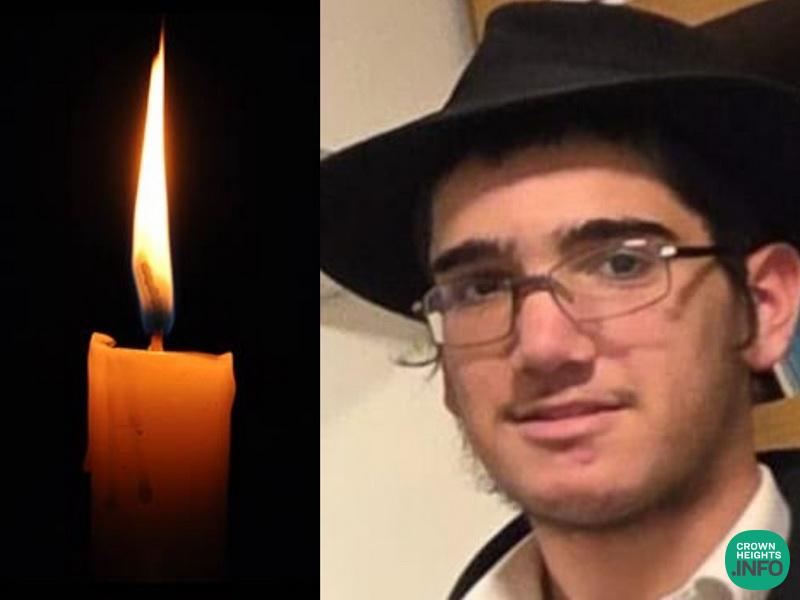
With great sadness we report the passing of Hatomim Ziv Moshe Schulman OBM, a bochur at the Lubavitcher Yeshiva in Rechovot, EY who collapsed yesterday while at the Yeshiva. He passed away on Tuesday, the 22nd of Tammuz, 5786.
He was 17 years old.
The Chabad community worldwide came out to say Tehillim after his collapse.
He is survived by his parents Eyal and Meirav Yakira Shulman.
Boruch Dayan Hoemes
 CrownHeights.info2 days ago
by CrownHeights.info
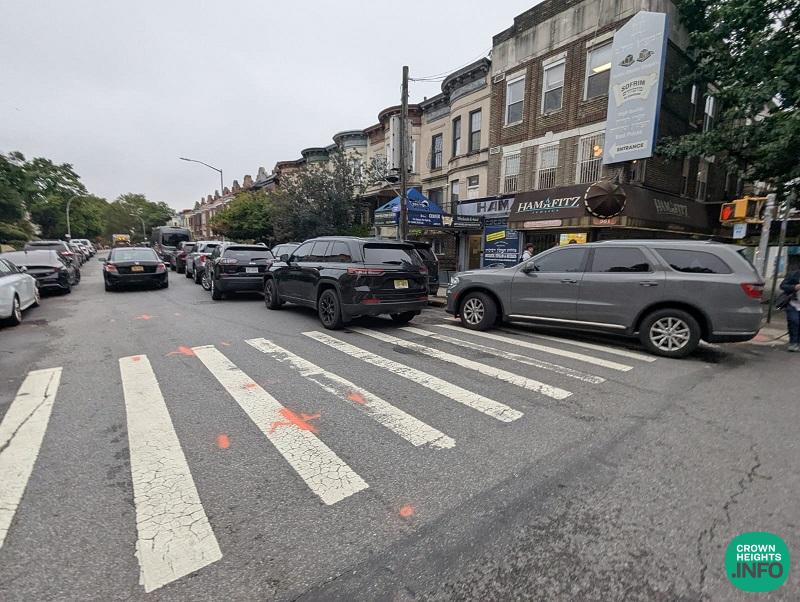
Carroll and Kingston, in the heart of Crown Heights, saw officers of the FBI in an early morning raid Tuesday morning, allegedly targeting a second floor office on the corner.
Details remain sparse but no arrests were reported, despite both the FBI and HSI reported on scene.
 CrownHeights.info3 days ago
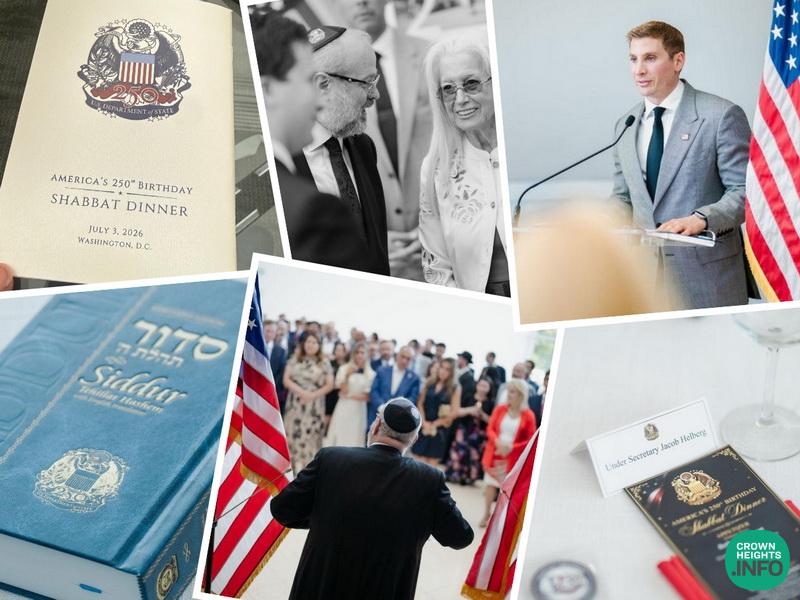
On July 3, Under Secretary for Economic Affairs Jacob Helberg and Ambassador Rabbi Yehuda Kaploun hosted America’s 250th Birthday Shabbat Dinner in partnership with the Combat Antisemitism Movement (CAM) at the Donald J. Trump Institute of Peace. Nearly 200 ambassadors, senior U.S. officials, and Jewish leaders participated in this historic kick-off to the Freedom 250 celebrations in Washington, DC, during the holiday weekend.
Ambassador Kaploun underscored why broadening appreciation for Jewish heritage remains a critical tool in the fight against global antisemitism. “The history of the Jewish people in America is a strong one, a resilient one,” he said. In his speech, Kaploun also highlighted the Lubavitcher Rebbe, noting him as one of the great Americans of this nation’s history.
Arie Lipnick, Chair of CAM’s US Advisory Board, announced that CAM will partner with the U.S. Department of State to launch a new educational initiative aimed at educating young audiences globally about the contributions of 250 notable Jewish Americans.
A Foundation Phantom humanoid robot interacted with guests, representing the role which technology will play in shaping the next 250 years of Jewish American history.
 CrownHeights.info3 days ago
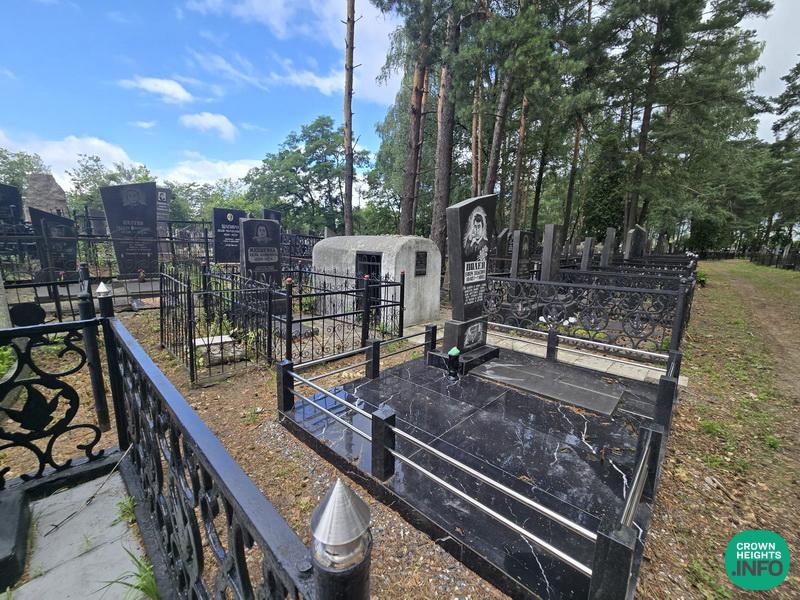
A major restoration project at the historic Jewish cemetery of Bobruisk, Belarus, is nearing the completion of its first stage, following nearly two years of gradual work led by the local Jewish community together with descendants of Bobruisk families around the world.
The cemetery, located near Minskaya Street in the Mogilev region, was established in 1921 and remains the city’s only surviving Jewish burial ground. Thousands of Jews from Bobruisk and the surrounding region are buried there, including Rabbi Shmariyahu Noach Schneerson of Bobruisk, the city’s Chief Rabbi and founder of the cemetery, whose resting place has survived to this day.
The current stage of restoration has focused on making the cemetery accessible and safe: paths and passageways are being cleared, overgrown vegetation and debris removed, protective treatment applied to prevent renewed wild growth, and unstable trees identified and removed where necessary. Future stages are expected to include new paths, shaded areas and drinking fountains for visitors.
“The condition of the cemetery was very painful,” said Rabbi Shaul Chababo, Chief Rabbi of Bobruisk and Chabad emissary to the city. “It was almost impossible to walk between the graves, and the feeling was very difficult. This initiative is being carried forward by Jewish families around the world — people born in Bobruisk and descendants of families who lived here throughout its history — who have taken responsibility for preserving this sacred place.”
Among the leaders of the initiative is Felix Gurevich of Florida, a native of Bobruisk, who formed a 15-member board of trustees and, together with the local Jewish community, began raising the resources needed for the cemetery’s rehabilitation.
Bobruisk was once one of the largest and most important Jewish centers in Belarus; in 1897, more than 20,700 Jews lived in the city, making up about 60 percent of its population. The cemetery also holds deep Holocaust memory, with several memorials standing there in remembrance of victims from Bobruisk and nearby communities.
In recent decades, after years of neglect, emigration, and incidents of damage and theft, the restoration has become an urgent act of dignity, remembrance, and connection — ensuring that one of Bobruisk’s most significant Jewish heritage sites can once again be visited, protected, and honored.
 CrownHeights.info3 days ago
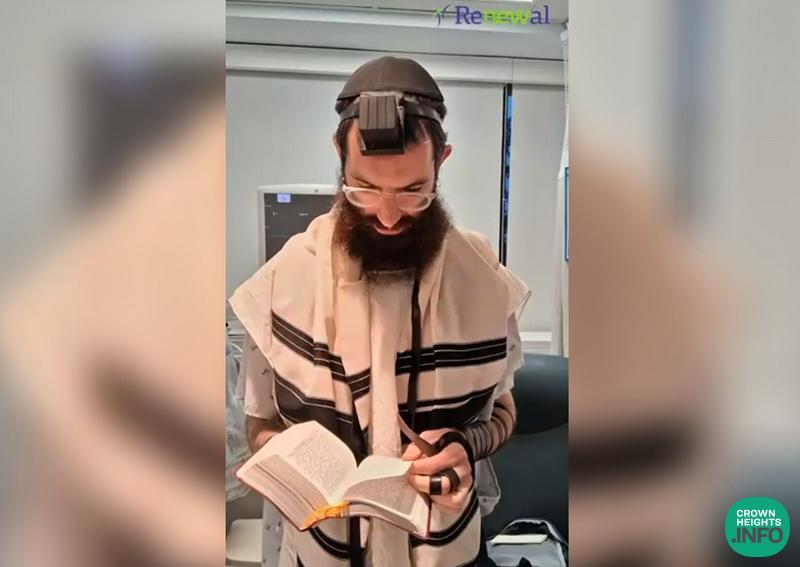
Today, Shliach Rabbi Moshe Spalter joined the growing number of shluchim who have gone the extra mile by donating a kidney to save the life of someone they had never met—giving the ultimate gift of life.
Originally from Costa Rica, where his parents serve as shluchim, Rabbi Spalter now leads Chabad of Lake Forest and Lake Bluff in suburban Chicago together with his wife.
Kidney donation had been on his mind for years. When his brother-in-law needed a transplant, he volunteered to be tested and viewed becoming a match as a clear sign from Hashem. A father of three young children, he hopes his decision will inspire others to consider the gift of living donation.
Just last week, Renewal celebrated its 1,500th kidney transplant—each one representing a life saved, hope restored, and the extraordinary impact of living donation.
If you are interested in learning more about becoming a living kidney donor or would like to begin the confidential screening process, please contact Renewal at [email protected]
 CrownHeights.info3 days ago
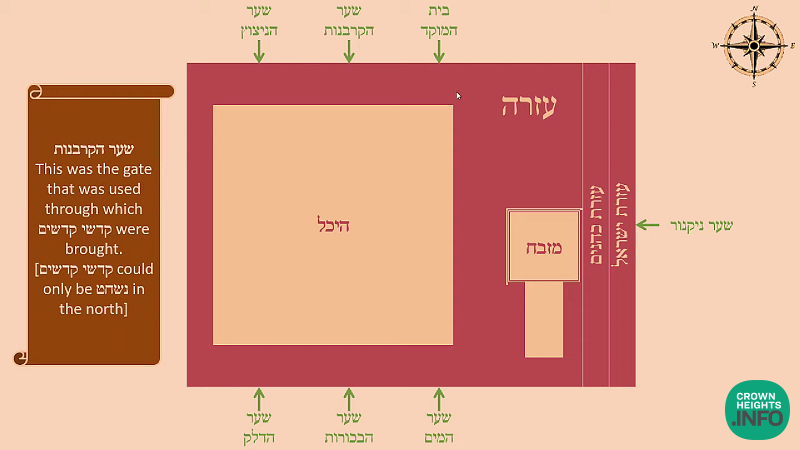
Today’s video goes through the 7 entrances of the Azarah; from the main entrance of Shaa’r Nikanor in the east to the 3 entrances on each the north and south, from the grand 4 room structure of the בית המוקד to the entrances used for the Korbanos, the wood, and the Nisuch Hamayim.
You will also see the size of the Azarah relative to the area around 770.
Yesterday’s Winners are:
$50 gift card: Feiga Chein
$36 gift card: J A
Link to the quiz
https://ispri.ng/rgZ9X
Link to join the WhatsApp group: https://chat.whatsapp.com/GVaB819H9hPFwL6c4DEGeg?mode=ac_t
Today’s class is dedicated לעילוי נשמת בלומא לאה בת הרה”ח הרה”ג ר’ ישעיה משולם זוסיא ע”ה
Donated by her grandchildren
חנה בת מלכה רייזל
and
משה אהרן לוי בן בת שבע
 CrownHeights.info3 days ago
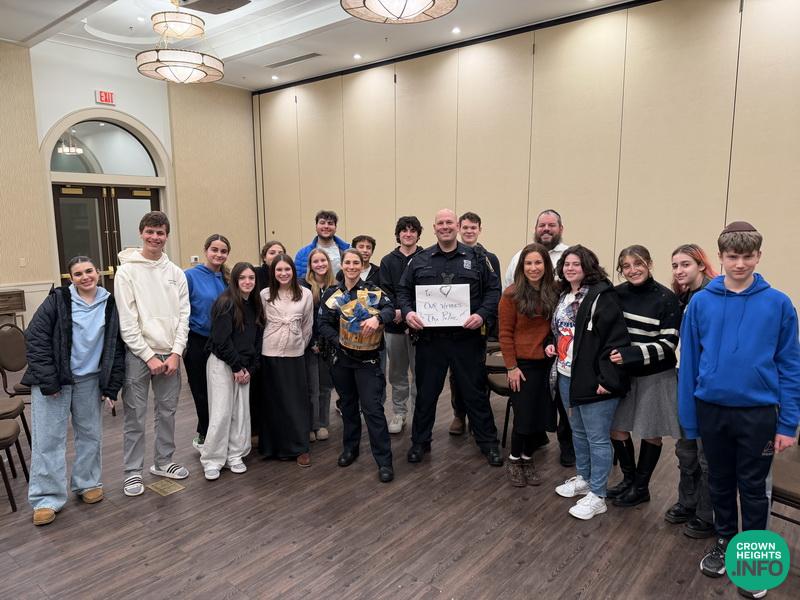
CTeen Orange recently hosted its annual Awards Gala, honoring more than 50 exceptional teens for their dedication to community service and Jewish leadership throughout the year. CTeen Orange is a branch of Chabad of Orange County, led by Rabbi Pesach and Chana Burston and youth director Sarah Litzman, and is comprised of teens from across the County, including Goshen, Monroe, Middletown, Washingtonville, Chester, Warwick, Cornwall and Newburgh.
Awards recognized teens for their contributions to the Friendship Circle, serving children, teens, and young adults with special needs, as well as CTeen leadership, Hebrew School volunteering, Synagogue attendance, and many other meaningful acts of service that have made a lasting impact across the community.
The evening was led by talented teen emcees and featured inspiring speeches from student leaders, highlighting the incredible passion, commitment, and Jewish pride of Orange County’s youth. Each honoree received special gifts in recognition of their accomplishments and the difference they have made.
Teen volunteer highlight events this year included a carnival to raise funds for charity, decorating cookies for hospital patients, gift packages for local police departments, soups for seniors and teddy bears for sick children, among others.
CTeen Orange is already planning an exciting lineup of programs, volunteer opportunities, and leadership experiences for the coming year, with even more opportunities for teens to connect, give back, and grow. For more information on the CTeen Jr Youth Group for middle school students, and CTeen Orange for High School students, log onto chabadorange.com
 CrownHeights.info3 days ago
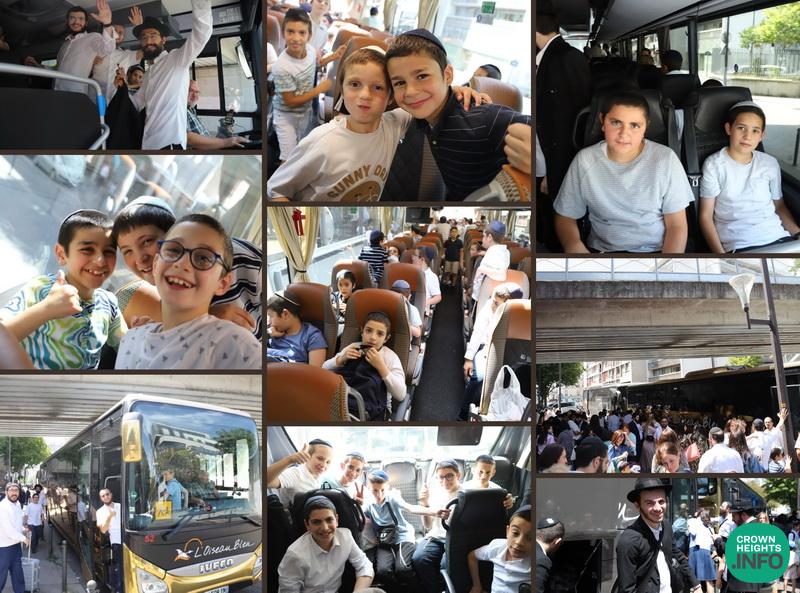
At 2:30 PM today, two buses carrying the boys of Gan Yisroel Pensaim departed from Rue Petit in Paris, marking the official start of an exciting summer camp season. The camp is directed by Rabbi Levi Maimon.
More than 100 campers left Paris in a warm, joyful, and spirited atmosphere, eagerly anticipating a summer filled with unforgettable experiences, adventures, and lasting memories.
Photos by Mordechai Lubecki
 CrownHeights.info3 days ago
Every mother spends countless hours caring for her family, often placing everyone else’s needs before her own. This summer, The Long Short Road is creating a space where mothers can pause, recharge, and return home with renewed strength.
On Sunday, July 26 (12 Av), mothers from across the community are invited to Healing Arts Haven, a full-day retreat in Brooklyn designed to nurture emotional well-being, build resilience, and foster meaningful connection.
The day will feature three experiential workshops led by respected facilitators:
Leigh Ioffe, Founder and Executive Director of The Long Short Road, who has dedicated her work to supporting mental health, resilience, and suicide prevention within the Jewish community.
Dini Gourarie, Certified Tapas Acupressure Technique (TAT®) Practitioner, offering gentle tools for releasing emotional stress and finding greater inner calm.
Channy Mockin, somatic coach and creator of the Alive Method, leading an engaging movement experience that helps participants reconnect with themselves through music, movement, and nervous system regulation.
Throughout the day, participants will explore practical tools that can be integrated into everyday life while connecting with other mothers in a warm and supportive environment.
In addition to the workshops, attendees will enjoy two catered meals, beautiful swag bags, exciting raffle prizes, and opportunities for reflection and connection.
“Healing Arts Haven was created to give mothers permission to pause,” says founder Leigh Ioffe. “When we take time to care for ourselves, we become better equipped to care for the people who depend on us.”
Event Details
Healing Arts Haven
Sunday, July 26, 2026 (12 Av)
8:30 a.m. – 5:00 p.m.
Crown Heights, NY
Scholarships are available for single mothers, and payment plans are available.
For more information or to register, visit: www.thelongshortroad.com/haven
 CrownHeights.info3 days ago
by CrownHeights.info
A 17-year-old yeshiva bochur is in serious condition after collapsing Sunday night inside a Chabad yeshiva on Hasam Street in Rehovot.
Emergency responders arrived to find the teen unconscious, without a pulse and not breathing. After sustained resuscitation efforts, medical teams succeeded in restoring the teenager’s heartbeat, according to reports.
United Hatzalah volunteers Yonatan Sharabi, Katriel Cohen, and Ayala Yitzhaki, who responded to the emergency, said they found the bochur completely unconscious upon arrival and worked alongside additional emergency personnel to stabilize him.
Following initial treatment at the scene, Magen David Adom paramedics transported him by mobile intensive care unit to the trauma department at Kaplan Medical Center in Rehovot. Resuscitation efforts continued during the transport.
The teen remains in serious condition.
Family members and friends are asking the public to daven for זיו משה בן מירב (Ziv Moshe ben Merav).
 CrownHeights.info4 days ago
The Star Spangled Banner Performed by Aryeh Hurwitz, at the Fiserv Forum in Milwaukee, his 5th NBA stadium and 9th pre game overall, as the Milwaukee Bucks faced off against the New Orleans Pelicans. The evening was in celebration of The Friendship Circle of Wisconsin.
 CrownHeights.info4 days ago
A veteran NYPD detective just 10 days from retirement was shot in the back Sunday morning in a wild Brooklyn gunfight that erupted when he and another cop jumped out of their car to confront an armed teen.
The 18-year-old alleged gunman was nabbed after a dramatic foot chase following the shootout, which occurred at Nostrand Avenue and St. Johns Place in Crown Heights around 4:45 a.m. — and miraculously left the wounded cop, a married dad of three, with just minor injuries.
The shooting broke out when the teen approached an unmarked NYPD car holding a semiautomatic pistol, according to police.
 CrownHeights.info4 days ago
New York City Emergency Management (NYCEM) is advising New Yorkers to prepare for periods of heavy rain, thunderstorms and localized flooding beginning overnight Sunday, July 5, and continuing through the morning of Tuesday, July 7, according to the National Weather Service (NWS). While most of Sunday will remain dry, weather conditions are expected to deteriorate late this evening, with the greatest travel impacts expected during the Monday morning commute and continuing through Monday night.
“As we’ve seen in recent storms, flash flooding can develop quickly and create dangerous conditions with little warning,” said NYCEM Commissioner Christina Farrell. “We’re expecting periods of heavy rain to especially impact the Monday morning commute and continue through the day, so New Yorkers should plan ahead, allow for extra travel time, and be prepared for rapidly changing conditions.”
NWS has issued a Flood Watch in effect through 6:00 a.m. Tuesday. Multiple rounds of rain and embedded thunderstorms are forecast to produce 2 to 3 inches of rainfall across the city through Tuesday morning, with isolated locations receiving up to 4 inches. Brief rainfall rates of 1 to 2 inches per hour are possible in stronger thunderstorms, which could overwhelm drainage systems and lead to flash flooding, especially in low-lying and poor drainage areas.
The highest risk for flooding is expected Monday morning through Monday night as additional rain moves across the region. Localized flash flooding may impact roadways, underpasses, highways, and areas with poor drainage. Briefly strong thunderstorms could also produce gusty winds capable of downing tree limbs and blowing around unsecured outdoor objects.
NYCEM has activated the city’s Flash Flood Emergency Plan, coordinating closely with NWS city and state agencies, utility providers and private sector partners. This proactive approach includes pre-storm actions such as targeted inspection and clearing of catch basins in flood-prone areas by the Department of Environmental Protection and the Department of Transportation to help reduce street flooding before heavy rain begins. Coordinated interagency calls ensure partners are briefed on emerging risks and prepared to escalate response operations as needed, while specialized emergency assets and response teams remain on standby for rapid deployment. NYCEM’s 24/7 Watch Command continuously monitors weather conditions and tracks developing systems in real time.
New Yorkers should allow extra travel time during periods of heavy rain, especially during the Monday evening commute. Avoid driving through flooded streets. Even shallow water can stall vehicles. Secure loose outdoor items such as patio furniture or trash bins before winds increase. If thunder is heard, move indoors and stay away from open areas. Clear debris from nearby storm drains if it is safe to do so to help reduce street flooding. Stay informed by checking the forecast and signing up for emergency alerts at nyc.gov/notifynyc. Have a plan and “Be Ready” for thunderstorms and rainfall by visiting nyc.gov/beready.
 CrownHeights.info4 days ago
At Zlata Hall in Kfar Chabad, 198 Chabad avreichim from across the country gathered last night to receive their certificates upon completing their training as Shluchhey chinuch, as part of a comprehensive educational initiative led by Reshet Oholei Yosef Yitzchak Lubavitch in Eretz HaKodesh.
The training of these new Shluchhey chinuch represents a major milestone for the world of Chabad education, taking place on the eve of the Chag HaGeulah of the Frierdiker Rebbe, and in the spirit of the Jubilee Year of Education.
As the historic evening opened in Kfar Chabad Bet, the newly certified Shluchhey chinuch were seated around elegantly set tables, with Chabad niggunim playing in the background.
The evening was opened by the emcee, Rabbi Dov Halperin. Rabbi Avraham Gechtman, representing the Sha’anan branch of the Shluchhey chinuch, and Rabbi Pizem, representing the Talpiot branch, were invited to recite the Rebbe’s and Rebbetzin’s chapters of Tehillim.
Rabbi Eliyahu Kritchevsky, director general of the Reshet, reviewed the far-reaching revolution of the Shluchhey chinuch initiative, highlighting the powerful mission of fulfilling the Rebbe’s holy desire: to train worthy avreichim to enter the field of education in the most professional and Chassidishe manner possible. He called for additional avreichim to be recruited into the army of educational shlichus.
At this point, participants viewed rare holy footage of the Rebbe speaking about the Chag HaGeulah of Yud-Beis–Yud-Gimmel Tammuz.
Rabbi Menachem Mendel Gluckowsky, deputy secretary of the Beis Din Rabbonei Chabad and a member of the Reshet’s leadership, presented the Rebbe’s pure educational approach, enriching his remarks with rare and captivating stories about the Rebbe.
The veteran educator Rabbi Naftali Roth then addressed the gathering. In his signature style, he shared illuminating glimpses into the Rebbe’s special regard for Jewish children.
At the heart of the event, participants watched a deeply moving and unique video presentation featuring Rabbi Shlomo Chaim Lison, the Rebbe’s shliach who carries the banner of educational shlichus at the cheder in Haifa, and who only recently, with Hashem’s kindness, merited a recovery from illness. Together with Shmulik Sofer, he sang his father’s soul-stirring niggun, “Ki Rega B’Apo.” Those powerful moments concluded with the niggun “Ashrei Adam Bote’ach Bach.”
Rabbi Yitzchok Isaac Landa, rav of the city of Torah and Chassidus, Bnei Brak, was then invited to deliver the keynote address. Drawing on decades of shlichus, Rabbi Landa captivated the audience with guidance on the proper approach to each and every student — especially in our generation — all rooted in the Rebbe’s outlook and directives.
The highlight of the evening came toward the conclusion, when the 198 excited new Shluchhey chinuch were invited to the stage to receive their certificates marking the completion of their training track.
Fittingly, the grand event concluded with joyous dancing, expressing the profound privilege granted to each of the participants: the merit to fulfill the Rebbe’s vision by dedicating themselves to the education of Jewish children.
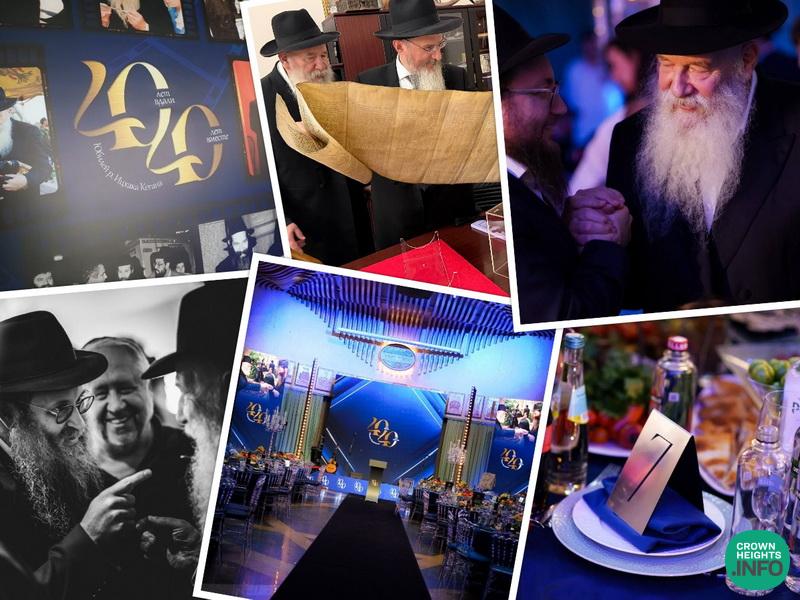 CrownHeights.info4 days ago
Contemporary Jewish Moscow presents a reality entirely different from the difficult periods Russian Jewry experienced in the past. The capital city, once a focal point of prolonged persecution, stands today as a living, beating symbol of an extensive spiritual and Jewish revival. In this historic atmosphere, reflecting the brilliant triumph of Mesiras Nefesh, masses gathered for an extraordinary event of tribute and appreciation. At the center of the occasion stood the personal and public story of the man known as the ‘Tzaddik of Leningrad,’ Rabbi Yitzchak HaKohen Kogan, one of the leading activists and founding fathers of the Torah world in the Commonwealth of Independent States during those difficult years. For the large audience that packed the hall, this was no ordinary eightieth birthday celebration, but a fascinating journey along the timeline, tangibly illustrating the immense power of a Chassid’s connection to the Rebbe.
The central theme woven through the evening’s highlights stemmed from a chilling definition provided by the celebrant himself, who declared to the audience that he was not celebrating eighty, but forty. His life, he described, is divided into two distinct periods: forty years of life in Russia, versus forty years of a new life that began the moment he merited to leave and arrive for the first time at the holy court to behold the holy countenance of the Lubavitcher Rebbe. The captivated audience was exposed to the tremendous strengths the Rebbe bestowed upon the Shliach, powers that turned him into a conduit of blessing for the lives of countless Jews. Throughout the event, the sweeping scope of his global activities was unfolded, starting from the establishment of the Shamir neighborhood in Jerusalem for Russian immigrants and the rescue project for the children of Chernobyl, through his appointment as a member of Agudas Chasidei Chabad in the Soviet Union and the struggle to redeem the Lubavitch library, to the return of the historic Bolshaya Bronnaya synagogue to Jewish hands, his position as the chief Shochet in Russia’s massive Shechita network, and the restoration of the holy sites in the town of Lubavitch, and in the cities of Rostov and Vitebsk.
The powerful and moving event was graced by the presence of high-ranking government officials, philanthropists, and friends of the community, alongside Shluchim and rabbis who arrived from Israel and around the entire world. The Chief Rabbi of Russia, the Gaon Rabbi Berel Lazar shlit”a, who was at the time on an inspirational tour among the Jewish communities in Panama, participated in the event from afar in a manner that left a profound impression on the attendees, as his moving video blessing was projected on the screens. Alongside this, the Chief Rabbi of Russia sent a letter of blessing, shedding light on their deep connection. In the letter, the Chief Rabbi recounted the story of their first meeting, which occurred following a clear, heavenly directive from the Rebbe, who unexpectedly gave him a dollar bill for Tzedakah in the Holy Land, despite the fact that he had not planned to travel there. The route was changed, and the historic encounter led to a joint tour of the Shamir neighborhood and an eternal friendship, which the letter described as being akin to a ‘threefold cord.’
Throughout his letter, Chief Rabbi Lazar dwelt on the essence of reaching the age of Gevuros (eighty), wishing that his eightieth year would represent a reinforcement of abundance, flowing like an ever-strengthening spring. He connected this to the celebrant’s name, Yitzchak, which symbolizes the attribute of Gevurah of our Patriarch Isaac and the ability to give time and time again, transcending all limitations. He praised the celebrant’s uncompromising dedication since his early days in Leningrad, through all the massive enterprises he established out of a burning Ahavas Yisrael and the warm heart of a Kohen, adding that he had always worked tirelessly for every matter of holiness. The Chief Rabbi concluded his letter with a deep blessing for success, robust health, and a particularly moving wish that he may very soon merit to return to holy service as a Kohen in the Third Beis HaMikdash.
A moment of spiritual elevation was recorded when Rabbi Kogan was presented with an exceptionally rare and extraordinary gift: an ancient Megillas Esther, over 150 years old. The Megillah, marvelously preserved and strictly Kosher, was copied with great precision from the Megillah of the Rebbe Maharash of Lubavitch, of righteous memory. Beyond the special beauty of the script, which reflects the tradition of the Alter Rebbe, the Megillah carries a deep historical connection to the Vitebsk region and Chabad heritage, serving as a gift of immense spiritual value for the celebrant.
The climax of the evening, which left many in the audience in tears of emotion, came as a complete surprise. Immediately after the screening of a moving film about the Chernobyl children’s project, the Rabbi of Bishkek, Shliach Rabbi Aryeh Reichman, himself a survivor of that heroic rescue project, took the stage. With a voice choked with tears, he turned to Rabbi Kogan and said: “The Judaism that you gave me, I am passing on today to even more Jewish children!” In a chilling closure of a circle, Rabbi Reichman presented Rabbi Kogan with a unique gift—the privilege of giving the Jewish name and reciting the blessing over the wine at the Bris Milah of an 11-year-old boy from his community, who had been circumcised that very morning.
The uplifting evening concluded with a sweeping Chassidic Farbrengen, breathing a spirit of connection and action among the participants, with a hopeful look toward continuing the momentum of development and spreading the wellsprings in Russia.
The special production, which successfully translated the deep spiritual message into a perfect and moving visual experience, was executed by his granddaughter, general producer and Shlucha Mrs. Musy Gechtman, together with visual content by MF Multimedia Productions, and meticulous design and branding by Schneur Cortes.
Photography: Mark Savin
 CrownHeights.info4 days ago
What if one of the biggest ideas behind the American Dream didn’t begin in America? Discover the surprising Torah principles that shaped the Founding Fathers’ vision of liberty, property, and opportunity.
 CrownHeights.info4 days ago
by CrownHeights.info
Two men have been charged after police allege an imitation pistol was pointed at people gathered outside a Chabad House in Sydney, in what Jewish community leaders have described as a deeply disturbing incident.
According to New South Wales Police, officers were called to Chabad Double Bay around midday on Saturday after receiving reports that a man inside a passing vehicle had pointed what appeared to be a handgun toward congregants gathered outside the synagogue.
Police quickly located the vehicle, stopping it in the Kings Cross area. A search of the Toyota SUV allegedly uncovered an imitation firearm, and two men, aged 22 and 25, were arrested.
The 22-year-old has been charged with using an offensive weapon with intent to commit an indictable offence, possessing an unauthorized pistol, and stalking/intimidating with intent to cause fear of physical harm. The 25-year-old has been charged with possession of an unauthorized pistol.
Both men were refused bail and were scheduled to appear in court on Sunday.
Executive Council of Australian Jewry co-chief executive Alex Ryvchin condemned the alleged act, noting that it comes at a particularly painful time for Australia’s Jewish community.
“Threatening and terrifying Jews for laughs. Well done to the police for their swift action,” Ryvchin said.
The alleged incident comes just months after the deadly terrorist attack targeting the Jewish community in Bondi. Chabad Double Bay is part of the same broader Chabad organization as Chabad Bondi, which hosted the Chanukah celebration that was attacked on December 14.
During that attack, authorities allege that 15 people were murdered by Sajid Akram and his son, Naveed Akram. Sajid Akram was fatally shot by police at the scene, while Naveed Akram is facing 79 charges, including multiple counts of murder and one count of committing a terrorist act.
The latest alleged incident has heightened concerns within Australia’s Jewish community, which has experienced a significant rise in antisemitic threats and intimidation in the wake of the December massacre. Community leaders praised the swift police response, which they say helped prevent the situation from escalating further.
The investigation remains ongoing.
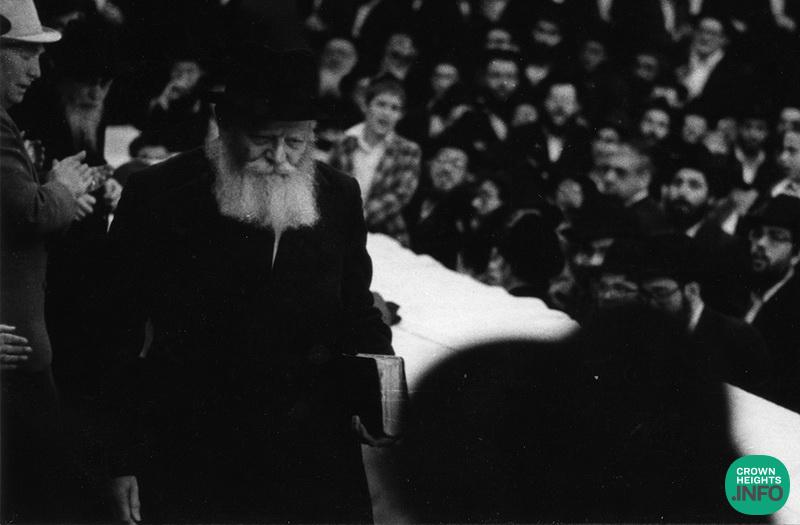 CrownHeights.info5 days ago
by Dovid Zaklikowski for Hasidic Archives
During one particularly difficult year the board of Oholei Torah asked Dovid if he would agree to be honored at the annual dinner. “He vehemently refused,” the late Mendel Shemtov, a Crown Heights businessman, wrote in a 2001 tribute to Dovid. “In his eyes, for a Chasidic Jew it was totally out of the question.”
In the end his brother Sholom convinced him to tolerate being honored for the sake of the school.
While Dovid accepted the honor begrudgingly, Sholom was delighted. At the dinner Sholom gave his older brother a standing ovation. “He felt so happy for the kavod [honor] that his older brother was getting,” Sholom’s youngest son, Avrohom Moshe, said.
In the years that followed, the Oholei Torah dinner honored many distinguished people, but no dinner passed without a celebration of Dovid Deitsch.
Ads for the dinner itself, placed in local Jewish newspapers, were another source of embarrassment to the businessman, as they invariably included a paragraph of praise to himself: “We would like to honor our chairman of the board of directors of Oholei Torah, the great philanthropist and selfless activist, indefatigable communal achiever, and leading personality.”
Though he tolerated the honor for the sake of the school, the public adulation bothered Dovid. Once he complained to the Rebbe, “I can’t stand this. I go to these dinners, and everyone wants to take a picture with me, and they put my picture in the papers. I don’t like it and I don’t want it.”
“Nu?” the Rebbe replied (paraphrased). “I don’t like it either, but it makes people happy, so we have to do it.”
An excerpt from the forthcoming book Yards of Kindness: The Life of Dovid and Sara Deitsch, available at HasidicArchives.com.
 CrownHeights.info5 days ago
There is a particular kind of joy that can’t be kept to yourself, the joy of a blessing you once weren’t sure would come. It echoes through the moments that define a lifetime: your child’s first locks of hair falling to the floor, your son being called up for his first aliyah, your hand letting go beneath the chuppah, and the indescribable privilege of welcoming another generation. Every celebration in a family’s life begins with the same miracle, the moment that family began.
For many families, every one of those moments was built by someone who chose to give. This year, Bonei Olam Chabad invites you to Celebrate Your Blessings. Help Another Family Begin Theirs. Because the beginning you make possible today will echo for generations.
The past year tells the story better than any appeal could. Bonei Olam Chabad supported 148 couples in total, with 119 actively pursuing the dream of building a family right now. Together we made 299 procedures possible, invested more than $1.3 million directly into the couples who needed it, and welcomed 36 precious babies into the world.
But financial help, as vital as it is, is only where the care begins. Bonei Olam Chabad walks with each couple through every stage of the journey, from first tests and treatments to the most advanced procedures available. That means connecting a family to a leading specialist, coordinating care through a high-risk pregnancy, or preserving fertility after a cancer diagnosis. It means partnering with top research institutions and drawing on the newest innovations, including advances in artificial intelligence, to give every treatment its greatest possible chance.
Behind the numbers are people who understand exactly what this support means, because they once received it themselves.
In that spirit of gratitude, we invite the community to join us for the 6th Annual Men’s Event on Monday, July 27. The evening features a soulful kumzitz with Eli Levin, an open bar, prime meats, and cigar rolling. It is an evening of celebration in every sense, and every seat helps turn someone else’s hope into reality. We also invite and encourage members of the Chabad community to join and create a team in raising money to support Bonei Olam Chabad couples through the next year of this journey.
Think of every simcha your family has been blessed to celebrate, and every one still to come. Your neighbor. Your friend. Your sibling. Someone in your own circle is still davening for their very first. Your blessings brought you here. This summer, Celebrate Your Blessings. Help Another Family Begin Theirs.
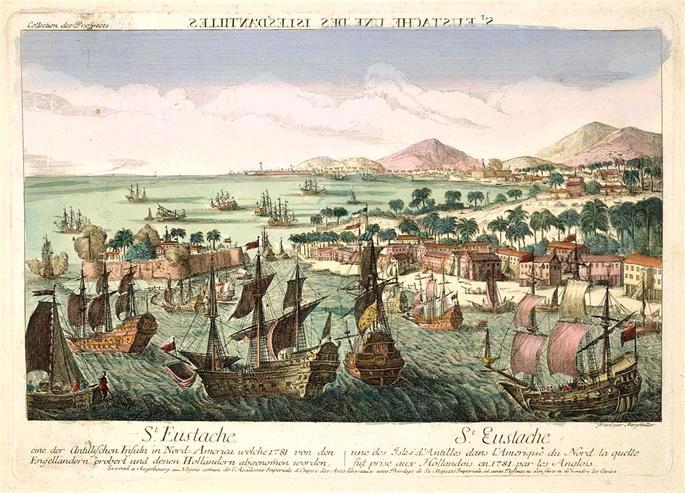 CrownHeights.info5 days ago
by Yaakov Landman – chabad.org
Way out among the Caribbean isles lies Sint Eustatius, known locally as Statia. This Dutch island was home to a small Jewish community that played an active role in the American Revolution.
Jews began settling on Eustatius in the late 1600s, and, by the 1750s, were sufficiently settled to build a synagogue, Chonen Dalim. Some Jews were plantation owners, but most were merchants and shopkeepers. On the whole, St. Eustatians were involved in commerce, and the island became a regional hub, with ships of various nations pulling into port to resupply and purchase goods. These Jews, with their business acumen, were able to fit right in.
With the outbreak of the American Revolution, out-of-the-way Statia played a major logistical role for the Continental Army. Small American ships evading the British naval blockade on the colonies docked in Dutch St. Eustatius to stock up on much-needed military supplies and gunpowder.
It was the help of the Eustatius merchants—among them many Jews—that kept Washington’s cannons firing. In fact, the island was even the first to accord diplomatic status to the American flag on November 16, 1776, when the American naval ship, the Andrew Doria, fired an honorary 13-gun salute and received one in turn from the military fort guarding the island. Governor Johannes de Graff then hosted a dinner honoring his American guests.
This incident is recorded as the first diplomatic recognition of the United States as an independent country by a foreign power.
Remains of the 1737 synagogue in Sint Eustatius.
Naturally, the British were not pleased about the munition smuggling, nor the honor accorded to an American naval vessel. They sent a protest to Holland and demanded that the island’s governor, Governor Johannes de Graff, be recalled.
While the governor was eventually recalled, smuggling at Eustatius continued at full force. American merchant ships were still supplied with gunpowder and munitions, and American privateering ships continued to be outfitted with cannons.
The British eventually decided that they had had enough.
Admiral George Rodney, a prestigious naval commander with decades of experience, was given secret orders to take the war to the Dutch and seize St. Eustatius. On February 3, 1781, Rodney sailed into the port with a massive fleet and thousands of soldiers. The Dutch, who had no idea that war had been declared between them and Great Britain, had only a tiny garrison on the island. They were in no shape to offer any resistance, and the island was taken without fight.
Once comfortably ensconced in the former Governor’s residence, Rodney ordered that the Dutch flag remain flying on the island to lure in any American and French ships in the region. Although this was contrary to the understood rules of war, Rodney viewed these American and French vessels as pirate ships, and he therefore felt justified in taking any action necessary.
Evidently, the ploy worked, as the admiral wrote to his wife in March, “Upwards of Fifty American vessels loaded with tobacco have been taken since the capture of this island.” He also wrote about the vast riches available for the taking: “The riches of St. Eustatius are beyond all comprehension … All the magazines and storehouses are filled, and even the beach covered with tobacco and sugar.”
Rodney was cashing in. But he was also determined to punish the residents of the island for their involvement in the munitions trade. Especially the Jews.
The Jewish cemetery in Sint Eustatius had its first burials in 1720.
Determined to confiscate all hard cash from the “nest of vipers,” as Rodney termed the island, he ordered that all residents were to be treated as prisoners of war, and their property confiscated for the Crown. This was followed by the appropriation of all the warehouses on the island, and the expulsion of foreign merchants.
Rodney, however, had it in for the Jews the worst. Arresting 101 Jewish men (probably the entirety or at the very least the vast majority of the male Jewish population), Admiral Rodney had them locked in a warehouse and stripped, to ensure that no money was hidden in their clothes. While this was happening, soldiers ransacked their houses and stores, seizing any cash they could find. Convinced that the Jews were hiding money from him, Rodney even ordered that the cemetery be dug up!
After three days, they were released, but 30 Jews were expelled from the island. While Rodney allowed non–Jewish merchants he deported to depart with their families and belongings, he did not allow the same for the Jews, and they were exiled alone to nearby St. Kitts.
Rodney’s brutal treatment of the Jews did not go unnoticed. Some of them were able to petition contacts in London, and Rodney’s conduct was attacked on the floor of Parliament by Lord Edmund Burke.
Additionally, Rodney was responsible for a significant military failure. While busy seizing the riches on the island, he allowed a large French fleet commanded by Admiral de Gras to slip past and continue heading towards the American coast. Had he been more responsible, he could have attempted to turn back the French.
So, while Rodney sailed home to defend his actions in parliament, the French continued their way up the Chesapeake.
While all of this was happening, the American Revolution was wrapping up. George Washington, having heard in the summer of 1781 that De Grass was heading for the Chesapeake Bay, marched south with a united French and American army, catching British General Charles Cornwallis off guard at Yorktown, Virginia.
At the same time, De Grasse led his fleet into the Chesapeake to cut off the British escape at sea, in the process defeating a British fleet at the Battle of the Chesapeake, which, because of Rodney’s absence, was left to the less experienced Thomas Graves.
With no opposition left at sea, De Grass moved to complete the encirclement of the British, and the combined artillery of the American and French militaries bombarded the British into surrender on October 17, 1781.
A large combination of factors had to coincide for the British encirclement and defeat at Yorktown, but among them was the fact that the highly experienced Admiral Rodney was not available to take on the approaching French fleet. He was busy gathering riches and persecuting the Jews.
In a way, Rodney’s actions at Statia were a cog in the wheel to American victory at Yorktown. As an isolated event, it does not appear to have much significance. But if viewed with a greater lens, we can see G‑d’s hand orchestrating events for America to become an independent country and a safe haven for millions of Jewish refugees in the future.
Oh, and Admiral Rodney? Well, he did continue to have a successful career, but a good part of the riches he seized from Eustacia was captured by the French while being shipped back to England, and the French ended up capturing the island not long after Washington’s victory at Yorktown.
 CrownHeights.info5 days ago
Rabbi Chaim Dalfin, author and Chasidic historian shares interesting facts, many revealed for the first time. The purpose of his program is to inspire all but especially the youth. Watch another installment here on CrownHeights.info.
Visit Rabbi Dalfin’s website: Click Here
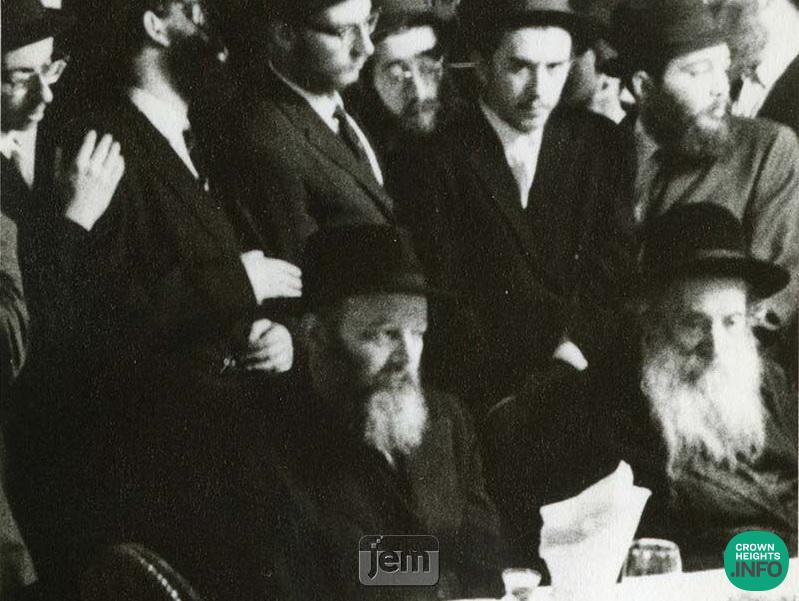 CrownHeights.info6 days ago
by Rabbi Sholom DovBer Avtzon
This week I am posting a powerful saying or thought which I heard during a farbrengen on Yud Beis Tammuz, as well as one of the concepts that I mentioned at a farbrengen. As always, your feedback and comments are most welcome and greatly appreciated.
While the main focus of a Yud Beis Tammuz farbrengen is about the Frierdiker Rebbe’s mesiras nefesh for every aspect of Yiddishkeit and especially as it applies to the education of Jewish children, however, it is also a time to pay attention to the hundreds of and possibly thousands of chassidim that not only put their lives in danger, but some of them actually paid the price. Either by being placed in prison, sent into exile and some actually gave up their life to fulfill the mission that the Frierdiker Rebbe gave them.
The chassidim knew of the strong possibility of what might happen to them, but they will that did not change their decision. They were also well aware that the sentence of imprisonment and exile was often a camouflaged death sentence, as many were not able to survive the harsh elements. Those that did survive did so only due to Hashem’s tremendous kindness.
One such person who was in the Russian prison for many years was Reb Shmuel (Mulei) Mochkin, the oldest son of the Mashpia, Reb Peretz. Once when the friends of Reb Mulei’s son came over to the house, one of them asked Reb Mulei in amazement, how was he able to live his life the way he did it, with so much mesiras nefesh in Russia? You sat in jail in Siberia.
Reb Mulei replied, what we did wasn’t special. I am positive that if any one of you would be living under the same situation and circumstances that we were living, all of you would have acted with the same mesiras nefesh that we did. None of us did anything extraordinary
The boy countered and asked in bewilderment, are you saying that there’s no difference between this generation and your generation? It can’t be!
He replied, yes there is one major difference. We grew up with a passion and a fiery desire to participate in a farbrengen especially if it was on or connected to one of the important dates in Lubavitch (Yoma D’pagrah’s). With today’s boys and teenagers I don’t see that tremendous passion.
That saying reminded me of what I heard from Reb Shlomo Galperin, that shortly before the Frierdiker Rebbe left Russia, a chossid asked him what can and should I do to demonstrate and impress upon my children to conduct themselves as chassidim.
See to it that [they are aware that] the farbrengens take place in your house.
At the moment we might not feel that we gained anything from a farbrengen, but years later everyone will clearly see the tremendous benefits of a farbrengen.
Now to what I mentioned at a farbrengen.
There is a saying, it is not important to know how much Torah a person learned, the important thing is how much did the person learn from the Torah.
So while it is important that we all discuss and know various aspects about the arrest and liberation pf the Frierdiker Rebbe, the main purpose is that we learn from it and apply a lesson from it into our lives.
Rabbi Berel Rivkin writes in Ashkavta D’Rebbe, that after the histalkus of the Rebbe Rashab, his son, the Frierdiker Rebbe said to him, My father commanded me to say a maamar chassidus, so I will say it to you in this room and thereby fulfill his request. However, after that maamar, Reb Berel informed the other chassidim who entered the room when the Frierdiker Rebbe began saying a different maamar. So we see that the Frierdiker Rebbe wasn’t looking to be in the spotlight, but when he saw what the Communists were doing to the Jewish people, by forcefully closing the schools, shuls, mikvaos, forbidding shechita and brissen, he saw that there was no one who was ready to do something, so he undertook the responsibility to be the one who does something in this aspect.
We often hear and perhaps discuss it ourselves about certain things that have to be addressed and it isn’t being done so.
Maybe it is a sign that we should get out of our comfort zone and do something about it ourselves. But each one of us may say, it isn’t my nature, and there are people who are much more qualified than me.
Even if that is true, Yud Beis Tammuz teaches us, to step forward and take a stand and do something.
If it is to help a youngster in years (or perhaps in knowledge of the Torah) that is in need of encouragement or help in their learning, be there for them.
If someone needs someone to speak to and get some advice, yes there may be people who their credentials show they are qualified, but your concern makes you the qualified person. [Obviously, don’t give advice if you are not positive that it is proper and sound.]
Your mesiras nefesh will be going out of your comfort zone, to be there for someone else. And this is something we all can do.
A Taste of Chassidus
Tzav Es Bnei Yisroel 1 Likkutei Torah Bamidbar 75A.
The Alter Rebbe explains a few points in this maamar and here we will focus on just a couple of them. One of the main question is, Why is it that the only place where the Torah notes that Hashem has happiness from our fulfillment of a mitzvah is when a person brings a Korban (sacrifice) to Him?
Our sages explain that this happiness is a result of Hashem stating I received enjoyment from the fact that I said something and My desire was fulfilled. Doesn’t that apply when we fulfill any mitzvah, and not just a korbon?
The truth is that it applies to every mitzvah, however, it is more openly apparent when one brings a sacrifice than when they fulfilled an other mitzvah, and Hashem wrote it in the Torah, connecting it to a mitzvah that we can physically see His happiness.
Every Korbon has something burnt on the Mizbaiach, (some more some less). Chassidus explains that the reason why blood is sprinkled on the mizbaiach is that blood represents a person’s passion. That is telling us that Hashem is informing us that we should use our passion to serve Him. Similarly, the reason why we burn the various fats on the mizbaiach is to guide us that our desires should be to serve Hashem, and not to enjoy worldly pleasures.
When we bring it on the fire of the Mizbaiach, a fire from heaven comes down and burns (eats) it.
That openly demonstrates that Hashem is happy with our action. So while this happens with the fulfillment of every Mitzvah, it is revealed to all when a korbon (sacrifice) is brought.
To explain it with a little more clarity. The possuk notes that every korbon that is brought onto the Mizbaiach, is called לחמי – My food. Just as by humans and other creations, when one who is faint eats something, their strength and subsequently their soul begins to return to the body, so too when we bring a korbon (or fulfill any mitzvah), we cause Hashem’s shechina to descend into the world (and strengthen it).
A second [but related] point the Alter Rebbe explains in this maamar is, why do we have the ability to do Teshuva only in this world and not in Olam Habuh. In Olam Habuh there is a revealed state of G-dliness, and the yetzer Horah admits that Hashem is the Creator, but our sages explain that nevertheless, the Yetzer Hora continues to act as it conducted itself when it was living in this world. [And that embarrassment is (part of) its punishment.]
The difference is that in Olam Habuh, everything has its set place; positive is positive and negative is negative. So being that everything is defined, it is not possible to transform negative into a positive (simply meaning to change anything). That is the way it is in the world that is set up by the path of Mimaleh kol Almin (that the amount of G-dly revelation depends on the ability of each thing to accept it).
However, in the world of Soivev there is no higher and lower, the heavens and earth are equal. Therefore, in this world which also has a connection to Soivev, there is a mixture of positive and negative. In other words, they are not defined, and therefore even something that seemed to be a negative can still be channeled into a positive.
This is similar to what was explained last week, that desire itself is not bad or wrong, the problem is only if I connect my power of desire for something that is opposite or even if it is not for a G-dly purpose.
With this we can understand why the sacrifices had to be in a specific place, the Mishkan or Beis HaMikdash (and also in a specific time frame), while davening which is in place of sacrifices and learning the laws of sacrifices are to be done even when the Beis Hamikdash is not standing and we are in exile or at night, when sacrifices can’t be brought.
Since the revelation of G-dliness is becoming apparent in the physical world, that can only take place in the place where Hashem’s essence is omnipresent, and the physical limitations don’t prevail, and that is in the Beis HaMikdash.
However, when one learns the laws of Korbonos or davens which is in place of them only cause a revelation in a spiritual sense, and therefore that is not limited to a specific time or place.
The Alter Rebbe brings out another interesting point showing how davening is connected to the korbonos.
In Shacharis we describe in great detail how the angels, the heavens and all creations nullify themselves to Hashem. That is in order to remind and inspire us to nullify our ego and desires to serve Hashem. And only then do we daven Shemoneh Esreh.
However, by Mincha we say Ashrei and say Shemoneh Esreh.
Shemoneh Esreh is where we request from Hashem to grant us something. That is similar to drawing down the fire from Above onto the Mizbaiach. While in Shacharis we strive to nullify ourselves, which is the inner concept of bringing a sacrifice.
Rabbi Avtzon is a veteran mechanech and is the author of numerous books on the Rebbeiim and their chassidim. He is available to farbreng in your community and can be contacted at [email protected].
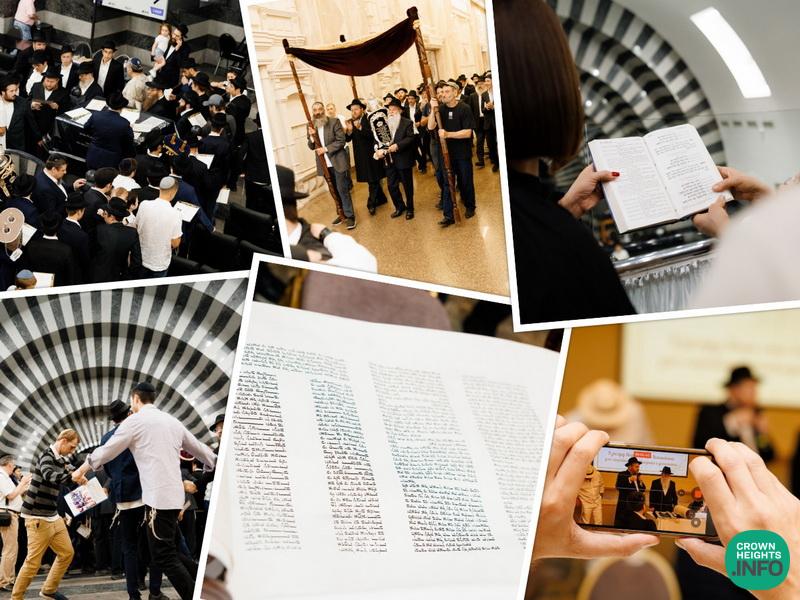 CrownHeights.info6 days ago
A significant and joyous event took place in the Dnipro Jewish Community – the completion of writing and the ceremonial donation of a new Sefer Torah to the Chabad community of Vinnytsia, in the merit of Igor Kolomoisky, son of Zoia, for his speedy release and long life, from his friends and the Dnipro Jewish Community.
The solemn ceremony of completing the Sefer Torah, hosted by Rabbi Moshe Leib Weber, was held in the “Ball Room” of the world’s largest Jewish center, “Menorah.” It was attended by numerous members of the Dnipro Jewish Community, a delegation from the Vinnytsia community led by the city’s Chief Rabbi Shaul Horowitz, as well as students and teachers of the “Tomchei Tmimim Yeshiva Ktana Ukraine” led by Rosh Yeshiva Rabbi Eliyahu Heifer. The Sefer Torah itself was written by the National Sofrut Center under the direction of Rabbi Reuven Margolin.
Addressing those present were the Chief Rabbi of Dnipro and the region, Shmuel Kaminezki; the Chief Rabbi of Vinnytsia, Shaul Horowitz; and one of the leaders of the revival of Jewish life in Ukraine, esteemed community member Reb Yitzchak Fridman. They emphasized the immense significance of this event both for the Vinnytsia Jewish community and for strengthening Jewish unity and fulfilling the high mission of Tikkun Olam – the spiritual perfection of the world.
The right to inscribe the final letters of the new Sefer Torah was granted to many members of the Dnipro Jewish Community. This is considered not only a great honor but also a special merit, the significance of which was repeatedly emphasized by the Leader of our generation – the Seventh Lubavitcher Rebbe, Menachem Mendel Schneerson.
After the writing was completed, the Chief Rabbi of Vinnytsia, Shaul Horowitz, lifted the Sefer Torah, and Reb Yitzchak Fridman dressed it in a festive mantle and crowned it with a crown. Then, under a wedding canopy – a Chuppah – the new Sefer Torah was solemnly carried through the galleries of the Menorah Center. The festive procession then made its way through the historic Jewish quarter of Dnipro and brought the Sefer Torah through the main entrance into the “Golden Rose” Central Synagogue, where traditional hakafos took place.
“I want to express my deep gratitude to the unique Dnipro Jewish Community and personally to its Chief Rabbi, Shmuel Kaminezki, who do so much for the development and strengthening of Jewish life not only in their own city but also help other communities. This support is especially valuable in these challenging times,” noted Chief Rabbi of Vinnytsia Shaul Horowitz. “We accept this Sefer Torah with immense gratitude and love. It will become a sacred treasure for our community and yet another symbol of the unbreakable bond between the Jews of Vinnytsia and the united and cohesive Dnipro Jewish Community under the leadership of Chief Rabbi Shmuel Kaminezki.”
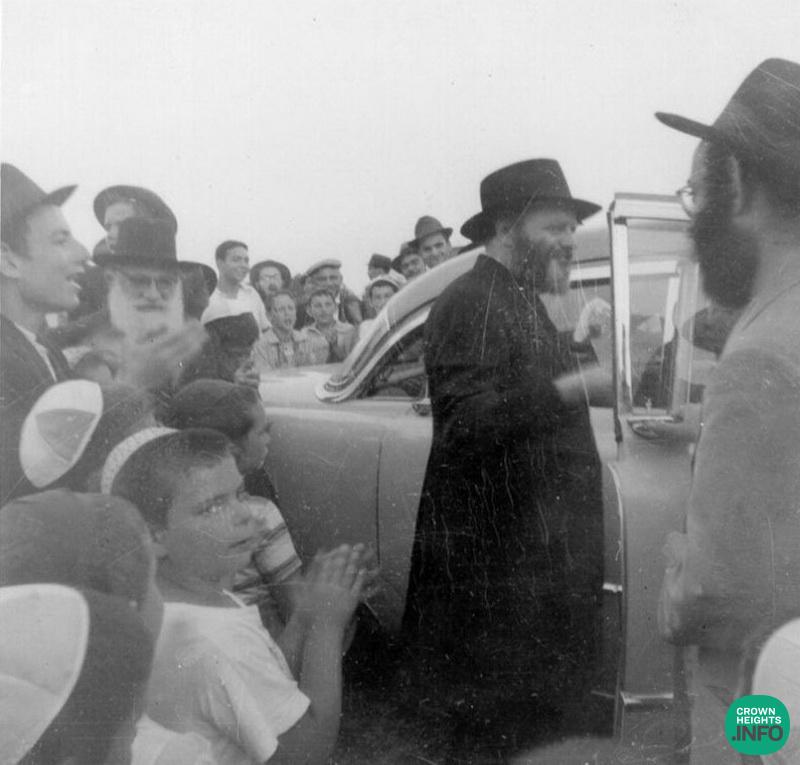 CrownHeights.info6 days ago
A Remarkable Message Hidden in the First Week of the Three Weeks
As we begin mourning the breaching of the walls of Jerusalem, the destruction of the Beis Hamikdash, and our long and bitter exile, this week’s Parshah seems to take us in an entirely different direction.
Instead of speaking about exile, it speaks about Eretz Yisrael.
Instead of speaking about destruction, it speaks about inheritance.
Instead of speaking about what we lost, it speaks about preparing to enter the Land.
The contrast is striking.
This week we read about the division of Eretz Yisrael among the twelve tribes. Every tribe receives its portion through a lottery directed by Divine Providence. Rashi tells us that the lots themselves miraculously announced which portion belonged to each tribe.
We then meet five remarkable women—the daughters of Tzelafchad.
Their request was simple, yet extraordinary.
“Our father left no sons. Why should our family lose its share in Eretz Yisrael?”
They were not asking for wealth.
They were asking for a portion of the Holy Land.
Earlier in the wilderness, it was the men who accepted the discouraging report of the spies and recoiled from entering Eretz Yisrael. But these five women refused to surrender even the smallest connection to the Land that Hashem had promised His people.
Hashem’s response was as remarkable as their request.
“The daughters of Tzelafchad speak correctly.”
Their love for Eretz Yisrael became part of the Torah forever.
The Parshah continues with Hashem instructing Moshe to appoint Yehoshua, the leader who would bring the Jewish people into the Land. It concludes with the Korban Tamid and the additional offerings of Shabbos and Yom Tov—the very service that would one day be performed in the Beis Hamikdash.
Pause for a moment.
As we begin mourning the loss of Eretz Yisrael…
the Torah fills our minds with Eretz Yisrael.
As we begin mourning the destruction of the Beis Hamikdash…
the Torah teaches us about the Beis Hamikdash.
Why?
Reish Lakish gives us a profound insight.
Hashem never brings hardship upon the Jewish people unless He has already prepared the cure.
Usually, medicine comes after illness.
With Hashem, the medicine comes first.
Perhaps that is precisely what is happening here.
As the Three Weeks begin, the Torah itself begins administering the cure.
Before our thoughts can become consumed by destruction, the Torah reminds us what we are mourning.
It fills our hearts with love for Eretz Yisrael.
It reminds us of the beauty of the Beis Hamikdash.
It places before our eyes the daily korbanos, the festivals, the inheritance of every tribe, and the generation standing at the threshold of redemption.
The Torah is teaching us that the greatest antidote to exile is never to stop living with redemption.
This same pattern appears in the very first tragedy we commemorate on the Seventeenth of Tammuz.
Moshe shattered the first Luchos.
It was an overwhelming loss. Chazal tell us that had those Luchos remained intact, the Torah would never have been forgotten.
Yet from those shattered Luchos emerged one of Judaism’s greatest gifts.
Hashem gave us the second Luchos together with the rich world of Torah Sheba’al Peh—Halachah, Midrash, Aggadah, and the endless depth of Torah study that has sustained the Jewish people throughout every exile.
The Alter Rebbe expressed this in three unforgettable words:
ירידה צורך עליה
A descent exists for the sake of a greater ascent.
The loss remained a loss.
The pain remained real.
But hidden within the descent was the beginning of a greater revelation.
The Rebbe once illustrated this idea with a simple comment.
During a visit to Camp Gan Yisrael, he noticed a cluttered room with a sign reading “זכר לחורבן”—a reminder of the destruction.
The Rebbe commented, “Why ‘זכר לחורבן’? ‘זכר למקדש’!”
The Rebbe was certainly not suggesting that we forget the Churban.
Rather, even while remembering the destruction, our thoughts should remain focused on the Beis Hamikdash itself. Our yearning should always be directed toward what will be rebuilt.
Perhaps that is the message hidden in this week’s Parshah.
As the Three Weeks begin, the Torah refuses to let us think only about what was destroyed.
Instead, it fills our minds with Eretz Yisrael.
With the Beis Hamikdash.
With korbanos.
With Yehoshua leading the Jewish people home.
With five women whose love for the Holy Land never wavered.
Yes, these are days of mourning.
We mourn sincerely.
We mourn deeply.
But at the very same time, the Torah quietly places the medicine into our hands.
It reminds us what we are longing for.
It reminds us where we belong.
It reminds us that exile is only a chapter—not the story.
May Hashem transform our mourning into everlasting joy, as promised by the prophets. May we merit to see the rebuilding of the Beis Hamikdash, the restoration of the Divine service, and the return of all our people to Eretz Yisrael with the coming of Moshiach, speedily in our days.
Have a Shabbos of confidence – the greatest ascent follows the deepest descent,
Gut Shabbos
Rabbi Yosef Katzman
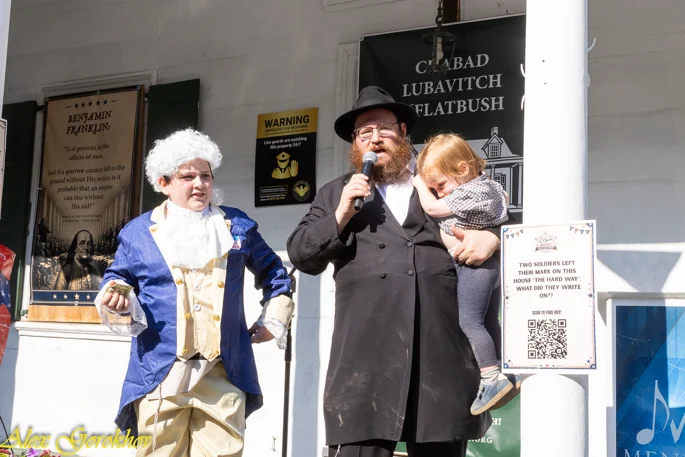 CrownHeights.info6 days ago
by Yisrael Eliashiv – chabad.org
There’s a Chabad center in Brooklyn, N.Y., where it is said that George Washington himself stayed in and stopped in for tea.
Chabad-Lubavitch of Flatbush has been housed in the Wyckoff-Bennett Homestead, a Dutch Colonial farmhouse on Brooklyn’s Kings Highway, since 2024, but the landmark farmhouse has been standing since around 1766.
The Wyckoff-Bennett Homestead is marked by its Revolutionary past. Built on what was then roughly 120 acres, the farmhouse was built in what is now Flatbush. During the war, German soldiers, colloquially referred to as Hessian, were quartered there. Two of them left their names and ranks scratched into the window glass. It was during this time, local legend suggests, that Washington passed through the property to drink tea.
For nearly two centuries, the property remained in the hands of two families before it passed in 1983 to a couple who loved history and antiques. They cared for the house until their passing, after which their children, who could not care for it, sold it.
The building later fell into serious neglect. A developer eventually took ownership, but the property deteriorated further. Historical items were removed, and squatters moved in. When Rabbi Zalman and Chana Liberow acquired the landmark in December 2024 for Congregation Chabad Lubavitch of Flatbush, the main house was empty and in disrepair. The adjacent barn, which carries an 1899 date on its beams, was in even worse condition. The Liberows invested significant resources to restore the barn as a usable space. It now serves as their current sanctuary while approvals are secured for work on the main house, where the family plans to live.
The transformation has brought the homestead more than new walls and a fresh coat of paint. Neighbors, both Jewish and not, have expressed strong relief that someone was finally caring for the long-neglected property.
The Wyckoff-Bennett Homestead as it appeared in the 1940s.
“They were so happy—everyone is thrilled that someone finally is doing something good with the property,” said the rabbi. “It’s an unbelievable feeling to get such a welcome.”
Liberow says the restored historic homestead has opened a door to those who might otherwise stay at a distance.
“The center has such a unique history that people can’t help but be interested in learning more,” he said. “We knew that when we were looking into acquiring the property, and we thought it would help us reach more people, spread more Judaism and actualize the Rebbe’s vision. That’s the main thing.”
As the country prepares to mark 250 years of independence, the Flatbush homestead is one of at least four Chabad-Lubavitch centers operating out of buildings tied to the Revolutionary War. Each followed a similar path: a structure raised for travelers, soldiers or settlers, left to decline, and then bought and restored by Chabad emissaries who have turned it into thriving centers of Jewish life.
The earliest photo of the General Wayne Inn, c. 1880. Photo courtesy Lower Merion Historical Society Archives
On a lively stretch of Montgomery Avenue in Merion Station, Pa., the General Wayne Inn still stands much as it did when it was built.
It carries with it a long and storied history. Built in 1704, the stone-and-timber establishment stood along the main road that ran from Philadelphia toward Lancaster. It was a popular stop for wearied travelers seeking rest and refreshment. A Friends Meeting House, where Quakers who opposed war gathered, was located nearby, while the inn itself served as a local gathering place for revolutionaries long before the colonies broke from Britain.
Before the Revolution, it was used as a post office for King George, and several Revolutionary War battles later took place in the surrounding area of the inn. The building’s location made it a natural stop for those moving through the region during those decisive years, which is why historians believe that General George Washington and other Revolutionary leaders almost certainly used the inn for their purposes.
Today, the same building stands but serves a very different purpose. In 1999, Rabbi Shraga and Michal Sherman, directors of Chabad of the Main Line, opened a small storefront on Montgomery Avenue to serve the growing Jewish community. It wouldn’t take long for them to need bigger accommodations. By 2005, the former tavern had stood empty for several years after a difficult period. The Shermans and the community saw an opportunity, and they purchased the landmark. After careful renovations, the historic inn was turned into a synagogue and community center while preserving its historic character.
The once-dilapidated structure in a very Jewish neighborhood is now bustling. Its location on a busy stretch of Montgomery Avenue, where thousands of cars pass each day, gives the center strong public visibility. People who might never have entered a synagogue notice the activity and sometimes stop in. What was once a roadside pub now hosts Shabbat services, classes and holiday programs that welcome Jews of every level of observance.
The General Wayne Inn in its current form, serving as the base of Chabad of the Main Line.
The former Three Bears property in Westport, Conn., evokes the memory of earlier American travels. Parts of the building date back to its days as a stagecoach stop. For more than a century, it operated as a well-known restaurant and inn, hosting weddings and community gatherings.
Rabbi Yehudah Leib Kantor, of Chabad of Westport, recalled the building’s closeness to the road. “You can almost imagine people pulling off and coming into the tavern,” he said.
The former Three Bears property in Westport, Conn., now home of Chabad of Westport.
When Chabad acquired the landmark around 2012, the Kantors had already been serving the community since 1997 from various temporary spaces.
The rabbi described the timing of the move as a miracle.
“G‑d leads the footsteps of man,” he said. “It was available, and its historic nature, plus the very open parking arrangement, really lent itself well to our needs.”
Chabad of Westport carried out a careful renovation that preserved the exterior and some original interior elements. As a result of their careful work, they received a historical preservation award.
The building’s historic sign now hangs inside the property. Kantor explained the intention behind keeping these traces of the past: “We have taken the old sign, the Three Bears restaurant sign, and we’ve put it inside the building to preserve some of the history,” he said. “The point of taking a historic site and making it relevant today with traditional values of the past really blend together in a beautiful manner. Because you’re really bringing the past into the present to create the future.”
The Chabad Center of Lexington, Mass., developed in a property directly tied to the opening of the American Revolution. Ensign Joseph Simonds lived on the site, 9 Burlington St., at the time of the Battle of Lexington on April 19, 1775.
Lexington’s Chabad House was the residence of Ensign Joseph Simonds at the time of the Battle of Lexington on April 19, 1775.
The Simonds family had settled in the area generations earlier and were among the major landowners in the northern part of town. Lexington itself is known as the Birthplace of American Liberty, the place where the first shots of the Revolutionary War were fired on the Battle Green.
The house remained a private residence for many years. It passed through different owners until the Chabad Center of Lexington acquired the property in 1985. The center, founded by Rabbi Alter Bukiet and Mrs. Sarah Bukiet, with their children Rabbi Yisroel and Mali New serving as associate directors, hosts a preschool, Hebrew school, adult education, synagogue services and community outreach. The center has since expanded to include a purpose-built facility on the same property.
In these historic structures, what was once a tavern, farmhouse, stagecoach stop or colonial home now serves as a place of Jewish prayer, learning and community building.
This pattern is consistent throughout; they are not preserved as museums, but serve as active centers where families gather for Shabbat, children attend classes, and neighbors find community.
The lights that once guided travelers and soldiers now guide a different kind of journey—one that keeps the past alive by making it relevant in the present.
For Kantor, the connection between the historic buildings and their current usage runs deeper
than architecture.
“This is a country that was built on religious freedom,” he said. “The founding fathers had the Biblical values in mind. To be living here with pride and with all the liberties, not freedom from religion but freedom of religion, is a very powerful thing in a very special place in the world. It’s an opportunity to create light and spread it outwards.”
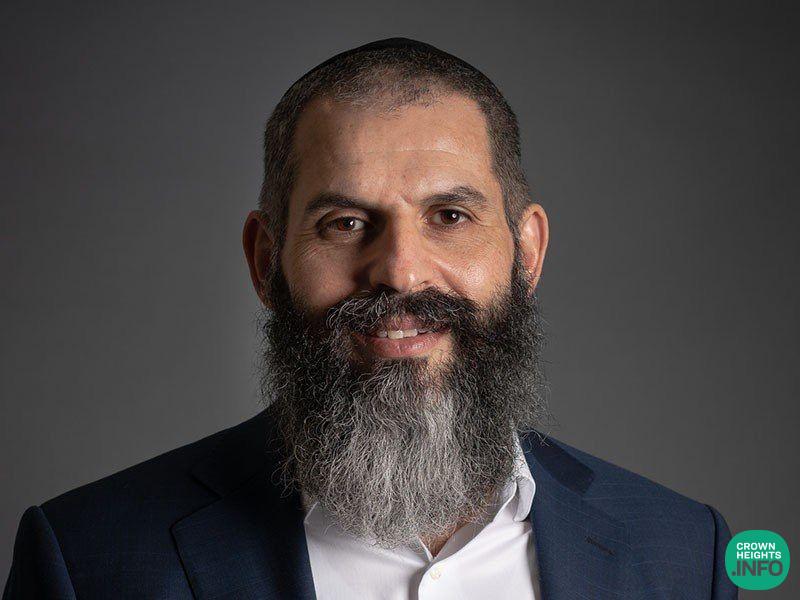 CrownHeights.info6 days ago
Mr. Eliyahu Kholedenko, Founder and CEO of Questrade Financial Group, will join this year’s Kinus HaMechanchim, bringing with him a demonstrated commitment to advancing Chinuch through meaningful initiatives and support.
In recent years, Mr. Kholedenko has played a significant role in strengthening Chinuch, including funding a major initiative dedicated to supporting Chinuch programs and backing the development of innovative AI-driven tools designed to enhance educational outcomes. His involvement reflects a forward-thinking approach to addressing the evolving needs of today’s classrooms.
The annual Kinus HaMechanchim will bring together mechanchim, principals, administrators, and school leaders for two days of professional development, practical guidance, collaboration, and inspiration.
During a general session, Mr. Kholedenko will hear directly from mechanchim about their experiences, the challenges they face, and the areas in which additional resources and support are most needed. The session will provide educators with an opportunity to share their perspectives and help strengthen understanding of the needs of the broader Chinuch community.
A highlight of the Kinus will be the banquet, where Mr. Kholedenko will serve as a featured speaker, addressing attendees and sharing his vision for the future of Chinuch and the role of innovation and partnership in supporting mechanchim.
Since founding Questrade in 1999, Mr. Kholedenko has grown the company into one of Canada’s leading financial institutions. Alongside his professional accomplishments, his commitment to Chinuch is deeply personal, and he continues to invest in initiatives that empower educators and strengthen schools.
“Strong Chinuch depends not only on the dedication of our mechanchim, but also on committed individuals who recognize its importance and are prepared to invest in its future,” said Rabbi Mendy Kotlarsky, General Chairman of the Merkos Chinuch Office. “Bringing together educators and supporters of Chinuch creates opportunities to listen, build meaningful partnerships, and provide mechanchim with the resources they need to succeed.”
Mr. Kholedenko’s participation reflects the Kinus’s broader mission of connecting mechanchim with Rabbonim, educational leaders, professionals, and supporters who share a commitment to strengthening Chinuch.
The Kinus HaMechanchim will take place י״ד–ט״ו מנחם אב | July 28–29 at the Armon Hotel in Stamford, Connecticut.
Registration is still open.
Register now: kinus.chinuchoffice.org
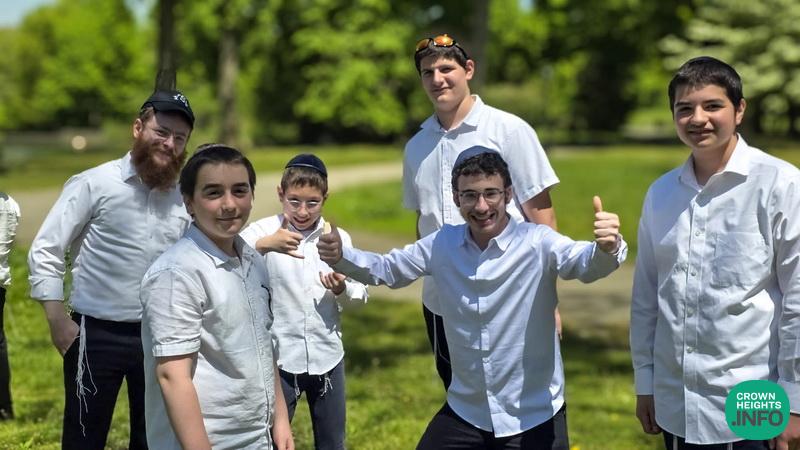 CrownHeights.info7 days ago
by Rabbi Gershon Avtzon – Cincinnati, Ohio
It is now the summertime, and many children are already in for camp — while many other parents are still deciding whether to send theirs. Parents weigh all kinds of considerations. Some are practical (for example: can they afford the camp tuition?) and some are emotional (for example: is the child mature and independent enough to go?). These are valid concerns, and they should first be discussed between the parents and then, if necessary, with the family Rav or Mashpia.
In this article, I would like to openly address a few concerns that are, in my opinion, not valid — and that can even be counter-productive in the long term.
**“I Need My Child’s Help at Home”
**Some parents — consciously or subconsciously — have a hard time letting their children go to camp because they have come to rely on them at home. This is especially true of daughters who help care for younger siblings. Before addressing why this is so problematic, I would like to share a story of the Rebbe that I heard first-hand. I will not be sharing names, but I personally verified the story.
There was a girl — today, baruch Hashem, already a grandmother — who grew up as the oldest of a very large family. Her parents were blessed with many young children, and she became a “second mother” of sorts to her siblings. When she was around ten years old, her friends signed up for camp and she was unsure what to do. She really wanted to go, and had she told her parents, they would gladly have sent her. But she felt guilty about leaving her “job” at home and adding so much pressure on her mother.
Growing up in a Chassidishe home, she had heard many times from her parents that whenever a Chassid has a question, they write to the Rebbe. Knowing this was a question her parents would never send in on her behalf, she wrote the letter herself and personally delivered it — without their knowledge — to the Rebbe’s mazkirus (office).
A few days later, she came home from school to find her father waiting by the door, visibly agitated and nervous. He asked her directly whether she had written anything to the Rebbe. Seeing that “the game was up,” she told him the whole story. Her father had just received a call from the Rebbe’s office with an answer for his daughter, and was completely taken by surprise. The Rebbe answered clearly: the daughter should go to camp.
It is so important for us, as parents, to recognize the pressure and guilt that some of our children are quietly living with. If we do not actively encourage them to simply be kids and carefree, we risk causing them to age and mature before they truly should. Beyond missing out on important social interactions and joys, they can begin to harbor a subconscious resentment toward their parents and toward parenting in general. The effects on their short-term and long-term development — both as individuals and, one day, as parents themselves — can be very real.
**Our Own Insecurities and Anxieties
**Too many parents struggle to “let go” of their children. Their own anxiety and need for control prevent them from allowing their children to separate and grow. There is a genuine debate about what age a child should first leave home for overnight camp — and, truthfully, every child is different — but the debate should only be about “when,” not “if.” (The exception, of course, is a child who genuinely does not want to go, which is a whole separate discussion.)
I do not like to be so blunt, but it needs to be said: parents who “over-protect” their children and refuse to separate at any point are usually struggling with their own separation issues and anxieties. Our children do not deserve to suffer because we are unwilling to properly deal with our own challenges. When the camp discussion comes up, we need to be honest about whose interests we are really protecting — our own, or our children’s.
**What the Rebbe Taught Us About Camp
**We must always remember how strongly the Rebbe encouraged overnight camps and the tremendous benefits our children gain from them. There are, of course, things that can always be improved, and some valid concerns that deserve to be addressed (a separate article and discussion, iy”h). But on the whole, camp is a transformational experience on so many levels.
Just consider this:
After accepting the nesius (leadership) of Chabad, the Rebbe never left New York City — for any reason.
The only exception was the Chabad overnight camps.
That alone should make us realize just how important these camps are in the chinuch of our children.
Please feel free to share your thoughts on the above with me by email: [email protected].
CrownHeights.info7 days agoNow during the period of the Three Weeks and a time when Jews are experiencing increased antisemitism worldwide, we share a letter of the Rebbe in which he gives us the proper and practical perspective on the matter and his advice.
By the Grace of G-d
19th of Av, 5742
Brooklyn, N.Y.
Mr.
Beverly Hills, Ca. 90211
Greeting and Blessing:
I received you r letter with enclosures.
Many thanks for the good news it contained about your plant to set up a suitable memorial for your father of blessed memory.
No doubt you know that one of your father’s good customs was his involvement with the annual Mo’os Chittim Fund under the Lubavitch-Chabad Program in Chicago, conducted by the late Rabbi S.Z. Hecht of blessed memory. Thus, your proposed plan is very much in the same spirit. Of course, all matters of goodness should be on the ascendency and should not be limited to any particular day or period of the year, inasmuch as our _Tora_h and mitzvos are “our life and the length of our days.” And life is, certainly, a continuous process. I am confident that you will be successful, as your father was, in carrying out this good work.
I might add that the general Jewish situation has, regrettably, not improved since the days of your father, which calls for increased efforts in matters of Yiddishkeit in general and in the area of tzedoko and kindness, including social services in particular.
You mention in your letter the matter of “Terrezin Requiem.” There is no need to point out to you that anti-Jewish feeling has recently grown worse and there seems little Jews can do to improve that feeling. What is important, however, is to remember that the best memorial for our Martyrs, who died because of their Jewishness Al Kiddush HaShem, is the strengthening and spreading of Yiddishkeit everywhere.
Wishing you hatzlocho in all above, as well as in all your personal affairs, both materially and spiritually.
With blessing,
P.S. No doubt you know that for reasons beyond my control, private audiences have not been renewed yet. However, in keeping with the tradition of your family, you surely know that the best personal contact is by way of promoting the programs and institutions of Chabad-Lubavitch in an ever growing measure.
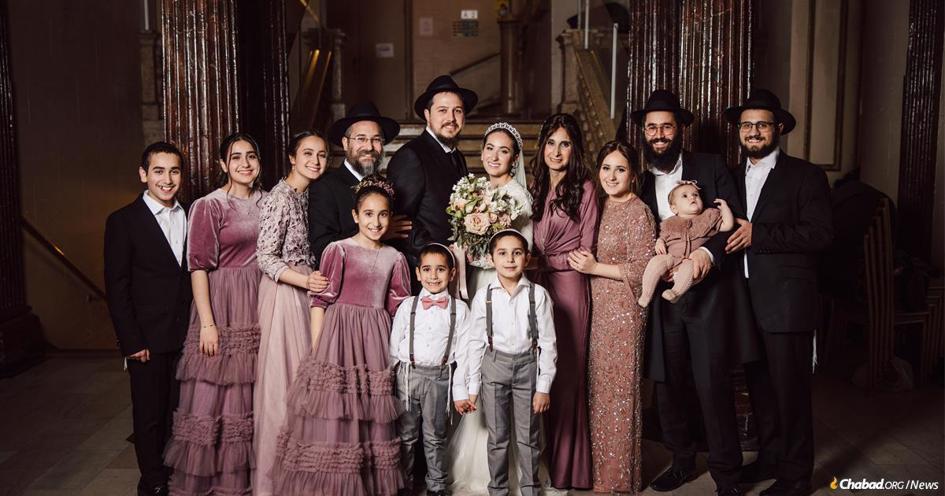 CrownHeights.info7 days ago
by Faygie Levy Holt – chabad.org
When Devorah Leah Reiter gathered women in her home every Thursday to recite Psalms together, she had one instruction: no sadness, no tears. After the prayers, she would share a Torah thought from the Rebbe—Rabbi Menachem M. Schneerson, of righteous memory—even as it grew increasingly difficult for her to speak. Then the women would get up and dance to the song “Thank You, Hashem.”
This was not the action of someone in remission. Reiter was in the middle of a seven-year battle with cancer, and she was running a Torah study and prayer circle, thanking G‑d for the many blessings she was able to enjoy even as she battled the cancer that would take her on 27 Iyar, 5786 (May 14, 2026).
For 25 years, Rabbi Yaakov and Devorah Leah Reiter helped build Chabad-Lubavitch of Roslyn on Long Island and a warm community around it. On top of her role as a mother of nine children and a community leader, she was also, by every account of those who knew her, someone who had mastered an almost impossible act: making her own pain invisible so that those around her could feel whole.
Rabbi Yaakov and Devorah Leah Reiter at a Purim event they organized for the community in Roslyn.
Devorah Leah Gottlieb grew up in Crown Heights, N.Y., the heart of the Chabad-Lubavitch community. The only biological child of her mother, Yaffa Leba Gottlieb, and adopted by her mother’s husband, Rabbi Yaakov Gottlieb, she was raised in a home that was open in every sense—to foster children, especially children with Down syndrome, whom her parents adopted. The acceptance and love she saw at home proved formative and made a lasting impression.
Her childhood friend Yehudis Wolvovsky remembers Devorah Leah as being, from a young age, oriented toward her neshamah, her soul, in a way her peers were not.
“She always had a spiritual side,” Wolvovsky says. “We all had a great time together and did all the things that kids do, but Devorah Leah was on a different plane.”
She was also deeply intentional about her relationships.
“She is just the only friend who would say ‘I love you.’ She connected with people and worked hard on relationships. We, her friends, felt like we were her sisters.”
After high school, their paths ran parallel. They attended the same post-high school seminary program, married men who were close friends, had children and went on to found Chabad Houses—the Reiters to Long Island, the Wolvovskys to Connecticut. They watched each other’s children grow up and, in recent years, became grandparents.
Devorah Leah Reiter shares a Torah thought during the weekly gatherings she hosted to pray for those who need healing.
When Reiter was 40, she got the dreaded cancer diagnosis. After it recurred and metastasized as an advanced stage-four illness, several doctors told her and her husband to, as her daughter Mushka Bernstein recalls, “go home, get comfortable, there’s nothing we can do.”
Not easily discouraged, the couple found another doctor who disagreed. Unlike the other doctors, he had an optimistic attitude that gave comfort to the Reiters, as did his belief that as a doctor he is an emissary for healing.
“According to the scans, the doctor said it didn’t look good. And because she was physically small, he didn’t know how her body would handle chemo, but she was determined to fight and see to it that her husband had a wife and her kids had a mother,” says Bernstein, who serves as a Chabad emissary in Toronto. “The only reason she fought all these years is for her kids; she said that many times over. It was always her thing: I need to make it to one bar mitzvah at a time, one wedding at a time.”
She made many of them. And between them, she kept working.
Before her illness, Reiter had been a preschool teacher, ran Friendship Circle for children with different needs, and co-directed many programs at Chabad of Roslyn with her husband. The question, once she was sick, was what she would do now.
“Instead of being depressed and not doing anything, she decided to do what she could,” says Bernstein.
Her family says that she deeply believed that the situation she was in was for the good and that there was a purpose behind it. She sought to find that purpose, and as an emissary began looking for ways to use her illness and what she was going through to help others.
During a Circle of Kindness visit.
To start, she founded the Circle of Kindness—now Devorah Leah’s Circle of Kindness. The aim was, and continues to be, to help families facing a cancer diagnosis. Devorah Leah would reach out to the families and ask them what they needed, be it a car ride to chemo treatments or a bowl of chicken soup. She would then reach out to her list of volunteers, many of whom were friends in the community, and pair up the families with a friend. Volunteers with the Circle of Kindness also packed and delivered holiday packages for the families.
Reiter would use her own experiences and find things that helped her cope with her illness to provide those who were also ill with a little relief. For instance, Reiter found massages to be helpful and she reached out to a salon to offer their service to other women who were ill.
Every step of the way, despite her own challenges, Reiter would encourage those who were also struggling with cancer. She would speak about her faith in G‑d, her bitachon, and how that was helping her. She encouraged them to stay strong and hold onto the joy, and, of course, to reach out to G‑d.
She also rallied friends for her Thursday morning “Prayer Circle,” another component of the Circle of Kindness. The women would gather every other week to pray for those in need of a refuah shelama, a complete healing. They would recite the names of each person they were praying for, making the prayers even more personal. And as they enjoyed some snacks, fruit and other treats, the women were careful to make blessings on the food in the merit that those who are sick be healed.
Members of the Circle of Kindness did it all, and continue to do so even now, while abiding by Reiter’s dictum of everything with joy.
Rosie Gottesman, who moved to Roslyn in 2019, met Reiter for the first time at a holiday meal at the Reiters’ home. She had only met Rabbi Reiter until that point and did not know about the illness. When she arrived, Devorah Leah was asleep on the couch and did not appear well. After the holiday, Gottesman called Rabbi Reiter and offered to help with carpool or errands. During the pandemic, she began driving Reiter to chemotherapy appointments herself, and the two women grew close.
“She was purely nonjudgmental. She opened her house to me and my husband and my son,” Gottesman says. “I always told Devorah Leah I owe everything to you. I was in such a bad place and the Reiters turned my life around—no question.”
Visiting seniors from her community.
Throughout everything, Reiter held firm to one conviction: suffering was not a reason to be sad. She told everyone around her to approach her illness besimchah, with joy, and she meant it.
“She believed deeply that that was what was going to help her,” says Wolvovsky.
When she was admitted to the hospital, she would tell her children that G‑d had a plan, and it would be fine.
“She was always positive. She didn’t show us any upsetness,” says Bernstein.
She also held firmly to the belief that her own struggles did not diminish anyone else’s—that her friends’ ordinary concerns were just as worthy of her attention as a terminal diagnosis.
“I always just want you to be my friend and share things with me,” she once told Wolvovsky.
Even as her voice weakened near the end, she stayed attuned to her children’s and friend’s lives in fine detail.
Says Gottesman, “She brought us all together. I have friends in Roslyn only because of Devorah Leah. Toward the end, I went to visit her twice a week, and even though she wasn’t talking, you still felt she was connected to you. She was a selfless woman who was always here to help everyone else, no matter what was going on in her own life, and that is truly hard to find nowadays. You don’t see women like her.”
In addition to her husband, she is survived by their children: Mushka Bernstein (Toronto); Chana Wagner (Portugal); Mendel Reiter, Sara Reiter, Esther Miriam Reiter, Tzvi Reiter, Fraidel Reiter, Yosef Reiter and Shneur Reiter; and grandchildren. She is also survived by her parents, Yaakov and Yaffa Gottleib (Brooklyn, N.Y.), and Mordechai Banayan; in-laws Dr. Levi and Raizel Reiter; in addition to her siblings.
 CrownHeights.info7 days ago
On Saturday, President Donald Trump’s administration plans to launch Trump Accounts, tying the 250th anniversary of the signing of the Declaration of Independence to an effort to boost financial independence for American kids.
Under the program, parents can open investment accounts for any child born during Trump’s second term and automatically receive $1,000 from the government. Accounts can be opened on behalf of older children — as long as they don’t turn 18 before the end of the calendar year — but they will not receive the $1,000.
That money — and anything else deposited by employers, philanthropies and relatives — is invested in the stock market by private firms. Children can’t access the money until they turn 18, and then only for specific purposes, like paying for a home or school.
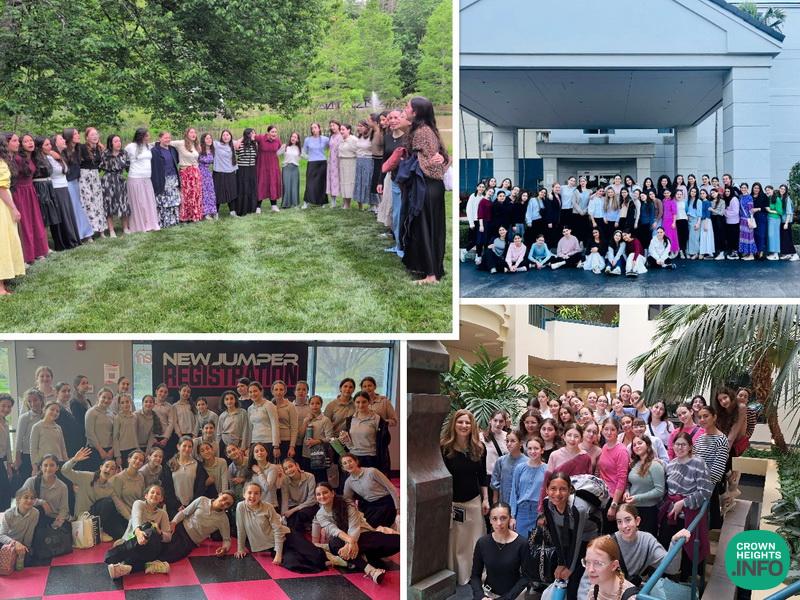 CrownHeights.info7 days ago
Summer: a time for relaxing, travel, camp, and for many parents, when they consider giving their child their own phone to help navigate all that. As mothers of The Club, proactively working to help our children experience healthy and happy childhoods, both physically and spiritually, we put together some information for our school’s magazine that we hope will be useful to you as you make these decisions.
Wishing you a happy and healthy summer!
—Mothers of The Club at Lubavitch Educational Center, Miami
A Mother’s Musings
Becoming a mother has an interesting way of making you revisit your own childhood. Holding my brand-new, precious baby and imagining her future naturally takes me back to a pivotal shift in my own youth.
When I was in Middle School, I begged and begged my parents to give me a phone. It felt like all my friends had one and there was so much happening on social media. Calls, group chats, games—a whole life I was missing out on.
So they gave me one. My friends and I didn’t have them in school but the day ended, we took them out. Much of the time, in the carpool line, at home, on the bus, at sleepovers, on weekends, we were on our screens instead of talking to each other or our families. I scrolled, checked, and watched for longer than I meant to.
I remember how I would check my phone every two minutes. Sometimes I’d stay up until two in the morning even when my parents thought I was sleeping because the phone was right next to my bed and the green light kept blinking, and I couldn’t make myself put it down.
Even WhatsApp wasn’t just messaging. I always checked my friends’ Statuses to see what they were doing. A lot of times it made me feel sad and left out, like my life wasn’t as fun as theirs. I posted on my Status too. And then I checked, and checked, and checked who saw it and who liked it and worried about it. The group chats never, ever stopped and kids shared things I wouldn’t have chosen to see—and now I can’t unsee them. I had access to all of it.
It felt like everyone was watching me, all the time. I felt a constant pressure to look a certain way. Even when my phone was in my pocket, the worries about how I fit in and measured up moved to my head.
Looking back, those short videos that went around did something to my concentration. My brain learned to expect something new every few seconds. Sitting down to read a book, listen to a teacher, or even have a regular conversation, felt almost impossible some days. My homework took twice as long as it did before my phone.
My parents and teachers were teaching me how the value of every person is intrinsic, from Hashem, and how externalities don’t truly define us. But on my phone, views and likes seemed so important. While I was learning that what is real about a person isn’t their followers or vacation picture but who they truly are on the inside, their essence, my phone was focusing only on appearances.
Now that I am beginning the journey of raising my own children, I want to give them the best that I can. I know that the habits they form as children are wiring the brains they will carry for the rest of their lives and I want to make sure they’re healthy ones.
Thankfully, there’s a lot I can do, starting with my own behaviors, though it won’t always be easy.
Looking at my child’s sweet face, I think: my phone influenced my past. Now I will take that experience and use it to shape my family’s future for the better.
Just Consider…
The Rebbe viewed modern technology as a useful tool to elevate the world, but one that must be used with caution. The Rebbe utilized live satellite hookups to broadcast farbrengens and encouraged Torah to be taught on the radio, but he also spoke out repeatedly against having a television at home, pointing to its “destructive influence on youth,” and the immorality that is inevitably transmitted. (—Likutei Sichos Vol. 18, p. 459-61)
Technology is like everything else in the world: it exists only for Hashem’s honor, to be used for Torah and mitzvos. “The ultimate purpose for which these new technologies were developed,” the Rebbe teaches, “is that they be used for holy purposes… The fact that they can also be used for mundane purposes, and even things that are the opposite of holiness, is to facilitate free choice… and Hashem commands, requests and grants the capacity that ‘you shall choose life.’” (—Toras Menachem Hisvadius 5742 Vol. 4, page 2150)
This principle is what we are trying to live by now: use technology where we are in control of it, as a tool for Hashem, and keep out of the home anything that controls us or brings us to negativity. Smartphones for kids, with social media and apps—whose sole goal it is to capture our attention and keep us scrolling, and where access to content that is against kedusha is a swipe away—falls on the other side of the line. When a human being is using technology, good can come from it, but when technology is using the human being, no real good can come of it.
Because even when technology can be harnessed for kedusha, it has to be used with caution and limits to keep it holy.
What We Can Do
Let your children be bored, send them outside, and do not rescue a bored child with a screen. Boredom is the birthplace of creativity, resilience, and imagination.
Fill your child’s time with real-world things first, like library trips, baking, LEGO, sewing, journaling, a musical instrument, or dance—so the screen just isn’t necessary for entertainment.
Use a dedicated family phone for kids who need to be reachable: a landline through Google Voice or your internet provider, or a basic flip phone they can borrow.
Use standalone, single-purpose devices for music and stories: 24six and Naki Radio for kosher music and radio; screen-free audio players; a basic Kindle for reading only.
Put real filters on every device: TAG South Florida helps families set up filters on phones, computers, and home WiFi; Google Family Link and Apple Screen Time are free; Circle Home Plus and the Xfinity app cover the whole network, including turning the internet on and off by device.
Keep all screens in public spaces, never behind closed bedroom doors. Presence is protection.
No phones at mealtime, parents included.
Research any new app before you approve it. Common Sense Media gives quick reviews on apps and sites.
Phone Alternatives
Thankfully, the choice today isn’t between a smartphone or nothing. A growing number of non-smartphone options let you stay in touch with your child without giving them a portal to social media and the open internet:
Though The Club does not recommend a smartphone at all, if your child does have one, consider using a managed iPhone which locks the phone down to a specific allow-list of apps (like Waze, Uber, banking) and disables social media and the open internet.
Here are two local Florida options:
About MUST & The Club
Our LEC community has built two initiatives that work to make it possible for a family to say no to a smartphone and social media without leaving the child feeling left out. We encourage parents in other schools to consider starting their own chapters!
MUST (Mothers Unite to Stall Technology) is a delayed phone use agreement for parents of elementary-aged children. It works because the “everyone has one” argument stops being true the moment a few other families in the grade are choosing the same path. Starting a parent pact in your child’s class only takes one other parent.
The Club is the parent-run, parent-funded initiative at LEC for girls who have chosen, together with their families, to live without a smartphone and without a personal social media account. Founded by mothers Rivkah Bloom and Esti Chazanow, it partners closely with the school, which provides in-school time for programming, incentives, and direct engagement with the girls. The Club currently runs in the LEC Girls Middle School and Beis Chana High School, led by groups of two to three parents in each grade. The original cohort just completed its second year with a Grand Trip to North Carolina.
Over 175 LEC students are currently benefitting from being part of The Club!
The clearest sign that the culture is taking hold came recently from an eighth grader whose older siblings each got phones at the start of ninth grade. She told her mother she does not want one and her closest friends do not have one. The pressure she feels is not to get online, but to stay off. We’re very proud!
Contact your child’s division to join or start The Club for their grade!
LEC gives a heartfelt thank you to the incredible Club mothers whose dedication, advocacy, and leadership have brought greater awareness and meaningful action to LEC: Mrs. Chanale Altein, Neomi Bialo, Rivkah Bloom, Esti Chazanow, Touba Fitzig, Gitty Freedman, Chana Gopin, Chanale Kornfeld, Dina Kranz, Shaynee Kroker, Rivky Rodal, Chana Rubashkin, and Rochel Zuckerman.
 CrownHeights.info7 days ago
Mr. Yitzchok Kosofsky
Click here for a PDF version of this edition of Here’s My Story, or visit the My Encounter Blog.
One hundred years ago, there were many Lubavitcher chasidim living in the Midwest; not just in Chicago, Illinois, but also in smaller cities in Wisconsin like Manitowoc and Sheboygan.
But for the most part, the more observant Jewish immigrants who came to America before World War I were reluctant to travel further west than New York; Chicago had some Judaism, but not as much, nor as strong, as New York. There was no yeshivah in Chicago until the early 1920s, when the Beis HaMidrash LaTorah, also known as the Hebrew Theological College, was founded; and there was no day school until the late ‘30s — which was when I started going to school.
One of the schools founded at around that time was connected to Bnei Ruven, one of the bigger Chabad synagogues in Chicago, and it was just two blocks from my house. So when I was seven or eight years old, my parents took me to the Bnei Ruven Talmud Torah, as the school was called, and registered me to come and study Torah there every afternoon, for two dollars a month.
When the Previous Lubavitcher Rebbe came to visit Chicago in 1942 — his second time there, after an initial trip to America in 1929 — I was eleven years old, and I remember going with the school to visit him. We took a “street car” trolley to the Graemere Hotel on Washington and Homan, and waited in the lobby until it was our turn to have an audience with him.
The following year, around the time I graduated from the Talmud Torah, a few chasidim the Previous Rebbe had sent to Chicago started a new yeshivah. I studied there with Rabbi Avraham Hershberg and Rabbi Yosef Wineberg, as well as with Rabbi Sholom Posner, for a few months before this yeshivah was founded. And although this yeshivah only lasted for a year or two, these people made a very big impression on me, and brought me even closer to Judaism, and to Lubavitch in particular. As a result, I continued to study Torah at night in the Beis HaMidrash LaTorah yeshivah even when I went on to attend a secular high school, went to college, began working, and got married.
In 1950, the Previous Rebbe passed away and was succeeded by his son-in-law. In 1951, my wife and I got married, and four years later, I finally met the Rebbe in person.
It was the summer of 1955, and I had just gotten a car, so on July 4th weekend — which that year fell out on the 12th of Tammuz, an important day on the Chabad calendar — I decided to drive in to see the Rebbe in New York. In those days, it took nearly twenty-four hours to drive from Chicago to New York.
I stayed in Boro Park and made the long walk into Crown Heights with a friend on that hot Shabbat afternoon in order to attend the farbrengen. Afterwards, I had a private audience with the Rebbe in which he instructed me to start studying the teachings of Chasidut, and specifically the Tanya, the classic work from the Alter Rebbe, the first leader of Chabad.
When I went back to Chicago, I called Rabbi Dovid Moshe Lieberman to schedule a regular study session with him and a friend, and we continued studying chasidic discourses once a week for many years after that.
While Rabbis Posner, Wineberg, and Lieberman had a big influence on me in terms of my personal growth and connection to Judaism, some of the younger yeshivah students I met over the years, like Bentzion Schaffran and Naftoli Berg, would encourage me to take on different Lubavitch activities. Among them was helping to produce chalav yisrael milk for the Midwest. According to the letter of Jewish law, in order for milk to be kosher, it must be under proper supervision during the milking process, to ensure that no milk from non-kosher animals has been mixed in. However, for decades, drinking unsupervised milk had become common in America, even among observant Jews.
In the early ‘60s, I tried to arrange chalav yisrael milk, but most of the dairies I called were not interested. The amount of milk we needed for people who were willing to pay extra for chalav yisrael was nothing compared to the size of their production.
It was a hard journey, but finally I found a Jewish man in the dairy business who was excited about the idea. He got me a huge farm with a dairy by the Illinois-Wisconsin border, and helped us set things up to get production going. On the day before Passover, the milk finally came out, to a tremendous level of demand. And so our chalav yisrael business started.
When we wrote to tell the Rebbe about it, he replied to tell us how happy he was, especially in light of a Chabad tradition concerning this area of kosher practice. Our Rebbes taught, he wrote, that drinking chalav yisrael “strengthens one’s faith, whereas milk that is not supervised by a Jew leads to doubts in one’s belief in G-d.” In the Rebbe’s eyes, not only was chalav yisrael important for halachic reasons, but also for its effects on one’s spiritual well-being. For this reason, the Rebbe encouraged me to persevere through the many challenges we faced.
After some time, the dairy closed down, and so Rabbi Yisroel Shmotkin of Wisconsin found us another farm in that state. Then that dairy stopped, and I got milk from Minnesota; then that stopped, and we got from other places, and so it went. The business wasn’t very profitable, but I wasn’t in it for the money. “Clearly, energetically promoting chalav yisrael is fitting” — the Rebbe once wrote to me — “and it is necessary.”
Generally, I hired other people to do the supervision, and to drive the milk from the dairy in a special tank truck. One year, though, I myself had to drive the truck back from Wisconsin, on the day before Passover, which was also the day of my son’s Bar Mitzvah. There was a big snowstorm, so the highway was completely covered in snow, and you couldn’t see lines on the sides of the road. I just followed the tire tracks in front of me. Thank G-d I made it home in time to take my son to shul.
Once, during a personal audience, I told the Rebbe that the volume of milk we were selling wasn’t as great as we had expected. People either didn’t know about chalav yisrael — some thought it meant the milk had come from Israel — or didn’t think it was important.
“How come we didn’t need to have chalav yisrael until now — and now we do?” they would say.
The Rebbe suggested a counterclaim: “Up until now you didn’t have a television,” I could tell these people, “— and now you do!” That is, when something better comes along, you accept it; chalav yisrael represents an advancement in Jewish observance, so you should grab it.
And so we were able to take something that was distant from most people, bring it close and make it available. Since those days, other people have taken over this work, and chalav yisrael is now widely available in Chicago. Today, many growing Jewish communities throughout the Midwest rely on this milk. In a 1961 English letter, the Rebbe wrote to me that with “proper organization,” chalav yisrael has “good prospects, not only spiritually but also materially, especially as the circle of observant Jews has been widening in recent years, and consequently also the circle of potential users of milk products under strict Jewish supervision.”
An accountant by profession, Mr. Yitzchok Kosofsky spearheaded a number of community initiatives over the eighty years he lived in Chicago. He was interviewed in July 2015. He passed away in 2020.
 CrownHeights.info7 days ago
Today’s video goes through the Har Habayis; from its size to the 5 different entrances to it. You will also see the size of the Har Habayis relative to the area around 770.
Link to the quiz https://ispri.ng/yMn2N
Link to join the WhatsApp group https://chat.whatsapp.com/GVaB819H9hPFwL6c4DEGeg?mode=ac_t
– 2 Daily raffles for those who take the quiz.
Prize 1: $50 gift card at Judaica World.
Prize 2: $36 gift card at Judaica World.
The raffles will be drawn each night at 12AM ET.
To dedicate a class and the prizes for $86 please email: [email protected]
 CrownHeights.infoCrownHeights.info7 days ago
Alternate side parking (street cleaning) and parking meter regulations are suspended Friday through Saturday, July 3rd through July 4th for Independence Day.
 CrownHeights.info7 days ago
“I don’t mind if he kicks me”, “I don’t mind if he punches me”, “I don’t mind if he sits on me as though he is riding a horse”.
I hear these things all the time from students to whom hurtful or inappropriate behavior is being done by another child.
This is usually said in scenarios where a child can easily get away with what he’s doing. Take for example: when a child sits on another child, when a child holds another boy’s hands and does not let the boy go. Often, the boy who the behavior is being done to is smiling too.
A child smiling is one of the most deceiving things.
As people, we smile when we feel good. But we also smile when we feel shame, when we feel a loss of control, or when we don’t have the words to deal with the current situation.
As counselors and recess monitors, we tend to sit with our hands folded until a child speaks up with a complaint. Often, it is only when a child walks up to us and says that someone is bothering him that we check out what’s going on. Too often, until a child complains, we assume everything happening is just a game.
On a personal note, as a child, I never told a staff member that I was not okay with being kicked when I was sitting and playing Monopoly on the floor of the hallway.
This was notwithstanding the fact that there was unbearable pain that I felt at the time. I often smiled in those times when I was teased. I felt ashamed to show on my face that it bothered me. At times, instead of showing a man’s face, I smiled and gave the impression that I was enjoying the pain. The smile was like anesthesia.
Recently, I was in shul and a young Bochur was holding onto another Bochur’s two hands as if playing a game for fun — not letting the boy go. The boy whose hands were being held onto was smiling. But I suspected that he was not okay with it.
I asked why the Bochur was holding the other Bochur’s hands this way. The Bochur released his hands and let go.
The Bochur thanked me a lot for letting his hands free. He told the other: “I told you I would get someone to help.” True story.
Kids are ashamed to say that something is not a game and that it bothers him or her.
They know that people tend to make fun of them and say: “You can’t take a joke, you’re such a baby?”
In another instance, where I knew that a boy was being bothered by another, I called him into the classroom alone during the break with the hope that without the social pressure he would be open with me and share with me how he’s being bothered. But he told me that he feared being labeled a snitch by his friends, so he refused to tell me how he was bothered.
Research shows (source: https://pmc.ncbi.nlm.nih.gov/articles/PMC7004015/) that only 55.4% of the bullied students had told their situation to someone, and much fewer had told an adult.
Dear recess monitors, please, when you see questionable behavior, call the boy to the side and ask him if it’s a game or if he doesn’t like what’s being done.
Certain behaviors like kicking another boy or sitting on top of another ARE NEVER ACCEPTABLE.
A recess monitor is not just a camera. Their job is to monitor and understand the situation, and most importantly, take action when needed.
I ask that when possible, the behavior should be stopped before a child walks over.
Dear administration, it would mean so much to me if qualified staff are hired to serve as recess monitors and are provided with appropriate pay, proper training, and the necessary resources, similar to the way teachers receive training in their field. In addition, principals should make recess a time when they are available to address the issues that arise.
Thank you for reading this article, and may we share good news, B’Ezras Hashem.
All those who are carrying heaviness on their heart from being bullied (or from anything else), I encourage you to begin — or continue — your healing journey. It is painful to heal. Do it slowly, and you will find so many rewarding moments, and with Hashem’s help, you will find steps of progress in your healing. I spent a lot of time and money working on my healing.
Thank you to all those who work day and night for the good of our school. May Hashem give you the strength to continue His work.
 CrownHeights.info7 days ago
The Crown Heights Beis Din has released a Day-to-Day Guide for the 3-Weeks 5786, along with fasting and heat-wave guidelines.
Heat Wave Guidelines:
 CrownHeights.info7 days ago
by Tzali Reicher – chabad.org
Nuchie Schapiro was sitting with his uncles, marking his father’s 21st yahrzeit in 2011, when he realized how little he actually knew about his family’s story.
The Los Angeles-based healthcare entrepreneur, now 42, was 27 years old. His father, Rabbi Levi Yitzchak Schapiro, had passed away suddenly at 41 in 1990, leaving behind a wife, four young children and a generation of students who never forgot him. Schapiro had been just 6 at the time.
The conversation at the memorial gathering was moving along rapidly as they regularly do by comfortable family gatherings, with relatives swapping names, stories and references with easy familiarity. But Schapiro stopped them every few minutes, asking for details and more more information as his uncles spoke about their family history. Who is this person to us? Where did this happen? How did they get from here to there?
“While my cousins all grew up hearing these stories from their parents, I never got that opportunity,” Schapiro says. “I knew the general outline of their stories, but sitting at that table showed me how much more I had to learn.”
He pulled out his iPhone 3, hit record and spent 90 minutes drilling them on a history he had grown up without.
“That was the first moment of gold,” he says. “And the genesis of this book.”
Fifteen years later, the resulting volume, Legacy of Resilience, is 624 pages long. Released earlier this year, it traces four generations of the Schapiro and Vilenkin families from the shtetls of Tsarist Russia through the Soviet Chassidic underground, a displaced persons camp in postwar Germany, resettlement in Ohio, and finally, in the Crown Heights neighborhood of Brooklyn, N.Y. It is a family memoir, a document of Chabad-Lubavitch history across 150 years, and, in its final hundred pages, the portrait of a father Schapiro had spent his life trying to know.
“The reality is that writing this book was the closest thing I could do to bringing him back and understanding a special man I never got to know,” he says.
The story Schapiro tells begins in the late 1700s and introduces his impressive lineage and family’s deep connection to the Rebbes of Chabad-Lubavitch over the centuries. Hundreds of meticulously gathered photographs, documents and maps guide the reader throughout the book, and the primary characters are introduced shortly into the story, beginning with Schapiro’s great-grandfather, Rabbi Shneur Zalman Vilenkin.
Vilenkin was the childhood teacher of the Rebbe—Rabbi Menachem M. Schneerson, of righteous memory—in the Ukrainian city of Yekaterinoslav (now Dnipro) in the early 1900s. The Rebbe and his two brothers would walk to Vilenkin’s home for their formative Jewish education. Decades later, when Vilenkin passed away in Crown Heights in 1963, the Rebbe attended his funeral, carried the casket to the hearse and stood at the cemetery gate for the duration of the burial. The Rebbe contributed to the funeral costs and asked that the headstone record that Vilenkin had been his teacher.
“He hut mir avekgeshtelt oyf di feet—he put me on my feet,” the Rebbe said of him.
Rabbi Zalman Vilenkin’s headstone. The Rebbe significantly contributed to the costs of the funeral and asked that the headstone note that Vilenkin had been the Rebbe’s teacher. Adam J. Leventhal / FindAGrave.com
Vilenkin daughter, Chana, married Rabbi Lipa Schapiro in 1937, joining the two family lines at the book’s center.
Educated in the underground yeshivas of the Chabad-Lubavitch movement, Rabbi Lipa moved between Soviet cities every six months to stay ahead of the secret police. In Leningrad, he secretly organized Torah classes for young adults until authorities came to his door and he jumped out the back window, spending the next three years wandering from city to city, never sleeping in the same place twice.
When World War II reached the Soviet Union in June 1941, Rabbi Lipa and Chana Schapiro found themselves separated by roughly a thousand miles.
Rabbi Lipa Schapiro and his young family spent six years as resettled refugees in Paris, although they originally planned to stay in the French capital for only six weeks.
Chana had traveled to Yekaterinoslav to visit her father when Nazi Germany launched Operation Barbarossa, violating its non-aggression pact with the Soviet Union. Rabbi Lipa was left in Leningrad as the city came under severe siege, its bridges and rail lines destroyed, trapping most residents inside. He managed to escape by boat with his father, Rabbi Nachum Schapiro, making his way eastward through Gorky (now Nizhny Novgorod), to Omsk, in southwestern Siberia, where they stopped to observe Yom Kippur among former prisoners of war, before continuing through Almaty and finally reaching Tashkent, some 3,000 miles from where they had begun.
The Rebbe, Rabbi Menachem M. Schneerson, of righteous memory, pours a cup of wine for Rabbi Lipa Schapiro during a Chasidic gathering in Brooklyn, N.Y.
Chana’s route was no less grueling. She fled Yekaterinoslav on foot and by wagon, traveling largely through forests, eventually reaching Makhachkala on the western shore of the Caspian Sea. There, her father taught Torah to refugees. When word spread that Chabad had established a foothold in Tashkent, Chana undertook the final 1,500-mile journey to reunite with her husband.
The couple had been separated for approximately a year and a half. They would spend the remainder of the war in Tashkent, where two of their children were born, having lost two others earlier.
After becoming the rabbi of the Empire Shtibel in Crown Heights, Rabbi Lipa Schapiro gave a Talmud class three times a week.
After the war, they posed as Polish refugees and crossed into Poland. They made their way through Czechoslovakia, Austria and Germany, arriving at the Pocking Displaced Persons camp in the American occupation zone. A planned six weeks in Paris became six years.
In 1953, the Vilenkin and Schapiro families were directed to Cleveland, Ohio, and settled there with the Rebbe’s blessing.
Vilenkin eventually moved to Brooklyn in the early 1960s, and the Schapiros followed in the 1970s, after leaving a lasting impression on the Ohio Jewish community. Rabbi Lipa became the rabbi of the Empire Shtibel synagogue, delivered regular classes in Torah and Talmud, and served on the Central Committee of Chabad-Lubavitch Rabbis of the United States and Canada. He continued teaching until the week he died in 2010 at the age of 97.
The Schapiro boys in Cleveland in the mid-1950s: from left, Gavriel; Leibel; Nachman, a first cousin; and Levi Yitzchok.
Naturally, Schapiro writes most poignantly of his father, Rabbi Levi Yitzchak Schapiro, in the last section of the book. A son of Rabbi Lipa and Chana Schapiro, he served as a teacher and assistant principal—first in the Bronx and then in Crown Heights, impacting hundreds of students and devoting his entire being to his work.
Rabbi Levi Yitzchok with his father and two of his brothers in 1973.
In addition to his educational work with children, he was a mentor to young families, patiently and lovingly. One of the families he formed a lifelong connection with was that of Dr. Moshe (Robert) Feldman, to whom Rabbi Schapiro became a cherished mentor and mashpia throughout the years. The Feldmans would go on to become proud Chabad chassidim, and Feldman served as a member of the Rebbe and Rebbetzin’s medical team, as well as the go-to physician for many in the Crown Heights community.
Legacy of Resilience is a memoir and a chronicle of one family’s journey through the Soviet Union and World Wars I and II. Yet it is also the broader story of the 20th-century Jewish experience and a history of the Chabad movement, as the Schapiros’ faith carried them through starvation, devastation and persecution in Eastern Europe, to rebuild in America, first in the fledgling Jewish community in Ohio, and then in the bustling Chassidic world of New York, all the while encountering noted rabbis, personalities and luminaries along the way.
Since its release, Legacy of Resilience has resonated deeply with readers, becoming Amazon’s No. 1 New Release in Jewish History through word of mouth alone.
A class photo at Oholei Torah in the Jewish year 5746 (1986). He was a teacher and then assistant principal there for 10 years.
The 90-minute recording at the yahrzeit gathering was only the beginning. Over the following years, Schapiro accumulated what he could. He contacted every relative he could find and asked for everything they had. A relative’s school social-studies project, in which students interview their grandparents, surfaced material he hadn’t known existed. Separately, a cousin had spent hours recording their grandfather’s full account of his life story on tape. Working with the United States Holocaust Memorial Museum and the American Jewish Joint Distribution Committee, and even able to reciprocate by sharing his own findings, Schapiro reconstructed the postwar Pocking chapter in unusual depth.
“People think it was freedom and a big bungalow colony,” he says. “But it was still a hard period.”
The displaced Chassidim in Pocking had to contend with kashrut challenges, competing secularist factions, and the hard work of building schools and institutions from nothing. Rebbetzin Chana Schneerson, of righteous memory, the Rebbe’s mother, was also there during this period.
Rabbi Levi Yitzchok Schapiro with his four young children on a family trip to Israel in 1988, two years before his untimely death.
His editor returned the first draft with 800 questions. It took him 11 months to address every note.
Schapiro worked on the manuscript every day for the past seven and a half years—early mornings, late nights, stolen hours after a full-time career in psychiatric healthcare, while also being there for his wife, Chavie, and six children.
“It was a one-man show,” he says. “Thank G‑d, I loved working on this project, and I never got burnt out by it. While other people kick back after work, this was my lounging.”
What Schapiro found, on the other side of seven and a half years, surprised him.
“I always struggled when people would loudly proclaim the actions and heroism of their ancestors, because I felt it was unearned. What did we do to deserve the praise they, not us, are due?” he says. “But through coming to learn and understand my own family’s story, I’ve come to see that it’s very appropriate to be proud of the ancestors you have, and to recognize the sacrifice our elders went through to preserve their Yiddishkeit, and to keep telling their stories for future generations to be inspired by.”
The hardest section was the last. “The first few times I worked on it, I bawled,” he says of the chapter describing his father’s final night. It was Dr. Feldman who was with him when he passed.
But finally, he says, he got to know his father.
“This is a book of the stories he would’ve told me but never got to, with the addition of his own. Whenever a student or friend of his met me over the years, I would treasure their memories and stories about him. Now, we’ve got a glimpse of the incredible and special person, father and Chassid he was. I hope this tribute makes him proud.”
To purchase Legacy of Resilience, click here.
Legacy of Resilience, 624 pages long, is a family memoir, a document of Chabad-Lubavitch history across 150 years, and, in its final hundred pages, the portrait of a father Schapiro had spent his life trying to know.
 CrownHeights.info7 days ago
Fifty years after the Rebbe launched the campaign to learn Hilchos Beis HaBechirah during the Three Weeks, The Moshiach Office at Merkos 302 is launching a first-of-its-kind educational platform that allows users to walk through the Beis Hamikdash in a fully immersive 3D experience.
The Beis Hamikdash 3D Experience, available at TheAlef.co/bhmk, is an interactive tool designed for shluchim, teachers, students, families, and communities. The platform currently includes a detailed experience of the Second Beis Hamikdash and, as its centerpiece, a never-before-produced fully immersive walkthrough of the Third Beis Hamikdash as described in Sefer Yechezkel. The First Beis Hamikdash experience is currently under construction and will be added to the platform as well.
The project was two years in the making and was led by Rabbi Mendel Lewis of BeisHamikdosh.com, whose extensive Beis Hamikdash resources have helped thousands of learners visualize and understand the structure and details of the Batei Mikdash. Research was conducted by renowned Beis Hamikdash expert Rabbi Yossel Meijers to create an experience that is not only visually impressive but also deeply accurate, well-sourced, and usable for real Torah learning.
“This is the first time there is a fully immersive experience of the Beis Hamikdash Hashlishi,” said Rabbi Shlomie Naparstek, Director of The Moshiach Office. “Until now, the Third Beis Hamikdash was something most people learned about from pesukim, diagrams, and descriptions. This tool allows you to actually walk through it, room by room, with the pesukim and explanations guiding you along the way. It makes the Beis Hamikdash clear, visual, and alive in a way that has never been available before.”
The platform allows users to explore the Beis Hamikdash room by room, see how each area is laid out, and understand what each part is and how it functions. Along the way, users encounter clear explanations, diagrams, sourced background information, and comparisons between the Third and Second Batei Mikdash.
The Second Beis Hamikdash experience also includes multiple views and explanations based on different shittos, including the Rambam, Rashi, and others. This makes the platform especially useful for anyone teaching or learning Hilchos Beis HaBechirah, Mishnayos Middos, or general Beis Hamikdash studies.
An additional feature of the launch is the accompanying educational toolkit, The Angel’s Journey. The toolkit follows the tour of the Beis Hamikdash as shown to Yechezkel Hanavi and includes a clear translation of the relevant pesukim, explanations, visual indicators, and a ready-to-teach class experience aligned with the 3D tool.
The experience was successfully tested in several Chabad Houses, where it was used as both a class platform and a visual learning aid. Educators can use the tool to present a full Beis Hamikdash class, guide a group through the 3D walkthrough, or support ongoing learning of Hilchos Beis HaBechirah. Families can use it at home, teachers can use it in classrooms, and shluchim can use it in Chabad Houses for adult education, youth programming, Three Weeks classes, and Moshiach and Geulah learning.
“This year marks 50 years since the Rebbe launched the campaign to learn the laws of the Beis Hamikdash during the Three Weeks,” said Rabbi Mendy Kotlarsky, Executive Director of Merkos 302. “The Rebbe taught that learning about the Beis Hamikdash is not only an act of study; it is an active part of rebuilding it. At this milestone, it is especially meaningful to give shluchim and communities a tool that brings that hora’ah to life in a way that today’s learners can see, understand, and experience.”
The Rebbe emphasized that when the Beis Hamikdash cannot yet be physically built, learning its laws is itself a form of building. The campaign to study Hilchos Beis HaBechirah during the Three Weeks was therefore not merely educational, but redemptive — a direct way to take part in the rebuilding of the Beis Hamikdash and hasten the coming of the Geulah.
The new 3D experience was created with that mission in mind: to make learning about the Beis Hamikdash more accessible, more visual, and more tangible for today’s generation.
“Every detail mattered,” said Rabbi Levi Raskin, Project Manager. “The goal was to create a tool that a shliach could open in a Chabad House, a teacher could use in a classroom, or a family could explore at home — and immediately feel that the Beis Hamikdash is not distant or abstract. We wanted the user to be able to follow the path of Yechezkel Hanavi, understand each stage, and connect the visual experience back to the sources.”
The Beis Hamikdash 3D Experience is produced by The Moshiach Office at Merkos 302 and is available through The Alef, the Chabad House source for Inyonei Geulah Umoshiach. The experience will also be available for Anash shortly through the Tut Altz platform at TutAltz.com/bhmk.
The platform is available for a one-time cost of $19, providing users with unlimited access to all the Beis Hamikdash experiences. This week, plans will include the first 48 hours free of charge.
As the Three Weeks begin, the Beis Hamikdash 3D Experience offers shluchim, educators, families, and communities a new way to fulfill the Rebbe’s call:
To explore the Beis Hamikdash 3D Experience, visit: TheAlef.co/bhmk (shluchim/Chabad Houses)
The Moshiach Office at Merkos 302 develops tools, content, and educational resources to help shluchim, educators, families, and communities make Inyonei Geulah Umoshiach clear, accessible, relevant, and practical. Through platforms such as The Alef and Tut Altz, The Moshiach Office creates learning experiences, campaigns, and resources that bring the Rebbe’s call for Moshiach education to life.
The Alef is the Chabad House source for Inyonei Geulah Umoshiach, providing shluchim with ready-to-use classes, tools, content, and programs to teach Moshiach and Geulah in a clear, engaging, and accessible way
 CrownHeights.info8 days ago
Up near the Lebanese border, nestled on the Mediterranean coast, sits the small community of Liman, whose residents recently welcomed Rabbi Yisroel and Chana Blau.
A large focus of their work is caring for IDF soldiers stationed at nearby bases, providing them with encouragement, uplifting Jewish experiences and spiritual support.
The Blaus are dedicated to strengthening Jewish life for local residents by creating meaningful holiday events, women’s programs, and adult education.
Their motto, “working under the sun and under fire,” reflects both the agricultural rhythm of the region and the security realities of living near the Lebanon border.
 CrownHeights.info8 days ago
A new website, shadchans.org, is offering the community a completely free shidduch resource — developed by a Lubavitcher pre-marriage counselor for Lubavitchers.
The platform is built around an in-depth compatibility questionnaire developed by a Lubavitcher pre-marriage counselor, designed with anash in mind. Unlike many services, it charges nothing — for anyone, ever.
For the site’s founder, the project is a matter of the heart. “It’s purely to give the Rebbe nachas, and l’ilui nishmas my sister, Devorah Leah Reiter a”h, a shlucha who recently passed away,” the founder shared. “If it helps even one more single find their bashert, it will be a zchus for her neshama.”
Singles, their families, and shadchanim looking to help can create a profile and begin — at no cost — at shadchans.org.
 CrownHeights.info8 days ago
As the school year comes to a close, Lubavitcher Yeshiva is proud to once again release the full school calendar for the upcoming Shnas Halimudim 5787 / 2026–2027.
This calendar is being shared at the start of the summer, so parents and families can properly plan ahead for the coming year.
The calendar includes important dates throughout the school year, including Yeshiva schedule, early dismissals, Chassidishe Yomim Tovim, special events, and other important Yeshiva updates. giving parents a clear picture of the full schedule from the first day of school through the end of the year.
This year, Lubavitcher Yeshiva is also adding a new option to make planning even easier. Parents can now download and sync the school calendar directly with their online calendar, keeping the full school schedule easily accessible throughout the year.
This initiative was first introduced last year and received tremendous positive feedback from parents and the community at large.
Lubavitcher Yeshiva is happy to continue this effort as part of its commitment to clear communication and supporting our parent body and community.
Click here to view the full 5787 school calendar.
Click here to download and sync the calendar with your online calendar.
 CrownHeights.info8 days ago
Battle of the duos! Who sang the soulful Hashiveinu song better? Benny Friedman & Shulem Lemmer vs. Shmuli Unger & Sruly Green.
Loading…
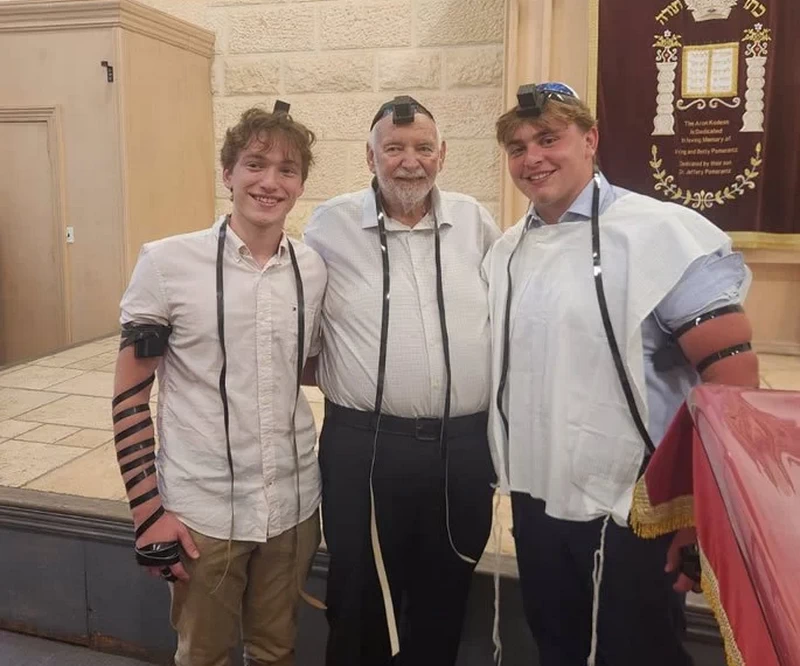 CrownHeights.info8 days ago
Three generations celebrated Jewish life thanks to Chabad of Fairlawn, NJ, and the dedication of a nearby yeshivah high-school student.
When Eytan Kirschenbaum found out that his friend Jared had never had a bar mitzvah he set out to make sure it would happen. Raising funds for tefillin and some Jewish books, he invited Jared and his friends and family to Chabad of Fairlawn.
At the reception, it was discovered Jared’s grandfather had never put on tefillin before as well. Soon Jared, his grandfather, and his cousin Dylan all had the chance to wrap for the very first time.
Let’s wish the entire family mazel tov!
Eytan and Jared.
Dylan receives an aliyah.
 CrownHeights.info8 days ago
From the first Jewish refugees to arrive in New Amsterdam in 1654 to the Hebrew Bible’s profound influence on the Founding Fathers, this fascinating conversation explores the often-overlooked role Jews and Jewish values played in the birth of the United States.
In this interview, historian Dr. Henry Abramson uncovers remarkable stories about America’s earliest Jewish settlers, the Spanish Inquisition, Christopher Columbus’ possible Jewish ancestry, George Washington’s famous letter to the Jews of Newport, Alexander Hamilton’s Jewish connections, and how biblical ideas of liberty, justice, and human dignity became woven into the fabric of the American experiment.
America 250 anniversary episode
 CrownHeights.info8 days ago
Anshei Lubavitch’s all-inclusive wedding package at Albany Manor, announced before Pesach, has now hosted its first few weddings — and each has been a beautiful, well-run celebration. Families who have used it have been spared both the cost and the logistics of a typical wedding, and the response has been remarkable.
The package, at Albany Manor on Rutland Road, is priced at $16,900 for 150 guests, with options for additional guests and other upgrades. For a Crown Heights wedding of that size, the savings are substantial, and they come without the trade-off that often accompanies budget simcha packages. This is a beautiful, high-end event, not a scaled-back one.
It works by bundling a single coordinated team under one fixed price, so families deal with one point of contact instead of a dozen vendors. The package covers event management and catering, photography, music, floral design, and videography with an edited highlight reel. The hall seats 150 with room for dancing and can accommodate up to 250 by clearing tables for the first dance after the main course.
The savings come from the management’s negotiations with numerous vendors, who agree to a lower price and make up the difference on volume. The arrangement gives vendors a steady stream of work and gives families lower prices — and it shows that elegant weddings can be done for less, bringing down rates that were until recently considered normal.
The wedding package grew out of two earlier offerings that proved the model. A Bar Mitzvah package at Anshei Lubavitch, introduced last year at $4,750, includes a 3,200-square-foot hall, a four-course meal for up to 100 guests, a photographer, and a one-man band. A lower priced Bar Mitzvah Package for $3600. A L’Chaim package followed in Kislev at $3,450, covering the hall, pastries, salads, fruit, dips and drinks, décor, and photography. A simpler L’chaim Package at $2200. Between them, dozens of Bar Mitzvahs and L’Chaims have already been held using the packages, and families have been very appreciative.
For inquiries on any of the packages, contact Yitzy of SilverLine Events at 917-376-6841.
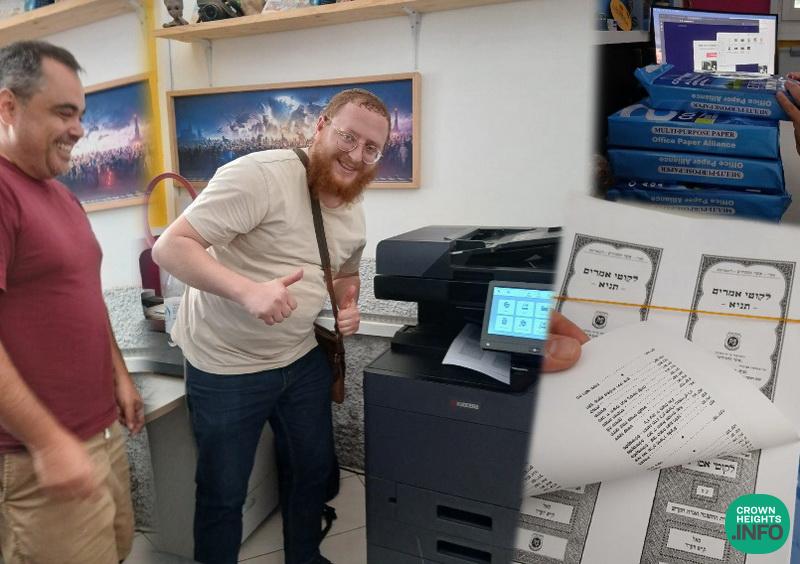 CrownHeights.info8 days ago
by CrownHeights.info
Another corner of the globe has joined the Lubavitcher Rebbe’s worldwide campaign to print the Tanya in every place where Jews live or visit, as the foundational work of Chabad Chassidus was printed for the very first time in the island nation of Cape Verde.
The historic printing took place in Santa Maria on the island of Sal on Yud-Beis and Yud-Gimmel Tammuz, in honor of the liberation of the Frierdiker Rebbe from Soviet imprisonment.
The project was organized by Eli Goldman together with Yanky Rubin, marking what participants described as another step toward fulfilling the Rebbe’s vision of spreading the wellsprings of Chassidus to every corner of the world.
“The Tanya is the spiritual Bible of Chabad Chassidic philosophy, and the Lubavitcher Rebbe had a vision of printing it all over the globe,” Goldman shared following the printing. “This is one step closer to Moshiach.”
Located approximately 350 miles off the coast of West Africa, Cape Verde is an archipelago best known for its vibrant culture, breathtaking Atlantic landscapes, and, more recently, its national soccer team’s surprising rise on the international stage. Goldman jokingly remarked that perhaps the spiritual merit of the Tanya printing contributed to the success of the country’s beloved “Blue Sharks.”
While Cape Verde has only a tiny contemporary Jewish presence, the islands are home to a fascinating chapter of Jewish history. During the late nineteenth century, Moroccan Jewish merchants settled on several of the islands, establishing trading communities that served as commercial links between Europe, Africa, and the Americas. Over time, many of these families assimilated into the local population, though traces of their legacy—including Jewish cemeteries and family names—remain today.
Goldman dedicated the historic printing to those early Jewish settlers as well as future Jewish visitors to the islands.
“In the merit of all the Jews who were associated with the island, all who will be in the future, and all the special Cape Verdeans, this is a gift,” he said.
The printing continues the Rebbe’s global initiative to have the Tanya printed in every possible location. Since the first edition was printed in Slavita in 1796 by the Alter Rebbe himself, tens of thousands of editions have been produced across the world—from major cities to military bases, remote islands, polar regions, and even outer space-inspired locations—transforming each new printing into both a practical distribution of Torah and a spiritual milestone.
With Cape Verde now added to that growing list, another point on the map has been connected to the timeless teachings of Chassidus, bringing the world one step closer to the ultimate redemption.
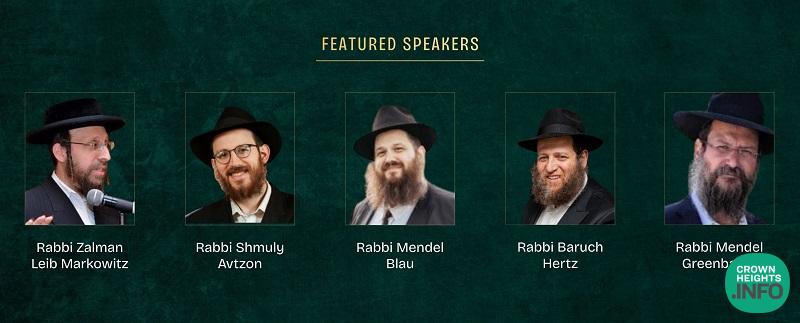 CrownHeights.info8 days ago
As the Kinus HaMechanchim approaches, organizers have begun releasing details about this year’s speaker lineup, with many more announcements still to come. The sessions will feature Rabbonim, educators, and professionals addressing key topics in Chinuch, offering mechanchim both inspiration and practical guidance for today’s classrooms.
The Kinus HaMechanchim will take place י״ד-ט״ו אב July 28–29 at the Armon Hotel in Stamford, Connecticut, bringing together mechanchim from across the country for two days of professional development, collaboration, and meaningful discussion.
Rabbi Zalmy Loewenthal, Associate Director of Merkos Chinuch Office, noted that having esteemed mechanchim who are actively leading and involved in chinuch provide direction and sessions at the Kinus adds tremendous value to the experience.
One featured session will be led by Rabbi Baruch Hertz, Rav of the Chabad community of Chicago and Dean of LGHS, titled “Halacha in the Classroom.” Rabbi Hertz will address a range of halachic situations that arise in schools, highlighting how these principles can be applied in ways that make chinuch accessible and relevant for every student. He will also offer a bonus Q&A session specifically for day schools.
Rabbi Greenbaum will open the Kinus with the welcome address. He will also lead a session for leaders titled “From Resistance to Results: Navigating Difficult Conversations,” focusing on implementing school changes and communicating them effectively to achieve positive outcomes. In addition, he will present an administrators’ session, “Safe Schools, Safe kids,” emphasizing the role of clear policies in safeguarding students and maintaining a secure, accountable school environment.
Rabbi Mendy Kotlarsky, General Chairman of Merkos Chinuch Office, emphasized the unique value of the Kinus as a gathering where mechanchim can learn from one another, draw inspiration from speakers, and return to their work with renewed clarity and purpose.
On the second day of the Kinus, members of the Vaad HaChinuch will lead a session focused on pressing questions in Chinuch, sharing insights drawn from years of experience.
The esteemed members of the Vaad HaChinuch of Merkos Chinuch Office include:
Rabbi Baruch Hertz
Rabbi Mordechai Farkash
Rabbi Zalman Leib Markowitz
Rabbi Mendel Blau
Rabbi Shmuly Avtzon
Together, they will discuss topics impacting classrooms and students, offering guidance and direction rooted in their extensive experience.
These sessions reflect the Kinus’s broader goal of equipping mechanchim with practical tools while connecting them with leading Rabbonim and Mechanchim.
Stay tuned for more details coming soon.
Register now at: kinus.chinuchoffice.org
 CrownHeights.info9 days ago
The dangerous heat arrives on Wednesday as the heat index climbs well past 100 degrees across the tri-state region.
On Thursday, the actual air temperature looks to reach 100 degrees, and we could be in the hottest stretch that we have not seen in over 15 years.
An extreme heat warning has been issued between Wednesday and Friday, as the heat index could approach 110 degrees. Indices this high can greatly cause heat-related illnesses like heat stroke or heat exhaustion. An extreme heat watch remains for Saturday, but it may just be a matter of time before it gets elevated into a warning.
Read More at Pix11
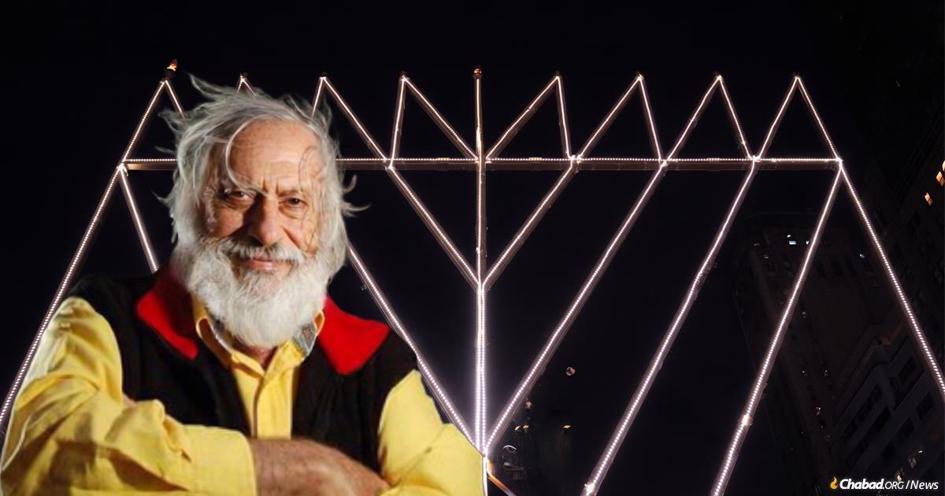 CrownHeights.info9 days ago
by Moshe New – chabad.org
“The driving force and the source from which I draw my inspiration,” wrote the Israeli sculptor and experimental artist Yaacov Agam, “stem from my desire to give … expression to the ancient Hebrew concept of reality, which differs in its essence from that of all other civilizations … .”
Thus Agam began his “Artist’s Credo,” which he wrote in 1964 and never altered.
“Art is a mirror of reality … ,” he continued. “The special significance of Judaism is the unity of G‑d and its conception that all the world is Him. The Jewish art form, then, must be special for it must reflect the Hebraic conception of reality.”
Agam, who passed away on June 21 (6 Tammuz) at the age of 98, would spend the rest of his life giving expression to the Jewish view of reality.
Internationally celebrated for paintings and sculptures that shift and change as the viewer moves, Agam was the most renowned Israeli artist of his era, with works in the Museum of Modern Art, the Guggenheim and the Centre Pompidou in Paris. Just months before his passing, Agam received the 2026 Israel Prize for Visual Arts, the nation’s highest cultural honor.
First lit on Dec. 26, 1986, the 32-foot menorah at Fifth Avenue and 59th Street, beside the Plaza Hotel, was certified by Guinness World Records as the largest in the world.
Perhaps one of his most viewed pieces is the towering menorah that stands at Fifth Avenue in Manhattan menorah, which he designed for Chabad-Lubavitch in 1986. The World’s Largest Menorah is erected outside the Plaza Hotel every Chanukah and draws crowds each night of the festival. The iconic menorah is seen by millions each year in person, and even more through various forms of media.
Menorahs had for a long time been built with curved branches, as famously depicted in relief on the Arch of Titus in Rome, which memorializes the Siege of Jerusalem. The Rebbe, Rabbi Menachem M. Schneerson, of righteous memory, objected to the widespread use of this design to depict the Temple menorah, taken from a Roman triumphal arch meant to humiliate the Jewish people. He also noted that it contradicted a famous sketch of the Holy Temple’s menorah made by the Rambam (Maimonides), which clearly showed the menorah constructed with diagonal branches.
The Rebbe posited that curved menorahs were used to illuminate other parts of the Temple and were differentiated from the main diagonal one. Though the Chanukah menorah has more branches than the Temple menorah, in order to celebrate the eight-day miracle, it is still meant to be evocative of the Temple menorah; therefore, the Rebbe preferred the design to be close to that of the original.
It would be up to Agam to build a menorah original in design, but true to this spirit, to be constructed at the crossroads of the world. Agam worked on it for months, producing a model which he gave to the Rebbe.
The Rebbe kept the model on his desk for three days, before giving it an emphatic stamp of approval.
The Agam Museum, which opened in 2017 in Rishon LeZion, is dedicated entirely to Agam’s work, and displays his kenetic works, changing sculptures and multi-layered color works, from different periods in his life. WikiCommons
Born Yaacov Gibstein in Rishon LeZion, Mandatory Palestine, in 1928, Agam was the son of Rabbi Yehoshua and Kendel Yocheved Gibstein. His father was a rabbi and kabbalist, whose mystical sensibility shaped his son’s lifelong fascination with the unseen.
He learned in cheder as a boy, later training at the Bezalel Academy in Jerusalem under Mordechai Ardon, As a teenager he was swept up in the British Operation Agatha roundups of 1946, spending months in the Latrun detention camp. In 1949 he left to study in Zurich under Johannes Itten, and in 1951 he settled in Paris, which remained his home for the next seventy-five years.
There Agam’s vision flowered. By his late 20s he was exhibiting alongside household names like Marcel Duchamp, Alexander Calder and Jean Tinguely, taking part in the landmark 1955 Paris show that gave kinetic art its name.
Perhaps most emblematic of the artist was Agam’s conviction that art was not a thing that is finished by the artist. Instead, he believed that art was something only truly finished by the viewer. His kinetic works could not be taken in all at once. One could look at one of his works and believe that the whole was always present, yet they would quickly realize that not all was wholly visible. This represented a theology he brought from his life into his art. “The special significance of Judaism is the unity of G‑d and its conception that all the world is Him … ,” he wrote in his credo. “In this sense, my works are reality, not abstraction, for to the observer is revealed a world that is ‘One, yet unique in unity.’”
Agam would eventually become one of the most widely-collected Israeli artists, living or dead. His dazzling Agam Salon graced the Élysée Palace in Paris, and the Fire and Water Fountain is a landmark in Tel Aviv’s Dizengoff Square. He also invented the “Agamograph,” and developed an acclaimed visual-education method for young children honored by UNESCO.
From the Agam Salon in Paris
It was the Israeli diplomat and statesman Joseph Ciechanover who first introduced Agam to the Rebbe around 1975. (Agam’s wife, Kalila, was herself a descendant of Rabbi Schneur Zalman of Liadi, the first Rebbe of Chabad.) The bond was immediate.
“[T]hank you for the wonderful album,” the Rebbe wrote to the artist in 1977, after Agam sent him Frank Popper’s 500 page album of his work. “Even though it’s completely outside my field, the overall impression is striking even to someone who is not an art expert. But surely, your work is aimed not only at experts.”
Over a period of nearly half a century, the Rebbe had articulated a revolutionary vision of the role of art in the Jewish experience. Creative art, the Rebbe explained, was a powerful medium with which to reveal the G‑dliness inherent in the material world—the ultimate purpose of humanity.
His letter to Agam offers a window into this worldview.
In 1977, Agam sent the Rebbe a copy of Frank Popper’s 500 page album of his work, in honor of the Rebbe’s 75th birthday. Pictured is his warm message to the Rebbe: “To Rabbi Schneerson/On the occasion of his birthday/With faithful blessings.” Then, overlapping the forms of the initial birthday message, he wrote a second message, this one in blue marker: “To the esteemed leader of the generation/And light unto Israel who blesses/His faithful with hope and prayer/With great respect.” JEM / The Living Archive
Agam had presented the album to the Rebbe in honor of the latter’s 75th birthday, and the dedication he inscribed on the inside cover amounted to an original artwork.
Writing in Hebrew in yellow marker: “To Rabbi Schneerson/On the occasion of his birthday/With faithful blessings.” Then, overlapping the forms of the initial birthday message, he wrote a second message, this one in blue marker: “To the esteemed leader of the generation/And light unto Israel who blesses/His faithful with hope and prayer/With great respect.”
One message Agam had written in letters of light (yellow), the second their shadow (blue). In his reply, the Rebbe picks up on this point, drawing a lesson from the interplay of light and shadow which Agam deploys in his heartfelt inscription. It was the shadow that contained the far deeper message.
“Shadow, at first glance, appears to be the result of something that conceals light and its source,” the Rebbe wrote. “However, according to our Torah … which states that ‘everything the Creator made in His world, He made for His glory,’ this includes shadow. This means that if one places the shadow in its appropriate form and in its appropriate place, then it too becomes a source of positive influence, just like light.
In this there is a concrete lesson, the Rebbe continues: “That even in days of ‘shadow,’ days that are ‘gray,’ in our physical and material world, where at first glance the shadows outnumber the lights and matter prevails over spirit, etc., a person is still required to fulfill their mission in this world according to the statement of our Sages, that even shadow should be for the honor of the Creator. On the contrary, the advantage of light over darkness then becomes apparent, meaning that through, and by, and in combination with darkness … it is within man’s capacity to ‘turn darkness into light.’”
Yaacov Agam works on a sketch of the Rebbe’s secretary Rabbi Binyamin Klein at the brit milah of the latter’s son. JEM / The Living Archive
On Chanukah of 1985 Ciechanover’s wife Atara passed the giant menorah erected by Chabad-Lubavitch on Fifth Avenue and found it lacking. This was one of the busiest corners in the world, and the current menorah, she felt, fell short of the Rebbe’s wish to engage every Jew.
She brought her concerns directly to the Rebbe, while in a private audience together with her husband.
“She told the Rebbe that she aimed to make a beautiful and dignified menorah,” Josef Ciechanover told Chabad.org in 2017. “The Rebbe agreed with her concern and told her the new one should be built according to the design of the Rambam. He corrected her sketch to show what he meant by it.”
With the Rebbe’s go-ahead, she approached her longtime friend Agam. The artist took the commission, although not without some trepidation, saying that while he “was excited to fulfill a request coming from the Rebbe,” he did have some “internal hesitation” due to what he saw as “the complexity of the project.”
Agam designed a new menorah following the Rebbe’s guidance and the Rambam’s depiction of the Temple menorah, with its branches rising straight and diagonal rather than rounded. He brought a miniature model to New York. It sat on the Rebbe’s desk for three days before an emphatic approval came—a fact Rabbi Shmuel Butman, who lit the menorah each year until his passing in 2024, would remind attendees of every year.
When it was noted that Agam’s design departed somewhat from the Rambam’s classic sketch, the Rebbe responded that the essential requirement was the diagonal branches and that within those parameters, an artist such as Agam must be given room to express himself.
Yaacov Agam works on a sketch of the Rebbe’s secretary Rabbi Binyamin Klein at the brit milah of the latter’s son. JEM / The Living Archive
First lit on Dec. 26, 1986, the 32-foot menorah at Fifth Avenue and 59th Street, beside the Plaza Hotel, was certified by Guinness World Records as the largest in the world. Two days later, Agam brought a model to the Rebbe during “Sunday Dollars,” when the Rebbe would distribute dollars for charity and people would have an opportunity to speak briefly to the Rebbe.
“Thank you for designing the menorah according to the opinion of Maimonides,” the Rebbe told him, in a moment captured on film.
“When the Romans drew the menorah, they did it according to others they had seen,” Agam replied. “I was told that the Rebbe said the arms should be straight.”
“And diagonally,” the Rebbe said.
“I also gave this menorah a spiritual dimension,” Agam said. “Everything ascends; there is no corporeality [gashmiut], and the crown is above.”
“It should be that, just like with Chanukah candles, we add from day to day,” the Rebbe said. “You too should add to your accomplishments every day, not only on Chanukah, but throughout the whole year. As I wrote to you, it is an integral part of Judaism—as during Chanukah—to not remain static; rather, we go from strength to strength until we reach ‘G‑d in Zion’ with the true and complete Redemption. And we will see Aharon the Priest kindle the Temple menorah of seven branches.”
Agam told the Rebbe of his intention for the menorah to be not just beautiful, but “Jewish.” “May this be a good beginning for the entire United States,” responded the Rebbe, “and for the entire world.”
Every Chanukah, millions pass beneath Agam’s golden menorah branches, light and shadow arranged, as the Rebbe taught him, in their proper form and proper place.

“Surely, your work is aimed not only at experts,” the Rebbe wrote to Agam. Pictured in an exhibit from the Agam Museum. WikiCommons
 CrownHeights.info9 days ago
by CrownHeights.info
Defense Minister Yisrael Katz has directed the Defense Ministry and the IDF to resolve the ongoing dispute surrounding the status of Chabad talmidei yeshivos and formulate a new framework to replace the previous arrangement, according to a report by Channel 14.
The directive comes after the IDF reportedly concluded that ending the long-standing “Chabad arrangement” in August 2025 had significant consequences for the military. Under the previous system, the IDF benefited from hundreds of highly motivated Chabad recruits who later enlisted, helping the army meet its Chareidi enlistment goals.
Katz’s involvement follows months of negotiations between senior IDF officials and representatives of the Chabad community that ultimately failed to produce a new agreement.
Since 2016, the special arrangement enabled Chabad talmidei yeshivos to spend a year studying at the Chabad-Lubavitch World Headquarters at 770 Eastern Parkway as part of the traditional “Kvutza” year. Participants signed a commitment to enlist in the IDF upon reaching the age of 26.
The framework came to an end after Israel’s High Court struck down the draft law, leaving no legal basis for its continuation. Multiple attempts to establish a replacement agreement have since been unsuccessful.
 CrownHeights.info9 days ago
Déjà Vu in 770
Over the past few years, the TTOP Boys Choir has made a name for itself with beautiful releases such as To Lubavitch and the Melaveh Malkah Medley.
This year, they took it to the next level.
Together with renowned singers Sruly Williger and Shlomie Dachs, the boys of Tomchei Tmimim Ocean Parkway recreated the iconic song, Oh Moshiach!, that was sung in front of the Rebbe. This production gives viewers a chance to see the original moment come alive again, with the next generation of talmidim standing alongside two of the voices who made it unforgettable.
A big thank you goes to Rabbi Yitzchok Achter, founder of the TTOP Boys Choir, and to Lev Akselrod, the choir’s voice coach, for their dedication, guidance, and commitment to bringing out the best in each boy.
A special thank you to Sruly Williger and Shlomie Dachs for joining this production and helping make it unforgettable.
Choir members: Dovi Bukiet, Mordy Seewald, Menachem Pekar, Eli Popack, Mendy Lieblich, Menachem Webb, Tzemach Vishedsky, Levi Kornblit, Rafi Lesches, Refael Pekar.
Spotify:
 CrownHeights.info9 days ago
One year after the passing of legendary musician and flutist Avi Piamenta, OBM, arranger and composer Achiya Cohen has released a powerful new composition titled “Niggun Avraham.”
The melody was born out of profound longing on the Motzei Shabbos when news of Piamenta’s passing first spread. Inspired by Avi’s groundbreaking musical style, the niggun serves as a deeply personal tribute to one of Jewish music’s most influential figures.
For Cohen, the release also marks the completion of an emotional journey. In the past, he composed “Yosef Niggun” in memory of Yossi Piamenta, OBM. Now, with the release of “Niggun Avraham,” issued just ahead of Avi Piamenta’s first yahrtzeit on 8 Tammuz, he completes the musical tribute to the Piamenta brothers.
The accompanying music video carries a remarkable story of its own.
Even before the song was officially recorded, its third section—known for its intricate and highly challenging musical arrangement—became a viral online challenge. Cohen invited musicians to attempt the difficult passage, and the response was overwhelming. Hundreds of musicians requested the sheet music, spontaneous performances began appearing at weddings, and dozens of artists from around the world submitted videos of themselves performing the piece.
From the hundreds of submissions, dozens of performances were carefully selected and incorporated into the official music video, transforming it into a moving, worldwide tribute that reflects the enduring impact of Avi Piamenta’s music and spirit.
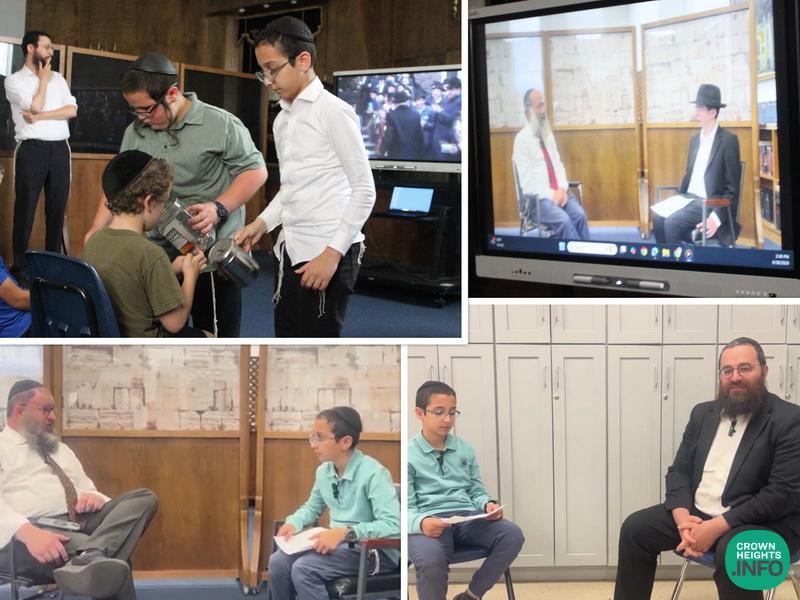 CrownHeights.info9 days ago
Gimmel Tammuz is a day for introspection and connection to the Lubavitcher Rebbe. Leading up to this day, many people take the time to go visit the Ohel. Others spend the day learning the Rebbe’s words of Torah and doing outreach activities.
At Lubavitcher Yeshiva Academy (LYA) located in Longmeadow, MA a group of middle school boys chose a unique and beautiful route this year. The students wanted to connect with people who had met the Rebbe and model the Rebbe’s teachings and guidance for them on a daily basis.
Together with Rabbi Lavy Kosofsky, LYA Judaic Coordinator, the boys prepared pointed interview questions that would allow the boys to learn and gain a new perspective of the Rebbe. The students then set up times to interview LYA Shluchim and teachers.
The interview process was meaningful for all involved. The boys interviewed their Gemara teacher Rabbi Avremy Raskin, who is an LYA parent, as well as a Shliach for 13 years in Brattleboro, VT. Rabbi Raskin grew up on Shlichus in Burlington, VT and now is Co-Director of Chabad with his wife Chaya.
The students interviewed Rabbi Chaim Kosofsky, Outreach and Shul Co-Ordinator, who has worked at LYA since 1988. The students also interviewed Rabbi Yakov Wolff, JLI Educator and Outreach, who has worked at LYA since 1996.
Their questions included:
Who is the Rebbe to you?
When was the 1st time you met the Rebbe?
How do you connect with the Rebbe?
What suggestions do you tell your students in order to connect with the Rebbe?
What teaching of the Rebbe most inspires you?
The result was an inspiring video that was shared with the school during a special Gimel Tammuz assembly. The students had time to reflect after watching the video. They agreed that the Rabbis each gave very interesting answers and enriched them with the fact that the Rebbe cared for each person, as if that person was the only one in the room. As Nochum Gurewicz explained, “Since we never met the Rebbe, it was meaningful to speak to our role models who did meet the Rebbe and hear their personal stories.”
Thank you to the interviewers: 7th grader, Nochum Gurewicz and 6th grader, Mendel Kosofsky. Thank you to the videographers: 6th grader, Hudi Helfen and 7th grader, Shmuel Aizik Raskin. Editing and compilation credit goes to Nochum Gurewicz.
LYA is a Chabad Day School located in Longmeadow, MA right on the Connecticut border. LYA was founded by the Previous Rebbe in 1945. LYA is the first Jewish Day School accredited by New England Association of Schools and Colleges (NEASC). LYA is more than a school and offers shul services, holiday programming and adult education. For more information about LYA or to contact Rabbi Noach Kosofsky, call 413.567.8665 or [email protected]. Check out www.LYA.org for more information about LYA.
 CrownHeights.info9 days ago
The Eber Family will be sitting Shiva in Crown Heights following the passing of Rabbi Shalom Dovber Eber OBM.
Shiva will take place at 725 Montgomery St.
Two Minyanim Needed
Shacharis: 8:00am and 9:00am
Micha/Maariv: Bzmana
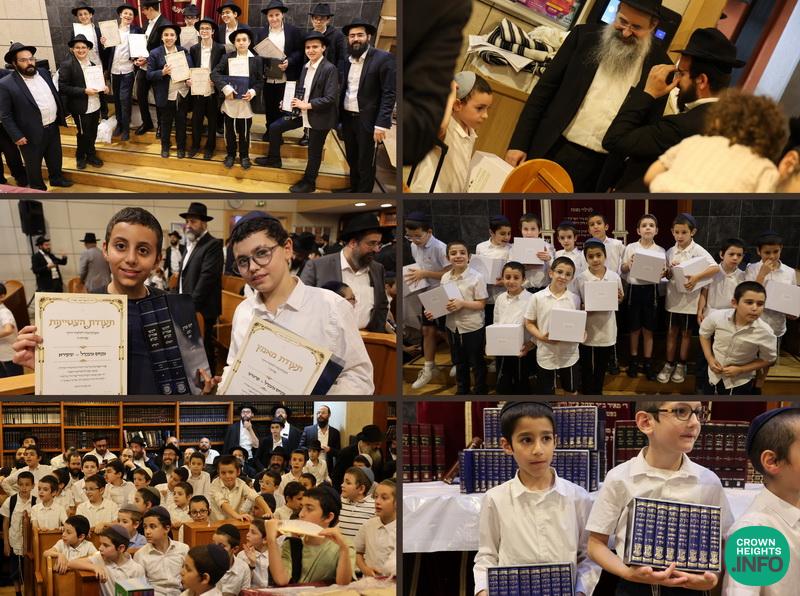 CrownHeights.info9 days ago
Today, the Lubavitch Cheder, under the leadership of Rabbi Levi Yitzchak Azimov, held its annual prize distribution ceremony and end-of-year celebration at Beis Chaya Mushka.
Students received warm blessings and were presented with awards in recognition of their dedication, hard work, and achievements throughout the school year.
A special thank-you was extended to the devoted melamdim for their tireless commitment and investment in their students:
Recognition was also given to the entire team of mashgichim for their exceptional dedication throughout the year.
The prize distribution ceremony was emceed by Mr. Waky.
Photos by Mordechai Lubecki
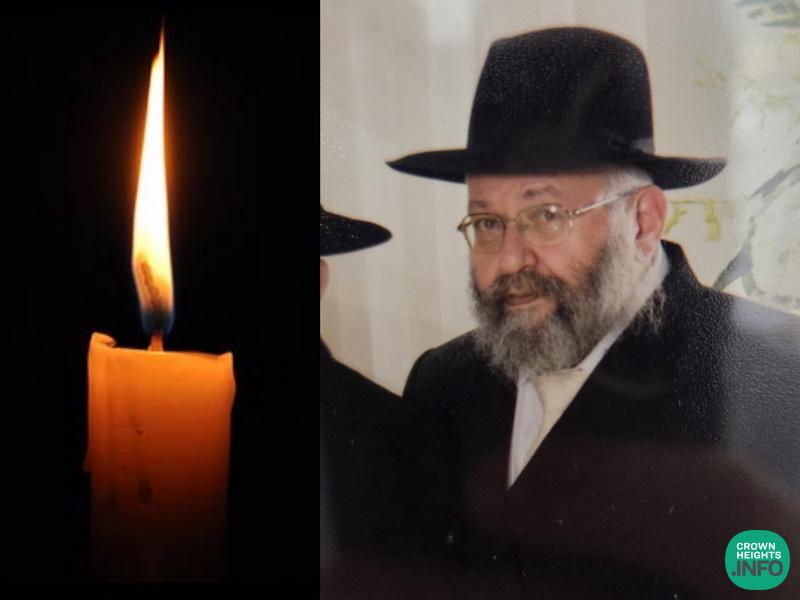 CrownHeights.info10 days ago
With great sadness we report the passing of Rabbi Shalom Dovber Eber OBM, a devoted Chossid who was instrumental in the dissemination of Chassidus through the WLCC Broadcasting service. He passed away on Monday, the 14th of Tammuz, 5786.
He was 78 years old.
Born in Tel Aviv on Erev Rosh Hashana, 5707, Shalom Dovber was the son of the famed Mechanech in Lod Reb Nissin Eber and grandson of the Mashpia in Nevel Reb Eliyahu Eber. Early in life, Sholom Dovber came to Crown Heights to learn in 770, finding his wife Esther Gorowitz and marrying in the United States.
In his earlier years he partnered with Rabbi Chaim Boruch Halberstam in Ess N’ Bench, a joint venture that would see them continue as partners throughout their lives. When WLCC was launched, Shalom Dovber again joined Rabbi Halberstam as a partner, editing and disseminating the recorded media of the Rebbe’s Chassidus. When the committee was created to oversee the dollar distribution, Shalom Dovber again joined Rabbi Halberstam, taking on the development, editing, and publication of the photos and videos.
He was also Zoiche to prepare the Kadeishim, Haftoros, and Mishnayis that the Rebbe used to read from in the pater years.
He is survived by his wife Esther (nee Gorowitz), and children; Mrs. Chani Steigman (Crown Heights), Mrs. Chevi Lebkivker (Crown Heights), Mrs. Chaya Neuwirth (Florida), Rabbi Yosef Eber Shliach (Florida), Mrs. Nechama Doina Dubrovsky (Florida), Mrs. Zelda Stillerman (Long Island, NY), and Rabbi Nissin Eber (Manhattan, NY).
The Levaya will take place Tuesday, passing by 770 at approximately 10:00am with Kevurah at Montefiore Cemetery at 11:00am.
Shiva information to be announced.
Boruch Dayan Hoemes
 CrownHeights.info10 days ago
On 25 Menachem Av 5777, Rabbi Leibel Schapiro, Rosh Yeshiva of Yeshiva Gedolah of Greater Miami and Rav of Beis Menachem in Miami Beach, began to share his personal zichronos of the Rebbe via WhatsApp.
As a young bochur, Rabbi Schapiro was recruited to assist Reb Yoel Kahn a”h, the Rebbe’s chief chozer, in reviewing the sichos and preparing Likkutei Sichos. His voice notes, filled with firsthand memories and insights, were initially recorded for his children. With his permission, they were shared more widely—and immediately went viral. Groups were formed for the sole purpose of listening to and passing along these timeless recollections.
For nearly three years, until Adar 5780 and the onset of COVID, thousands eagerly awaited each new installment. Since then, the zichronos continued to circulate informally across various platforms, continuing to inspire.
Now, with great enthusiasm, Rabbi Schapiro will be’ezras Hashem resume recording his memories and publish them twice a week bezh. In addition to zichronos connected to the Rebbe, the future zichronos will include memories of different chasidim, other events that took place in 770 and in “Lubavitch” at large.
To make these recordings even more accessible, they are now available as a podcast on Spotify, where you can listen to all previously released recordings in one place. By following the podcast, listeners can easily find specific zichronos and automatically receive new recordings as they become available.
The goal of this project is to strengthen and perpetuate the flame of hiskashrus to the Rebbe and his directives. May these efforts hasten the coming of the Geulah, when we will once again merit to hear directly from the Rebbe, b’korov mamosh.
New Episode:
 CrownHeights.info10 days ago
by Leah-Perl Shollar – chabad.org
The mystery began with a tantalizing clue: a woman without a name, known only through her relationship to someone else.
In a letter written by the sixth Rebbe, Rabbi Yosef Yitzchak Schneersohn, to Rabbi Mordechai Heifetz,1 on December 4, 1935 (9 Kislev, 5696), I read:
Regarding the request to teach Chassidism to the future daughter-in-law of our dear friend, beloved amongst men, who embodies chassidic qualities, the G‑d fearing, pious, R’ Mordechai Dubin – may he flourish – mazal tov – this is a very appropriate thing to do.2
This letter was the catalyst for a far-reaching chain of events. Rabbi Yosef Yitzchak used Heifetz’s inquiry as an opportunity to broaden the issue of girls’ education in Chabad. In a lengthy reply, Rabbi Yosef Yitzchak cited testimony that chassidim of old educated their daughters as well as their sons, concluding:
Thus, if fifty-five years ago, when every Chabad home shone with the essence and light of Chassidism, how much more so today do we feel the lack of education for girls in Torah and in the ways of Chassidism. It is clearly urgent, [and a matter that] touches upon one’s very soul; [we must] awaken the inner spark which is received as an inheritance from parents to their children.3
But who was the young woman to whom Rabbi Yosef Yitzchak referred? I set out to uncover more about her and restore her place in the historical record.
The young woman’s name was Edith (Eidel) Pappenheim. Born February 22, 1917, she was the second of seven children born to Kalonymus Kalman (Heinrich) Pappenheim (1880-1943) and Sophie (Schifra) Schiff (1886-1944).4 Her family belonged to the inner circle of Vienna’s Orthodox community, her grandparents being among the founding members of the city’s famous Schiffschule, formally “Khal Adas Jisroel,” a 750-seat synagogue that served as both spiritual center and a fortress against secularism’s inroads.5
The Schiffschule, pre-World War Two.
Edith came of age in a protective environment, where home, synagogue, school, and community life reinforced each other. The Schiffschule complex housed a network of institutions: a school serving students from kindergarten through high school, a matzah bakery, a society to care for the ill, and a tzedakah fund—a kind of miniature shtetl amid the glamor and drama of interwar Vienna.
Of the country’s 250,000 Jews, 180,000 resided in Vienna, mostly packed into the four-square miles of the Second District, Leopoldstadt.6 Nicknamed Mazzesinsel, “Matzah Island,” Leopoldstadt was nearly 40% Jewish. Its streets were home to chassidic courts, secular Jewish intellectuals, polyglot Jewish newspapers, and coffeehouse culture.
News item about a Chanukah performance at the Agudath Israel school, mentions Edith and her sister Ilse, as well as a future Bais Yaakov teacher, Rosa Lederer.
In the aftermath of World War I, the glittering world of fin-de-siècle Vienna was cracking. The old Habsburg Empire collapsed, leaving Austria strained by political violence, economic hardship, socialism, authoritarianism, and rising antisemitism.
Edith’s family responded to these buffeting winds by anchoring themselves more deeply in tradition and community service. Their home at Praterstraße 33, near the Danube Canal and a short walk from the giant Ferris Wheel built for Emperor Franz Joseph’s Jubilee, was both private residence and community headquarters.7 Following the example of her grandfather Wolf, her parents hosted rabbinic greats from across Europe and held communal meetings and events in their home.
Wolf Pappenheim headed Agudath Israel’s Vienna branch, overseeing the planning and implementation of at least two of the movement’s Knessiah Gedolah conventions.8 Convened as a response to the challenges of modernity, these gatherings established Agudath Israel as the mouthpiece of interwar Orthodox Jewry and, through its Keren HaTorah arm, enabled the Beit Yaakov movement for women and girls to flourish. Wolf also served in the leadership of both Keren HaTorah’s central headquarters and Beit Yaakov in Vienna.9 Edith’s father, Kalman, served on the board of trustees for Beit Yaakov.
Likely the view from Edith’s childhood home. Eli Ringer Collection
Given Edith’s family involvement with Agudath Israel and Beit Yaakov, she likely was certainly aware of the September 1929 Neshei Agudath Israel Women’s Conference in Vienna, attended by delegates from across Europe.10 A Bais Yaakov elementary school had opened for the academic school year 1926,11 which twelve-year-old Edith almost certainly attended. The conference program included a visit to the school, whose 150 students were described as “aristocratic, religious … girls … faithful Jews who will proudly carry the banner of the Torah Nation.”12 The description could have certainly applied to the woman Edith would become: refined, devout, loyal, and formed by a world that expected its young women to carry Torah with dignity.
Edith’s older sister Liane was enlisted as an instructor at the Vienna branch of the Teachers’ Seminary at Leopoldgasse 26.13 When the dean, Dr. Shmuel Leo Deutschländer, came to the Pappenheim home and asked her to join the staff of the newly-founded branch, Liane demurred, explaining that she lacked the training and credentials. Deutschländer promised to provide curricular materials and told her, “You’ll study at night and teach by day.”14 Thus, Edith grew up surrounded by living examples of communal devotion, people who accepted responsibility before they felt ready because the needs of the hour demanded it.
During these years, both Liane and Edith took part in the burgeoning religious life for women, leading youth groups for younger girls, and giving Torah classes for women. Edith seems to have spent time at the Kraków Bais Yaakov, where she formed a close friendship with Basya Epstein Bender15 who was there between 1931-1933. This places Edith within the Bais Yaakov orbit of the movement’s founding mother, Sarah Schenirer, and within the company of future leaders of charedi girls’ education, including Dr. Judith Rosenbaum Grunfeld and Mrs. Vichna Eisen Kaplan.
Beth Jacob Teachers’ Training Institute in Vienna School and Dormitory: II. Malzgasse 7 Pedagogical Administration: II. Leopoldsgasse 26. History of Beth Jacobs Schools, 1933
In addition to her friend Basya, Edith also became close with a local Viennese girl, Chava Heschel, daughter of the second Kopischnitzer Rebbe.16 Through her experience with the Kraków Beit Yaakov, and through her friends Basya (who was from the town of Otwock, Poland) and Chava (the daughter of a chassidic rebbe), Edith was drawn beyond her Austro-Hungarian milieu into a more Eastern Europeanly inflected chassidic sphere.
Bais Yaakov promotional literature listing Fraulein Pappenheim as an instructor. History of Beth Jacobs Schools, 1933
A generation earlier Sarah Schenirer had encountered Hirschian teachings in Vienna and carried them back to Kraków. Edith’s path reversed the flow: though a product of Vienna, she was shaped by Beit Yaakov and would eventually bring her training to Riga, Latvia, which likewise absorbed influences from both central and eastern Europe. This exposure may also help explain her later openness to marrying Zalman Dubin, a young man from a chassidic family.
But how did such a match come about? While no definitive answer has yet emerged, several possibilities suggest themselves. Perhaps the seed of the Pappenheim-Dubin match was planted at one of the Agudath Israel Knessiahs that occurred throughout the 1920s and 30s, which were attended by Edith’s father and grandfather, as well as by Zalman’s father, the famed Mordechai Dubin. Hailed as the unofficial foreign secretary of Lubavitch.17 “[Dubin’s] name was synonymous with charity, kindness, wisdom, and yiddishe shtoltz. He was renowned as a Jew to whom any Jew in need could turn.”18 Dubin headed the local Agudath Israel branch and represented the party in the Latvian parliament (Saeima). He served as head of the Riga Kehillah, was a shtadlan for Latvian Jews, and concerned himself with every matter that touched upon Jewish life anywhere, big or small.
Mrs. Liane Pappenheim Ringer
Or maybe it started when the Sixth Rebbe, Rabbi Yosef Yitzchak Schneerson, visited Edith’s childhood home in Vienna. Could he have played a role in the match?
In early 1935, Rabbi Yosef Yitzchak was staying in the spa town of Purkersdorf, near Vienna. It was there, on 16 Shevat 5695 (January 20, 1935) that he began writing Der Langer Brif (“The Long Letter”) to his daughter, Rebbetzin Chaya Mushka Schneerson, then living in Paris with her husband, Rabbi Menachem Mendel Schneerson. Two days later, on 18 Shevat 5695 (January 22, 1935), Rabbi Yosef Yitzchak held a farbrengen in Edith’s home, attended by members of Vienna’s Agudath Israel. In fact, the connection between the Pappenheims and Chabad rebbes dated back to the times of the Fifth Rebbe, Rabbi Shalom DovBer Schneersohn, who had been a guest in the home of Edith’s grandfather, Wolf Pappenheim.19
The Rebbe outside the sanatorium in Purkersdorf.
In the course of the farbrengen, Rabbi Yosef Yitzchak related a story about his grandfather, the Rebbe Maharash, who had once stirred an assimilated young Jewish gambler from France to return to his roots: “The Rebbe added that this young man later became a great Torah scholar and his descendants are among the most distinguished Jewish families.”20
The choice to recount a story about an assimilated Western Jew to this particular audience was deliberate. Rabbi Yosef Yitzchak’s message for the Orthodox Viennese community, living in similarly acculturated surroundings, was clear and unequivocal: in the face of Western allurements, neither retreat nor compromise, but influence.
To move this charge into action, Rabbi Yosef Yitzchak called upon each Agudah member to ‘donate’ another Jew to the organization, “so that another Jewish soul could be introduced to Agudah’s values and ideals.”21 The point was not merely institutional recruitment. Beneath it lay the spiritual obligation of the farbrengen itself: even a Jew formed by Western culture could return to his or her innate bond with G‑d through Torah and mitzvot.
This stance of unadulterated truth as the antidote to assimilation would recur in Rabbi Yosef Yitzchak’s many communications over the next decade.
On the eve of Passover 5695 (April 15, 1935), Rabbi Yosef Yitzchak wrote to Kalman Pappenheim, asking him to speak with his “elder daughter” about publicizing the mitzvah of Family Purity.22 The editor of Igrot Kodesh identifies this daughter as Edith, which raises two chronological difficulties: 1) Liane was the elder daughter, and 2) Edith was not yet married, while Liane had married just five days earlier. The request is still a striking one, coming during the week of sheva brachot.23
Letter from Rayatz to Kalman Pappenheim, Igeros Kodesh HaRayatz vol. 17.
This letter suggests that Rabbi Yosef Yitzchak turned to the Pappenheim family not only for communal activism, but as a possible source of female religious influence. If the struggle against assimilation was to succeed, its warriors could not remain confined to male leadership; it would require educated and dynamic women like these Pappenheim sisters, prepared to take a public stand for Torah values.
By the autumn of 1935, Edith herself had stepped into the role of public lecturer on topics of religious observance. In November she was in Latvia, where she remained for three months, perhaps to determine whether she could imagine making her life there. During her visit, she addressed a gathering of the Beit Yaakov and Bnot Yaakov organizations, delivering a lengthy report on the current activities of the Viennese Beit Yaakov movement.24 She also encountered a number of young women who would later form the nucleus of Achos Tmimim.25 It seems that she also formalized her engagement to Zalman, as it was during this sojourn that the question of Edith’s own study of Chassidism arose.
We now return to the letter that began this investigation. On 9 Kislev 5696, December 5, 1935, Rabbi Yosef Yitzchak responded to Rabbi Heifetz’s inquiry about teaching Chassidism to Mordechai Dubin’s future daughter-in-law.
The timing is striking: Edith was then in Riga, moving between the world of Viennese Beit Yaakov activism and the emerging circles that would soon crystallize around young Chabad women, just as they were preparing for their first Yud-Tes Kislev farbrengen.26 Rabbi Yosef Yitzchak’s reply indicates both his approval of this revolutionary step, and his concern that the renewal of this tradition (teaching Chassidism to women) be undertaken with care. A successful outcome would require a teacher who was not only knowledgeable in the relevant topics but also skilled in presenting complex concepts and texts in ways a novice could grasp.
Rabbi Yosef Yitzchak selected one of his own discourses, Kinyan Hachaim, as the text with which to begin her studies. He directed Rabbi Heifetz “not [to] hurry through, but … take your time and explain it well.”
Kinyan Hachaim rests on a Torah verse, “Today is the birthday of the world,”27 recited in the Rosh Hashanah Mussaf Amidah after each set of shofar blasts. The discourse presents Rosh Hashanah not only as a day of judgement for the world, but as a day of personal repentance and return.
Frontispiece of Ma’amar Kinyan HaChaim printed in Riga, September 1928.
While the text is fairly short, it contains a number of foundational chassidic concepts: the difference between serving G‑d as His child or doing so as His servant, and how each shapes our mitzvah performance; the tension between free-choice and G‑d’s omniscience; the propitiousness of the Ten Days of Repentance for connecting with one’s true essence and G‑d. It also explains why Rosh Hashanah is observed on the anniversary of humankind’s creation rather than the first day of genesis, emphasizing the unique power and responsibility of humankind within creation. The text concludes by outlining the process of teshuvah and provides practical guidance for how to effect this mitzvah.
It is significant that Rabbi Yosef Yitzchak chose to begin Edith’s study of Chabad Chassidism with this text, rather than with Tanya, its foundational text, or with a more accessible medium, such as chassidic tales. Instead, Edith was brought into a discourse that exposed her to a wide range of theological and spiritual ideas, all framed through practical application.
Kinyan Hachaim also held particular significance for Rabbi Yosef Yitzchak himself: it was the first of his discourses that he selected for publication, suggesting that he viewed its themes as central to the guidance he wished to offer his followers in sustaining a Torah life.28
In the winter of 1936, Rabbi Heifetz updated Rabbi Yosef Yitzchak on Edith’s progress. Rabbi Yosef Yitzchak was then in a sanatorium near Vienna, receiving treatment for various health problems.29 Despite these challenges, he continued to write prolifically and responded to Heifetz with detailed instructions for Edith’s program of study.30 The central message was always that Edith’s studies should not be rushed.
Rabbi Yosef Yitzchak instructed that Edith “… should practice reading each section [of Kinyan Hachaim] several times until it is well understood and she can discuss it in her own words, with her own personal style.” Any “kernels of wisdom or insights she gleans and grasps well, should be set aside … After reflecting on them a few times, she should write them down (in the same language she writes her personal thoughts) and try to explain them in writing for herself.”
Lastly, he instructed that Edith should “… write and explain … the takeaway.” This emphasis on elucidating a practical application to one’s daily service of G‑d (“ובכן”) is a quintessentially Chabad approach to Torah study: ideas must not remain abstract, but descend into thought, speech, writing, and service of G‑d.
Pivoting from details about the manner in which Edith should study Chassidism, in the remainder of his letter Rabbi Yosef Yitzchak told a story about German Orthodoxy in which three women took upon themselves the observance of mikvah and helped rebuild Jewish observance in Frankfurt after the spread of Mendelssohnian education.
It is hard not to hear the story as a message meant for Edith. She too was a young German-speaking Orthodox woman, preparing for marriage and standing at the threshold of a new religious path.
Throughout the following years, Rabbi Yosef Yitzchak repeatedly returned to the idea that educated, pious women could serve as agents of Jewish renewal during periods of religious crisis. Edith herself would soon be invited into that tradition.

“The Teachings of Chabad Chassidism and Their Educational and Ethical Significance: The Lubavitcher Rebbe’s Response to a Written Inquiry from Germany”
On April 17, 1936, Rabbi Yosef Yitzchak responded to Professor Chava Bitner31 who had asked whether German Jews should study Chassidism. His answer was a sweeping introduction to Chabad Chassidism: its basic ideas, history, and central texts. He emphasized that anyone with reason and understanding could study Chassidism, but that such study required preparation: Fear of Heaven and the actual performance of mitzvot. Two months later, the essay was printed in volume 4 of HaTamim and Rabbi Yosef Yitzchak asked Edith to translate it from the original Hebrew into German.
It is astonishing that Rabbi Yosef Yitzchak entrusted this work to Edith: a nineteen-year-old woman, only six months into her formal study of Chassidism. The assignment speaks volumes about his confidence in her intelligence, Jewish learning, and ability to grasp chassidic concepts quickly. It also underscores Edith’s own courage to accept such a task.
One wonders how she received it. Did she see the translation as a kind of test, or even a graduation exercise? She had already given public Torah lectures and personally knew many prominent Jewish leaders through her family’s public work. Still, this request came from the rebbe of her future father-in-law and fiancé. It was no small thing. Edith must have felt both the weight of the expectations placed on her and the significance of carrying Chabad thought into German.
She seems to have completed her first draft fairly quickly. In a letter to her father dated July 23, 1936, Rabbi Yosef Yitzchak mentions that he enclosed a letter for “his daughter, the young student,” adding “I am greatly pleased that even here, in the sanatorium, with G‑d’s help, something beneficial is being accomplished through the translated letter … [which was] given to Dr. G., who read it twice or thrice and was deeply interested in its contents.” Dr. G. related to Rabbi Yosef Yitzchak “that even in Paris, among the assimilated Jewish men and women, the recent events had awakened them to return to Judaism – and that he himself was among them.”
The compliment is unmistakable. Only a year and a half earlier (January 1935) at the farbrengen in Edith’s childhood home, Rabbi Yosef Yitzchak told the story of the assimilated French gambler who returned to Torah and built a distinguished Jewish family due to the intervention of the Fifth Rebbe, Rabbi Shmuel. Now Edith’s translation was reaching another Western Jew who was stirred to return. The call of the hour was outreach to those who saw themselves on the periphery of Jewish life, and Edith, newly initiated into Chabad thought, was already helping carry that call forward.
Rabbi Yosef Yitzchak directed Rabbi Chaim Mordechai Aizik Hodakov (then, principal of the Torah v’Derech Eretz Schools in Riga and head of Jewish education for the Latvian Ministry of Education) to arrange for the work’s publication. Supervision of the project was entrusted to Rabbi Yosef Yitzchak’s son-in-law, the future Seventh Rebbe, Rabbi Menachem Mendel.32
Over the next few months, as Edith prepared for her wedding, married, and relocated to Riga, letters flew back and forth between Rabbi Yosef Yitzchak, his son-in-law, and Hodakov as the work moved toward publication. Rabbi Menachem Mendel urged that the finished booklet be printed in sufficient time to be distributed amongst the various Chabad communities in advance of the tenth anniversary of Rabbi Yosef Yitzchak’s liberation from Soviet imprisonment on Yud-Beis Tammuz.
In June 1937 (23 Sivan, 5697), Rabbi Menachem Mendel wrote to Hodakov about corrections to the galleys. He stressed the importance of the project, since “this is the first attempt at publishing Chassidism in the German language, it is of the utmost importance … to ensure that this production is done very well, making it as thorough as possible, thereby allowing it to reach the broadest circles.”
Rabbi Menachem Mendel specified that the product should be pamphlet-sized, using a deco style font in navy ink and heavy paper with a deckle edge, explaining that “the exterior appearance should look appealing” and give the reader a pleasant experience. “If this pilot project turns out successfully,” he concluded, “it is my hope that we will then be able to procure permission to also translate and publish some of the kuntreissim33 into German, French, etc. At any rate, there is much weighing on the results and impact of the first attempt.”
Here we see that Edith’s work is the first chassidic matter being translated into German, and from what I can tell, any foreign language. The finished booklet seems to have satisfied Rabbi Yosef Yitzchak enough that, on August 10, 1937, he instructed Hodakov to purchase one hundred copies for him to take to Marienbad “to distribute to the German youth.”34 This helps explain why Edith’s role mattered so much: the translator of this work needed not only fluent Hebrew and eloquent German, but sensitivity to both Chabad thought and the German-speaking Jewish world it hoped to reach. Perhaps her surname, which was an old and respected one in Germany and Austria-Hungary, added cachet.
Few existing copies of the work survive. One is held at the National Library of Israel and two are preserved in the Aguch Library next to 770 Eastern Parkway. Edith’s35 original translation, “Die Chassidism-Chabad-Lehre und ihre erzieherische und ethische Bedeutung: eine Antwort des Liubawitscher Rabbi auf eine briefliche Anfrage aus Deutschland,” can be found online on Chabad.org’s German language affiliate.36
The union of a Pappenheim, whose lineage stretched back generations in Central European Orthodoxy, with the son of Latvia’s foremost community leader, was a celebrity affair trumpeted in the Jewish press. Riga’s Agudath Israel newspaper, Hajnt carried Dubin’s public invitation to the wedding and reported on the grand send-off of the Dubin family from the Riga train station, where rabbis, scholars, community leaders, and Chabad chassidim gathered with singing and farbrengen. The pages of Hajnt overflowed with congratulatory greetings from all sides – politicians, organizations, religious figures, and community leaders
February 12, 1937, Hajnt #37.
Their wedding represented more than the union of two prominent Jewish families. It brought together several of the religious worlds that had shaped Edith’s life: the Austro-Hungarian traditionalism of the Sofer dynasty,37 the Agudath Israel and Beit Yaakov circles of Vienna and Kraków, and the Chabad community of Latvia. Held at Vienna’s Schiffschule on 4 Adar 5697 (14 February 1937), the wedding was an international Jewish event. Thousands of congratulatory telegrams poured in from across Europe, Palestine, and the United States, including from over twenty-two Latvian government officials, including presidents past and present, its minister of war, director of the national bank, and many more. Riga held its own festivities with an all-night farbrengen and three hundred wedding meals distributed by the Folk’s Kitchen.
Hajnt headlined the celebration as “Riga at a Hungarian-Galicianer Wedding,” combining “European sophistication, rabbinic discourse, and chassidic warmth and enthusiasm.” Reports were spiced with quite a bit of joking about the culture and custom clash between the two communities: “The Viennese wedding feast, which was supposed to end by 10:00 p.m., stretched until 3:00 a.m. following foreign traditions of extended joy.” The sheva brachot that followed received extensive coverage in the press, and community locals noted that “the Latvians must be good judges of character if they took the most beautiful bride and the greatest scholar in Vienna!”38
Following the wedding, the young couple settled in Riga, and later spent time in Otwock. Edith’s husband, Zalman, had studied at Tomchei Tmimim in Otwock in the fall of 1937, and did so again in 1938, following their wedding. The couple rented an apartment in the same courtyard as Rebbetzin Shterna Sarah, the mother of Rabbi Yosef Yitzchak.39 While in Otwock, Edith was involved in some capacity with the Beit Yaakov school there, and resumed her friendship with Basya Bender, who was teaching in the Otwock Beit Yaakov.40 It seems that around this time Edith decided to use her Jewish name, Eidel, at least in written communication.41 This may reflect her exposure to Chabad Chassidism, whose teachings place great importance on using one’s Jewish name due the spiritual vitality that it channels. We will follow her lead, and henceforth refer to her as Eidel.
Schneur Zalman Dubin, Fräulein Eidel Pappenheim (left).
Just six weeks into married life, Eidel was speaking for Jewish women’s groups in Latvia, with transcripts of her lectures being printed in Hajnt: “A few weeks ago, Eidel Dubin, the daughter-in-law of Riga’s communal leader R’ Mordechai Dubin, arrived in Riga. In Riga, she is known as the wife of Schneur Zalman Dubin, but in Vienna, she was well known as one of the most active members of the Beit Yaakov movement […] Mrs. Dubin is an outstanding speaker, capable of inspiring her audience.”
She spoke about the Exodus from Egypt, arguing that every generation faces a defining challenge; the central question of her own generation being Torah-true education, for which Jewish women bore a special responsibility. Citing the example of our matriarch Sarah, Eidel maintained that a woman must first educate herself before she can educate her children and others, concluding, “Only by educating children with pure faith, without distorting Judaism, will we be worthy of redemption from this exile.”42
The image of the righteous women of Egypt was one Eidel would return to repeatedly. Faced with persecution and uncertainty, she presented Jewish women not as passive custodians of tradition but as active participants in the survival and redemption of the Jewish people.
A month later, she addressed a group of Orthodox girls and reminded them of their Jewish birthright:
You have all heard of our forefather Abraham. He was the first person in the world to seek out the Creator and to truly find Him. When G‑d made a brit (covenant) with him, this eternal bond was not only for Abraham himself, but primarily for the future generations, for his children … You may think, dear girls, that when it says, “his children,” it refers only to sons. But the verse also includes “his household,” which refers to his daughters as well.”43
Eidel paired this charge with an emphasis on practical mitzvah observance: affixing a mezuzah, keeping Shabbat, dressing in a Jewish style, saying blessings, eating kosher food, and giving charity. She identified these acts as foundational to the architecture of Jewish survival: “A healthy Jewish home is immediately recognizable” from the mezuzah at the door to “the beautiful glow of the Shabbat and holiday candles,” and the aura of peace and unity that “illuminate a true Jewish home.”44 Some of these practices, it should be noted, would later be included in the canon of the Seventh Rebbe’s mitzvah campaigns.
Despite her youth, Eidel did not hesitate to speak up for the Torah values with which she was raised. She warned her listeners that they were “young saplings” in a storm, vulnerable to ideologies seeking to uproot them. Orthodox youth, she insisted, must not only preserve their own commitments but awaken their parents as well: “Father, Mother, I have learned in school how you must live! You must keep a kosher home, observe Shabbat, and fulfill all the mitzvot.”45
A few weeks later, Eidel addressed the challenge of assimilation directly in a lecture on the holiday of Shavuot. Jewish nationhood, she argued, did not begin with the physical liberation of the Exodus but with the acceptance of the Torah at Sinai. Ancient civilizations had possessed culture, patriotism, and national pride, yet vanished from history. The same fate awaited Jews who abandoned Torah, whether through assimilation or through forms of Jewish identity that substituted philanthropy or nationalism for mitzvah observance.
“The only reason we became G‑d’s people,” she reminded her audience, “is that we stood at Mount Sinai and declared, ‘We will do, and we will hear’… The only way to unite with G‑d is through Torah.”46
The following months were momentous. Eidel’s German translation of Rabbi Yosef Yitzchak’s essay was distributed in Marienbad over the summer, and the New York branch of Achos Tmimim was founded, extending the movement across the Atlantic. During this time, Rabbi Yosef Yitzchak spent a number of months at Wald Sanitorium in Perchtoldsdorf, departing Austria on March 9, 1938. Three days later, German troops crossed the Austrian border in the Anschluss, bringing an abrupt end to the Jewish world that had nurtured Eidel.
Mordechai Dubin played a prominent role in aiding Austrian Jewish refugees, joined by Sophie and Kalman Pappenheim.47 Eidel and Zalman assisted with their rescue efforts, spending considerable time outside the country. Mordechai, Zalman, and Eidel only arrived back in Latvia on April 14, just one day before Passover.48 Nine days later, on the final day of the holiday, hundreds of Viennese Jews were forced into Prater Park and publicly humiliated in front of jeering onlookers, a grim preview of what lay ahead.

“The suffering and hardships of the Jews of Vienna are becoming more terrifying and severe from day to day” Hajnt, April 19, 1938.
At the same time, in Otwock, Rabbi Yosef Yitzchak marked Acharon shel Pesach with a farbrengen, telling the story of a courageous Jewish woman whose self-sacrifice earned her a place in the heavenly “palace of righteous women,” underscoring his repeated emphasis that women’s courage, ingenuity, and sacrifice could sustain Jewish life.49
On May 8, 1938, Eidel delivered the first in a three-part lecture series titled, “The Jewish Woman, Then and Now.” The event drew an overflow crowd, with Hajnt noting that “every last seat” was occupied and that the audience included “the most distinguished women of Riga’s Jewish society.”
A generation earlier, discussions of Jewish womanhood and Family Purity belonged almost exclusively to the private sphere, but by 1938 they had become matters of urgent public concern. The organizers themselves marveled at the revolutionary quality of the speech: “Fifty years ago, such a topic would not have been relevant. The theme of tonight’s lecture by our distinguished speaker, Mrs. Eidel Dubin, clearly illustrates how far we have distanced ourselves from our past…”
Eidel’s appearance at the podium is a fulfillment of the vision Rabbi Yosef Yitzchak had articulated several years prior: that educated, articulate Jewish women should strengthen Jewish life by bringing these traditionally private mitzvot into the public conversation. The timing, too, is striking: less than two months after the Anschluss, with Austria shattered and refugees streaming eastward, Eidel responded not by retreating into personal mourning, but by speaking publicly about the responsibilities of Jewish women.
Across the three lectures, Eidel approached the topic from multiple perspectives. She demonstrated that Jewish women had always occupied central roles in religious, educational, and communal life. “The Jewish home is the fortress of our nation,” Eidel declared. “Only through a pure and sanctified family life can we hope for redemption from exile.”50
She marshaled evidence from Maimonides and contemporary physicians to argue for the mitzvah’s physical and psychological benefits. She cited Rabbi Meir’s dictum that the periodic separation between husband and wife strengthens love and harmony in marriage.51
And she addressed the stigma around mikveh. She observed that the mitzvah had been “distorted and discredited by the intelligentsia” as a matter fit only for “common folk, the simple masses, and not refined and intelligent women.” Speaking as a woman formed in Western Europe, she was “truly shocked to see how neglected this critical mitzvah of Family Purity is in these lands.”
For those surprised by her public frankness, Eidel explained that the hour demanded it. Assimilation, godless nationalism, and reliance on the nations had all failed; like the Jews in Egypt, the Jewish people now needed Divine redemption. That redemption, she insisted, would come “through the merit of their righteous women.”
Eidel’s presentations were so popular that she was invited to speak in Liepāja52 and Ventspils.53 Hajnt reported that her two-hour address held the audience “with the greatest attention,” praising her as “a gifted orator” whose fluent, compelling presentation wove together ma’amarei Chazal and logical argument.
The effect of Eidel’s lecture was immediate. Within ten days, the Liepāja community resolved to restore their women’s mikveh. Hajnt noted that since Eidel’s lecture, the topic had become “the primary subject of discussion” in the city. Her address had brought to the surface what had “long weighed on the hearts of Jewish women and mothers” – that the mikveh’s condition had become so dire that observant women faced serious hardship, especially in winter. The community, the paper concluded, now had to prove its commitment by restoring the mikveh “in accordance with the needs of modern times.”54
The months that followed placed Eidel’s public work within a rapidly darkening European landscape, with Latvia as a notable safe haven. On 25 Tammuz 5698 (July 24, 1938), Rabbi Yosef Yitzchak sent his “Epistle on the Preservation of a Jewish Soul” to the girls of Achos Tmimim in Riga, which they later printed in booklet form. The title captures the task increasingly confronting Eidel and her generation: to preserve not merely individual lives, but the spiritual and communal life of the Jewish people itself.
Within months, the phrase took on devastating urgency. During Kristallnacht (November 9–10, 1938), synagogues across Germany and Austria were burned and destroyed, including Eidel’s beloved Schiffschule, founded by her grandparents and the site of her wedding to Zalman scarcely two years earlier.
In 1939, as Europe lurched toward war, the Pappenheim and Dubin families crisscrossed Europe, fleeing danger and endangering themselves by engaging in rescue work. By May, some 130,000 Jews had left Austria, and members of Eidel’s family began arriving in Riga. By summer’s end, Eidel’s friends and associates from the Beit Yaakov and yeshivah worlds were also on the move.
On Friday, September 1, 1939, a group of yeshivah students from the Mirrer Yeshiva arrived in Riga to news of the outbreak of World War II. Eidel’s friend Basya and her husband, Dovid Bender, were among them. After Shabbat, the Benders visited Eidel and Zalman at the Dubin summer dacha in Jūrmala. Mordechai Dubin provided funds for the Mirrer group, and the Benders left four days later for the United States via Stockholm, the route Rabbi Yosef Yitzchak would take the following year.55
Mordechai Dubin was deeply involved in the efforts to save Rabbi Yosef Yitzchak from Warsaw, all the while attending to the needs of Polish and Austrian Jews who continued to stream into Latvia.56 Through the combined efforts of Chabad chassidim in the United States and Mordechai Dubin in Latvia, Rabbi Yosef Yitzchak and his family reached Riga in December 1939 and departed for the United States three months later. Given what we now know about the rescue, whose every step is documented in Altein’s Out of the Inferno, we can well understand the immense pressure and focus of the entire Dubin family during this time.
Eidel, too, was personally involved in refugee relief. She assisted Beit Yaakov girls who reached Vilna and worked with her friend, Basya Bender (then in America) to raise funds through the American Beth Jacob Committee.57
By now, Eidel had become the sort of woman Rabbi Yosef Yitzchak’s stories had celebrated: resourceful, responsible, and devoted to sustaining Jewish life in crisis.
One bright spot during this terribly difficult time was her sister Ilse’s marriage to Gabriel Blumenfeld. Her sister Flora later married Moshe Yehudah Kahan.
Eidel’s last recorded speech, delivered June 3, 1940,58 alongside one of the Achos Tmimim girls, Baila Godin (whose brother served as secretary to Mordechai Dubin), bore the poignant title, “Whither the Jewish Woman?” In its words one hears the pain Eidel was enduring as the Nazis advanced across Europe, and her firm commitment to faithfulness. “Today is a sad time for all of humanity in general and for the Jewish people in particular,” she began. Yet, unlike those without faith, “the Jew with faith understands why he suffers; he accepts all tribulations […] and holds fast to the holy Torah, the Tree of Life.”
Returning to themes that had occupied her public career, Eidel spoke of the three mitzvot of challah, Shabbat candles, and mikveh as the distinctive spiritual mission of Jewish women. In the face of mounting attacks on the Jewish people, she called not for military or political solutions, but for spiritual resistance: “Not by might, nor by power, but by My spirit, says the Lord of Hosts59… Our weapons against our enemies … must be purity and holiness. Our banner must bear the motto: Come, let us walk in the light of the L-rd.”60
Fourteen days after Eidel’s stirring call, the Soviet Union occupied Latvia, ending its independence.61 By the end of the month it was incorporated into the USSR. Jewish communal institutions were shuttered, and Mordechai Dubin’s records and archives seized.62
Anticipating catastrophe, Rabbi Yosef Yitzchak mounted a determined effort to rescue his chassidim in Europe. In August 1940, the United States approved visas for 109 Latvian Jewish community leaders and their families. The first four names on the list were “Dubins – Morduchs, Fanija, Zalman, Edite.”63
But the family did not leave. The closure of the American Legation in Riga following the Soviet occupation undoubtedly complicated matters, but it’s likely the Dubins felt they could not abandon either Eidel’s family or the wider Latvian Jewish community. After Zalman was mistakenly arrested in place of his father, the danger became unmistakable. In February 1941, Mordechai Dubin was arrested by Soviet authorities and eventually transferred to Moscow.64 Despite appeals reaching as far as First Lady Eleanor Roosevelt, no rescue proved possible.
The German invasion of Latvia on June 22, 1941, brought swift catastrophe. Within days, every synagogue in Riga was burned but one, many with people locked inside.65 In October, Jews were confined to the Riga Ghetto, Eidel, Zalman, and their families amongst them.66
Partial list of visa applications submitted by Rayatz.
Stepping into his father’s role as community protector, Zalman remained active in the ghetto’s underground Jewish life. Having witnessed the destruction of Riga’s Jewish world, they likely knew of the Rumbula massacres67 and suffered the death of Eidel’s sister Ilse in the ghetto. In June 1943, the ghettos of Riga, Liepāja and Daugavpils (Dvinsk) were liquidated. Eidel, Flora, and their parents were sent to Kaiserwald, a concentration camp outside Riga; Zalman was deported to Germany in 1944.68
In the last photo I have found of Eidel, likely from an identity card, she looks straight into the viewer’s eyes, her expression marked by determination and sorrow. Her wavy wig is neat, her dress elegant and modest; she wears a touch of lipstick and a short string of dark pearls. She was twenty-six years old when she was killed.69
Long before there were thousands of Chabad women emissaries, there was Eidel Dubin—a twenty-year-old lecturer who could quote Tanach, Talmud, Maimonides, and Hume; draw large audiences; and move communities to action. She appears as an early prototype of the now prolific shluchah: intellectually serious, publicly effective, charismatic, and personal, traditional in values yet modern in bearing.
She inherited a tradition of righteous women who sustained Jewish life in times of crisis and, for one luminous span of time, added her own chapter to that history.
This article is drawn from a book in progress on the life and work of Eidel Dubin. Because so much of her story survives only in scattered fragments, readers with documents, photographs, family recollections, or other relevant information are warmly invited to contact the author.
Footnotes
1. Also sometimes written as Cheifetz, he was known as Mottel “Disner.” Heifetz was a shochet in Riga and one of the three “shepherds” of Achos Tmimim. See The Untold Story of Achos Tmimim – The Young Chabad Women Who Blazed a New Path in Communal Life and Torah Study.
2. Igrot Kodesh HaRabbi Yosef Yitzchak, vol. 3 p. 468.
3. Igrot Kodesh HaRabbi Yosef Yitzchak, vol. 3 p. 468.
4. Edith’s siblings were Liane Yittel Ringer (1911-1990) z’l; Ilse Genendel Blumenfeld (1918-1943) Hy’d; Flora Bluma Kahan (1919-1943) Hy’d, Helene Chayale Blonder (1922-1995) z’l, Adolf Avrohom (1924-1944) Hy’d, and Siegfried Shimshon (1926-1942) Hy’d.
5. The shul was one of those destroyed during Kristallnacht, November 10, 1938.
6. Kalman Pappenheim sat for an interview with Hajnt while visiting the Dubin family in Riga; the newspaper already refers to Pappenheim as Dubin’s “relative,” although the marriage is still eight months away. See Pappenheim, K. in Hajnt, April 3, 1936.
7. Pappenheim, S. (2025). Lev Shlomo. It seems the family may have originally lived at Obere Donaustraße 91; they later had a business registered there, under Sophie’s name.
8. Held September 1923 at the Sofiensaal concert hall, the grand congress was a seminal event in the modern history of Orthodoxy. Of the six hundred delegates from around the world were many of the era’s greatest Torah leaders, including the Chafetz Chaim; Rabbi Chaim Ozer Grodzinsky, Dr. Azriel Hildesheimer of Berlin, and Rav Meir Shapiro, who announced the establishment of the Daf Yomi cycle. Wolf Pappenheim’s son Maurice (1888-1959) can be seen at the Knessiah, attempting to stop a videographer from filming the Chafetz Chaim (see https://youtu.be/87XlDRjmPME).
9. Bajs Jakob – Sein Wesen und Werden, 48.
10. For a photo from this gathering, see The Untold Story of Achos Tmimim – The Young Chabad Women Who Blazed a New Path in Communal Life and Torah Study.
11. According to dates found on The Bais Yaakov Project website (https://thebaisyaakovproject.religion.utoronto.ca).
12. Beit Yaakov Journal, 1929, 6(46).
13. A stolpersteine affixed there reads: “In remembrance of the Beth Jacob school association, which dedicated itself to the advancement of Orthodox Jewish schools.”
14. Personal communication, Mrs. Rachelle Strenger Ringer, Liane Pappenheim’s daughter (February 17, 2026).
15. A Tale of Two Worlds, D Gliksman, 2022, p. 214.
16. Rabbi Avraham Yehoshua Heschel. Edith later introduced Chava to a Lubavitcher young man from Riga – Zalman Gurary – and the two young women continued their friendship in Riga. Chava learned general studies in a local school and had a melamed for “everything else” (Esther Sternberg, personal communication, May 2, 2024).
17. Godin, A. (n.d.). The Memory of the Just. Shamir Publication. Trans. D. Margolin.
18. A Tale of Two Worlds, Gliksman, 2022, p. 213-214.
19. See above, Pappenheim, S., Lev Shlomo. D. Margolin shared that Rabbi Yosef Yitzchak lodged at the Pappenheim’s dacha outside of Vienna and also stayed with the family at their home during the time he was attending the Purkersdorf Sanitorium (personal communication, May 8, 2024). I have been unable to find out more about this.
20. “How the Rebbe Maharash, of Blessed Memory, Along with Several Great Figures, Transformed a Parisian Jewish Young Man into a Baal Teshuvah,” Hajnt [Riga], January 22, 1935, afternoon edition.
21. Rabbi Yosef Yitzchak’s stance vis-a-vis Agudath Israel is complex and outside the scope of this article. The Rebbe’s tone here – and in other contexts relating to the Pappenheim family – is notably positive.
22. Igrot Kodesh HaRabbi Yosef Yitzchak, vol. 17 p. 140.
23. The presence of Mordechai and Fania Dubin at Liane’s wedding (noted in the announcement above) suggests that the Pappenheim and Dubin families were already closely connected by April 1935. It may be that the match between Edith and Zalman was progressing, or that they were already engaged.
24. Hajnt [Riga], November 3, 1935, afternoon edition.
25. Viz, Bliner, Lifschitz, Skoblo, and Godin – whose brother served as secretary to Zalman’s father, Mordechai.
26. See The Untold Story of Achos Tmimim: The Young Chabad Women Who Blazed a New Path in Communal Life and Torah Study for more details.
27. Although this is not a scriptural verse per se, it comes from the machzor and is found as far back as the Abudraham (early 14th century).
28. The interested reader is directed to Rabbi Yekutiel Green’s elaboration on the text. Also see Eli Rubin, “A Linguistic Bridge Between Alienation and Intimacy: Chabad’s Theorization of Yiddish in Historical and Cultural Perspective,” Part 2, In Geveb, (January 2019), for the circumstances surrounding this first publication.
29. Hajnt [Riga], January 15, 1936, morning edition.
30. Igrot Kodesh HaRabbi Yosef Yitzchak, vol. 3 pp 623-625.
31. The original text gives her name only in Hebrew, leaving its German spelling uncertain. Searches for Bitner, Bittner, Böttner, and Bythiner, paired with Chava, Eve, and Eva, did not produce relevant results.
32. At this time, the couple was living in Paris, having fled Berlin following Hitler’s rise to power.
33. This refers to a booklet or pamphlet that focuses on a specific topic in Torah and Chassidism, often given out as souvenirs of special moments in Chabad history.
34. These communications were gathered in a teshurah (wedding souvenir), Ateres Zekeinim. (2001). Printed and verbal communication from His Holiness, Admur Yosef Yitzchak and Admur Menachem Mendel of Lubavitch, transmitted into the hands of their faithful secretary, Rabbi Chaim Mordechai Aizik Hodakov. Souvenir of the wedding of Levi and Miriam Chana Hodakov-Weizner, Thursday, 29 Sivan, 5761. [Self-published]. An article based on the teshurah appears in A Chassidisher Derher, 2022, “The pilot project,” pp. 35–37.
35. It’s interesting that Rabbi Menachem Mendel directed Hodakov to omit the “Frl.” (i.e., fräulein) “for obvious reasons.” This may have been because she was married by the time the work was published, or because he was concerned that potential readers might dismiss a work by a young, unmarried woman as lacking in gravitas. A later letter from Rabbi Yosef Yitzchak to Rabbi Menachem Mendel about the girls of Achos Tmimim who were translating a chassidic work gave the same direction.
36. The author thanks her son-in-law, a native Swiss German speaker, for his help with the English translation; he attests that Edith’s original German is elegant in both language and style. Professor Bitner sent a follow-up question on April 1, 1937, and Rabbi Yosef Yitzchak replied the following day. That second exchange was later appended to Edith’s translation of the original letter.
37. The Sofer dynasty began with Rabbi Moses Sofer (1762–1839), known as the Chassam Sofer after his major work of responsa. As rabbi of Pressburg, he became one of the most influential Orthodox leaders of nineteenth-century Central Europe, defending traditional Jewish learning and communal authority amid the pressures of reform and modernization. His descendants, especially son Rabbi Avraham Shmuel Binyamin Sofer, the Ksav Sofer, continued his rabbinic leadership and helped make Pressburg a lasting center of Hungarian Orthodox Judaism.
38. Hajnt {Riga], February 21, 1937.
39. Toldot Chabad BePolin, Lita & Latvia, B Levin, 1988, p. 182.
40. Dubin, Edith. Letter to Basya Bender, n.d. Translated from Yiddish by D. Gliksman. Private collection.
41. Her friend, Chava Heschel Gurary, continued to call her ‘Edith’ (Esther Sternberg, personal communication, March 9, 2025), as did her family (Rachelle Ringer Strenger, personal communication, February 16, 2026).
42. Hajnt [Riga], April 6, 1937.
43. Hajnt, “An Address to the Orthodox Youth” Part 1, 1937.
44. Hajnt, “An Address to the Orthodox Youth” Part 1, 1937.
45. Hajnt, “An Address to the Orthodox Youth,” Part 2, 1937.
46. Hajnt, “Shavuot and Ruth,” May 23, 1937.
47. Karner, Lesiak, Strods [Eds.] (2010). Austrian Jews in Latvia: Flight – Asylum – Incarceration p. 31; Eric Le Bourhis, personal communication November 25, 2025; and Rachelle Strenger, personal communication, February 17, 2026.
48. House registers held at the Latvian National Archives, shared with the author by E. Le Bourhis of INALCO.
49. J. I. Schneersohn, Likkutei diburim (Yid.), ii. 1400.
50. Just three days after this lecture, on May 10, 1938, Eidel’s grandfather Wolf Pappenheim died in Vienna at the age of ninety. Given the rapidly deteriorating conditions for Austrian Jews after the Anschluss, it remains unclear whether Eidel was able to return for the funeral.
51. Talmud, Niddah 31a.
52. Known in Yiddish as Libau (ליבאַװ), it’s a four-hour train ride from Riga using today’s transportation.
53. Known in Yiddish as Vindava (ווינדאַװע), about 2-3 hours away from Riga using today’s transportation.
54. Hajnt, June 1, 1938.
55. Gliksman, p. 214.
56. Mordechai Dubin took upon himself the support of Polish refugees with financial aid, government intervention, travel documents, housing, and food. He even proposed a scheme of paper marriages between girls from Otwock and American Chabad yeshivah students learning there, to enable the girls to enter the United States. Parents understandably feared for their daughters being alone in a foreign country and did not go through with the proposal. Tragically, most of them perished (statement from Rabbi Avraham Barnetsky (1916-2006), student in Otwock and teacher in Tomchei Tmimim in Brooklyn for over fifty years; Gliksman, 2022, p. 214, fn.7.
57. Gliksman, pp. 250–251; and Dubin, Edith. Letter to Basya Bender, n.d. Translated from Yiddish by D. Gliksman. Private collection. In contrast to the system organized for the students of Europe’s yeshivos, there was no such mobilization to rescue their Orthodox counterparts, Bais Yaakov girls. This makes Eidel’s work even more significant.
58. Eidel’s penultimate article, “Her Ethical Will,” (Hajnt, April 15, 1940), honored Sarah Schenirer on the fifth anniversary of her passing.
60. Isaiah 2:5. The entire verse reads, “Beit Yaakov, come let us walk in the light of the L-rd,” and is often sung in Beit Yaakov schools, sometimes as part of their anthem.
61. Earlier in June, Zalman had been recruited to join a finance committee for a local branch of Tomchei Tmimim, located in Līvāni, around 150 miles southeast of Riga.
62. A few months later, the entire Dubin family was moved out of their home into a smaller apartment; in an ironic twist of fate, their former home became the headquarters for the NKVD. Dubin was exiled by the Soviet government following their occupation of Latvia in 1941 and died in exile. For more about this towering figure, see Latvian-Jewish Statesman, Chassid and Martyr: Mordechai Dubin.
63. Levin, D. (1988). Toldot Chabad BePolin, Lita & Latvia. p. 377.
64. Zajac, N, When the First Lady tried to save Reb Mordechai Dubin, Anash.org.
65. Victims included many great figures of Chabad leadership in Riga. For a first-person account, see https://www.yiddishbookcenter.org/collections/oral-histories/excerpts/woh-ex-0006214/day-they-burned-synagogues-riga
66. Their names appear in the ghetto food registration records.
67. The Einsatzgruppen and Latvian collaborators murdered 25,000 Jews in a forest near the city. See Michelson, F. (1979). I survived Rumbuli (W. Goodman, Trans.). Holocaust Library.
68. From current records we now know that he was killed in Buchenwald.
69. According to Latvian records, Kalman and Sophie were killed in Kaiserwald in 1943. Ilse died in the Riga Ghetto in 1941; Flora perished with Eidel in Kaiserwald (see https://www.names.lu.lv).
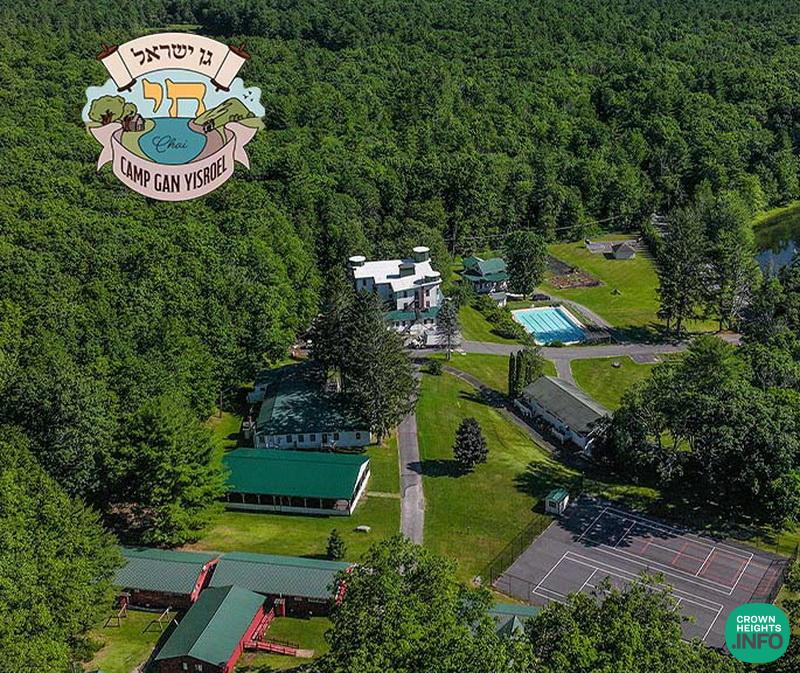 CrownHeights.info10 days ago
We are so excited to share that CGI Chai officially closed on the purchase of our very own 36-acre campgrounds in Lackawaxen, Pennsylvania! We finally have a permanent home to grow into and expand.
While renting campgrounds worked in the past, it was not a sustainable option financially nor for the stability we need to grow and achieve the goals we’ve set for the future.
When this property came to our attention, we knew right away that it could be our home. It’s ready for us to move into this summer and gives us room to grow for years to come.
Having a permanent place to call home means the money that used to go toward rent can now go toward building our future: lowering tuition, expanding scholarships, and continuing to build the programs and culture that make Chai, Chai.
Camp Gan Yisroel Chai is a place where girls connect with each other, their staff, themselves, and the Rebbe. It is a place where campers become staff, staff become leaders, and everyone feels part of one big family.
We’re ready to build a future.
We are so grateful to Joshua Rubin of Rubin Commercial Group for bringing us the opportunity, and to every parent and supporter who has believed in us along the way, we are here thanks to you.
There is so much more now to fix, build, and pay for on these new grounds. If you share the vision to help create this amazing space for our children there’s plenty of opportunity to make a real difference.
Reach out to help make this dream a reality:
Malka Aisenbach
Geula Gniwisch
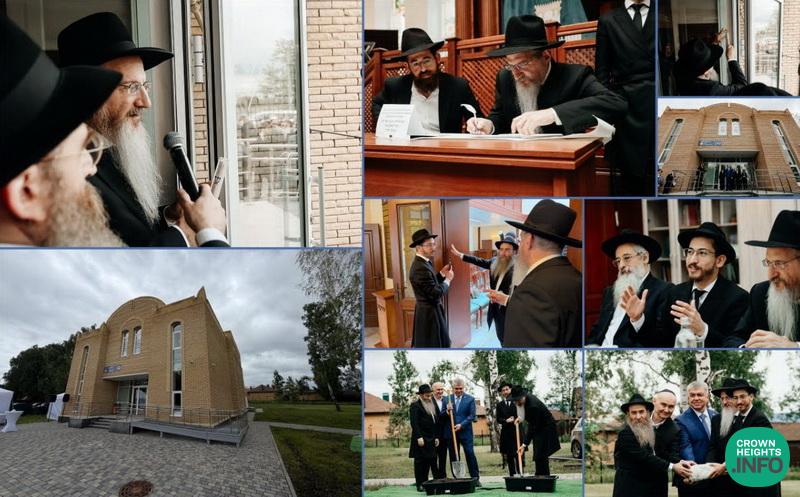 CrownHeights.info10 days ago
The days of the month of Tammuz, carrying the profound significance of the redemption of the Rebbe Rayatz of Lubavitch, took on a vivid and tangible expression this week of the triumph of spirit over matter, especially as we enter the centennial year of his redemption.
Across the Muslim Republic of Tatarstan in Russia, in the city of Naberezhnye Chelny, an unprecedented atmosphere of spiritual elevation was felt. The city, currently marking the 400th anniversary of its founding and known worldwide primarily for its extensive automotive industry and the giant ‘Kamaz’ factory celebrating its 50th anniversary, took on a festive spirit. Against the roar of the factories and the momentum of industrial development, entirely different sounds emerged and rose. The local Philharmonic Orchestra, playing the melodies of the 12th and 13th of Tammuz Festival of Redemption with great emotion, welcomed the masses of celebrants who flocked to the opening celebration of the new and magnificent Jewish Center and synagogue located in the heart of the city. For the many attendees, who stood in awe of the building now serving as a living testament to an unstoppable Jewish revival, it was a pure moment of “This is the day the Lord has made; let us rejoice and be glad in it.”
Behind the impressive structure, which spans two spacious floors and includes a beautiful sanctuary, a rich library, an event hall, and a community kitchen—lies a story of wondrous Divine Providence.
The Mara D’Asra, the young and energetic Shliach Rabbi Chaim Dovid Payer, brought a moving life circle to a close on this day. As an eleven-year-old boy in the city of Kazan, his Jewish world began to take shape when he came to the local synagogue to recite the Mourner’s Kaddish for his father. He was welcomed warmly and received dedicated, personal guidance from the Rabbi of the Republic of Tatarstan, the Shliach Rabbi Yitzchok Gorelik. From that moment, his path was paved for an impressive journey of returning to his roots, which led him to study in the ‘Tomchei Temimim’ yeshivas in Moscow and the Holy Land, and ultimately to his rabbinic ordination. Now, under the directive of Rabbi B. Lazar, Rabbi Payer has returned to the republic where he was born to serve as the spiritual leader of the community in Naberezhnye Chelny, the second-largest city in the Republic of Tatarstan. He works vigorously, receiving constant support from his father-in-law, Rabbi Shevach Zlatopolsky, who serves as a Shliach in Almaty.
The historic event was led by the guest of honor, the Chief Rabbi of Russia, who opened the emotional chain of events by affixing the mezuzahs, and was subsequently honored with writing the first letter in a magnificent Torah scroll that will be donated to the community. Immediately afterward, the distinguished guests went out to the sounds of the crowd’s singing to the center’s plaza, for the pouring and laying of the cornerstone for a Mikvah Taharah, which will be built in the complex and complete the spiritual infrastructure for the Jews of the region.
A long and distinguished line of public figures came to salute the community’s development, headed by Mayor Mr. Nail Magdeev, President of the Russian Jewish Congress Mr. Yakov Gentsis, and members of the family of the philanthropist Mr. Vainer, who assisted with a generous heart.
Joining them was a respected gallery of rabbis and shluchim who arrived from near and far to rejoice in the community’s celebration: The Rabbi of the Republic of Bashkortostan and the city of Ufa, Shliach Rabbi Dan HaLevi Krichevsky; Rabbi of the city of Chelyabinsk, Shliach Rabbi Meir Kirsh; Rabbi of the city of Sochi, Shliach Rabbi Sholom Lazar; Chairman of the Federation of Jewish Communities and the ‘Ohr Avner’ Foundation, Shliach Rabbi Dovid Mondshine; Director of the Shluchim Office in Russia, Shliach Rabbi Menachem Mendel Mondshine; Shliach in the Zhulebino neighborhood of Moscow, Rabbi Yitzchak Voldorsky; Maggid Shiur at the Mesivta in Moscow, Rabbi Meir Fyodorov; Maggid Shiur at the Yeshiva Gedolah in Moscow, Rabbi Nissan Pill; and the Sofer Stam Rabbi Efraim HaKohen Cohen. Alongside them were the leaders and prominent members of the community, representatives of various religions, and many friends.
An uplifting moment took place when the Philharmonic Orchestra played the melody of the 12th of Tammuz, and the conductor, Mr. Lermont, one of the community’s dignitaries, invited all the rabbis to sing the melody accompanied by the instruments—a sight that deeply moved the mayor and the numerous participants.
At the opening ceremony, the Chief Rabbi of Russia delivered a fascinating and uplifting address, in which he dwelled upon the meaning of the sanctuary residing in the heart of every Jew. In his remarks, he revealed a detail that evoked awe and publicly sanctified God’s name: the President of the Muslim Republic was the one who pushed, supported, and even invested substantial financial resources into establishing the Jewish center, serving as a rare paragon of mutual respect and brotherhood in a multinational country. The open doors of the new Jewish center, now bustling with life and prayer, promise to empower the local community, connect more and more Jews to their heritage, and illuminate the entire automotive capital with the precious light of Torah and Chassidus for generations.
Later in his address, the Chief Rabbi noted among other things: “It is said in the Torah, ‘And they shall make Me a sanctuary, and I will dwell among them’ (b’socham). The commentators point out that the meaning of the verse is seemingly unclear: if it had been written ‘and I will dwell within it’ (b’socho), it would be understood that by building the Holy Temple, one brings about the resting of the Divine Presence within the house.
“However, it says ‘among them’ (b’socham)—within each and every individual. And since the Almighty is already present within every one of us anyway, what then is the need for the building? The explanation is that by building a sanctuary and revealing the desire for it to be the center of our lives, we establish a permanence for the Divine Presence to dwell within us. We proudly demonstrate that the Divine presence is the most important thing for us, and by doing so, we establish His dwelling place in the heart of every single Jew.
“When infrastructure is built in the city and living conditions are improved, it is wonderful. When I am told that a grand, wide road will be paved here, that is all well and good. But where is the center of the city? Here, in the place where the sanctuary resides. And it is wonderful to see the visible joy in everyone who enters here and feels at home. Why? Because thanks to the sanctuary, the potential within everyone can be exposed and revealed. It could be a small child, or it could be a person who has already lived a full and worthy life.
“I would like to welcome here, first and foremost, Mr. Vainer, the father and his son. Exactly today, ninety-nine years ago, the Rebbe Rayatz of Lubavitch, who in those days fought against the Communist regime that opposed religion and faith in God, was released from his imprisonment, and it was a moment of the triumph of the spirit. Today, when we see how we stand together, representatives of other religions, our brothers whom we are so glad are with us today—we see how much religions are respected specifically here in Russia. This is a truly multinational country, and not just in words. What we currently see in the West, unfortunately, is not a cause for joy, but we see how here in Russia, peoples live in peace and live together. Why? Because we have respect for religion, faith in God, and this is what unites us.
“Therefore, I wish each and every one of you great success, happiness, and spiritual growth. You are fortunate to have such a wonderful rabbi come to you. Someone said today that he is very young; I say that being young is a wonderful virtue, as he has a lot of energy. He will still learn much from you. He already feels not just ‘at home,’ but this has already become his hometown. Thank you for welcoming him so wonderfully. Thank you to Rabbi Gorelik, who invests so much, not only in the building but in creating a wonderful Jewish life in all of Tatarstan.
“I bless you that this should be a good beginning. The very fact that such a center has been built is a wonderful thing, but now everyone is needed here every single day. Why? Because only together will we be able to reveal our potential and glorify this beautiful city. My blessings for a long life. May God grant that we can always show everyone how to be friends and how to unite forces. This is the blessing I wish for each and every one of us—health, happiness, and success, and that this center will beautify the life of every person and empower what already exists within them, so that it becomes much greater and more beautiful, and in the merit of all this, may we merit the true and complete redemption speedily.”
Photography: Yegor Sukhov
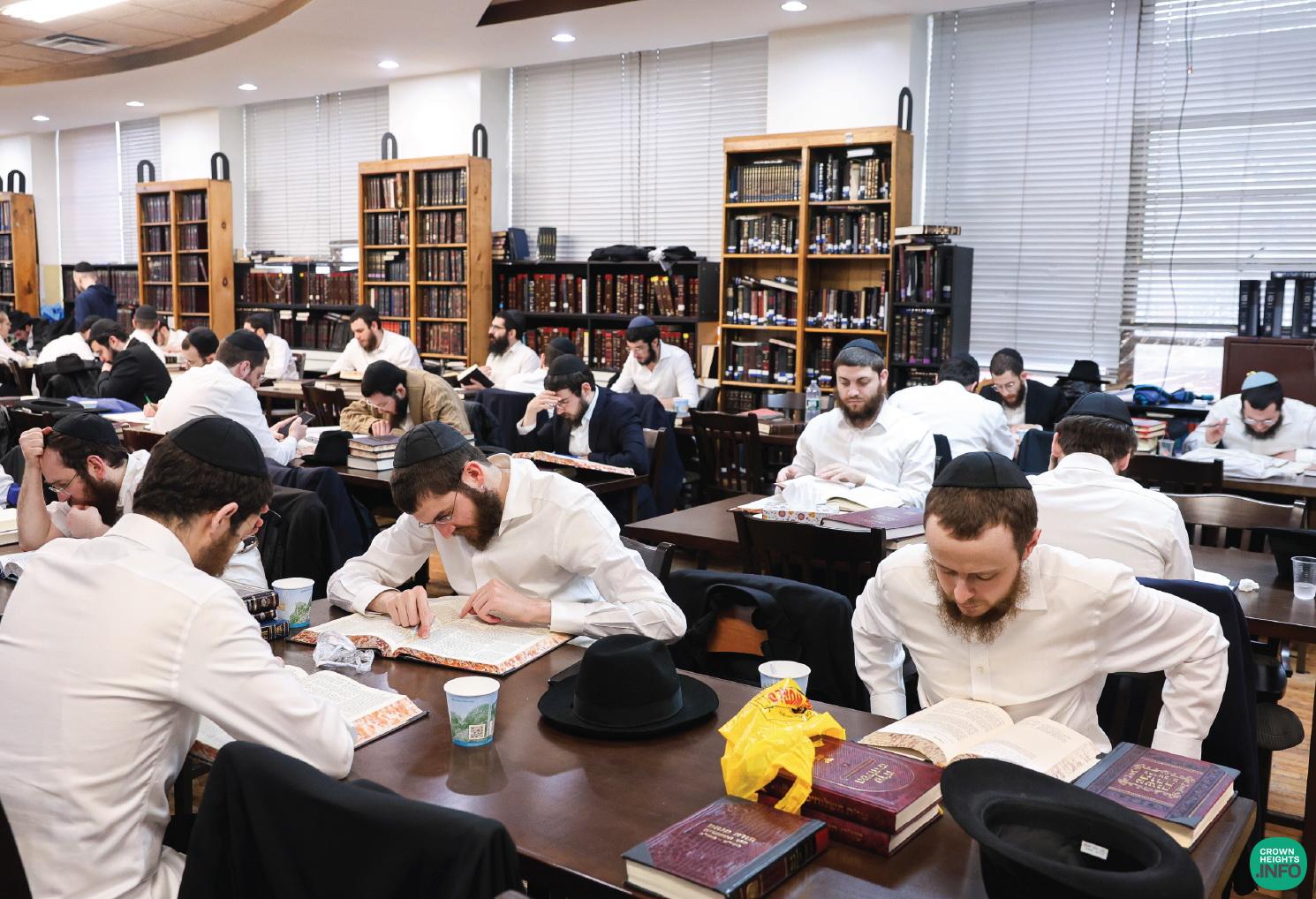 CrownHeights.info10 days ago
More than sixty years ago, the Rebbe founded Kolel Menachem – the very first Lubavitch kolel. Throughout the years, The Rebbe remained personally involved, regularly requesting updates on its attendance and progress. It was never just another institution; it was the Rebbe’s Kolel.
This past Nissan, Machne Israel undertook the responsibility of supporting and expanding the Kolel, with a commitment to strengthen this treasured institution for generations to come.
The growth has been remarkable.
We began by providing monthly stipends to 40 full-time yungeleit. By Iyar, that number had grown to 46. Today, in Sivan, 57 full-time yungeleit receive monthly stipends, enabling them to dedicate themselves fully to Torah learning while supporting their families with dignity.
As more dedicated yungeleit seek to join, we hope to welcome and support 12 additional members in the coming weeks.
One of the most inspiring developments has been the community’s response. Already, 21 supporters have stepped forward to “adopt a Kolel member,” committing to sponsor a monthly stipend and becoming true partners in the Kolel’s continued growth.
As the Kolel continues to grow, so does our investment in its future. Over time, we will be making a series of facility improvements to enhance the learning environment for our yungeleit.
Every new member welcomed into the Kolel strengthens Torah learning, supports another family, and carries forward the Rebbe’s vision.
We invite you to partner with us in ensuring that the Rebbe’s Kolel continues to grow and flourish.
Visit KolelMenachem.org to learn more and become part of this important mission.
 CrownHeights.info10 days ago
Rabbi Shmuel Lesches, Magid Shiur in the Yeshiva Gedola of Melbourne, Australia, has compiled a guide to the laws and customs of the fast of the 17th of Tammuz and the three weeks for the benefit of the wider Lubavitch community.
Please note: All times listed are for Melbourne only.
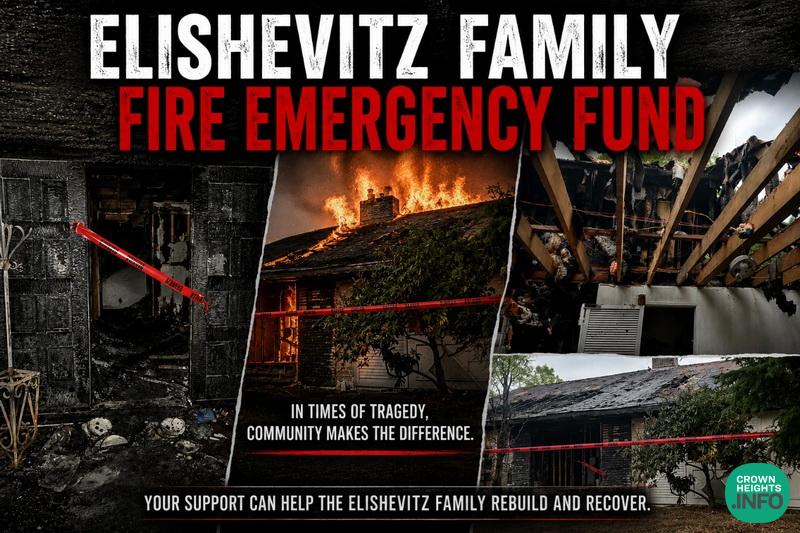 CrownHeights.info10 days ago
On Shabbos morning the unthinkable happened.
A devastating fire engulfed the Elishevitz family’s home. Baruch Hashem, everyone made it out alive, though some suffered minor injuries. But within a matter of minutes, everything they owned was gone. Their home was reduced to ashes, and with it, all of their belongings, treasured memories, clothing, furniture and the countless everyday necessities that make a house a home.
In a single morning, an entire lifetime had to begin again.
Anyone who knows Rabbi Sholom and Mrs. Chaya Elishevitz knows that their home was never just their family’s home, it was a home for the entire community. Their door is always open, their table always had room for one more guest, and their hearts were always open to anyone in need. They have quietly given of themselves to so many families throughout the ETC Bellevue community and the MMSC Day School community, offering kindness, hospitality, guidance, and support without ever expecting anything in return.
This is our opportunity to surround the Elishevitz family with the same love and generosity they have shown to so many others. As they face the overwhelming task of rebuilding their lives from nothing, every contribution, large or small, will help provide stability, hope, and the ability to begin again.
Please open your hearts and give as generously as you can. Together, as a community, we can help this extraordinary family rebuild not only their house, but their home.
Thank you for your kindness, your generosity, and your heartfelt support.
Rabbi Mordechai and Rochie Farkash
Families of Rabbi and Mrs. Elishevitz
Board of MMSC Day School
To Donate: https://www.chabadbellevue.org/templates/fundraising/default_cdo/aid/7412879/jewish/Campaign.htm
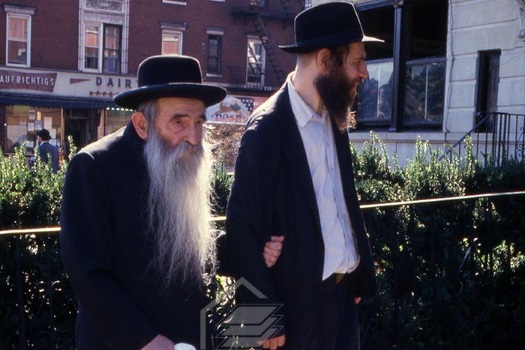 CrownHeights.info11 days ago
Rabbi Chaim Dalfin has released a sixth installment from an interview with Reb Aron Dalfin touching on Reb Avraham Mayore Drizin.
 CrownHeights.info11 days ago
Yossi Farro has turned a mitzvah into a global mission. In this episode of Meaningful People, he shares how a childhood spent putting tefillin on strangers in New York grew into a journey that has taken him around the world, connecting with celebrities, billionaires, entrepreneurs, influencers, and everyday Jews. From chance encounters with actors to live streams and meetings with some of the biggest names in business, Yossi explains how persistence, authenticity, and a simple pair of tefillin opened doors he never imagined.
Along the way, Yossi discusses the Chabad philosophy behind mivtzoim, why he believes tefillin has the power to inspire lasting Jewish connection, and the remarkable stories that have kept him motivated through thousands of encounters. He also reflects on the Rebbe’s tefillin campaign, outreach after October 7, lessons from some of the world’s most successful people, and why his mission is only getting started.
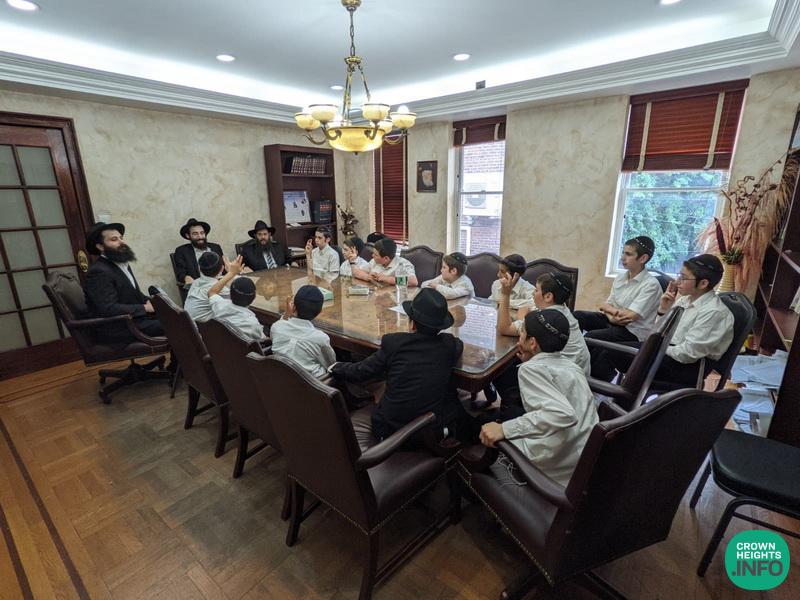 CrownHeights.infoCrownHeights.info11 days ago
In a beautiful display of Yedias Hatorah and Yiras Shomayim, the talmidim of Kita Vov of Cheder Ohr Menachem visited the Beis Din following months of dedicated learning, demonstrating an impressive mastery of Hilchos Shabbos.
Under the devoted guidance of their melamed, Rabbi Yochanan Twerski , the talmidim were cross-examined by the Mara D’asra, Rabbi Yossef Yeshaya Braun, together with Rabbi Menachem Rottenberg of the Badatz, joined by the Cheder’s Menahel, Rabbi Menachem Mendel Yusewitz.
The Rabbonim were deeply impressed by the boys’ clear yedios, remarkable fluency, and ability to respond immediately and confidently to every shailah presented before them. Their command of the halachos reflected the many hours of diligent learning and review invested throughout the year.
Following the examination, the talmidim gathered together for a special fleishige Seudas Mitzvah barbecue at the home of Rabbi Yusewitz, celebrating this significant accomplishment in an atmosphere of Torah, simcha, and chassidishe warmth.
The memorable event left the talmidim inspired to continue growing in their Limud Hatorah with renewed enthusiasm, carrying with them the importance of learning Torah not only with diligence, but with true clarity and mastery.
 CrownHeights.info11 days ago
by Ahron Gluck
I want to thank Hashem for giving me the opportunity to run for office, I would like to thank the 2,245 members of the _Shchuna_who came out and placed their trust in me by casting their vote. While we did not achieve the outcome we had hoped for, together we sent a clear and powerful message to our elected officials in Albany: Crown Heights and East Flatbush cannot be treated as a dumping ground for homeless shelters, and the safety, security, quality of life, and concerns of all district residents deserve to be taken seriously.
I would like to congratulate our Assembly Member, Brian Cunningham, on his reelection victory. I have spoken on the phone with Assemblyman Cunningham moments after the race was called, he invited me to sit down together and discuss issues facing our district and to find common-ground on implementing solutions to address those concerns and help the community. I will IYH be taking the Assemblyman up on his offer and look forward to working with Assemblyman Cunningham for the neighborhood’s benefit.
To my incredible campaign team, staff, volunteers and loyal supporters, thank you for standing with me from the very beginning. Your countless hours of hard work, dedication, and belief in this campaign made everything we accomplished possible. I will always be grateful for your friendship and commitment.
I want to publicly thank and acknowledge the six elected members of our community, the Vaad Hakohol for their efforts involved with voter registration drives over the past several months. The Vaad Hakohol stood their ground and convictions by the voting initiative and now have emerged as the only CH Jewish community organization engaged with voter registration, The Vaad Hakohol’s courage and leadership will never be forgotten by the entire community that they are honored to represent.
A heartfelt thank you as well to all the community leaders of the Crown Heights Political Action Committee (CH PAC) for their endorsement and full support throughout this campaign. In addition to our community’s win for the District Leaders races, the fact that our community came out and followed CH PAC’s endorsements this was a strong statement by our members that the Vaad represents the voice and votes of Crown Heights.
I would like to congratulate CH PAC endorsed candidate for Brooklyn 6th Municipal Court District judge (which includes parts of the Shchuna), Janice Purvis on her win.
As well a huge Mazal Tov to my friend and CH PAC endorsed Democratic male District Leader / State Committee Member elect Akel Williams who bravely defeated the current Crown Heights openly anti-semitic incumbent because of the Jewish community votes which put him over the top, and to his running mate CH PAC endorsed female Democratic District Leader / State Committee Member elect Nakisha Evans on her win. They are both friends and supporters of the Jewish community and understand the issues facing the neighborhood, Askonim met with them and are looking forward to working with them for the betterment of all residents in our beautiful diverse and multicultural neighborhood.
I also want to recognize and thank the major Jewish news websites serving our community. Their commitment to accurate reporting and keeping our community informed is an important service to Crown Heights and Lubavitchers worldwide.
I would like to highlight that during the campaign, I have met with many of my neighbors and friends in the African American community. The same concerns we have regarding the homeless shelters, they have. The same concerns we have in regards to bike lanes and citibikes, they have as well.
In 1991, in the wake of the Crown Heights riots, NYC Mayor David Dinkins visited the Rebbe on Sunday afternoon to receive a dollar and a blessing. The Rebbe said, “[We are] one side, one people, united by the management of New York City.” Let’s thrive to continue working with our neighbors for the betterment of our district.
During my campaign some of the messaging highlighting certain neighborhood concerns have been voiced bluntly—to say the very least… I would like to fully apologize to Assemblyman Brian Cunningham and other elected officials that I have offended when voicing community concerns. My sincere hope is that we as a community can find common ground with our elected officials and work together with them to address these very important issues, many which both the Jewish community and our friends and neighbors in the African American community together are wholeheartedly against, like the mega homeless shelter, in a way that truly benefits our neighborhood instead of the current status quo.
As for me, I will be able to now spend more time with my dear family and return to work as a general contractor and DOB Consultant, where I will continue doing my part to help people with building their homes and navigate the Gov bureaucracy, and strengthen our neighborhood. Public office is only one way to serve a community, and I remain committed to making Crown Heights a better place in the private sector for all who call it home.
Most importantly, I hope this campaign inspires more members of our community to get involved in the democratic process. Whether it’s registering to vote, volunteering, attending community meetings, or even running for office if the need arises, our voices matter. A stronger community begins with engaged residents.
This campaign may be over, but my commitment to Crown Heights is not. I will continue advocating for our neighborhood on an individual level, standing up for our community, and working toward a safer, stronger, and brighter future for everyone.
Thank you, Crown Heights, East Flatbush and Prospect Lefferts Gardens, for your support, your encouragement, and your faith in me. It has been the honor of a lifetime to earn your trust.
May Hashem bless our community and all residents of the 43rd Assembly district.
