

New York (VINNEWS/Rabbi Yair Hoffman) The kesuvah, of course, is a legal contract, written in Aramaic, that a groom gives to his bride. For thousands of years, this document protected a woman if her husband ever divorced her or if he passed away. The money was meant to be large enough that a husband would think twice before ending the marriage carelessly. Yet today, in America and other countries outside of Israel, the value of the kesuvah is so miniscule that it no longer effectively serves that purpose.
Two Hundred Zuz, or Twenty-Five?
The kesuvah of a first-time bride states the main obligation with the words “kesef zuzei ma’asan,” meaning two hundred zuz. The Rambam (Mishneh Torah, Hilchos Ishus 10:8) explains that the “zuz” is the same as a dinar, but that these coins were not pure silver: they were only one-eighth silver (7 parts copper to 1 part silver). Because of this, the 200 “dinar” of a besulah were actually equal to only 25 zuz of pure silver, and the 100 of a widow to just 12.5. The Shulchan Aruch (Even HaEzer 66:3) rules this way, which is why the Sephardic kesuvah is valued at only 25 dinar.
The Rama (ibid), on the other hand, holds that the zuz of the kesuvah is the normal, full dinar. To make clear which type is meant, Ashkenazim add the phrase that the sum is “due to you by Torah law” (d’oraisa), and so the Ashkenazic kesuvah is valued at the full 200 dinar. The Sephardim do not add that phrase, relying on the contract rule of “al hatachtonah”: any undefined term is read at its lowest value. This one difference is the root of the gap between the two traditions.
The research presented here draws heavily on the remarkable scholarship of Rabbi Ahron Notis in his recent volume, The Great Shiurim Debate, published by Mosaica Press.
Putting Real Numbers on It
Twenty-five dinar equals about 106 grams of silver (under 3.5 Troy ounces); 200 dinar equals about 850 grams (about 27.4 Troy ounces). The dollar value swings with the price of silver, which has been volatile, ranging in recent years between about $18 and $30 a Troy ounce but climbing to roughly $60 a Troy ounce as of July 2026. At that price:
- An Ashkenazic kesuvah for a first-time bride (200 dinar) is worth roughly $1,640.
- A Sephardic kesuvah (25 dinar) is one-eighth of that, roughly $205.
- A widow’s kesuvah is half a first-time bride’s; a Sephardic widow’s comes to only about $102.
The number on the parchment never changed; only the price of silver did. Because the kesuvah is tied to silver rather than to paper money, its value floats with the metal, but it is never a large or reliable sum.
Why So Low? The Rivash’s Answer
The Rivash (vol. 2, siman 153) was asked exactly this: the sum seems far too small to make a husband hesitate before divorce. His answer was that the kesuvah was never built for the wealthy; it was built for the poor of the time of Chazal, people who lacked even enough bread, slept on the ground, and mostly went barefoot. For such a person, 200 zuz was a genuinely meaningful sum. He proves it from the Mishnah: someone with 50 zuz who does business with it is no longer “poor” (and may not take the gifts left for the needy), and 50 zuz is only half a widow’s kesuvah.
The key point is that silver has largely kept its purchasing power when measured in bread. In an era when bread was most of a poor family’s budget, 200 zuz truly hurt to pay out. The 200 was always the floor, designed around the poor; a wealthier bride could always demand more.
The Three Money Promises in a Kesuvah
A kesuvah contains three obligations. The first is the ikar kesuvah, the ancient core amount (200 dinar in the Ashkenazic text). The second is the dowry (nadunya), the value the bride’s father sent along, which the husband had to return upon divorce or death; today it is written as a fixed 100 zekukim of fine silver. The third is the tosefes kesuvah, an added amount the groom voluntarily promises, another 100 zekukim. Together the dowry and the addition make the familiar 200 zekukim of Ashkenazic kesuvos.
These sums were once negotiated case by case, but communities eventually adopted one standard figure for everyone. As the Raaviyah (Sefer Raaviyah, vol. 3, Biur Mishpetei HaKesuvah, siman 916) explained, since most people were poor, a uniform amount spared anyone the embarrassment of a small, revealing number.
The Mystery Unit: What Is a Zakuk?
The word written in the kesuvah is zekukim (singular: zakuk), and one point deserves to be clear: there was never a coin stamped “zakuk.” The word means “refined,” and it first referred to a weight of refined silver, much as the English “pound” began as a unit of weight. Over time it likely attached to the European “mark” currency, so that, like the British pound, it came to mean a coin rather than an actual weight of silver. Before World War II, the zekukim in a European kesuvah pointed to the real money of the day, such as zlotys or marks.
Today no unit anywhere is called a zakuk. Rav Moshe Sternbuch (Hilchos HaGra U’Minhagav, Dinei Nisuin, siman 126) writes that it is not clear what “zekukim of fine silver” even means; the Maharam Mintz, cited there, identified it with the mark currency worth 48 groshen. We are left writing in a measure that no longer exists, and no one is sure which historical mark was meant.
Why Not Just Write It in Dollars?
If the old units are gone, why not use dollars or shekels? The answer lies in a problem with modern money: it is not backed by silver or gold, and it steadily loses value to inflation. A fixed dollar figure would erode over a long marriage and could be nearly worthless by the time it was collected. Silver, by contrast, holds its value in bread. The rabbis kept silver, but by now no one agrees which silver coins the zekukim were meant to be.
Rav Moshe Feinstein’s Attempt to Fix It
Rav Moshe Feinstein (Igros Moshe, EH, vol. 4, simanim 91–92) proposed a fix. Noting that in Czarist Russia the custom was to collect 75 rubles (then worth a bit over $40, a meaningful sum for ordinary people), he suggested that in America we understand the word zakuk as the weight of a mark, about half a pound. A groom would then obligate the value of 100 pounds of silver (about 45 kilograms which as of July 2026 is $87,000), more than fifty times the ikar kesuvah, a sum large enough to truly make divorce not “light in his eyes.” But no such custom was ever adopted, and so the financial obligation of the kesuvah today remains insignificant.
Why Doesn’t Anyone Update It?
Gedolei Yisrael once kept the tosefes kesuvah meaningful by raising it as economies changed, but since World War One the amount has been frozen. Two reasons explain the lack of urgency. First, the fear of easy divorce has faded: Ashkenazim no longer permit a get against the wife’s will, and secular law now imposes a heavy financial burden on a man seeking divorce. Second, the kesuvah money is rarely collected at all; divorcing couples reach a broader settlement in which the husband gives far more than the kesuvah requires. So communities keep copying the same wording of 200 zekukim, even though neither the groom, the bride, nor the officiating rav know what it means.
Can a Woman Still Collect Her 200 Zekukim?
It depends on where the kesuvah was written. In a place with a definite local custom fixing how much silver the 200 zekukim represent, she can collect that amount. But in most of the world today there is no such custom, and the rule of “al hatachtonah” takes over: an unclear sum is enforced only at its lowest interpretation. Since the smallest reasonable value of a zakuk is very little, there is sadly not much she can actually collect.
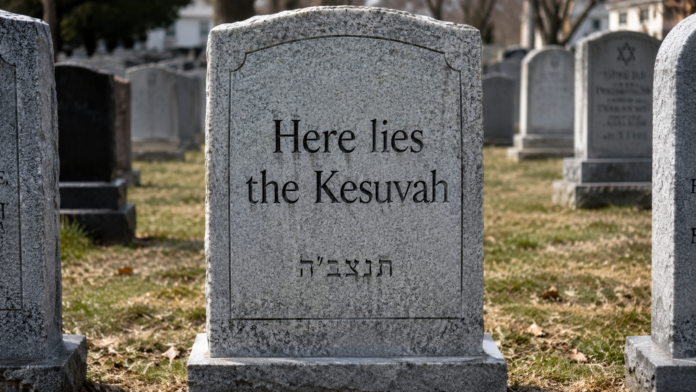
The kesuvah remains a holy and essential part of every Jewish wedding, and its role in protecting the dignity and rights of a Jewish woman is as important as ever. What has died is the meaning of its money. The document still names ancient units, zekukim, that no living person can find or spend, and that were never even the name on a real coin.
In the end, the kesuvah is a living testament to Chazal’s concern for the almanah and the divorcee. It is this author’s view that the matter should be taken up with our Torah leaders and that we should endeavor to have various communities adopt the view of Rav Moshe Feinstein zt”l and make the Kesuvah a viable legal document collectable in court.
Below is the traditional Ashkenazic kesuvah in English translation alongside the Aramaic original. The footnotes connect specific phrases to the discussion above, so a reader can see exactly where each ancient measurement and obligation lives inside the document itself.
On the fifth day of the week,
בחמישי בשבת
the fourth day of the month of Adar,
ארבעה ימים לחדש אדר
in the year five thousand seven hundred seventy-seven from the creation of the world,
שנת חמשת אלפים ושבע מאות ושבעים ושבע לבריאת עולם
according to the reckoning that we count here in the city of Bnei Brak —[1]
למנין שאנו מנין כאן בעיר בני ברק
how so-and-so, son of so-and-so,
איך מוה”ר פלוני בן מוה”ר פלוני
said to this maiden, so-and-so, daughter of so-and-so:[2]
אמר לה להדא בתולתא פלונית בת מוה”ר פלוני
“Be my wife according to the law of Moshe and Yisrael.”
הוי לי לאנתו כדת משה וישראל
“And I will work for you, honor you, provide food for you, and support you,
ואנא אפלח ואוקיר ואיזון ואפרנס יתיכי ליכי
in accordance with the practice of Jewish men who work for, honor, feed, and support their wives faithfully.
כהלכות גוברין יהודאין דפלחין ומוקרין וזנין ומפרנסין לנשיהון בקושטא
And I give to you the mohar of your virginity, two hundred silver zuz that are due to you by Torah law,[3]
ויהיבנא ליכי מהר בתוליכי כסף זוזי מאתן דחזו ליכי מדאורייתא
and your food, your clothing, and your needs, and to come to you in the way of all the earth.”
ומזוניכי וכסותיכי וסיפוקיכי ומיעל לותיכי כאורח כל ארעא
And Mrs. so-and-so, this maiden, consented, and she became his wife.
וצביאת מרת פלונית בתולתא דא והות ליה לאנתו
And this dowry that she brought in to him from the house of her father,[4]
ודן נדוניא דהנעלת ליה מבי אבוה
whether in silver or in gold, in ornaments, in garments one wears, in furnishings of the dwelling, and in bedding —
בין בכסף בין בזהב בין בתכשיטין במאני דלבושא בשימושא דדירה ובשימושא דערסא
all of it the chosson accepted upon himself in the sum of one hundred zekukim of kesef tzuri.[5]
הכל קיבל עליו מוה”ר פלוני חתן דנן במאה זקוקים כסף צרוף
And the chosson agreed and added to her from his own another one hundred zekukim of kesef tzuri corresponding to them,[6]
וצבי מוה”ר פלוני חתן דנן והוסיף לה מן דיליה עוד מאה זקוקים כסף צרוף אחריהם כנגדן
so that the total is two hundred zekukim of kesef tzuri.[7]
סך הכל מאתים זקוקים כסף צרוף
And thus said the chosson:
וכך אמר מוה”ר פלוני חתן דנן
“The responsibility of this document of the kesuvah, this dowry, and this addition I have accepted upon myself and upon my heirs after me,[8]
אחריות שטר כתובתא דא נדוניא דן ותוספתא דא קבלית עלי ועל ירתי בתראי
to be paid from the finest and best of my property and possessions and acquisitions that I have under all the heavens,
להתפרע מכל שפר ארג נכסין וקנינין דאית לי תחות כל שמיא
that which I have acquired and that which I am destined to acquire —
דקנאי ודעתיד אנא למיקני
property that carries responsibility and property that does not carry responsibility.
נכסין דאית להון אחריות ודלית להון אחריות
All of it shall be liable and a guarantee to pay from it this document of the kesuvah, this dowry, and this addition,
כלהון יהון אחראין וערבאין לפרוע מנהון שטר כתובתא דא נדוניא דן ותוספתא דא
from me and even from the cloak upon my shoulders,[9]
מנאי ואפילו מן גלימא דעל כתפאי
in life and in death, from this day and forever.”
בחיים ובמות מן יומא דנן ולעלם
And the responsibility of this document of the kesuvah, this dowry, and this addition the chosson accepted upon himself,
ואחריות שטר כתובתא דא נדוניא דן ותוספתא דא קבל עליו מוה”ר פלוני חתן דנן
with the stringency of all documents of kesuvos and additions that are customary among the daughters of Yisrael,[10]
כחומר כל שטרי כתובות ותוספתות דנהגין בבנת ישראל
made in accordance with the ordinance of our Sages of blessed memory —
העשויין כתיקון חז”ל
not as a mere asmachta and not as a standard form of documents.
דלא כאסמכתא ודלא כטופסי דשטרי
And we made a kinyan from the chosson to Mrs. so-and-so, this maiden,[11]
וקנינא מן מוה”ר פלוני בן מוה”ר פלוני חתן דנן למרת פלונית בת מוה”ר פלוני בתולתא דא
upon everything that is written and explained above, with an article that is fit to make a kinyan with.
על כל מה דכתיב ומפורש לעיל במנא דכשר למקניא ביה
And all is firm and established.[12]
הכל שריר וקים
The author can be reached at [email protected]
[1]The kesuvah is dated and localized because it is, above all, a binding legal contract, not a ritual formula. This is why the questions raised in this article, about how much its sums are worth and whether they can be collected, are real questions of contract law, decided (as noted below) by rules such as “al hatachtonah,” that an unclear amount is read at its lowest value.
[2]“Besulah” (maiden / first-time bride) is the key status word. As explained above, a besulah’s ikar kesuvah is 200 zuz, while a woman who was married before (a beulah, including a widow or divorcee) receives half that amount, 100 zuz.
[3]This is the ikar kesuvah, the core biblical-rabbinic obligation. Two points from the article live in this single line. First, “two hundred silver zuz” (כסף זוזי מאתן): a zuz is a silver dinar, about 4.25 grams of silver, so 200 of them are about 850 grams. Second, “that are due to you by Torah law” (דחזו ליכי מדאורייתא): Ashkenazim add these words, following the Rama, to specify that full Torah-weight zuz are meant, not the lighter debased coins that the Rambam and Shulchan Aruch describe, coins only one-eighth silver, which reduce the Sephardic value to 25 zuz.
[4]“Nadunya” is the dowry, the second of the three money layers discussed above. It was not a gift to the groom; its value had to be returned to the wife upon divorce or the husband’s death.
[5]Here is the first appearance of the mysterious unit at the heart of this article: “one hundred zekukim of kesef tzuri” (מאה זקוקים כסף צרוף). As explained above, there was never a coin named “zakuk”; the word means “refined” and referred to a weight of refined silver that later attached to the European “mark” currency. This clause fixes the dowry at a standard 100 zekukim, the community-wide sum that replaced individually negotiated amounts.
[6]This is the tosefes kesuvah, the third money layer: the amount the groom voluntarily “adds” (והוסיף) from his own. Historically this was the layer that Gedolei Yisrael periodically raised to keep the kesuvah meaningful, and it is the layer Rav Moshe Feinstein proposed reinterpreting as 100 pounds of silver.
[7]The dowry (100) plus the addition (100) yields the familiar “two hundred zekukim” total. This is the figure that, as the article notes, has not been adjusted since before World War One, and whose real value “neither the chosson, the kallah, nor the mesader kiddushin” can state today.
[8]“Achrayus” (responsibility / lien). The groom binds all his property, present and future, as security for these three obligations. This is what makes the kesuvah collectible in principle. Whether a woman can truly collect the 200 zekukim, however, depends on whether a local custom fixes their silver value.
[9]“Even from the cloak upon my shoulders” is a vivid legal flourish stressing how total the lien is. It underscores the original purpose of the kesuvah: to make divorce a serious financial matter, “not light in his eyes,” the very purpose that has eroded as the money’s value faded.
[10]“As is customary among the daughters of Yisrael” signals that the kesuvah follows a standardized communal text. This standardization is exactly why the sums became uniform (per the Raaviyah, so as not to shame the poor) and also why an outdated figure persists unchanged: the text is copied by custom.
[11]“Kinyan” is the formal act of acquisition that makes the groom’s commitments legally binding. It confirms that the obligations above, however antique their units now sound, were undertaken as real, enforceable law.
[12]“Hakol sharir v’kayam”, “all is firm and established”, is the traditional closing that validates the document. It is a fitting final line for this discussion: the kesuvah remains firmly established as a holy and living contract, even as the precise worth of the money it names has been quietly forgotten.