
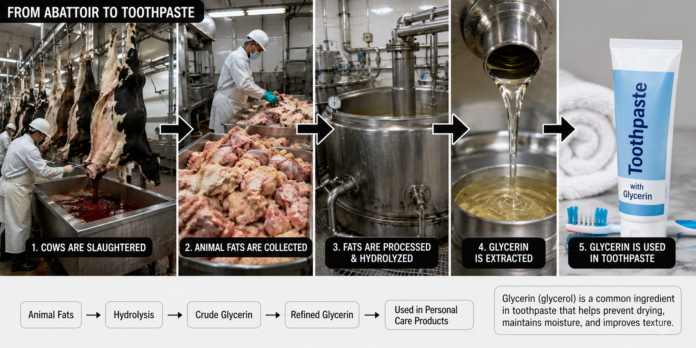

New York (VINNEWS/Rabbi Yair Hoffman) On the killing floor of a modern abattoir (a non-kosher schlachthous), an animal is reduced to its parts in minutes. A little more than half of it walks out the door as meat. The rest — the hides and hooves, the horns and bones, the glands, the blood, the fat scraped from a hundred hidden places — is swept into a category the industry calls, with unsentimental precision, inedible by-products.
Almost nothing is thrown away.
That fat is rendered, refined, and split into its component acids. One of the sweet, clear liquids that emerges from that dark and bloody abattoir is glycerin. From there it travels — into soaps, into cosmetics, into the pharmaceutical supply, and, more often than most people would care to know, into that innocent looking tube of toothpaste sitting on the bathroom sink.
This kind of means that twice a day, a Jew who generally only shops at kosher stores or otherwise carefully scrutinizes every item purchased for a hechsher may be running the residue of a non-kosher animal across the most sensitive tasting surface he owns — and then, thankfully, spitting it out.
Does that tube of toothpaste demand a hechsher of its own? The question is neither as trivial nor as settled as it first appears, and it has divided many a top Posaik.
Rav Yisroel Belsky zt”l (1938–2016) pointed to a Taz (Rav Dovid HaLevy 1586-1667) that it is forbidden to put something non-kosher in one’s mouth – even if one does not intend to swallow it. Lehavdil bain chaim l’chaim, Rav Herschel Schachter (b. 1941) held that the Taz was only referring to a food, but toothpaste is specifically not something that is generally eaten or swallowed.
The difficulty is sharpened by the fact that glycerin itself is not a spoiled or repulsive substance. On the contrary, it is sweet. One therefore cannot dismiss the concern simply by labeling the ingredient inedible.
First Basis for Leniency: The Tzemach Tzedek (via Pischei Teshuva)
The first justification to permit toothpaste draws on the ruling of the Tzemach Tzedek, cited in the Pischei Teshuva (1813–1868) (YD 108:1). His reasoning proceeds in steps. The prohibition against tasting a non-kosher substance without swallowing is only derabanan – rabbinic, enacted out of concern that one might come to eat it. Where the substance is inedible, that concern is weaker.
And although the Noda BiYehuda (1713–1793) maintained that tasting with the mouth is itself included in the prohibition even without swallowing, the prohibition in such a case remains merely rabbinic. Applied to toothpaste — which is only tasted on the tongue, is a spoiled substance not fit to be eaten, and is spit out rather than swallowed — this yields grounds for more leniency.
This permission, however, is not straightforward. The Pri Megadim (Rav Yoseph Teumim -1727–1792) disputes the Tzemach Tzedek’s reasoning, and in YD (Siman 298:15) he writes explicitly that regarding tasting he does not have a clear basis to rule leniently. The first argument, therefore, is a machlokes.
Second Basis for Leniency: The Har Tzvi and Bittul B’Rov
A stronger and independent justification comes from the Responsa of the Har Tzvi (Rav Tzvi Pesach Frank, 1873–1960) (Siman 298). His argument shifts the analysis away from tasting entirely. The requirement of nullification specifically in sixty parts (bittul b’shishim) governs food mixed into food. Here, however, the non-kosher glycerin is mixed into a base of ingredients that are themselves unfit for eating. In such a mixture, a simple majority (bittul b’rov) is sufficient to nullify the prohibited component. The Imrei Yaakov ruled leniently on the same basis.
He explains the underlying principle by way of the Rashba (c. 1235–1310): a discernible taste blocks nullification only where the taste is identifiable as the taste of the prohibited substance itself. Where that is not the case, the prohibited component is nullified by the majority in the ordinary manner.
Third Basis for Leniency: The Absence of Intent to Taste
A further leniency is cited in the name of Harav Reuven Feinstein (b. 1937), with lbc”l Rav Elyashiv zt”l (1910–2012) concurring. The rabbinic prohibition against tasting was enacted because tasting can lead, by way of swallowing, to actual eating. That rationale applies where a person intends to taste. In the case of toothpaste, however, one does not intend to taste at all — the tasting is merely incidental to brushing — and so the decree does not extend to it.
The Position of Rav Henkin zt”l
Rav Yosef Eliyahu Henkin zt”l (1881–1973) (Responsa Siman 41) addressed the matter in the context of young children and ruled that one need not be exacting. His reasoning: the children swallow nothing of it; the substance is introduced in a manner that causes it to be nullified; and the mouth is wiped clean afterward. On these grounds he saw no real concern.
The Stringent Position: Rav Belsky in the Name of Rav Yaakov Kamenetsky
Against the accumulated grounds for leniency stands the position reported in the name of Harav Yisrael Belsky zt”l, citing Harav Yaakov Kamenetsky zt”l (1891–1986). While conceding that the essential letter of the law is lenient, they held that in practice one should be stringent.
Rav Belsky advanced a further, substantive point: in his assessment, modern toothpaste qualifies as “fit for eating” (ra’ui la’achilah). If so, the entire foundation of the Tzemach Tzedek’s leniency — which rested on the substance being inedible — no longer applies to contemporary formulations. The sefer notes that even so, room to permit may remain on the strength of the later reasonings (the Har Tzvi and the absence of intent). The Responsa Pe’as Sadcha (Siman 84) is likewise stringent regarding toothpaste and records that the meticulous are careful in this matter.
How Rav Belsky Distinguished Between Brands
In practical terms, Rav Belsky zt”l would differentiate between different types of toothpaste depending on how much glycerin they contain. Toothpaste is made of cleansers, flavors, and sweeteners. He ruled that if the majority of the toothpaste is comprised of inedible ingredients (i.e., cleansers), then the glycerin, which is a minority, would be nullified. If, however, the amount of glycerin is greater than the inedible components, it may not be used. Because it can be difficult in practice to make this assessment, he recommended buying only toothpastes that are certified kosher or are known to use kosher glycerin.
Giving Non-Kosher Toothpaste to Children
Feeding prohibited substances (ma’achalos assuros) to a minor is forbidden by Torah law. There is accordingly greater room for stringency in giving non-kosher toothpaste to a small child, who is liable to eat and swallow it. And since a kosher variety can be obtained, one cannot rely on the leniencies here — even though the prohibition in this case is only rabbinic — given that the child’s need can be met with a permitted product.
Mouthwash Is More Stringent Than Toothpaste
Rav Belsky also held that mouthwash is treated as more problematic than toothpaste. The Har Tzvi’s leniency rested on the non-kosher component being mixed into a base of inedible ingredients. In mouthwash, by contrast, the principal components are themselves fit for consumption. The bittul b’rov argument therefore does not apply, and the basis for leniency is correspondingly weaker.
A Consideration Toward Stringency
Even granting the lenient view, there is reason to prefer kosher toothpaste. Some rabbanim, including Rav Herschel Schachter shlita, have ruled that toothpaste may be used even if it contains non-kosher ingredients, because it is inedible and is not intended to be swallowed. Yet we have seen that even regarding soap — which only goes on dishes and has a terrible taste — there is a preference for using kosher soap. How much more so with cleansers that go into one’s mouth and have a pleasant taste; it is preferable that they be kosher.
Certified Kosher Brands Are Readily Available
Several toothpaste brands do hold reliable kosher certification. Popular options include Adwe, Tom’s of Maine, SprinJene, Spry, Supersmile, Brightol, and Orbitol. These certified products allow one to satisfy the stricter opinions without difficulty, and their ready availability removes much of the practical hardship that once weighed toward leniency.
We have seen three different grounds for leniency — the rabbinic-only nature of the tasting prohibition (Tzemach Tzedek), nullification by simple majority in an inedible base (Har Tzvi), and the absence of any intent to taste (Rav Reuven Feinstein). We have also seen the countervailing stringency of Rav Belsky who held that practice should follow the stricter view and that modern toothpaste may no longer qualify as inedible at all. With reliably certified brands now easy to obtain, the meticulous have every reason to choose one. Everyone, however, should consult with their own Rav or Posaik.
The author can be reached at [email protected]