
Lifestyle publication for busy Jewish women featuring recipes, parenting tips, and home inspiration.
Lifestyle publication for busy Jewish women featuring recipes, parenting tips, and home inspiration.

 Between Carpools
The BCP Kosher Kopykat recipe series is one of our favorites! Most of the recipes with the Kosher Kopykat tag have been inspired by restaurant foods, including The Carrot’s Cilantro Dressing, Mike’s Chicken, Teva’s Tuna Carpaccio, and much more.
Other times, we get the restaurants to share their actual recipe. The Cookie Corner’s Avocado Toast is one of those!
When we receive a recipe from a restaurant, the job isn’t much easier. Usually the recipes that restaurants share with us are in large, commercial quantities or include vague instructions. It’s hard to replicate it exactly, even when we have the actual recipe! The commercial ovens, stoves, ingredients don’t always yield the exact same results. Still, we’re impressed with how close to the original we’ve gotten a lot of them to be.
A month ago, the BCP team set out to talk. No computers, no photoshoots, just to sit and discuss what we’ve done well, what we could improve, how to use our time more efficiently and what you – our readers – want more of. With all great meetings come great food, and so we make sure we eat well! That meeting ended with dinner by Soya by Salt, a seaside Asian restaurant on the Long Branch boardwalk in Pier Village (And yes, even though it was wintertime, we happened to be there on a beautiful day where we could also enjoy a little outdoors).
And while we loved everything they recommended, two of our favorite dishes were the Ramen Soup and the Beef Chow Fun, which is essentially noodles and beef. While our initial reaction was, “Let’s get the recipe for the Ramen Soup,” it turned out to be too complicated for the average cook (with lots of components). So, noodles it was!
With some help from the chef, the manager, and some proteksia from Tzila, our administrative manager, we got it!
If you have a kosher restaurant and want to share a recipe feel free to reach out to us!
Now, let’s make Beef Chow Fun.
Thin slices of steak are key — they cook quickly and stay tender.
You can either combine all the marinade ingredients, then add the steak, or simply add the steak to a bowl and add the ingredients. Whichever makes more sense for you.
Mirin is one of the ingredients that makes this sauce special.
We found Mikee Vegan Oyster Sauce in our local grocery store. If you don’t find it, this vegan Oyster Sauce brand is available on Amazon with the Badatz hechsher.
No long marinating time is needed–30 minutes to 2 hours in the fridge is perfectly fine.
One of the most important things when getting a recipe from a restaurant is the ingredients they use. The brand of noodles is what makes this dish restaurant-quality. The restaurant sent us a photo of the noodles they use and we found them easily in large national supermarkets and on Amazon!
Boil the noodles according to package directions. Drain and toss with a little oil to prevent sticking.
Next, prepare the sauce. The Vegan Oyster Sauce is used in the sauce also, not only in the marinade. Don’t try to sub if you want the same results.
Now it’s time to cook the steak. Heat 2–3 tbsp oil in a large pan or wok over high heat. Add marinated steak in a single layer (cook in batches if needed). Stir-fry 2–3 min until cooked through.
Add in the cooked noodles.
And the stir-fry sauce. (If the sauce feels too thick, splash 1–2 tbsp water to loosen it.)
Toss it all together until well-coated!
Time to serve! Drizzle with sesame oil if desired. Garnish with sesame seeds or green onions. Serve hot!
Note that traditional Beef Chow Fun usually features flank steak, but since that is not a kosher cut, Soya uses ribeye. (When you see Flank Steak at a kosher butcher, it is usually a different cut and simply the name is being used.)
Marinate the steak. Combine all marinade ingredients in a bowl or resealable bag.
Add sliced steak, mix, and marinate 30 min to 2 hours in the fridge.
Prepare the noodles. Boil noodles according to package directions. Drain and toss with a little oil to prevent sticking.
Prepare the Stir-Fry sauce. In a bowl, combine all ingredients.
Cook the steak. Heat 2–3 tbsp oil in a large pan or wok over high heat. Add marinated steak in a single layer (cook in batches if needed). Stir-fry 2–3 min until cooked through.
Add cooked noodles and stir-fry sauce to the pan. Toss everything 1–2 min until noodles are heated and coated with sauce.
Finish & Serve. Drizzle with sesame oil if desired. Garnish with sesame seeds or green onions. Serve hot.
If the sauce feels too thick, splash 1–2 tbsp water to loosen it.
 Between Carpools
I went to my second grader’s Purim play this week and I did not expect to be so emotional.
It wasn’t perfect. A crown slid down over someone’s eyes. A girl forgot her line and just stood there blinking. Her friend leaned over and whispered it. An adorable Haman started laughing when she spotted her mother in the audience.
No one stopped the show.
The music kept playing. The teacher didn’t run on stage. The curtain didn’t close. The girls just found themselves again, and kept going.
The show must go on.
I sat there thinking — this is exactly what our lives look like. We go to sleep with a plan–a good one. In our heads, tomorrow feels calm and manageable. We picture how the morning will go, we imagine conversations landing softly, and we assume dinner will defrost on time.
And then…it doesn’t.
Someone wakes up sick. The baby spills yogurt on your new sweater. The snow comes–again. The chicken is still frozen. A conversation shifts in a direction way we didn’t expect.
Suddenly we feel like we forgot our lines.
What throws us isn’t always the thing itself. It’s that moment between what we pictured and what is happening. That pause can feel terrifying, or exhausting. It can feel personal.
Watching those little girls helped me see something simple; forgetting your line doesn’t mean the story is over.
It means–you take a breath and keep going.
Purim is like that too. The whole Megillah feels ordinary on the surface. Parties. Politics. People making choices. Hashem’s name doesn’t even appear. All along, something bigger is moving underneath it all.
Maybe our homes are like that.
Maybe the spilled yogurt and the missed cues and the awkward conversations are not interruptions to the story. Maybe they are the story.
I watched one girl pause after she lost her place. She looked out at the audience, a little flushed, a little unsure. Then she said the next line and smiled. That’s it.
That’s the whole lesson.
We don’t need perfect days. We need steady hearts.
Some mornings will feel smooth. Some will feel scrambled before we’ve had coffee. The house still wakes up. The children still need us. Our husbands still walk through the door at the end of the day.
The show goes on.
Not in a dramatic way. In a normal, quiet way.
Dinner might change. Bedtime might stretch. A conversation might need a redo. We don’t storm off stage. We adjust. We soften. We continue.
You are the mother in this home. The wife in this marriage. No one else can play the part the way you do. Not because you are flawless — because you are you. And when the day doesn’t follow the script you imagined, maybe the only question that matters is: how do I want to show up here?
May we all be blessed with the kind of steadiness that lets us breathe, find our place again, and keep going — trusting that even the messy scenes are part of something meaningful.
And now I’m curious.
When was your “the show must go on” moment this week? When did something fall apart a little… and you chose to stay? Let’s share those stories. Those are the real Purim miracles — quiet, ordinary, and happening right in our kitchens.
Thank you Chaya B. for inspiring this post.
 Between Carpools
This craft idea was so fun, it actually kept both our little ones and even 13-year-olds busy for a while!
If you have white cups at home, your kids can start right now. If not, you may have to wait until Amazon is delivering again to get these coffee cups (local stores usually tend to stock coffee cups that have a design). (Don’t have cups? See our Purim Salt Craft for another great activity.)
We used 12 oz. cups here, but the project can work with any size (if the cup is smaller, the head might stick out on top of the cup and that’s fine!) You’ll need two cups per project.
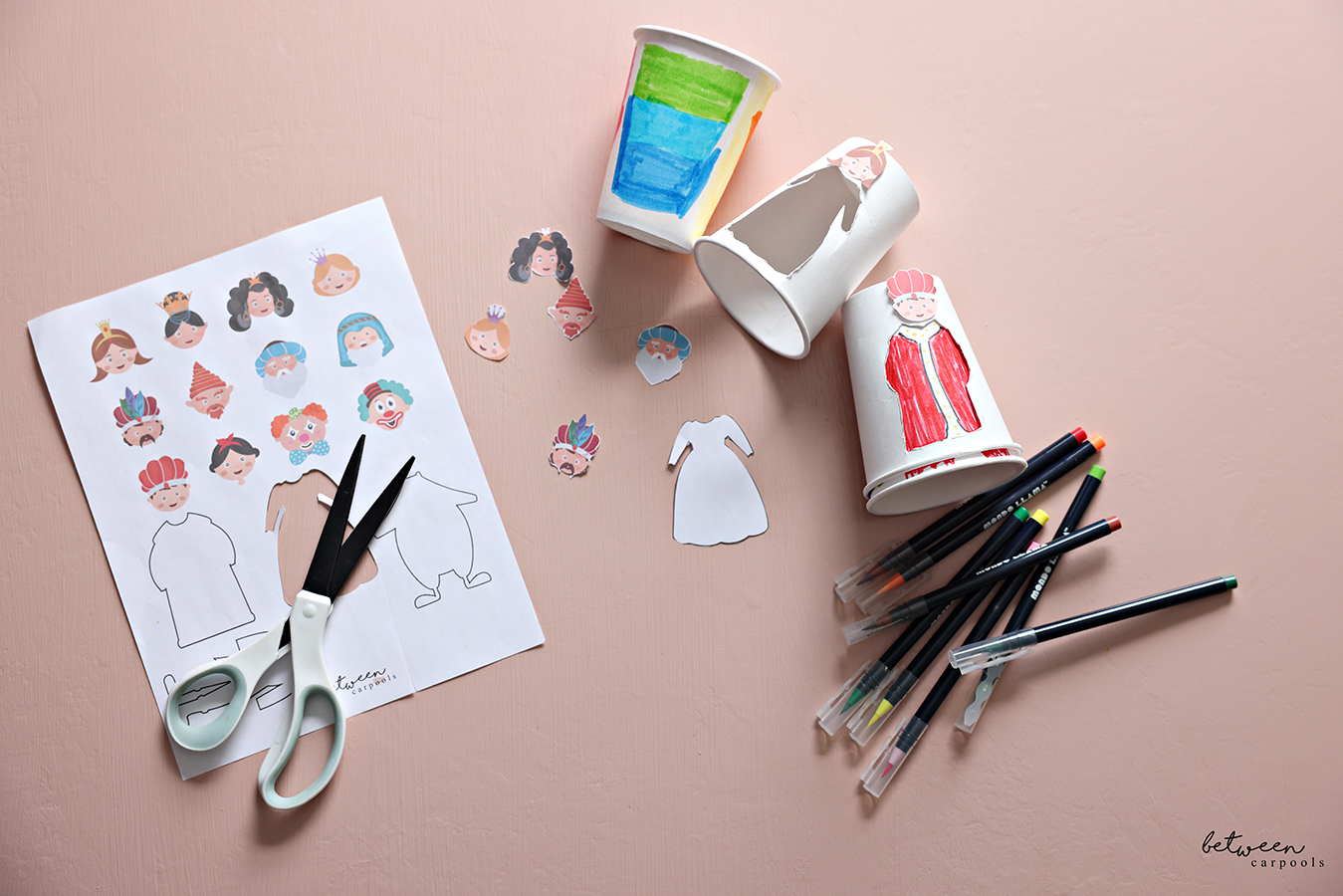
Start by downloading this sheet of Purim faces and outift shapes. Choose one of the outfit shapes and cut it out, then trace it onto the cup. The cup is going to be used upside down, so the narrow part of the cup is the top.
You can use two outfits per cup if you like, just make sure the seam of the cup is in between. See the photo above for a reference as to where to trace the outfit on the cup.
The hardest part is cutting out the outfit shape. If an adult is around, using a razor type of tool is the most efficient. Otherwise, just poke a hole with your scissors and then cut out your traced outfit shape.
Next, cut out one of the Purim faces and glue it on top of the outfit. If you are doing two outfits per cup, choose two Purim faces, one for atop each outfit!
Now it’s time to create some patterns and prints on your second cup. Color them however you like! There’s no need to stay within any lines (however you do need to cover a space at least as big as an outfit cutout).
Color 3-4 different designs on the underneath cup – be creative!
Now stack the cups!
and give it a twist! Each time you twist, another one of your patterns appears in the outfit cutout.
Watch your Purim characters change their outfits with each twist of the cup.
You can even make more outfits by adding an additional insert cup.
Have fun!
For another Purim craft that’s perfect for today and uses materials you have at home, see our Purim Salt Craft.
 Between Carpools
When I heard Perroquet was expanding in Lakewood, I thought,
Nice. Bigger space. Mazel tov.
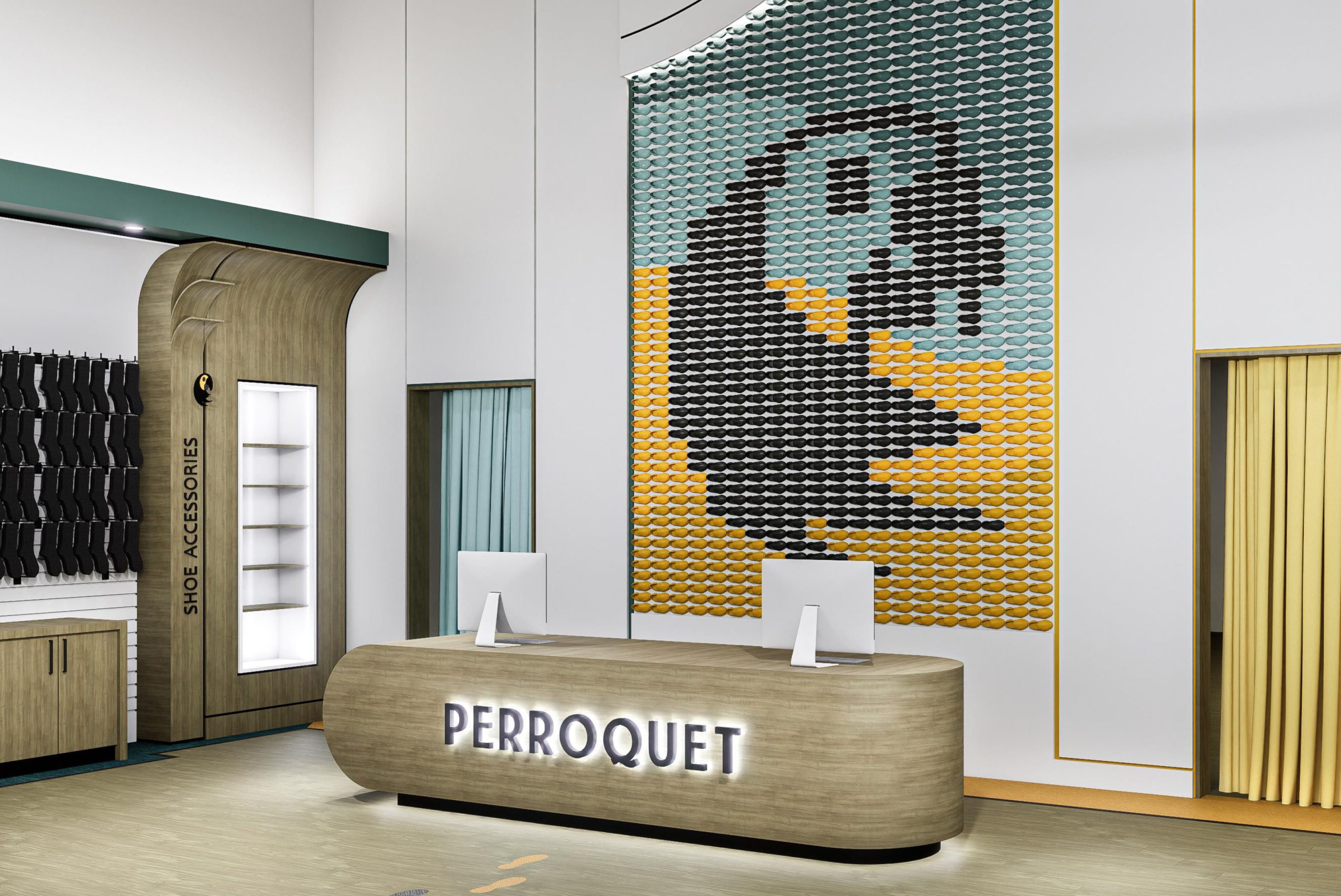
I did not expect to walk in and feel like I’d just entered the calmest 5,000 square feet in town.
FIVE. THOUSAND. SQUARE. FEET.
And suddenly it makes sense.
Perroquet has always been known for exceptional customer service. This store feels like their way of saying: we mean it. We planned for you.
If you’ve ever gone shoe shopping with more than one child, you understand what that means. No bumping into strollers. No balancing a toddler while someone squeezes past. No digging for sizes. No chaos.
You walk in — and you can breathe.
The entire space was designed by Susan Strauss, and it shows. Airy. Polished. Thoughtfully laid out. The displays make sense. The flow makes sense. Finding the right pair feels easy.
It’s elevated. But still warm. Still Lakewood.
Over 185 styles this season.
Let that sink in.
Dressy. Casual. Sneakers. Sandals.
Girls. Boys. Baby. Teens.
It’s the kind of place where you realize halfway through,
Oh. I can just do everyone here.
Teens walk out happy. Toddlers are comfortable. Moms feel accomplished. That’s not a small thing.
Global Reach
Wherever in the world you are, dear reader, chances are there’s a seasonal Perroquet location near you. With pop-ups spanning communities across the globe, Perroquet has become a household name trusted by families season after season for quality, style, and consistency.
With 17 Worldwide locations they make it accessible to all their loyal customers.
And you can always shop online perroquetshoes.com for quick nationwide shipping!
 Between Carpools
How deep are you into Spring ‘26 shopping? Because as much as we like to pretend it’s not around the corner, we also don’t want everything to sell out. And yes, it’s still cold. And no, our Mishloach Manos isn’t totally finished. Yet, it’s still time.
This year, Pesach shopping just got cuter, and a whole lot more affordable.
Meet Capri, the brand-new dresswear brand you’re going to love, now available at Tottini! Shop gorgeous pieces perfect for Shabbos and Yom Tov, comfortable enough for real life, easy to coordinate across the kids, and priced to keep you smiling.
Capri’s pieces are really unique! Gorgeous details (can you even with the collars in this Double Button collection, or this perfect linen blouse?!), beautiful mix-and-match colorways, and pieces for everyone in the family.
It’s hard to pick our favorite pieces, or even our favorite collections. We love the taupes, soft teal, and light pink woven throughout the Capri line, so start with your favorite piece (or your hardest to please kid!) and build their wardrobes our from there.
Shop the whole collection at www.tottini.com/collections/capri, and check out our favorite collections, below.
 Between Carpools
Editor’s Note: We love organizing here on Between Carpools, so we’re also excited to introduce Devorah Pomerantz, whose creative out-of-the-box ideas can help those with all types of spaces. We hope that some of her solutions may be just what you needed!
Dear Devorah,
My closet is small and awkward, and more than once I’ve been told that the solution is to redo it – rip it out and start from scratch with something custom.
That’s not something I can afford right now. Is there a way to make it functional without tearing it apart?
– Closet-Conflicted
Here’s the good news: most closets don’t need to be rebuilt. They need to be rethought. And thankfully, rethinking is a lot less expensive than rebuilding.
Some of the best closets I’ve worked in didn’t involve construction or custom plans. They worked because the space was used more creatively – and because the client stopped forcing the closet to function the way it was “meant” to.
Let me show you what I mean.
No Contractor Required
After hearing “redo your closet” enough times, it’s easy to assume there’s no other option. But more often than not, the fix isn’t construction – it’s strategy.
In one chosson–kallah apartment we worked in, the client wanted more shelving but didn’t want to invest in custom work. So instead of changing the closet itself, we worked within it.
We brought in simple cube shelving and placed it directly inside the closet, taking advantage of vertical areas that weren’t doing much before. Some cubes received cloth bins, others were left open. What had been one open, underused section became clear zones. Folded clothing finally had boundaries. Accessories had a place. Nothing about the structure of the closet changed – but how it worked absolutely did.
Which, to be fair, is usually the goal.
This approach works especially well in apartments and rentals, where flexibility matters. It’s not about cutting corners. It’s about making smart choices that work for the space you actually have – and the life that’s happening inside it.
Shoe Racks That Do More
Closets don’t always need a full redo to work better. Often, a few well-chosen additions are enough to change how the space functions.
White wooden shoe racks are a great example. In closets with white or wood shelving, they blend right in and don’t feel temporary or added on. Each rack essentially acts like an extra shelf – adding structure and usable space without changing the closet itself.
In this closet, we stacked two shoe racks to create more usable storage. The bottom rack was used for shoes – nothing revolutionary there. The top rack, though, pulled a little extra weight.
We slid bins into the upper rack – the Chancellor bins from The Container Store fit perfectly – and used them like drawers. In a closet that didn’t have drawers at all, we suddenly had contained storage for undergarments, yarmulkes, and other small items that don’t do well living out in the open.
The footprint stayed the same, but the closet became much easier to live with. Which is always a win, especially in a small closet.
When the Space Calls the Shots
There are moments when organizing means setting the rules aside and paying closer attention to what the space actually needs.
Most of the time, I wouldn’t put shoes on a top shelf. That’s not usually where they belong, and for many people, it wouldn’t make sense. But in this closet, the bottom section was already spoken for – luggage and larger storage items that weren’t going anywhere.
The shoes were already living on the top shelf – just not in a way that was working. They were stacked in shoeboxes, hard to see, and even harder to access. The shoes themselves were clean, well cared for, and worn intentionally, which made a different approach possible.
Instead of fighting the layout, we worked with it. We placed shoe racks on the top shelf, within reach, and used that space intentionally for footwear. Because of the shelf hardware, the racks needed a small adjustment. Flipping them upside down allowed them to sit flat and secure, without forcing the closet to do something it simply wasn’t built to do.
This isn’t something I’d recommend in every home. But in this one, it made sense. The shoes were easier to access, the shelf was clearer, and the closet finally felt manageable.
Sometimes the right solution isn’t the standard one – it’s the one that works.
These are the felt baskets featured on the top shelf.
Drawers are great. We love drawers. They keep small things contained and make spaces easier to use.
But when a closet doesn’t have drawers – and adding them would mean more work than anyone wants to take on – bins, especially opaque ones, can step in and do the same job.
What makes opaque bins especially useful is that you don’t see inside them. You can slide one out, grab what you need, and slide it right back in – without everything being on full display.
The shelf feels calmer, and smaller categories stay where they belong instead of slowly taking over the entire shelf.
It’s not replacing drawers.
It’s about creating the same function in a different way.
This cart was also used in the closet below.
Wide shelves tend to promise a lot.
Plenty of space. Room to spread out. Everything visible at once.
At first, the piles look neat. Clean. Organized.
Then real life shows up.
You grab a shirt from the bottom of a stack. The pile starts to tilt. Clean laundry gets added on top. And before you know it, those neat piles have quietly merged into one large, unstable mountain of clothing.
Enter shelf dividers. They break one wide shelf into smaller, more usable sections and give piles a clear place to stop. Everything has a place to land, which makes shelves easier to maintain – not just nicer to look at on day one.
They also happen to make closets look more finished, which is a nice bonus for something that’s really there to save you from refolding the same stack over and over again.
Final Thoughts
You don’t need to bring in a contractor to fix a closet.
Most of the time, it’s about using the space more thoughtfully – and being willing to adjust when the “right” solution doesn’t quite fit.
Sometimes that means rethinking shelves.
Sometimes it means creating drawers where there aren’t any.
And sometimes it means letting go of the rules and doing what works.
The goal is the same either way: a closet that actually works for you.
If it’s easier to live with tonight – and not mysteriously undone by morning – I’d call that a win.
You got this!
Happy Organizing,
Devorah
We used the following items in the closets above:
 Between Carpools
It’s been ten years since the loss of my 23-weeks-and-6-days-old fetus, Chaviva.
At the time, A TIME- an incredible organization for all fertility challenges – encouraged us to give her a name, as a way to stay connected and to be able to daven for her by name. Being able to hold onto the idea that this was all for a reason, along with learning about gilgulim and listening to other deeply helpful shiurim, carried me through a very challenging period.
(I once heard Chani Juravel suggest saying אלקי נשמה… from the perspective of just having experienced a miscarriage. To this day, that thought sticks with me in davening.)
I remember investing so much time and emotional energy choosing her name together with my husband. In retrospect, it was therapeutic for me. Neshama. Emunah. So many options. We ultimately chose Chaviva—because she was already loved. Our family was SO excited for a baby!
At the time, a Rav told my husband that losses like these often affect women far more intensely than men, and that he should understand that (translation: put up with me and my hormones until further notice). I couldn’t grasp how he didn’t experience this as the same kind of loss of life and potential that I did. I truly felt like I had lost a child—ish.
Healing came in the days and weeks following the birth- a birth where the only cries you hear are those of the mother and father, while the baby is silent. One of the most eerie moments of my life, overflowing with emotion.
(Sorry if I’m being heavy! This is me trying to keep it light actually…!)
Our stillborn—as the hospital calls it—came after two earlier miscarriages. Which means I was pregnant for over 86 weeks by the time my next baby was born. You can imagine how amazing I felt…and looked.
… Thank You Hashem!
The healing happened because of the family and friends who surrounded us with support. Lunches were dropped off. Small notes and gifts just appeared. Tefillos were said. Messages came in from people who had been there themselves. All of it mattered more than I ever would have imagined. I felt like it wasn’t just in my head, it was actually traumatic.
It’s been ten years. And you know what? I still think about Chaviva! And I think about that winter break that began just days after the loss, and how empty it felt—even while surrounded by my other children. That kind of emptiness you wake up to and wonder if it really happened. And then feel the punch all over again.
Looking back, it was a family-wide social and emotional experience. (Not just because I’m a therapist!) Each child was told in a different way depending on their age. Some cried more than others. I remember wanting to protect them from the sadness—and even more so, them wanting to protect me. It hurt me to see them sad, and it hurt them to see me cry.
With open communication, tons of support from my husband, family, and friends—and therapy when needed— I’d like to announce: time really does heal.
It’s been ten years. And recently, my husband asked me if I’m still thinking about Menucha.
Menucha!!!!!
“Wait, Did you really just call her Menucha?!”
He did. For real.
I burst out laughing.
I guess the Rav was right after all—these losses really are different for men and women.
 Between Carpools
BCP Note: We ask you to read this post with an open mind to a different perspective on the word Zionist. Where Zionism represents a true love of the land, people and history of Eretz Yisrael. The love of “Tzion” that has existed among our people back to the times of our Avos. This post is not about political Zionism, but about the deepest connection we have to our Homeland.
We just spent six weeks exploring Greece and Israel. Because of how the flights worked out, Greece was made possible as an add-on. Israel was the main character.
This part of the trip was centered around a milestone in our family: our daughter’s bat mitzvah. We have been planning and saving for this her entire life, not for a single event or party, but for the chance to spend significant time together as a family in Israel—long enough to explore it, live in it, and experience it fully.
We wanted to mark her bat mitzvah in a way that felt intentional rather than performative. Instead of compressing the moment into one day, we chose to spend that money and effort on time. Ordinary mornings, repetitive errands, Shabbat routines, favorite routes, and places we returned to again and again—enough time for Israel to stop feeling like a destination and start feeling like a home.
This trip was also unapologetically Zionist in its intent. We wanted our children to build a positive, lived relationship with Eretz Yisrael. We wanted them to know the land with their feet, their hands, and their daily lives.
For our bat mitzvah girl especially, that meant experiencing Judaism as something physical and inherited rather than abstract or symbolic—prayers said where prayers have been said for thousands of years, holidays observed where they shape the public calendar, Jewish time unfolding in Jewish space. For her siblings, it meant absorbing all of this more quietly, through repetition and proximity, until it felt normal rather than extraordinary.
We wanted our children to understand that the Jewish connection to Israel is not recent, not fragile, and not theoretical. It is ancient and continuous. It shows up in archaeology and geography, in language and liturgy, in the way Jewish history here does not stay safely in the past. In Israel, Jewish history is not something you visit; it is something you inhabit and walk and drive alongside.
At the same time, we wanted them to love Israel in a human way. To associate it with routines and rituals, with favorite bakeries and familiar streets, with long walks, small adventures, and shared meals. To experience Israel not as an argument to be defended, but as a place where Jewish life is fully and unapologetically lived.
That kind of connection cannot be taught in a classroom or absorbed in a weeklong trip. It requires time, boredom, repetition, and days that don’t make great photos. It requires living somewhere long enough for it to stop performing for you.
So we came not to check boxes, but to settle in. To let Israel introduce itself slowly.
What follows is not just an itinerary, but the shape our days took as we tried to give our children something deeper than memories—a sense of belonging to a land, a people, and a story.
One of my favorite moments of the trip was when my bat mitzvah girl admitted she missed doing homeschool, the routine of reading and doing workbooks. We brought their online classes with us, but she missed science, etc. I told her, “In a way, this entire trip is school, it’s a giant field trip.” My oldest son had an epiphany: “This entire trip has been educational!” What a betrayal. He thought we were having fun.
We didn’t plan this trip quickly, and we didn’t plan it lightly. We saved for it for years—literally our daughter’s entire life—because when we finally brought our children to Israel, we wanted time. Not a highlights reel. Not a rushed checklist. Enough time for the country to unfold slowly, to layer itself into their understanding in a way that would last.
We structured our time deliberately, spending several weeks in Jerusalem before heading north.
Early in the trip, while still based in Jerusalem, we took our children south.
By the time we arrived, they had already absorbed a great deal about October 7. They had listened to my work with hostage families doing media relations and political advising. They had overheard conversations, interviews, and reporting about the war and its consequences because we both work in journalism (my husband Seth is an editor and writer at a Jewish political magazine called Commentary). Shielding them from reality wasn’t possible—and pretending it hadn’t shaped Israel today wouldn’t have been honest. We wanted them to see it for themselves, with context, with care, and with us.
We visited Sderot, the Nova site, and the surrounding communities. This is what we did, in case other folks want to do the same with older kids and pre-teens.
They didn’t experience it as shock; they experienced it as confirmation of something they already knew: that Jewish history does not stop, and that it still demands responsibility from those living inside it.
From there, we moved backward in time.
Yerushalayim became our anchor. Staying put for weeks allowed the city to stop feeling overwhelming and start feeling navigable. Shabbat arrived without stress. Familiar streets replaced novelty.
A word here about where we stayed:
Over a year ago, DansDeals (a discount blog I religiously follow), posted a sale for a site called Rentals of Distinction. They have apartments across Jerusalem for rent; apartments that are owned by regular people and rented out when they’re not in use. One of the reviews I saw on the site looked like a familiar name; I reached out to that friend and he confirmed they were legit, and he had a great stay. So we booked an amazing deal, and got an additional deal because we were staying for a full month.
But then, right before we left, we heard there was a problem: the street we were staying on was undergoing major construction at all times of day and night. The manager told me, “It would be awful with all your kids.” (Because kindly, he remembered we were traveling with six small-ish kids.) They offered to move us to another location, a much bigger apartment in a better location, but, he apologized profusely, he’d have to charge me $500 more over the course of our stay. That translated to an extra $125 a week for a much better place, and okay, twist my arm, we said sure, we’d love to move.
I reached out to them when I got home to ask if I could offer my readers a deal, and they kindly agreed. If you contact them and book a stay with them and mention my name at the time of your booking, they can offer:
*Option 1:* 10% off the rental total on select apartments
(Not every apartment will qualify, but most do.)
*Option 2:* One-way transportation – either from or to the airport.
*Option 3:* A standard fridge stock-up.
We had a great stay, and I’d really recommend reaching out if you’re looking to stay somewhere in Jerusalem with your family.
From the stability of having a home base, we explored. We took a wonderful tour of the Machane Yehuda market with Harry Rubenstein and then kept going back to our favorite spots again and again.
We walked to the Kotel several times and explored the Old City at length. We took family photos with Miri Homa to document this special time together.
We began with Tanach as geography. Walking through the Ir David transformed Tanach from story into terrain. The physicality of it mattered—climbing, walking, descending, getting tired. We had an incredible tour guide and would have done the water tunnels had it been warmer.
We spent a day and drove to ancient Shiloh, placing the Mishkan not in imagination but in space. We used one of their tour guides and were so much better informed because of it; there’s no way I would suggest going there without one. We had lunch at the nearby Gvaot Winery. This day required a car or a driver, and as we drove, we also got a clear window into the security concerns for Jews living in Yehuda v’Shomron (aka the West Bank). Barbed wire, checkpoints, and warning signs throughout, but we felt safe on our drive.
We took a full-day tour to Chevron and gave weight to the names of our Avos that our children had known their whole lives. This tour was one of the hardest things we did with the kids’ attention spans, and I’m not sure I’d recommend other families with small kids do a full-day tour like this.
At Eretz Breishit, the camel riding was a massive highlight for the kids. We “met” Avraham and learned the importance of welcoming guests and how life was lived in his day. It was a morning activity, and it was probably the best one we did.
We did a full-day drive by ourselves to Masada and visited Yam Hamelach at Ein Bokek Beach (it was cold in December, and we didn’t stay long). This was a day we wished we had brought Franny (more on her later) to give us more narrative and color for the events that happened there.
When attention waned, we shifted deliberately. Judaism is not only textual; it is agricultural, animal-centered, and seasonal. Visiting the Jerusalem Biblical Zoo and the Biblical Museum of Natural History helped our children connect mitzvot, metaphors, and animals they had only encountered on the page. These weren’t filler days, but they were definitely lighter. They were integration days—Torah made physical, creation made visible. The Biblical Zoo was a full day, but be warned that inexplicably, the cafe there isn’t kosher; I wish we had brought lunch. If we had, we’d have done the aquarium there as well. The Biblical Museum in Beit Shemesh was half a morning, and, to be honest, underwhelming, but they had a petting zoo portion that was a hit. We paired it with a trip to see a friend in town and lunch at the food court in the mall, an exciting experience for kids who have grown up Kosher-keeping.
Archaeology came next, once everyone had context. Hands-on experiences mattered most. Sifting dirt at the Temple Mount Sifting Project and digging at Beit Guvrin National Park taught our children how history is known, not just what it claims.
We took an incredible morning tour with Franny Waisman to Herodian, which left such a mark on our kids’ understanding of history. They learned that Jewish presence here isn’t a theory—it leaves evidence. She was the best tour guide we had the entire trip and made a lasting impression on kids and adults alike.
The Temple Mount sifting project was also an education in how enemies of the Jewish state have tried to erase our connection to the land, but how Jews refuse to accept it.
We had a friend guide us up to the ancient temple site, Har HaBayit. This situation is always evolving, and when we were there, we felt safe, but we did witness a man nonviolently arrested by Israeli police for lighting a menorah there. It’s a red pill moment, the fact that Israelis and Jews finally have access, but we are still so limited by geopolitical considerations. (BCP Note: Regarding the halachic implications of ascending Har Habayis, please discuss this with your Daas Torah.)
Later, we moved north and shifted our home base to Tzippori. Our accommodations at The Castle in Zippori Village are absolutely magical and perfect for families, especially adventurous ones like ours. The Castle itself is a spacious, two-story villa modeled after the ancient Crusader castle overlooking Zippori National Park, with five bedrooms, three bathrooms, a large Jacuzzi, and plenty of living space, easily fitting big families or groups of up to 12 people. What makes it truly special for kids is the amount of space to explore — from roaming freely all around the property to discovering a playground, huge grassy lawns, and even a treehouse filled with toys, plus the delight of gathering fresh eggs from the resident chickens each morning. On-site, there’s also a vineyard and winery to explore. It’s a place where children can run and explore safely, adults can unwind with breathtaking views and peaceful surroundings, and everyone can make memories that will last a lifetime. During the warm-weather months, there’s a pool that doubles as a mikvah, and while they were building it, they uncovered the tomb of an ancient rabbi right outside our door. We got Shabbat takeout nearby from a storefront with dozens of prepared food options.
It was on the north shore that the medieval period came into focus. The museum in Akko’s Knights’ Halls was spectacularly executed, and compressed empire, crusade, and survival into something our children could visualize. By then, they already had a timeline in their heads, so this layer felt additive rather than confusing. Jewish history, they could see, had continued even when sovereignty had not. The entry to that site comes with access to others in town, and it’s worth spending time visiting the Turkish Baths and Templar tunnels as well. We had lunch at Roots, which was the culinary highlight of the trip.
In the north, we also visited Caesarea and had another encounter with Herod, who built the seaport site. There were great restaurants on the shore (Aresto was the best dairy restaurant we ate at on the trip), and we had fun exploring it on our own, but it would have been worth having a guide.
Had we planned better, we’d have realized that all of the museums we wanted to visit in Haifa (Maritime and the underground immigration) were closed on Fridays. Instead, we went to Jungle Kef, near Tveria, which was an unexpected delight and a great place for kids to get up close with all kinds of animals.
We spent a day in Tzfat exploring and window shopping, and didn’t plan carefully enough to do workshops offered there in beekeeping or mosaics; all looked worth checking out. We did the Safed Puzzle Room, which was a real highlight for the older kids and parents (the younger kids colored and got in our way, adding an element to our game that was not necessarily helpful).
Throughout our time, we focused on the miracle of the founding of the modern state of Israel. Visiting the Herzl Museum, the Ayalon Institute (also known as the bullet factory), and the Underground Prisoners Museum in Akko, which reframed the state’s founding as moral courage rather than inevitability. The story stuck because it was human. Young people took risks so the Jewish state could exist. Our children understood that safety is fought for, not assumed. All three of these museums were exceptionally well done, and I would recommend them all. The Herzl Museum is situated on Har Herzl, and it’s worth visiting a few select soldiers and historical figures there and learning their stories. Two of our kids are named for men buried there, and it was so meaningful to visit them. A note that Yad Vashem is not open to younger visitors, but is also nearby. Both Herzl and Ayalon require advanced booking and planning; the hours and tours are not available as a walk-in.
Throughout the trip, we made room for beauty. Mosaics at Tzippori and Caesarea. A glassblowing workshop in Jerusalem where creation was tactile and joyful. These moments mattered because Jewish history is too often taught as endurance alone. Israel insists otherwise. Jews make beauty. We always have.
Looking back, what worked wasn’t that we saw everything. We didn’t. What worked was pacing, intention, and honesty—staying in one place long enough to breathe and alternating heavy days with lighter ones. Letting history accumulate rather than overwhelm us and trusting our children with complexity rather than protecting them from it.
We wanted our children to understand that Israel is ancient and modern, beautiful and burdened, miraculous and demanding. That loving it requires knowledge. That belonging to it carries responsibility. And that the story didn’t end in Tanach—or in 1948—or even on October 7.
It’s still being written.
And now, they know where they are in it.
 Between Carpools
I know it’s freezing outside and spring feels forever away, but Pesach is truly right around the corner. We’ve been dreaming in soft florals, fresh silhouettes, and easy, elegant layers—and we’re so excited about the collection we’ve put together. These dresses are beautiful, feminine, and thoughtfully modest, with a few styles that may need light alterations to make them perfectly your own. Whether you’re hosting, traveling, or just showing up looking effortlessly put together, this collection was curated to make you feel polished, comfortable, and completely ready for the season ahead.
Want more great finds for you? Find more great curated edits, including these focused on you, here on This/That!
Want to see This/That curated edits as soon as they launch? Sign up to their WhatsApp Community here.
 Between Carpools
Month: Adar
Mazel: Fish (dagim)
Mishenichnas Adar marbin besimchah… With the arrival of the month of Adar, our level of joy is increased. What is the formula toward heightening joy? We get our first clue from the fact that the letters samech and tzadek in lashon hakodesh are interchangeable. Where there is tzemichah, growth, there is simchah, joy. But what does growth look like, especially for us busy mothers? Here’s one powerful direction for which this month is especially auspicious for: By tapping into its power of inversion.
One significant theme of the Purim story, which we celebrate during the month of Adar, is “venahafoch hu,” the element of reversal, of turning a scenario upside down—or rather right side up. In Megillas Esther, so much of what first appeared dismal—Esther’s appointment as queen, Haman’s rise to power, the lot to annihilate Klal Yisrael was drawn for chodesh Adar— turned out to be a seed toward the nation’s salvation. Adar is the month when the power of inversion is most potent, and it’s a koach we want to tap into every day of this month in order to experience more of the joy this month is auspicious for, as well.
How does that work? If we think about it, perhaps the greatest detractor of joy is when we go through life feeling forced to do what we’re doing, believing that we have no choice—I gotta do what I gotta do. This perspective sucks all enthusiasm and pleasure out of life.
Think about the contrast between a soldier who’s carrying out his compulsory duties (What a pain!) and one who chooses to join the military from his great love for his country (What a privilege!). What a world of a difference in their attitude! That’s precisely the recipe for simchah: to shift from chore to choice, from “I must do this,” to “I want to do this.”
This, dear sisters, is the koach of Adar–tapping into the power of inversion in order to transform our perspective from chore to choice, thus accessing a wellspring of simchah within.
It was at the end of the Purim story that kimu vekiblu, the Yidden re-accepted the Torah—this time, from ahavah, from choice. At Matan Torah, Chazal explain, the mountain was dangling upon their heads. It was an acceptance that felt compulsory. This time, in Adar, it was a re-acceptance of love_: I’m choosing this; I’m embracing this._
By inverting our perspective from chore to choice, we tap into our inner reserves of joy and experience untold simchah even as we engage in our everyday responsibilities.
Here’s how to maximize the potential of this month:
1. Every morning this month, think of (at least) one responsibility you will be carrying out that day. Whether in regards to childcare, housekeeping, avodas Hashem, or any other realm of duty, choose something that you’re currently viewing from the perspective of “I must do this.” I must get the kids costumes/arrange the mishloach manos/daven Shacharis/cook for Shabbos/throw in a load/cook supper etc.
2. Now apply the inversion (venafoch hu) formula to this chore by asking yourself: How can I turn this item on my to-do list from a chore to a choice?
This is neither a form of self-manipulation nor a scheme to convince ourselves that we want something that we’re really dreading. Rather, we’re scratching beneath the surface of the duty in order to discover the element of desire that is already there—and making that our focus. True, there may be aspects of the task that feel unpleasant, overwhelming, or even dreadful. (Exploring the root of the discomfort and coming up with solutions to minimize the unpleasantness is a great idea, of course.)
But now, we’re tapping in to the place inside of us that truly does want to engage in this task. I want to get the kids costumes because it brings me joy to see them so happy; this gives them positive associations to Yiddishkeit. I want to cook for Shabbos because this is my way of nourishing my family spiritually, emotionally, and physically. I want to wash the laundry because this is how I take care of my family/ how I keep the home functional/ how I express my love/ I derive pleasure from the results/etc.
3. With your new, inverted perspective in mind—****I’m choosing this vs. I’m forced to do this****— you’re ready to tackle the task—and many others throughout your day—with a renewed sense of joy and excitement. Keep davening throughout the day, “Hashem, help me stay focused on the element of choice in what I’m any way doing so that I can experience more and more joy from the everyday duties.”
It’s fascinating to observe how this inversion of perspective from chore to choice—a true growth process— ushers in untold enthusiasm and enables us to connect to what we’re doing. This shift in itself often enables us to engage in the task with so much more intention, presence, and pleasure. It frees us from the shackles of duty and introduces us to the blessed world of bechirah. This Adar, by inverting from “I must” mode into “I’m choosing this” mode, may we all merit experiencing new levels of joy every day.
Have a freilichen Adar and a freilichen tamid!
 Between Carpools
This time of year can be a tricky time if you need maternity clothing now. It’s still winter, yet winter is not lasting much longer. If you’re investing in new clothing now, you want it to at least last through your pregnancy. Some of the basics and transitional picks included here are perfect!
And if you are not quite there yet but will need by the time spring comes around, then you’ll love these lighter styles that are comfortable and wearable for spring through the summer months.
For more maternity basics and winter picks, see 30 Great Maternity Finds here.
 Between Carpools
Often, the menu planning just doesn’t happen. And even if you happen to have the right ingredients on hand, often there’s just not enough time, even for the quickest of recipes.
Then there are those days when you just might have the 20-30 minutes needed to make the quickest and easiest of Dinner Done recipes. But that grocery run? Didn’t happen and not going to happen.
So what do you do on those days when you just can’t catch your breath…but your family still needs dinner? When neither Dinner Done or Dinner Done 2 can come to the rescue, Between Carpools brings you yet another solution for your busy life.
Today, we are thrilled to announce a revolutionary companion to our new cookbook. We’ve partnered with a leading food-science lab to bring you the…
What is it?
We’ve taken the most popular recipes from the new cookbook—from the sesame chicken to the salmon rice bowl—and used a proprietary flash-freeze-drying process to shrink them into single, elegant capsules.
Think of it as Instant Soup…but a complete, wholesome meal you’ll be proud to serve your family. And the best part…they will never know it’s an instant meal.
Here’s how it works:
On those days when the traffic, the workday, or the errands just seem to take longer than you expected, simply come home and add your desired capsule to a 9 x 13-inch baking pan.
Capsules are available in two different varieties, Dinner Done and Dinner Done 2.
Currently Available:
Dinner Done 2 Capsule Pack:
Why You’ll Love It:
There’s no schlepping groceries.
No chopping vegetables.
Zero Cleanup: No pots, no pans, no oily counters.
Nada.
Just a good, wholesome meal in minutes.
Customer Reviews
“I screamed. My kids screamed. Then we ate.”
— R., Lakewood
“I don’t understand it, but dinner was done and that’s all I needed.”
— S., Five Towns
“My husband asked questions. I told him it’s Purim.”
— T., Monsey
“I used the dairy pill and suddenly it was pasta night. I blacked out for 60 seconds.”
— Anonymous
“Is this halachically allowed?”
— Waiting to hear back
If you like this product from BCP, you might also like these as well.
 Between Carpools
By now, you don’t need an introduction to AliPicks. You already know how this works: shop beautiful pieces that look boutique-level, wash like a dream, and somehow still costs less than you expect every single time you open the link.
So the real question isn’t whether you’re going to check AliPicks, it’s what you’re going to add-to-cart first!
Let’s start with dressy.
Our favorite collection? The Spanish Sunset.
How great is this coral color palette? It feels warm, current, and so classy.
Another standout is the Venice Pink collection: stunning embroidery detail on this gorgeous pink collection.
The Barcelona Blue collection comes next, with perfect matches for everyone in the family. Love baby blue for springtime!
Lots more dressy collections here!
Got Shabbos done?
Let’s do weekday next.
The Passport collection has the perfect basics in gorgeous, soft colorways that elevate the everyday.
Love the Denim Stripe collections: available in blue, pink and ivory for perfect, easy, everyday looks.
More weekday looks, here.
And don’t forget pajamas! Your kids will love this soft, delicious modal on these gingham plaid pajamas.
AliPicks outdid themselves! Keep checking back for new arrivals, and meanwhile, shop our top picks, below.
 Between Carpools
Last year, we featured this fun and satisfying Watercolor Painting Craft featuring salt and glue before Chanukah. Now, we bring you a Purim version!
If you loved it for Chanukah and you already have the materials on hand, download, print, and get painting right away! And if not, perhaps you tried the Watercolor painting hack this past midwinter, then it’s likely you also have everything you need at home already!
You’ll Need:
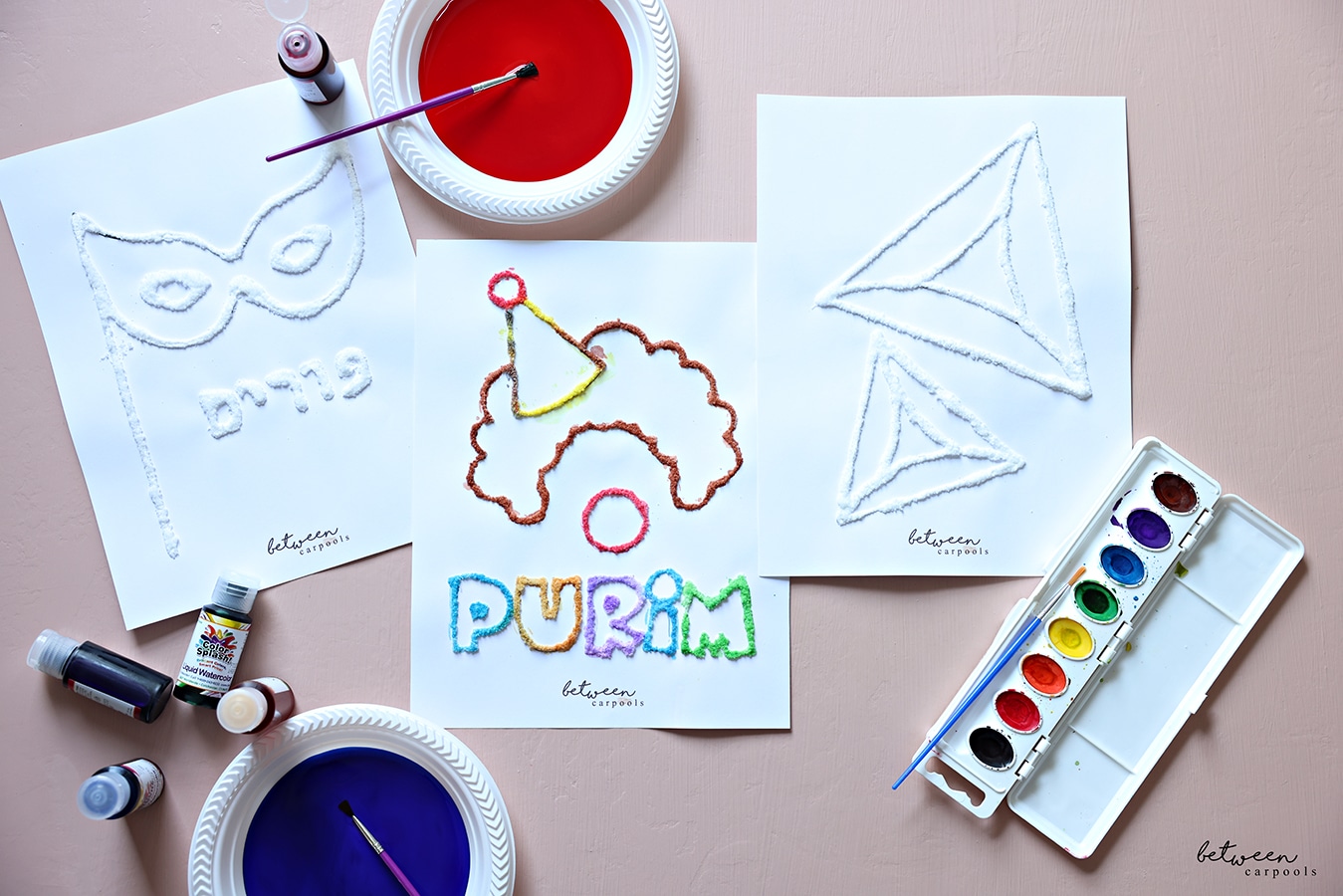
Download our Purim pictures here. The simple line drawings are easy to trace with glue.
Cover the glue with table salt and carefully shake off the excess. Let dry completely!
Dilute a bit of watercolor paint in plastic bowls of water. It’s best to use a separate paintbrush for each color.
Using the brush, dab a bit of watercolor onto the salt outline.
Watch the color spread along the salt. It won’t spread to the paper beneath it!
 Between Carpools
Purim gifting isn’t just something you cross off a list. It’s something that sends a message. I appreciate you. I want you to enjoy. I want to take the opportunity and the joy of Purim to express my hakaras hatov.
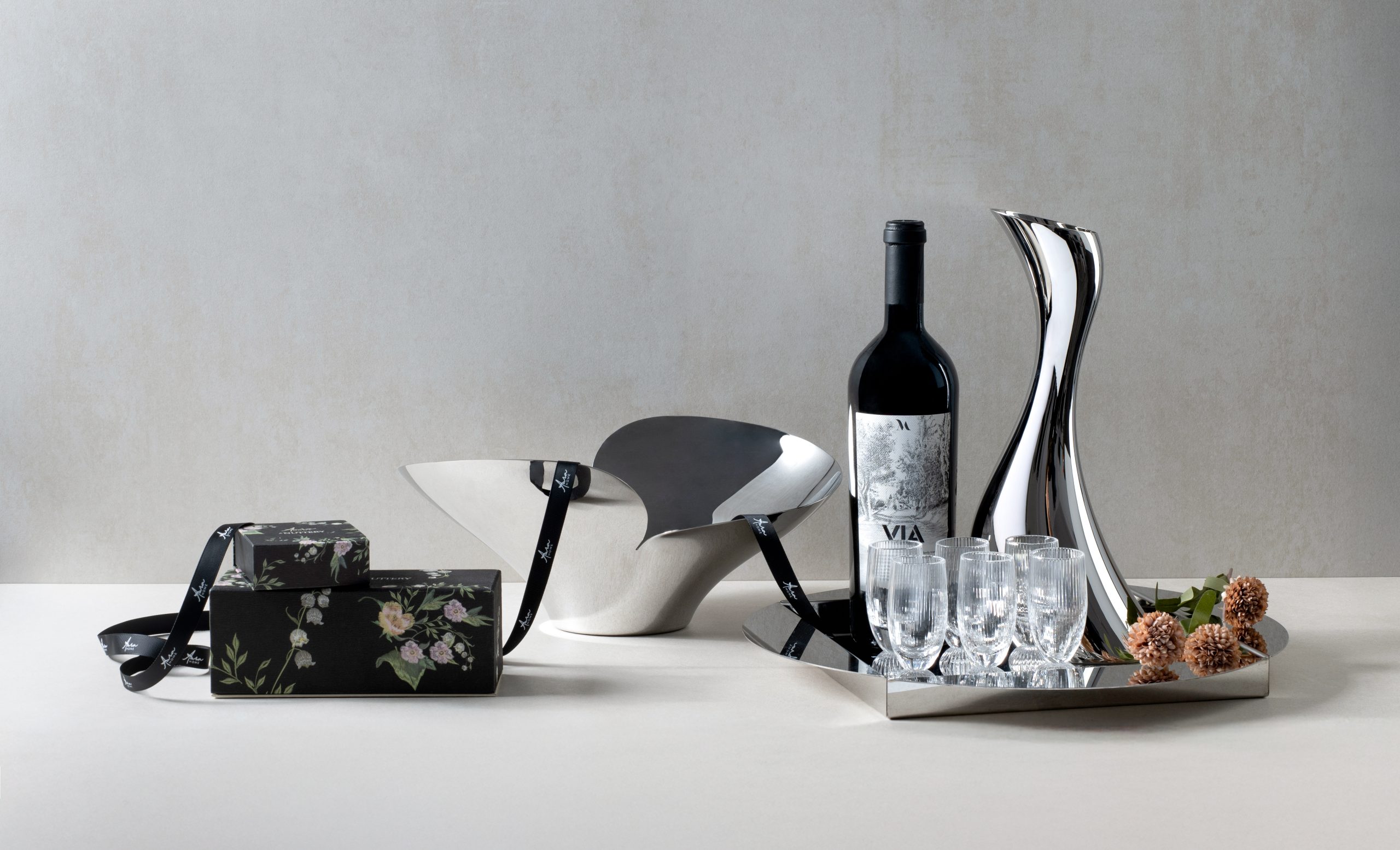
And nothing does it better than a mishloach manos package from Aura. They’re appreciated. They’re exciting to receive. And they’re sure to be enjoyed, long after the packages are unwrapped and Purim is cleaned up and put away.
Aura Home makes it so easy. The packages are beautiful and ready for you–simply choose your favorite and send! And, of course, there’s options available at all price ranges.
The 22 curated gift packages start at $60 for challah cover package or this vase package.
We love the salt shakers in this package (so pretty!) for $70 or complete their end table with this vase and picture frame package.
There’s also magnificent significant gifts–including Georg Jensen pieces like this one.
All of these packages are already put together in beautiful chocolates and nuts featuring Nuttery Chocolates.
They’re just so perfectly curated and there’s so much value!
Aura Home also services your corporate mishloach manos needs. They’ll help you remotely or in store…simply pick your budget and they’ll put together the beautiful, exclusive package that fits your needs. There are no limits! Be in touch!
 Between Carpools
Sometimes, it’s that finishing touch that pulls everything together. You know, the right label, the matching ribbon. Or, in this case, the right spot to take that family picture.
Your kids are all dressed in their costumes- they look adorable! The hours spent on Temu or scouring Purim stores finally feels like it was all worth it. They all look so cute and so happy.
Phew!
Let’s snap a picture? Yes!
What if instead of your dining room wall, you can have a backdrop that pulls you into the scene of this year’s theme? We say go for it.
Most photo backdrops are in the $10-$20 range.
While you have your backdrop, it’s also good incentive to get everything done early and take those photos on a day BEFORE Purim, so when Purim comes, there’s less photo-getting stress.
Important! Make sure to check the size of the backdrop and measure your wall.
Pick a size that makes sense to you (and the size of your family). For reference, we used a 10 foot x 8 foot backdrop and it was perfect for a photo which included 4 adults and 3 children.
We used a ladder and some painter’s tape to hang it up for the day and it lasted just fine.
The options are endless! Here are some themes we found but if we missed yours, simply search!
 Between Carpools
You slip into bed, exhausted, ready to finally rest—and then your mind starts racing. You replay conversations, plan tomorrow’s to‑do list, or feel your heart beating faster than it should. You tell yourself, “I need to sleep,” but the more you try, the more awake you feel.
If this sounds familiar, your body isn’t broken—it’s communicating.
When sleep doesn’t come easily, it’s often a message, not a malfunction.
1. Your Body Is Saying: “I’m Still in Go‑Mode.”
All day long, your body runs on adrenaline—managing work, home, kids, and endless details. By bedtime, your mind may be ready to rest, but your body hasn’t caught up.
What to do:
• Create a transition ritual. Dim lights, slow your pace, and do one calming activity that signals “day is done.”
• Breathe slower than you think you need to. Try a gentle rhythm: inhale for 4 counts, exhale for 6. This tells your nervous system it’s safe to power down.
2. Your Body Is Saying: “I’m Overstimulated.”
Screens, noise, and constant multitasking keep your brain alert long after you’ve turned off the lights. Even if you feel tired, your brain may still be processing.
What to do:
• Set a “digital sunset.” Turn off screens 30–60 minutes before bed.
• Replace scrolling with something sensory. A warm shower, lotion, or soft music helps your body shift from stimulation to calm.
3. Your Body Is Saying: “I’m Holding Too Much.”
Sometimes sleeplessness isn’t about caffeine or screens—it’s about unprocessed emotions.
Worry, frustration, or guilt can keep the body tense even when the mind wants rest.
What to do:
• Name what’s on your mind. Write down your thoughts before bed to release them from your head onto paper.
• Use gentle tapping or deep breathing to calm the body’s stress response.
• Remind yourself: “I can think about this tomorrow. Right now, I rest.”
4. Your Body Is Saying: “I Don’t Feel Safe Enough to Let Go.”
Sleep requires surrender. If your body feels unsafe—rushed, pressured, or emotionally unsettled—it will stay alert to protect you.
What to do:
• Soften your environment. Lower lights, reduce clutter, and make your bedroom a calm space.
• Soften your inner tone. Instead of “I have to sleep,” try “I’m allowing my body to rest.”
• Focus on comfort, not control. The goal isn’t to force sleep—it’s to create safety so sleep can happen naturally.
5. Your Body Is Saying: “I Need Consistency.”
Irregular sleep and wake times confuse your internal clock. Your body thrives on rhythm—it wants to know when to expect rest.
What to do:
• Wake up at the same time every day, even after a rough night.
• Expose yourself to morning light. It resets your body’s natural rhythm and helps you feel sleepy at night.
When you can’t sleep, your body isn’t fighting you—it’s asking for attention. Instead of frustration, try curiosity. Ask, “What do I need right now?” Sometimes it’s quiet. Sometimes it’s release. Sometimes it’s simply permission to rest.
Your body always wants to return to balance. When you learn to listen, sleep becomes less of a battle and more of a natural response to feeling safe, calm, and cared for.
 Between Carpools
I know we’re talking about Pesach cleaning a bit early, but honestly, now is the perfect time to start decluttering. These quieter months are the perfect time to get your home in order!
Around this time of year, I always get the same question:
“But Ellie… my husband isn’t interested in decluttering.”
Okay. Great.
Because this actually has nothing to do with your husband. Or anyone else in the house whose stuff might be getting in your way.
The Biggest Rule of Frum Minimalism
This is the biggest rule of Frum Minimalism.
The biggest!
We may never, ever declutter other people’s things.
When I give workshops and classes, I literally make everyone say this out loud together, so I know they heard it and internalized it:
We may never, ever declutter other people’s things.
Say it out loud!
Not your husband’s.
Not your kids’.
Not anyone’s.
So What _Do_We Do If Our Husbands Aren’t Interested?
Here’s the process. It’s simple, and it works.
**Step one:
**We deal with our own things first.
As the women of the house, we start with ourselves.
**Step two:
**Then we move to shared spaces:
– the living room
– the dining room
– the kitchen
– shared bathrooms
In these spaces, we’re allowed to declutter and organize, because they belong to everyone.
And we make it very clear to the family that shared spaces have rules, and those rules need to be respected.
Creating a Clearly Defined Space for Your Husband
Next step:
We create a clearly defined space, within reason, for your husband’s things.
If he cooks, give him one or two cabinets in the kitchen where all his tools and interesting gadgets live. (Same applies for teenagers.)
If he likes to lounge in the living room and has books, slippers, or random things he uses, create a basket for him.
Label it clearly:
“Husband’s Things.”
This way, his things have a home, and they’re not floating all over the room.
What About the Bedroom?
Same rule applies.
When you’re organizing your bedroom, do not touch his side of the closet.
Not even a little.
If his things are floating around the bedroom, you do the same thing:
You create a clearly labeled bin or box:
“Husband’s Things.”
Any time his things are left out, you place them there.
You do not:
– touch his closet
– get rid of his shoes
– decide what he needs or doesn’t need
Ever.
Why This Works
The most important thing here is respect.
Your family, and especially your husband, has to understand that:
– you respect their possessions
– you will never declutter their things
– shared spaces still need to function
Trust me. I’ve been doing this long enough to say this confidently:
Every husband eventually joins in.
Not because they were pushed.
Not because they were forced.
But because they see the benefits:
– for you
– for the home
– for the family as a whole
Happy Decluttering!
 Between Carpools
Has the winter freeze gotten to you yet? What about to your kids?! Because even though I’m okay with a little bit of hibernation, my kids are decidedly not. So when one of our readers requested a post with ideas for after school activities for her elementary school aged boys (my favorite population!) I figured it was the perfect time to share my survival tips.
In the fall, spring, summer, and even during the mild parts of winter, I’m team outside. Everyone, out!
Balls, scooters, hoses, bikes, digging in the dirt, whatever it takes to get energy out. But this winter, we’ve been forced to get a little more inventive.
Here’s what I’ve done!
Balls are allowed in the house. Not hardballs with baseball bats, but playground balls, soccer balls, and footballs are fair game. They’re not only allowed, they’re encouraged! Yes, something might break. For us, it’s worth it.
Games are more fun when I play. Classic board or card games are just a lot more fun when Mommy joins in, so I’ve sharpened my Cover Your Assets skills considerably. Realistically, it’s important for me to remember that my presence ups the fun factor. (Board game recs, here.)
New toys and activities really help. By nature, I’m a minimalist and I’ve been around the block long enough to know that ‘new’ doesn’t always equal ‘holds their interest.’ But when you’re looking to fill the after school hours and outside is pretty much off the table, a new activity/toy/game really does help.
Here’s what’s been keeping us entertained this season. And please leave your activity ideas below, it doesn’t seem like it’s warming up anytime soon.
You might also want to check out this Great Activity for Boys using Painter’s Tape and our Activity Book Roundup.
Happy playing!
 Between Carpools
Yes, we have seen the boards. They are popular and practically everywhere. But, that said, we can also agree that at any family gathering it’s the açaí board that gets finished first.
Refreshing, delicious, customizable and…kinda, healthy too.
All you need is a nice label and you’re ready to go. We designed these Purim labels to make it easy for you to customize and print!
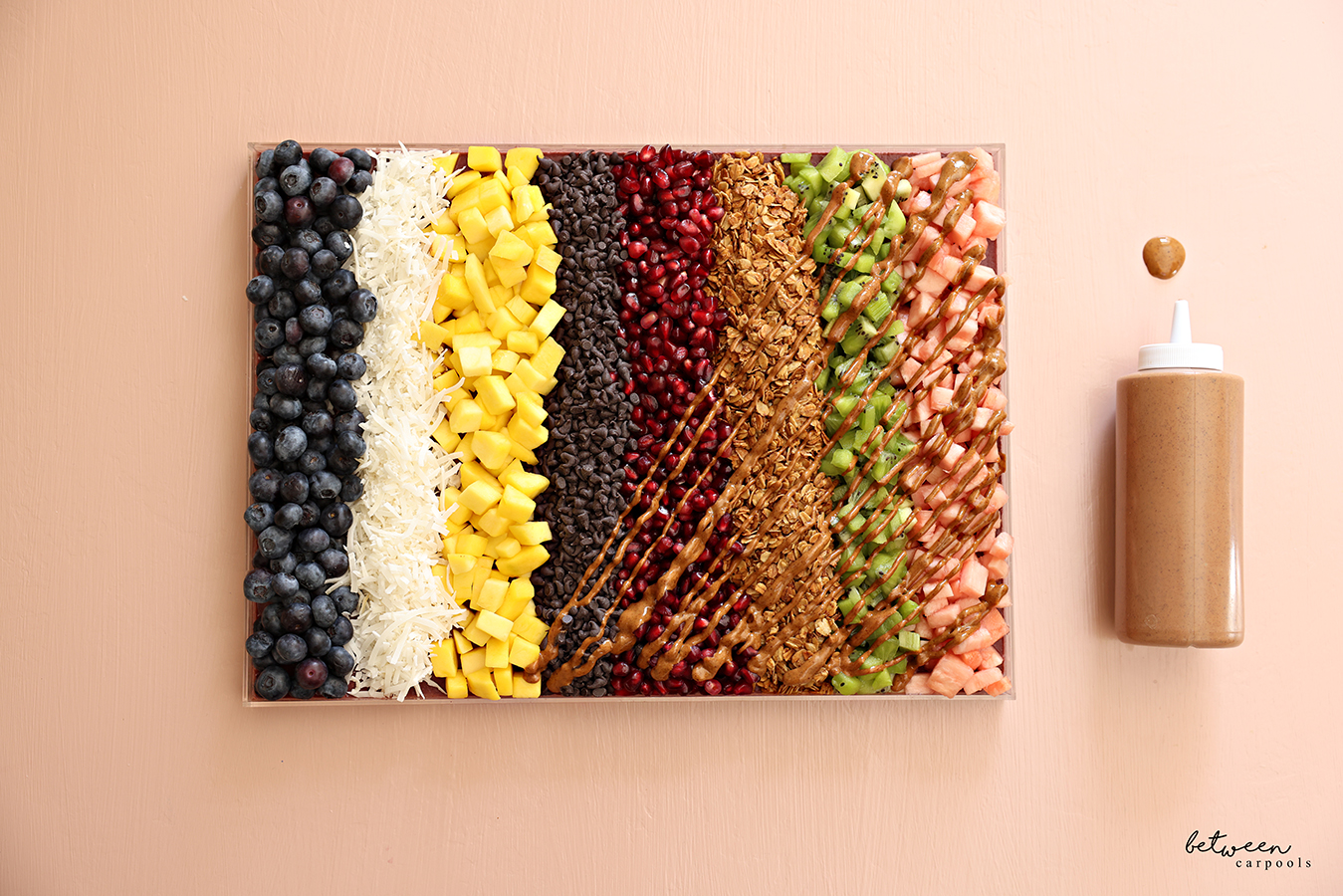
So, if you are looking to bring something special to your host this Purim, or looking to prep and freeze a dessert in advance, here is a recipe we love–and all the steps involved in making that perfect açaí board.
We used this board because it’s not so expensive (think gifting), comes with a cover and looks really pretty once done.
You can also present it in a more traditional platter like this one here and your host will be left with a functional tray once done.
Start by placing all the ingredients in a food processor or blender.
If using a blender like the Vitamix, place the almond milk first. The liquids help get things moving.
It might take a while and you might need to help it along a bit by stopping and mixing.
Once smooth, it’s time to pour the açaí onto the board.
Spread evenly and freeze.
You want to wait until the açaí is firm before placing the toppings. That will ensure the fruit won’t sink into it.
Place the toppings in neat rows and return to the freezer until ready to serve.
The açaí will need about an hour to thaw before it’s scoopable.
Don’t forget the best part. The warm almond butter for drizzling!
We added a tablespoon or two of oil to thin it so that it drizzles nicely. Warming the butter up in the microwave will also ensure it drizzles easily.
Complete the look by placing the almond butter in a squirt bottle for easy, neat drizzling.
Place all ingredients in a food processor or blender. If using a blender like the Vitamix, place the almond milk first, this will help with the blending process.
Blend all the ingredients together until smooth. It might take a while and you might need to help it along a bit by stopping and mixing.
Once smooth, it's time to pour the açaí onto the board. Spread evenly and freeze.
You want to wait until the açaí is firm before placing the toppings. That will ensure the fruit won't sink into it. Place the toppings in neat rows and return to the freezer until ready to serve.
Note that it takes a while for the frozen platter to thaw so that it is scoopable. You might want to remove it from the freezer about an hour before serving.
Drizzle with almond butter. We added a tbsp or two of oil to thin the almond butter so that it drizzles nicely. Warming the butter in the microwave will also ensure it drizzles easily.
– another Açaí Recipe Perfect for Teens to Bring to School
The post Açaí: A Trend That is Here to Stay appeared first on Between Carpools.
 Between Carpools
Dr. Ilyssa Bass, psychologist and parent educator, is hosting her annual summit, Parenting Complex Kids Summit.
The summit starts TODAY, Monday Feb 9th and runs through Sunday February 15th.
Each day has 6 experienced professionals giving deeper understanding and practical tools for raising behaviorally challenging/high-stress kids. That’s 30+ top professionals giving their best aytza on how to help complex kids!
(ALL of the speakers will be free to listen to on the last day, Sunday the 15th, so it’s not too late to sign up!)
The summit is for parents of kids who:
Can be rigid, have meltdowns, are super-sensitive, start up constantly with siblings- are behaviorially just. So. hard.
Have diagnoses like ADHD, ASD-HF, Anxiety, Learning Differences or may be gifted
Have no diagnosis or slip through the cracks of diagnosis
Fall in the gap between being able to manage in traditional educational settings, but not need special ed.
If the regular chinuch techniques and classes are not enough for raising this child (in fact, those techniques often backfire), this is a wealth of FREE resources to help you figure out why.
This year’s Summit speakers include top psychiatrists, psychologists, behavioral consultants, occupational therapists and parent coaches. It also features Rabbonim and Rebbetzins who really get it, including:
To sign up and see the full list of speakers and topics, go to drilyssabass.com/summit.
Every year we feature Dr. Bass’s summit on Between Carpools and every year our readers get SO much out of it! She gets the best speakers and she is a very good interviewer.
We hope you get valuable information and inspiration from this year’s summit!
 Between Carpools
This recipe is brought to you thanks to my father. I was over at my parents’ house shmoozing one evening when my father asked if I had ever tried my sister’s biscotti. She had recently made them a batch and he couldn’t stop raving. He said I must get the recipe from her to post on Between Carpools. Gotta listen to my father, so that’s what I did!
You’ll have to take out your Kitchen Aid for this one, but it’s worth it.
First, combine the oil and sugar and mix.
Add the vanilla
and orange extracts…
And the orange zest (the secret ingredients that make these so good).
Combine flour, salt, and baking powder in a separate bow.
Add them to the mixer and stir.
Add the nuts
and cranberries.
Mix these in by hand.
Form a log on a cookie sheet that has been lined with parchment paper. Dough may be sticky; wet hands with cool water to handle dough more easily.
Bake until logs are light brown. Remove from oven, cover with a wet towel, and set aside to cool for 10 minutes. Meanwhile, reduce oven heat to 275F.
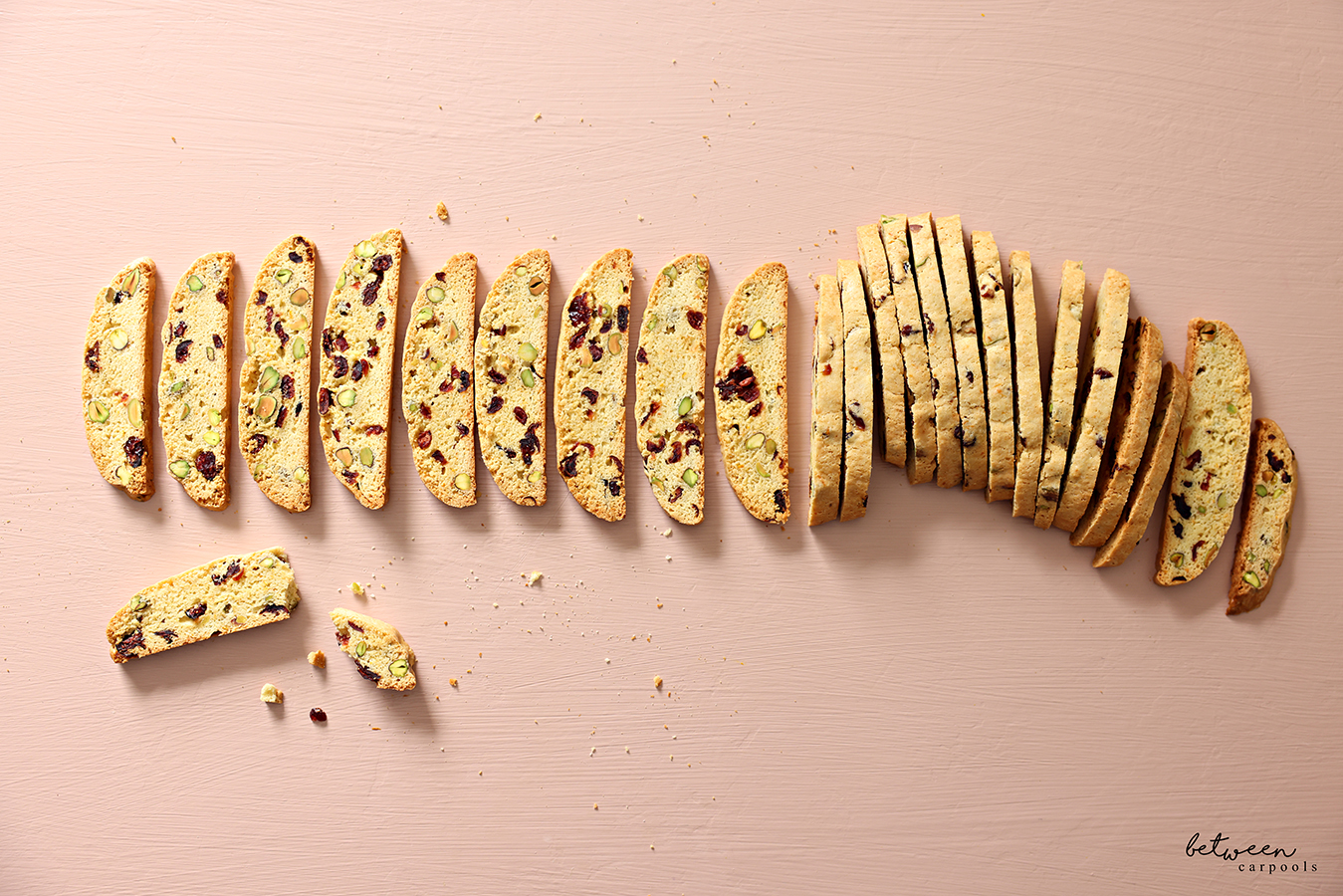
Once they cool a bit, cut the logs into 1/3 inch thick slices.
Lay the biscotti on their sides and bake for approximately 20-25 minutes more, or until dry and crisp.
My mother said she freezes these in small packets or they would just eat too many of them in one sitting – and that’s definitely good advice!
Ta, this one’s for you! The BCP community thanks you!
Preheat the oven to 300°F.
In a large bowl, mix together oil and sugar until well blended. Mix in the vanilla and orange extracts and zest, then beat in the eggs. Combine flour, salt, and baking powder; gradually stir into egg mixture. Mix in nuts and cranberries by hand.
Form a log on a cookie sheet that has been lined with parchment paper. Dough may be sticky; wet hands with cool water to handle dough more easily.
Bake for 35 minutes in the preheated oven, or until logs are light brown. Remove from oven, cover with wet towel, and set aside to cool for 10 minutes. Reduce oven heat to 275°F.
Cut logs into 1/3 inch thick slices. Lay on sides on baking sheet., Bake approximately 20-25 minutes, or until dry.
 Between Carpools
We’ve really been enjoying using this tray in our own homes. It’s now the top item on our list of Gifts That Also Work for Mishloach Manos.
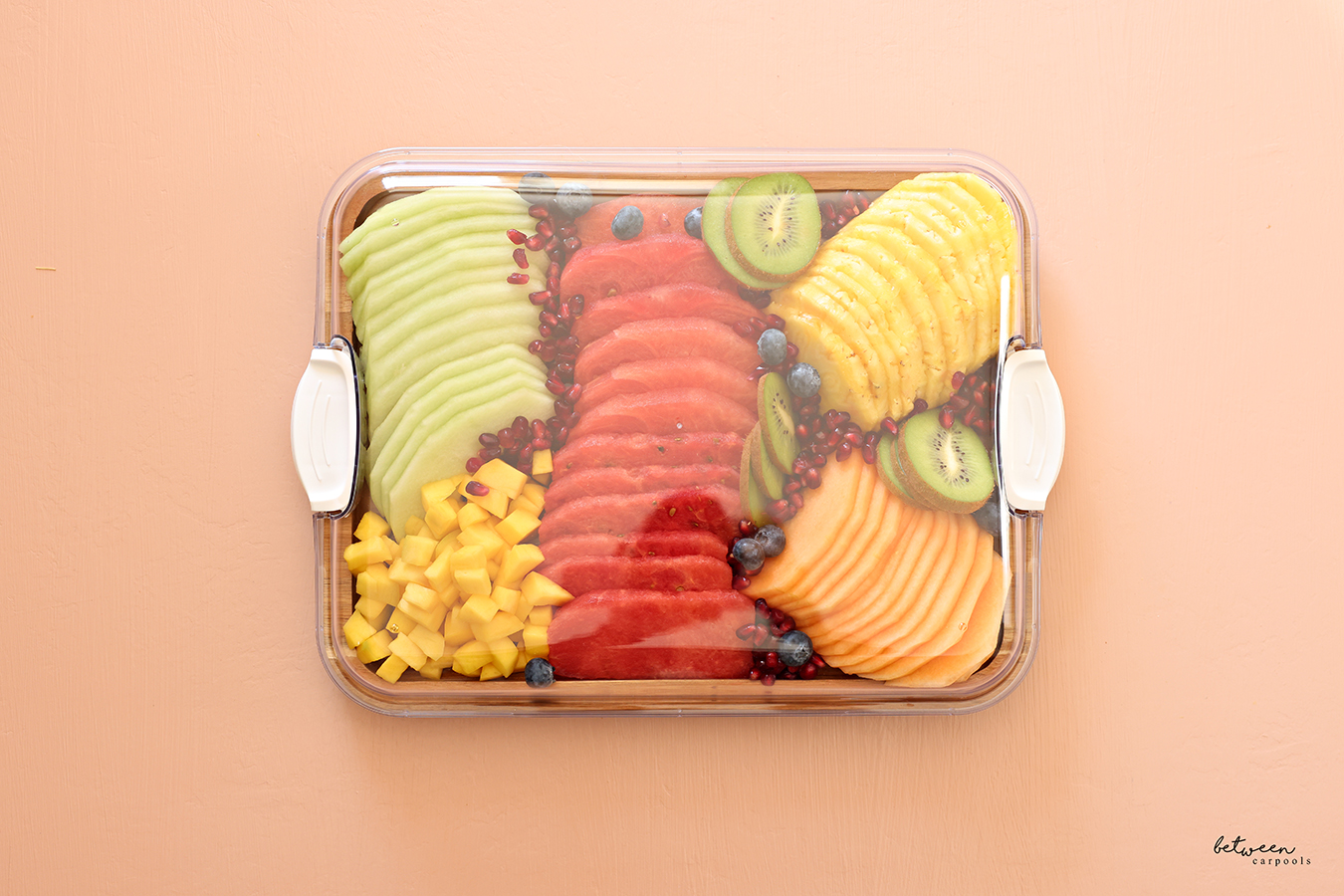
One, it’s not just another pretty tray. It’s so practical. Pull it in and out of the fridge. Take it with you if you need to transport food. Wherever you take it or put it, whatever you have inside stays secure and fresh!
It’s perfect for that fruit platter. The fruit stays fresh inside. Then, simply remove the lid when you’re ready to serve. Or, leave it on the counter with the lid on (great for summer!).
We also love this for leaving the veggie platter on the counter. It will naturally encourage a love of veggies!
When you want to put it away, there’s no need to transfer the remaining veggies to another container.
And, it’s the perfect size for storing a 9×13 worth of baked goods.
We love that we’ve been able to get rid of having those tins out on the counter.
The lid is high enough for most items you’ll bake in a 9×13 (in our experience, it’s high enough for homemade muffins as well, but not as tall as bakery muffins).
Because we love using it and find it also so pretty and portable, we think it also makes a great gift, whether for your hostess or your mishloach manos.
 Between Carpools
There’s such a great variety of creative vendors that can help make your Purim process a little easier. Whether you want classic mishloach manos or you want to send a more substantial gift, there are gorgeous options below! You’re bound to find just what you had in mind.
> See all Purim Food Packages
> See Purim Labels
> See all Purim Gift Packages
> See Purim Table Decor
FOOD PACKAGES
New at Parfetty this year is the Blossom Tote. It’s a beautifully filled textured bag filled with goodies and a custom label. It’s all set and ready for you to gift!
There’s also a new collection of the classic and innovative BottleBuddys–it’s the perfect item to slip over a wine or any nice drink.
The signature filled-and-ready Parfetty Corduroy Pockets and Felt Pouches are so smart and sleek.
And, of course, the ever popular themed KiddieKubes and adorable kids Bottle Buddy collection will always be Purim favorites.
To Order: Browse the selection and place your order at Parfetty.com.
PC Pops is taking the hassle out of Purim! With prices starting as low as $4! PC Pop peanut chews are made fresh in small batches without any preservatives.
Personalized ribbon and chocolate covered Oreos are available!
Attention corporate accounts: let PC Pops take care of your Mishloach Manos from start to finish! They’ll pack and ship out your gifts to all your clients.
Delivery is available in Lakewood and surrounding areas, Brooklyn, Five Towns, Monsey, Passaic and Teaneck. Free Lakewood, Baltimore, and Flatbush pickup locations. PC Pops also ships anywhere in the US
To Order: Browse the selection and order online at www.pcpops.com.
The Purim Collection at The Pop Box was designed for the moment when you want your gift to feel right — not excessive, not random, not last-minute. Each box is a complete, premium Mishloach Manot, curated to stand on its own or combine with others to tell the Purim story in layers. Thoughtful from the first impression to the final detail, it allows you to show up for the people in your life with confidence, intention, and care.
To Order: View the creative and innovative Purim packages and order at getthepopbox.com.
Coco Artisan Sweets offers beautiful handmade chocolate arrangements for every occasion. At Coco, they understand the power of a well-chosen gift. That’s why they create meticulously handcrafted artisan chocolates that offer the best of all worlds: exquisite taste, elegant presentation, and a truly personal touch.
Located in Chicago, Coco Artisan Sweets offers local pickup and delivery, and nationwide shipping on select items. Email for all shipping inquiries. Kosher certified by the CRC, Coco’s gourmet chocolates make the perfect Mishloach Manos gift!
To Order: Browse the selection and order online at cocoartisansweets.com.
Mention BCP for 20% off your order Purim order.*
Celebrate Purim with ChocoBON! ChocoBON features gourmet flavor filled dark chocolate squares.
Mix and match to create your own message!
Two great complete Mishloach Manos options to choose from or customize our chocolate box to match your theme.
Customize a cookie with your business logo or family name to make it personal!
*excluding minis.
To Order: Reach out today @ 917-270-5873 to celebrate Purim with ChocoBON!
At The Nuttery, every gift tells a story—one of care, creativity, and celebration. As Purim approaches, they thoughtfully curate collections that reflect the vibrancy of our community, helping you express meaning through beautifully crafted gifts.
This year, they are proud to debut the Artisan Bloom Collections by artist Shayna Denburg, featuring Petals of Spring and Tulip Confections—artist-inspired designs that celebrate color, creativity, and the spirit of the season. These join the beloved Checkered, Cirque, and Floral Dreams Collections, alongside Nuttery Classics and Luxe Gifting Arrangements. The Nuttery Heritage and Favorites boxes give you a taste of some of our favorite specialties.
The Nuttery ships throughout the United States & delivers locally in Brooklyn, Lakewood, Monsey, Monroe, and the Five Towns.
To Order: Shop in-stores or online for meaningful & delicious Shalach Manos your recipients will love.
Wheat & Whisk is the real stuff. Sourdough that’s actually sourdough, built on time, care, and a process that shows. The crust delivers that unmistakable crunch when you break into it, followed by a chewy, flavorful interior that holds up slice after slice.
The branding and packaging are just as intentional, clean, modern, and gift-ready turning every loaf into something you’re proud to bring or send.
Available just for Purim, Wheat & Whisk pairs its signature loaf with a handcrafted-style beer, creating a Mishloach Manos that’s just the right balance for gifting everyone on your list.
To Order: Be in touch with Wheat & Whisk on WhatsApp, email [email protected] or phone (732) 288-8022.
Looking for a Mishloach Manos that won’t get traded, re-gifted, or lost under a pile of hamantaschen? Meet Pinch — the kosher premium spice blends that turn your Purim gift into something deliciously useful long after the costumes come off.
Instead of another box of candy, give the gift of tasty, perfectly balanced flavor. Whether your friends are grill lovers, busy parents, or “I just wing it” cooks, spice blends like King Salmon Rub, Boss Brisket Blend, and Busy Chicken make them look like kitchen pros — thanks to you.
The signature glass bottles feel upscale, look gorgeous in a gift basket, and keep every spice fresh and full of flavor.
Perfect for hosts, neighbors, rebbeim, coworkers, and anyone you want to impress without sending another sugar rush. We wrapped all five blends into one incredible gift box so you can give something thoughtful, practical, and seriously tasty.
Because the best Purim gifts aren’t just opened — they’re cooked with, shared, and remembered.
To Order: Find your flavor at pinchmyspice.com.
New this year from Sprinkles! Give individual acai cups for Mishloach Manos that your recipients are sure to enjoy! Two sizes are available, the small one includes one individual acai cup with assorted fruits and toppings, granola, and sauces. The bigger size has 2 individual acai cups with fruits and toppings plus 2 squeeze bottles with sauces and a packet of granola. This is a great option for bulk and corporate orders. gold
Orders must be in by Feb. 23rd or while supplies last. So don’t delay! Place your order today! Sprinkles is looking forward to serving you in a most easy and hassle free way.
To Order: Fill out THIS FORM to order your Acai Mishloac Manos!
Get Purim-ready with **Iced by Goldie**!
Whether you need a thoughtful gift under $10 or a show-stopping custom chocolate creation, Iced By Goldie’s full Purim line has you covered.
**New this year:** Custom-themed s’mores kits, peanut chew pops, and personalized cookies! Buy them individually or add them to any package for that extra touch.
**Planning a Simcha?** Book their Chocolate Bar to treat your guests to an unforgettable experience!”
> Based in Far Rockaway and shipping across the USA, we have something for everyone.
To Order: Browse the selection and place a delicious order at www.icedbygoldie.design.
Yummy Blessings is known for both delicious and beautiful desserts that are always perfectly packaged. Each of their decadent products are made by hand, using the finest ingredients, featuring unique designs. With a range of price points, our Purim collection has gifting options for everyone on your list. Our products are certified Kosher by Rabbi Gornish. Many of our items can be shipped nationwide.
To Order: Reach out to [email protected], @yummyblessings on Instagram, or 917-687-4300.
If there’s one thing that you know everyone enjoys, it’s soft, delicious Beef Jerky! It’s perfect for Shabbos, perfect to gift, and you know that it’ll be the item that they’re excited to receive.
Under the Hashgacha of the CRC Hisachdus.
Nationwide Shipping!
To Order: Easily place orders online at www.jerkymunch.com OR Call/WhatsApp 732-784-7554.
The Jerusalem Butler features over 150 American-style businesses in Israel. They cover it all! Business types include gifts, services, housewares, food, real estate… anything you can think of! The businesses they feature cater to Americans, so you’ll connect with English speakers and enjoy the customer service you’re used to.
That includes everything gifting, including food gifts and Mishloach Manos. Whatever you need to send in Israel, you’ll find it. Simple add to cart and place your order and your gifts are delivered in Israel!
To Order: Browse the site, WhatsApp at (347) 815-0804 or email at [email protected] for help finding whatever it is you need! Either they’ll have the answer for you, or they’ll refer you to who can help.
Gold Sugar invites you to the place where taste meets elegance. Treat your recipients to indulgent chocolate they are sure to enjoy and will be surprised to see is Parve! Gold Sugar offers ready-made Mishloach Manos as well as add-in items that you can use to complete your own. They offer both classic and fun options.
To Order: See the order form to see their tickled pink world of decadence by clicking here.
Parfetty has an array of Purim Label designs! From Classic Labels, Themed Labels, and Cookie Corner Labels (to match the Cookie Corner Mishloach Manos), there’s a style to match your color scheme and theme. We also love the Parfetty tag option if you want to tie it with a ribbon.
FREE SHIPPING on label orders of 48 or more before R”C ADAR. Nationwide shipping.
To Order: Browse the selection and customize your labels at Parfetty.com.
Purim gifting, reimagined!
Aura curates exceptional gifts that truly matter — thoughtfully selected, beautifully presented, and ready to delight everyone on your list. Whether it’s for your Rav, boss, neighbor, friend, or employee, each piece is wrapped in Aura’s signature style and made to be used, enjoyed, and remembered. From elegant tabletop accents to luxurious statement packages, these are gifts that make an impression.
To Order: Shop the selection and find something beautiful at Aurapurim.com.
For a while, you’ve known YB Gift Shop to be the source of beautiful Mishloach Manos gifts–at prices that make sense. Long after Purim is over, your recipient will enjoy the beautiful gift!
YB Gift Shop can also ship your gift to all your recipients!
To Order: There’s easy online ordering at ybgiftshop.com!
Wine and Co sets an unprecedented standard for corporate Purim gifting. Featuring a collection of high-end wines, chocolates and modern gifts carefully curated by our team of wine connoisseurs and designers. Purim gifting now takes on class and ease. Whether you’re gifting clients, employees, or affiliate professionals, Wine and Co has something suitable and customizable for you. We will personalize the gift you choose with your logo, gift message, and any customizations we can accommodate.
Wine and Co is a non-profit enterprise: all proceeds go to support a Talmud Torah and the learning of tinokos shel bais rabban.
To Order: View the beautiful collection and order at wandcogifts.com.
Use code BCP10 for 10% off your order!
Looking for an elevated Mishloach Manos for someone special in Israel? Explore Feldart Israel’s Mishloach Manos featuring modern lucite homeware and Judaica designed to be enjoyed long after the holiday. Each set includes thoughtful lucite pieces that add a clean, modern touch to the home.
Perfect for gifting family, friends, or corporate clients in Israel, these Mishloach Manos blend tradition with a modern approach to gifting.
To Order: Visit feldart.co.il to explore our Mishloach Manos collection and make your Purim gift a memorable one.
Elevate Your Purim Gifting with Accents Israel: 2026 Edition.
Purim is just around the corner, and Accents Israel is back with an even more stunning collection for 2026! Whether you’re gifting your married couples in Israel, Rebbeim, or employees, Accents remains the premier destination for high-end, beautifully wrapped Mishloach Manos delivered across Israel.
The expanded collection for students is better than ever! They have the perfect, curated packages for your son in Yeshiva or daughter in seminary, featuring on-trend items they’ll actually use and cherish.
At Accents, they pride ourselves on providing seamless American-style service. They are incredibly easy to work with and specialize in customizing packages to fit your exact vision and budget. Every gift is finished with our signature stunning gift wrapping, ensuring a “wow” moment upon delivery.
To Order: Ready to make Purim effortless? They’re here to help and would love to chat! Simply check out the Accents website, WhatsApp them or email to customize your order today.
Gift Wrapped features a curated collection of creative and artsy specialized Mishloach Manos for all categories. The food is all gourmet and features specialty items that are exciting to receive. Gift Wrapped features personalized and warm service where the customer is really cared for and given exceptional service. Gift Wrapped wants to help you find the perfect gift for each recipient! Look out for their pre-Purim pop up shop!
To Order: See more at @chayasgiftwrapped, call 7187550323, or email [email protected].
Support Tomche Shabbos this Purim with a meaningful fundraising campaign that brings joy to others while helping needy families with dignity. Featuring beautiful, elegant assorted gift packages and baskets filled with an array of delicious goodies, this initiative makes giving effortless and heartfelt. Each thoughtfully curated package can be shipped nationwide, allowing you to send Purim cheer to friends and family near and far while directly supporting Tomche Shabbos’s vital work. It’s the perfect way to fulfill the mitzvah of Mishloach Manos, spread happiness, and make a real difference—one stunning gift at a time.
To Order: Browse the selection and place your order at Purimrus.com.
Do you want to give a gift that lasts? Elevate your Purim gifting with unique and beautiful Mishloach Manos from A Perfect Present, the year round source for luxurious housewares! Their exquisite gifts are all about the gift, carefully curated with specialty items and presented with elegance. The extensive collection is available on their site, featuring a wide range of choices and price points.
Enjoy local delivery in the LA community or nationwide shipping.
To Order: Order online at APerfectPresentLA.com.
Use code BCP5 for $5 off your order if placed before 2/16
This Mishloach Manos gift set features a luxury car diffuser that delivers a curated fragrance experience. The set includes all 6 naturally fresh scent options. The diffuser is fully wireless, includes a USB-C charging cable, and automatically turns on and off when you start/stop your car. Multiple diffusion settings are available, releasing fragrance every 5 or 10 minutes.
The package also includes premium chocolates, elegantly presented with the option to add a custom wrapper featuring your logo and a personalized message.
Free shipping is included on all orders.
To Order: See what Aura Lux is all about at AuraLuxNYC.com.
Your Purim Table Decor is ready at Parfetty! New this year is the Floral Burst ensemble. It’s bursting with life and color! It’s so perfect for Purim with its bright colors, and yet is so elegant at the same time. Want a different look? The Purple and Rust party themes are also beautiful and ready to order so you can set a beautiful table with ease.
And, of course, Parfetty’s signature napkins are also available to enhance your table.
To Order: Find your favorite look and order at Parfetty.com.
 Between Carpools
Over the past few years, Between Carpools has offered great labels and printables, just when you need them. Each one is more fabulous than the next.
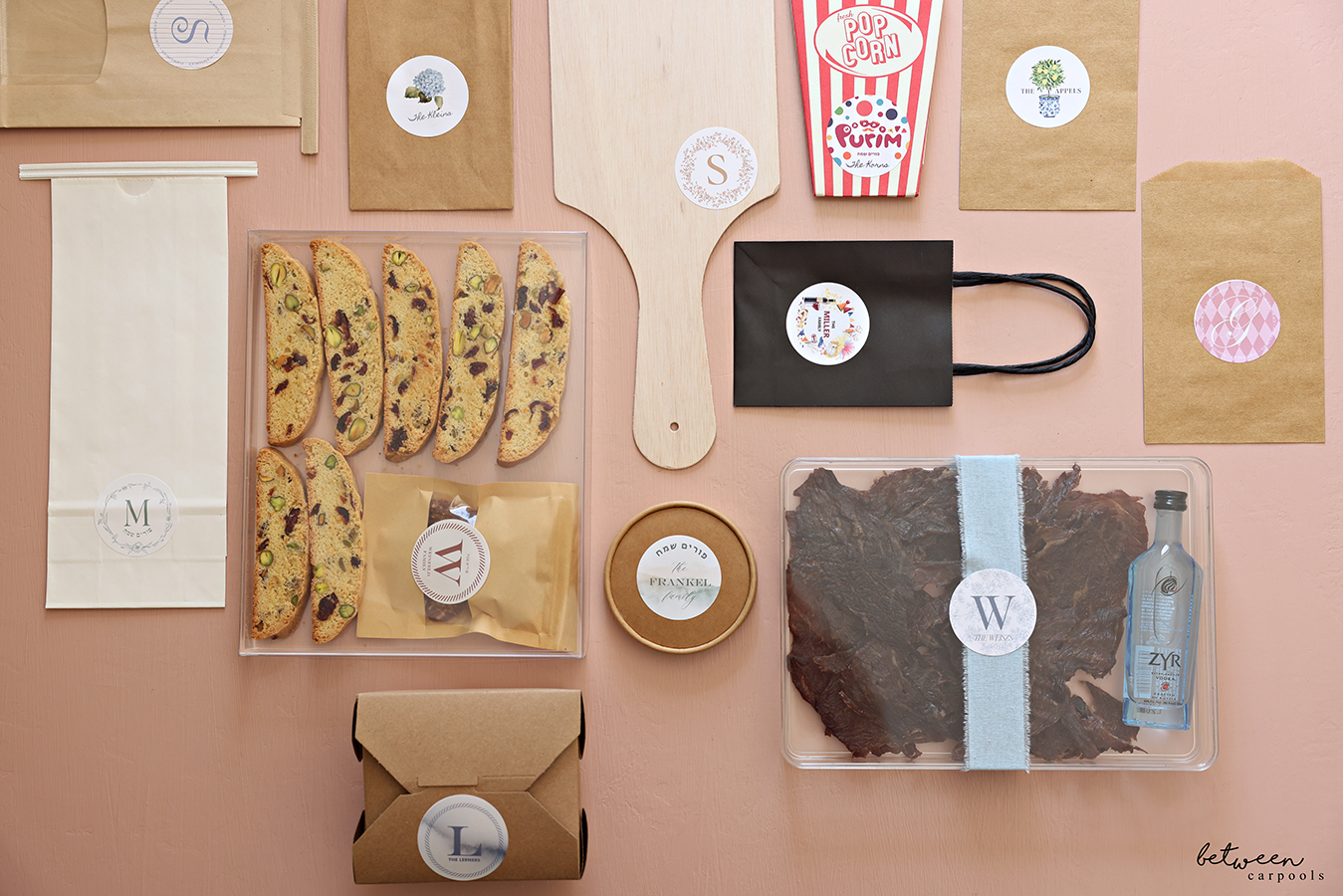 Between Carpools
Did you know you can customize labels with your family name right on Amazon? That custom label is just the touch your mishloach manos needs. All you need is a design and we took care of that for you!
With a quick turnaround time, you’ll be ready for Purim sooner than you thought.
When you click order and customize Amazon Labels such as these, you’ll have the option to upload a background design like the ones above and then customize your text.
We designed so many options so you can choose from styles that are classic, pretty, fun, or just whimsical and sweet.
These are many customizable options. Choose the quantity, size, and more.
That pretty label takes the most basic packaging from simple to polished.
Which label will you choose?
View and download all the label backgrounds we designed!
You can find these trays here (and stay tuned for more ways to use them!)
Your design will come on a roll of stickers like this one.
 Between Carpools
It’s the kind of place that you need to visit to believe, and I really didn’t understand the scope of what Serendipity is and what it does until I walked in and got a tour.
Serendipity is not a tzedakah; nor is it for profit. Serendipity is completely self funded. That means that by shopping at Serendipity, you help fund the operation and help everyone have access to affordable clothing and accessories.
My first impression upon entering was: “It’s hopping! There’s such a range of people here.” And it’s completely in between seasons–probably the quietest time overall–with winter on the way out and spring soon to be on the racks. (Come early for the first spring picks!).
Even though Serendipity does sell gently used clothing in great condition, there’s also tons and tons of brand new items. All the aisles are marked with big, clear signage and everything is so well-organized.
Untitled (1350 x 900 px) – 1
What do Jewish brands do with their overstock after a season? What do retail stores do with their beautiful, designer items that they have no space to store? After the last sale of the season, it heads out to Serendipity. Last season’s new-with-tags brand name spring dresses end up on the racks for under $20.
Untitled (1350 x 900 px) – 1
You’ll walk in just to check out–but you walk out with pieces that you were completely surprised to find. I even walked out with a brand new designer top from a favorite brand!
Here are some of the things I was surprised to find at Serendipity:
Snoods, pre-tieds, hosiery, and hair accessories at a fraction of the price they usually cost.
Boys white shirts, brand new in the package!
Brand-new real leather loafers and Shabbos shoes for kids ranging up to $30 in the cutest colors.
Brand-new pajamas, from $4 for some brands to $10 for other brands
Fresh, beautiful polo shirts for boys, perfect for the spring season.
Real designer pieces–you never know what you’ll find!
Beautiful teen dresses, usually $200+, from name brands, ranging from $10-24.
Simcha gowns! Brand name children’s gowns, worn once and now ready for you.
Sterling silver CZ jewelry–really beautiful pieces at half the price of the shops!
Brand new packages of black tights, 2 for $6!
The selection at Serendipity is always changing: items stay on the rack for one month only. As well, new items are put out every single day. Those who visit often never find that same ‘ol.
There’s also a precious selection of brand new layette!
The prices at Serendipity keep people coming back. Adult clothing generally ranges from about $2 to $30 (from used to new), and kids’ clothing from $2 to $20 (used to new). Donated items are vetted so only what the clientele would really like goes onto the rack.
If you’re looking for a place to donate beautiful pieces you no longer wear, this is one where your clothing will be worn and loved again. Save your good stuff for them.
Serenity by Serendipity New! Looking for classic sterling silver jewelry pieces at amazing prices? Serendipity’s newest project: Serenity By Serendipity allows you to shop classic sterling silver pieces like eternity bands, diamond stud earrings, tennis bracelets and necklaces, bezel styles, and pearl earrings. Their pricing is amazing, and proceeds help fund Serendipity.
Stop by Serendipity once, and let us know what you find!
The post You’ll Be Surprised By What You Find at Serendipity appeared first on Between Carpools.
 Between Carpools
Now that Tu B’Shvat is behind us, we’re already looking ahead to Purim! For many of us, the endless requests from our kids—paired with glossy ads and infinite options—can quickly turn excitement into stress and overwhelm.
Let’s shift our focus and approach this joyful Yom Tov with positivity and calm by planning ahead using our “STOP” method.
“STOP and Read the Room” is a strategy developed by Sara Ward, SLP, that can be adapted in many ways. For children, I often use the method of “stop and read the room” to build situational awareness; i.e. let’s read the room, and break down the setting into four main components in order to understand expectations.
As adults, we can use this same framework to plan for any upcoming holiday (or event) by breaking down our task into four simple, manageable categories.
Let’s use “STOP” to create your Purim prep plan:
Find a designated area—such as a table, workspace, or basement corner—where you can store Mishloach Manos supplies, groceries, and all your Purim paraphernalia. Having everything live in one spot reduces visual clutter and saves you from last-minute scavenger hunts around the house.
Create for yourself a practical timeline of when to have all your Mishloach Manos ready. (i.e. teachers’ need to be ready before the kid’s ones.) Give yourself two evenings, or about one week before Purim, to focus on assembling the Mishloach Manos. If your plan includes baking or more complicated assembly, build in extra time and some “wiggle room” so the process stays enjoyable rather than rushed.
Gather supplies you already own, like ribbons, bags, and cellophane, and take stock of what you still need to purchase. Creating a simple checklist can help prevent duplicate buys and unnecessary last-minute trips to the store.(If purchasing items online, especially from China, leave yourself a good “Plan B” in case your items don’t arrive in time.)
Get your kids involved by assigning age-appropriate tasks—it’s a great way to make it a family effort and lighten your load. Bonus: when kids feel included in the process, they’re often more invested and excited about the end result.
As always, the key is to make a good plan, then “Let go, and let Hashem run the show”.
Wishing you all a joyous, meaningful, and stress-free Purim!
The post STOP and Break Down Your Purim Prep appeared first on Between Carpools.
 Between Carpools
A gentle alert. It’s typically early in the season that H&M gets in the most on trend styles that look like they cost way more than they do. But beware–when something is too good to be true, it usually sells out quickly.
We brought the best of the bunch directly to you, searching through the just-in spring collection for items for baby, girls, boys, and even teens that are just your taste at prices you’ll love. Browse and find your favorites below!
BABY
Sleeping Sack | Two Piece Set | Waffle Romper | Two pc Bloomer Set | Sweater | Diaper Bag | One-Piece Romper | Sweater 2pc
Wrinkled Romper | 2pc Printed Knit Set | Two-Peice Boys Quilted Set | Short Sleeved Printed Set | Long Sleeve Pointelle Set | Ruffled Romper | Sweatshirt Set | Wrap Tie Romper
Floral Swimsuit | 2pc Blouse Bloomer Set | Ruffle Blouse | White Shirt | Ruffles Skirt | Blue Sweater | Floral Dress | 2pc Blouse and Legging Set | Beige Floral Romper
Sailor Two-piece set | Linen 2-Peice Set | Boy’s Sailor | Sailor Top | One Piece Romper | Sailor Dress | 2pc Linen Pant Set | Linen Bow
Striped Sweatshirt | Denim Pants | Harbour Tee | Patches Sweatshirt | Striped Polo | Sweatpants | Polo Half-Zip Sweatshirt | Short Sleeve Embroidered Tee | Printed Sweatshirt | Striped Sweater
Striped Red Sweaters | Blue Ribbed Tee | Hair Ties | Striped Red Set | Smiley Denim Skirt | Blue Stripe Sweater | 2-Peice Denim Embroider Dress | Denim Overalls | Embroidered Denim Skirt | Hello Kitty Briefs
Amour Sweatshirt | Cherry Tee | Pointelle Pajamas | Cherry Floral Sweatshirt | Tee and Dress Set | Cherry Boots | Pink Sweatshirt Set | Pointelle Sweater | Le Port Sweatshirt | Short Sleeve Tees | Cherry Wrap Set | Cherry Dress | Pink Jumper
White Blouse | Floral Ruffle Jumper | Pointelle Sweater | Floral Dress | Striped Blue Sweater | Quilted Jacket | Pink Dress | Striped Knit Romper | Linen Dress | Bag | Shoes | Linen Gray Stripe Romper | Floral Embroidered Dress | Socks
Knit Polo | Striped Linen Shirt | Striped Knit Polo | Linen 2pc Set | Rib Knit Polo | Linen Long Sleeve Shirt | Big Brother Sweatshirt | Little Brother Sweatshirt | Boxers
Pink Cabel-Knit Sweater | Sneakers | Smiley World Sweatshirt | Gray Hooded Sweatshirt | White Bear Sweatshirt | Navy Striped Cardigan | Navy Paris Cable Cardigan
Blue Sweatshirt | Blue Floral Sweater | Blue & White Striped Sweater | Cherrry Pajama Set | Striped Shirt | Floral Ruffle Blouse
The post Top H&M Kid’s Early Spring Picks appeared first on Between Carpools.
 Between Carpools
You’re ready for something fresh, something transitional, something that will take you throughout the spring until it really gets warm…but outfits you can enjoy right now too.
H&M is fully stocked! There’s fresh pieces at great prices. And we did the work for you, curating and pulling them into complete ensembles that just work. Whether you need to fill in a fresh outfit for Shabbos, weekdays, or any occasion in between, browse the looks below for something you’ll love.
Italia Sweater | Burgundy Striped Shirt | Pleated Skirt | Suede Shoes | Earrings | Sneakers | Batwing Sleeve Knit Top | Sueded Loafers | Pointelle Burgundy Cardigan | Wrap Paisley Skirt
Ruched Floral Blouse | Leaopard Skirt | Leopard Top | Pink Printed Skirt | Tan Merino Wool Sweater | Smocked Dress | Suede Mary Jane Flats
Lace Top | Lace Trim Skirt | Black Floral Skirt | Fine Knit Sleeveless Sweater | Lace Texture Sweater | Suede Mary Jane Flats
Suede Bow Loaferes | Printed Headscarf- Belt | Denim Dress | Striped Cable Sweater | Ruffle Denim Shirt | Maroon Sneakers | Denim Skirt | Leather Loafers | Rugby Polo | Sneakers | Fitted Tee
Blue Sweater | Long Cotton Jumper | Rib-knit Sweater | Printed Shirt – Printed Skirt | White Blouse | Blue Dress | Navy Poplin Dress | Tapered Interlock Top | Linen Blend Skirt
Necklace | Printed Crinkled Blouse | Pink Sweater | Striped Dress-Skirt | Pink Floral Dress | Cream Floral Jumper | Triple Belt | White Blouse | Printed Skirt
Polka Dot Skirt | Pointelle Sweater | Lace Detail Sweater | Pollka Dot Blouse | Brown Dot Skirt
Pull Twill Skirt | Tiered Skirt | Striped Blue Shirt | Bow Loafer | Suede Flat | Striped Tan Shirt | Suede Loafer
The post H&M Late Winter/Early Spring Picks for Women and Teens appeared first on Between Carpools.
 Between Carpools
Sometimes it just takes one little detail to elevate a space. A small tray, a new stool – these things can spark more joy than their price tag would suggest. And something practical that’s pretty is just a double win!
A cozy boucle ottoman or bench that can store throws or sweatshirts? Yes! A bathroom mirror that tilts up or down so it can be used seated or standing? Practical and on trend at the same time.
Amazon has so much to offer and we rounded up some of our personal tried and true favorites.
The post Beautiful, Easy Upgrades for Your Home from Amazon appeared first on Between Carpools.
 Between Carpools
Did you ever use a cookie stamp? Once you see how fun it is to personalize your sugar cookies, you might not need any other cookie cutters in your baking bin. It’s just what you need for your mishloach manos. It’s classy for your own packages. It’s cute for your kids. It’s low-cost, edible, and adds that perfect, personal touch you were looking for.
You might just find yourself using your cookie stamp all year long for all occasions, not only before Purim!
To start, you’ll need a great sugar cookie recipe. We have one here. This sugar cookie dough has been on Between Carpools since 2016. It’s a classic sugar cookie that’s tried-and-true that we’ve been turning to for a decade! Note that the recipe is very large. You can halve it, but you might need the whole thing if you’re making a lot of cookies. When it comes to sugar cookies that come out consistent and neat, we do recommend sticking with a classic margarine-based dough like this one vs. an oil-based dough.
As far as the cookie stamp itself, it’s easy to use! The stamps come with letters; simply slide them into the cookie cutter to personalize your message.
Just because you’re using a stamp doesn’t mean your cookie shape needs to be generic. If you want to use a shape that fits your theme, you can also stamp cookies of other shapes with a message using embossing sets like this one.
Once your stamp is set up, simply press it into the dough like you would with any cookie cutter.
The stamp creates a message that’s clearly legible and remains so through the baking process.
Your cookie can simply say Happy Purim or include your family name. For the most crisp details, dip your cutter in flour before pressing!
This dough keeps its shape well even without refrigeration.
Your cookies are ready for wrapping!
You can take your personalized cookies a step further with these custom face-shaped cookies. Everyone will definitely know who this mishloach manos came from!
Whether it’s the whole family or just one of your children. There are few things that are more adorable!
Voila! Aren’t these fun??
Adding a themed cookie shape to your Purim theme also ties everything together. In this post you will find amazing theme ideas and packaging to go with it all. Almost all the themes will have a cookie cutter shape in them.
See another way we used cookie cutter stampers in this post.
The post How to Personalize with a Cookie Stamp appeared first on Between Carpools.
 Between Carpools
If you’ve ever tried to dress the whole family and ended up with ten tabs open and zero decisions made… same. It’s why we turn to Tottini, each and every season.
Why is shopping so easy?
With Tottini, you can shop by collection, finding all the coordinating pieces that everyone in the family will (actually) want to wear.
And their prices are as gorgeous as their clothing!
Shipping is free above $100, or shop in one of their gorgeous storefronts to feel it all for yourself.
This season, Tottini brought in multiple brands all in one place, making shopping more convenient than ever!
And included in their new brands launch?
Shabbos is here!
Keep an eye on www.tottini.com to see their Shabbos collections launch!
With Tottini, you’re getting:
• Adorable, well-made pieces that wash beautifully,
• Coordinated looks without feeling matchy-matchy,
• And prices that make outfitting everyone doable!
Tottini just makes family dressing cuter, easier, and more affordable than ever! More pieces keep dropping (look out for swimwear!), so keep checking www.tottini.com.
Meanwhile, shop our top picks below.
The post Tottini Launched Their Spring/Summer Collection: You’re Going To Want The Whole Thing appeared first on Between Carpools.
 Between Carpools
The secret ingredient is farina! It is loaded with vitamins, including high in iron and vitamin B. It contains other minerals like calcium, magnesium, and selenium, which support various bodily functions.
Farina is a complex carbohydrate. Taste-wise, though, it mimics corn meal perfectly and doesn’t change the taste of the muffin but only makes it more wholesome.
There’s no need to follow any instructions when combining the ingredients.
Simply add them all together in a bowl in any order!
No need for a mixer, simply mix using a fork or spatula.
You can customize however you like!
Of course ‘chocolate chip’ is a go to but blueberry is also a favorite.
This muffin is also a great base you can use to make other muffin flavors.
Other flavors I’ve made are double chocolate, cappuccino, and mock blondie (by replacing some white sugar with brown sugar and adding in some chopped pecans).
It’s a shame to put a crumble on these since the crispy tops are the best part!
Preheat oven to 350°F. Grease a muffin pan or line with cupcake liners.
In a medium bowl, combine all ingredients and mix with a fork.
Add batter to prepare muffin pan. Bake for 20 minutes. (Alternatively, if you like crispy tops, bake at 400°F for about 5 minutes less time). Baking time will depend on the type of baking pan being used.
The post Farina Gives This Kid-Friendly Muffin the Perfect Texture appeared first on Between Carpools.
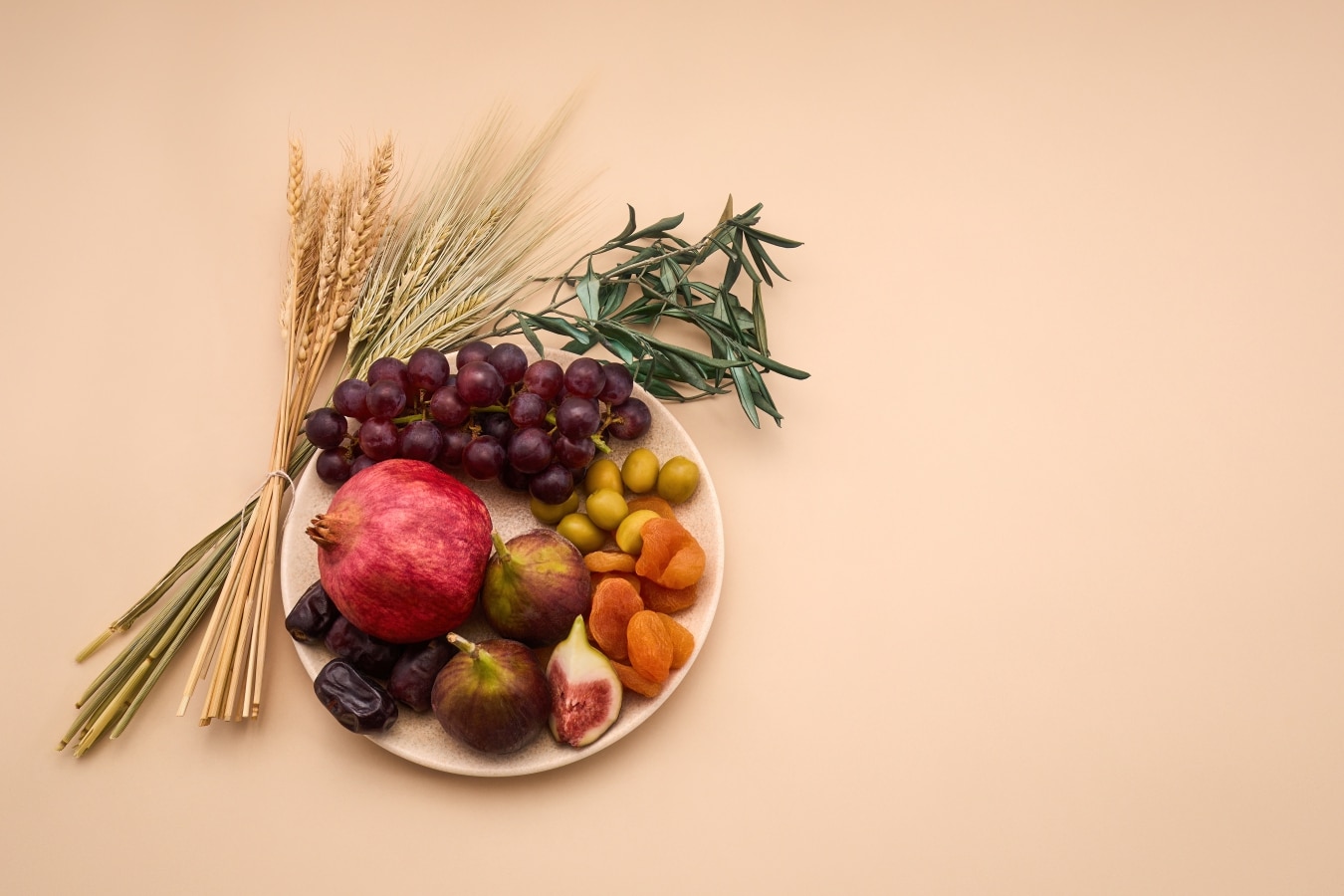 Between Carpools
There is what to be learned from everything in Hashem’s magnificent creation, including fruit, especially the shivas haminim. Would you imagine that the delicious fruit we eat can also be inspiring? Here are some lessons we can learn when we take a deeper look at fruit.
Appreciating Hashem’s Chessed
Fruit stands out as one of the most beautiful and sweet sources of sustenance we have. Rav Avigdor Miller ztl called fruit “Hashem’s candy.” In fact, noted author Bracha Goetz has an adorable children’s book called “Hashem’s Candy Store” that reflects this theme. Hashem created the world with the reality that human beings need to eat to survive. He could have built into the world some sort of gray glob that contained all of the nutrients we need for survival. Every day we would ingest that substance and be sated for the day. But Hashem in His great chesed bestowed upon us an array of delicious, refreshing, colorful foods so that we can actually enjoy what we eat. This is no dispensation of His obligation so to speak to keep us alive. This is pure love. And nowhere is this more apparent than in the vast array of fruits available in our world. Aside for the brilliant colors that make them so palatable and the sweet taste that you can’t get enough of, there is the sheer variety. He created so many different kinds of fruit, each more delectable than the next.
If you ever find yourself wondering if Hashem really loves you, just look at the fruit in your fridge. Your answer is right there.
Lessons from the Beauty of Fruit
Hashem made fruit, which are so beneficial for us, so appealing and vibrant. This is no accident. Many fruits also start out a dull green until they ripen, and only then do they turn their vibrant shades, tantalizing us. And finally, fruit doesn’t begin to fall from the tree until it is fully ripe, becoming most accessible to us only when it is healthy for us to eat it. Hashem put so much into making it easier and more pleasant for us to consume that which is healthy and good for us. This is an important yesod in chinuch. We want our children to follow certain behaviors and retain certain values, but we need to make those behaviors and values tempting! We are struck with obstacles in the increasing allure of the world that is against our values. There are things in foreign cultures that seem so exciting, and we need to battle those influences by making Yiddeshkeit and Torah vibrant and exciting so our children aren’t compelled to look elsewhere (this is also a great lesson as we lead into Purim). We need to bring the fruit to them, and we need to paint that fruit in the brightest colors possible, infused with the juiciest juices possible. Experiencing Shabbos needs to be as geshmak as biting into a ripe, luscious watermelon with the juice dripping down our chin.
A life of emes and yiras shamayim needs to be as tantalizing as a bunch of plump purple grapes and a fuzzy, dripping peach.
Lessons from the Olive: Squeezing the Oil
Olives are a wonderful fruit. They have much nutritional value and are a great addition to a Greek salad. But the real potential in olives lies in the oil they produce. It’s the oil that served as the catalyst for nes Chanukah, that we light our Shabbos neiros with, the oil that is used for frying and dressing and so much more.
But the only way you can get to the oil is by pressing those olives. The more you squeeze them, the more precious oil you procure.
Sometimes life is tough and we feel like we are being squeezed from all ends. We wonder what the point of all of these challenges are, and why we couldn’t just sit in peace in our Greek salad or on a fancy meat board. But our challenges are Hashem’s way of showing us our potential, of allowing us to see what has been inside of us all along and helping us bring that potential to fruition.
This is true of am yisrael as a whole. Our beauty shines forth in our adversity. When we suffer global losses, we come together, we grow, we build our faith and we produce an oil so breathtakingly beautiful no other nation can ever come close.
And it is true of an individual as well. Our challenges have a way of bringing out our inner core, of showing ourselves how resilient we can be, how much faith and hope and love we have been harboring all along. It sat there until we were tested, and only now that we have been pressed can our true beauty flow.
The same is true of another one of the shivas haminim: the grape. Grapes are delicious in their own right, but their true value is in the wine they produce. And only when they are stomped upon and squeezed to their last breath, does the wine truly flow. Our tribulations squeeze us, but they also bring out the best in us. This can also teach us the value of humility. That only when we learn how to truly humble ourselves, to crush any vestige of ego that we harbor, can our greatness flow.
Lessons from the Outer Layer: Peel the Layers
Most fruits contain the meat on the outside and the pit on the outside. Some have a soft skin surrounding the meat, but that skin is just as edible, and in fact contains many of the nutrients of the fruit. But then you have the pomegranate. The rimon’s tastiness is buried within a hard outer shell. Imagine someone biting into a pomegranate as they would an apple. They would immediately wrinkle their nose and discard the bitter fruit. They might even lose a few teeth in the process. But that is only because they assumed that what they could see is what there is. They didn’t bother to peel the layers, to get past the tough facade and find the thousands of seeds inside bursting with the sweetest, juiciest flavor.
The gemara in Sanhedrin (37.) quotes Reish Lakis as saying of Kllal Yisroel, “Afilu reikanin shebichah milein mitzvos k’rimon.” Every one of us has so much to offer, but if we get turned off by the shell of every person we encounter, we won’t ever get to experience the deep goodness they all harbor within.
Take a moment to peel through the layers and find the seeds where the true sweetness lies.
Lessons from an Apple: See the Potential
Another famous thought from Rav Avigdor Miller as it relates to fruits is seeing the niflaos haborei in an apple. Every apple contains seeds bearing the potential for thousands more apples. One seed grows a tree, and every tree can grow innumerable apples in its lifetime. We can draw an analogy to human potential. When you look at a person, you see their facade, you see the apple. If you are more perceptive, you can see the seeds within. But can we begin to fathom the vast potential contained in those seeds? Can we begin to fathom what every human being is capable of, if we give them the chance to thrive, if we take the time to carefully plant and water and nurture the seeds they carry within them?
As the saying goes, “Anyone can count the seeds in an apple, but only Hashem can count the apples in a seed.” In the spirit of v’halachta b’drachav, it is up to us to find the potential in every human being we encounter. The most impactful teachers you remember are the ones who saw your potential and helped you bring it out. It’s not only teachers who have that power. Any human being can touch another by finding their potential and helping them bring it out. When we can look at a person and see not only what they present but also all they can be, we can change their lives.
Lesson from a Grape: Make Sure You’re Supported
One of the most important things you need to consider when trying to grow grapes is what kind of support you will give your vines. Vines need a trellis of sorts to ensure that they grow upward instead of staying on the ground. Human beings are no different. We were placed in this world with a mission, a purpose. Our life is one of growth and upward movement. And much like the grape vine, we need to be backed by support if we want to grow upward. Otherwise, we flop to the floor. Our greatest backbone is the Torah. When we attach ourselves to the Torah, we flourish and we grow upward, bearing remarkable fruit. Our support system needs to be daas Torah, connecting to a Rov who can guide us as we grow, who can help us make sure we are constantly upward bound. The trellis of daas Torah is vital for every ben Torah, every eved Hashem. Otherwise, his life will be linear and his grapes just won’t grow.
And we can extend this to other kinds of support as well, each according to her needs.
Our extraordinary cadre of superwomen sometimes operate under the misconception that we need to do everything ourselves in order to prove our worth. To lean on others is weak. We need to be the ones others lean on. But let’s remember that the strongest vines are the ones with the strongest support. Making sure we have those stakes of support built from the get-go is the biggest act of strength and courage we can do for ourselves.
Lessons from a Date: Never Give Up
Date palm seeds can go dormant for decades until the right light and water conditions present themselves. They lie beneath the surface of the ground, seemingly dead. No one would expect to see any sign of life from them, ever. And yet, when all hope has been lost and all expectation given up, they suddenly spring to life and blossom into a beautiful, lucious, fruit bearing tree.
Yeshuas Hashem k’heref ayin. We can sometimes plant seeds and then build our hopes around them, only for those hopes to be dashed. And yet, one never knows when Hashem will decide the time has come for those seeds to bear fruit. We must never lose hope, and always place our faith in Him that our yeshuah will come just as the right conditions present themselves. As in, just when the moment He has determined it to arrive.
This Is Precisely Message of Tu B’shvat
We celebrate the birthday of the trees at a time when the trees are seemingly dead. We are deep into the winter, surrounded by bare branches and barren trees. It seems to be a strange time to celebrate the life of a tree! And yet, it is precisely at this time that we celebrate. For we may not see it, but the trees are not entirely dormant. This is the time when the saps within the tree begins to rise, preparing for the renewal of spring.
_Galus i_s long and hard, and it seems as if there is no end in sight. This is both the communal galus klal yisroel has experienced for so many years already, and every individual’s personal galus, whatever hardships they may be enduring. We think there is no end in sight. We look around and all we see are dead branches and barren landscapes. But unbeknownst to us, beneath the ground, the sap is rising. The yeshuah is materializing. And just when Hashem deems it right, our yeshuah will burst furth, blossoming and thriving with the breathtaking fruits of spring.
May we see that day very, very soon!
The post Be Fruitful appeared first on Between Carpools.
 Between Carpools
You’re carrying so much.
The kids, appointments, supper, Shabbos, homework, registering for school, playgroup and camp, calling the plumber, paying the dentist bill, dealing with the car inspection…
And he… just lives his life.
Maybe he’s not a bad guy. He’s not cruel. He’s not out partying. He’s just… not helping.
At least not in the way you desperately wish he would.
You think, “If I don’t take care of it, no one will.”
And maybe that’s actually true.
But being the “responsible one” all the time is draining. Exhausting. Lonely.
And you may wonder:
Why should I stop controlling things when that’s the only way anything gets done?
Why should I let go if he’ll never step up?
Why is it always ME?
You’re not wrong for feeling this way. Any woman carrying the entire load would crack under the pressure. Your frustration makes sense. And you deserve so much compassion for how hard you work.
This isn’t about pretending he’s secretly amazing, or promising that if you try one magic technique, he’ll suddenly wake up a new man.
This is simply about one skill – a way to remove some of the weight on your shoulders even if he never changes.
When a woman feels overwhelmed and unseen, she often starts controlling without even realizing it.
Not because she’s bossy.
Not because she wants power.
But because she feels unsafe.
So she jumps in—
“I’ll speak to the mechanic.”
“I’ll just fill out the forms.”
“I’ll remind him three times or it won’t get done.”
Control becomes the default mode because the alternative feels like letting everything fall apart.
But here’s the real, painful truth:
Even though controlling everything keeps the balls in the air, it drains your energy and blocks connection.
It makes you feel like the only adult in the home.
It creates resentment.
It makes you feel alone, even when you’re married.
So what can you do?
Relinquishing control does not mean you trust him blindly.
It does not mean you pretend he’s perfect.
It does not mean you drop the ball and let life crash.
It means choosing, slowly, gently, to stop trying to manage what isn’t actually yours to manage.
It means stepping out of his lane so you can breathe again.
It means letting go of the anxiety-driven instinct to oversee, correct, supervise, remind, teach, or push.
It means allowing him to be himself, even if he is inconsistent, slow, forgetful, or different from you.
Relinquishing control is not for him.
It’s for YOU.
Here’s what that looks like in real life:
If he’s bathing the toddler and the bathroom becomes a splash-zone?
If he gives the kids cereal for supper?
If he dresses the baby in stripes and polka dots?
You breathe.
You let him.
For one week, don’t remind him about trash night.
If he remembers, great.
If he forgets, the world does not end.
It creates learning – his learning, not yours.
Try saying:
“Whatever you think.”
“I trust you on this.”
Or simply swallow the comment and walk away.
Even once a day is a win.
This is where your power truly is.
Here’s what relinquishing control actually changes:
You stop micromanaging every detail.
Your shoulders soften.
Your nervous system settles.
You feel lighter.
Instead of being the household drill sergeant, you become a woman who chooses what she does and what she lovingly puts down.
The kallah who didn’t come into marriage to be a project manager.
The woman who wanted partnership, not pressure.
You reclaim your own inner peace instead of waiting for him to wake up one day magically transformed.
Not because he changed, but because you stopped drowning in tasks that were never meant to be yours alone.
Not because you forced it, but because letting go of control opens a quiet doorway where warmth can seep back in.
None of this requires him to change.
None of this depends on him stepping up.
This is the part that belongs to you and only you.
My client, Sarah, was exhausted from carrying everything.
She didn’t trust her husband with anything, even remembering to pick up milk.
One day she told me, “I can’t live like this anymore. I’m angry all the time.”
We worked on tiny moments of relinquishing control:
When her husband offered to take the kids to school, she didn’t tell him which way was the fastest way to go.
When he loaded the dishwasher “wrong,” she let it go.
When he forgot to call their son’s rebbe, she didn’t remind him.
A few things did fall through the cracks.
But something else happened:
She felt less tense.
She felt more like herself.
She wasn’t simmering with resentment all day.
And here’s the real shift:
She said, “I finally feel like I have my life back.”
Her husband didn’t suddenly become superman.
He didn’t become more helpful overnight.
But she changed.
Her peace returned.
Her heart and her home softened.
Her marriage felt warmer, not because he improved, but because she stopped living in fight-or-flight.
You don’t have to wait for him to:
read your mind
become more responsible
develop initiative
help more
take over the load
turn into the husband you wish he could be
You can begin to feel lighter, calmer, and more connected today, through one small act of relinquishing control.
Not because he deserves it.
Not because he will magically change.
But because carrying everything alone is too heavy for anyone.
And you deserve a life that feels peaceful—even if he remains exactly the same.
The post When You’re Carrying Everything—and He Still Doesn’t Step Up appeared first on Between Carpools.
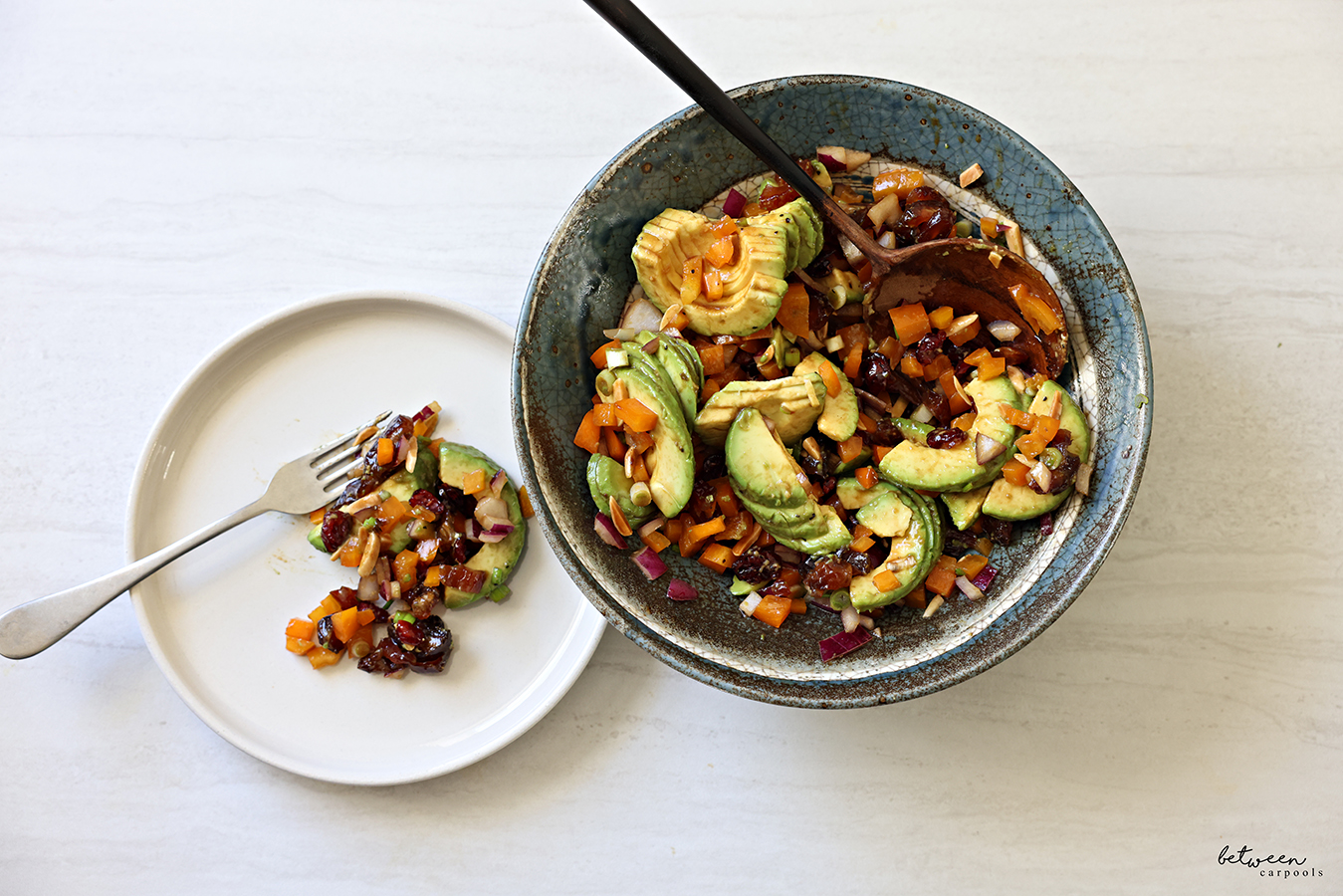 Between Carpools
Do you remember this Green Apple and Celery Salad? It’s still one of my favorites. It’s the one of those few salads that stays crunchy and yum even when the leftovers have been sitting in my fridge for a couple of days.
When my neighbor Suri passed by with new recipes from her sister Shaindy, that Green Apple and Celery Salad was one that stood out. And this Avocado and Date Salad was the other one. Suri had already tried it and confirmed that “it’s really good!”
It seems Shaindy is really good at combining textures that really work together.
What I like about this avocado salad is all the variety. Usually, avocado salads are one-note. Yes, we love avocado but adding some crunchy and chewy factors to the usual mush can’t be bad.
To the contrary, it could be very good. You just need to be willing to try.
Start by slicing the avocado. For tips on slicing an avocado beautifully, see the full instructions in the middle of this post on making an Avocado Board. Renee Muller showed me how she places the avocado, cut side down, on the cutting board and peels off the peel then slices. It’s a game-changer.
Top with the dates, pepper, red onion, scallions, Craisins, and almonds.
Toss with the dressing. And that’s it!
If you want to make this in advance, I recommend preparing the other ingredients and the dressing. Then, when ready to serve, slice the avocado, (the red onion and scallion if you prefer to slice the onions fresh as well) top it with everything else that you already prepped, and dress.
Add avocado to a dish or bowl. Top with dates, pepper, red onion, scallions, Craisins, and almonds.
Combine all dressing ingredients and drizzle on salad. Toss to combine.
The post Avocado and Date Salad appeared first on Between Carpools.
 Between Carpools
You want to give that room a bit of a refresher, but, let’s face it, you cannot deal with paint or buying furniture, not right now. Sometimes, all you need is some new linen and an accessory or two and that does the trick.
Whether it’s for a kids room, a guest room, or even for yourself (H&M also has premium picks for under $100), there’s some really beautiful options.
Please check sizes before purchasing, and note that H&M Linen sets come without a fitted sheet. Find fitted sheets here.
Extra pillowcases are also available for many of the duvet sets.
The post Low-Priced New Linen Picks appeared first on Between Carpools.
 Between Carpools
Ever heard of the term guardianship? Or special needs planning?
Many families of special needs children only learn about either one when something goes wrong. Maybe it’s an emergency room visit. A doctor who won’t speak to you. An important medical decision for your child you assumed you’d always be allowed to make, and suddenly, legally, you can’t.
Or maybe it’s after a parent passes away, when a family discovers too late that their child with special needs has automatically inherited money, and as a result, has been kicked off their absolutely vital government benefits.
‘That’s exactly what I help families avoid,’ explains Malkie Scher, an attorney at Moskowitz Legal Group. Malkie heads the firm’s special needs planning and guardianship department, where her focus is helping families plan ahead, before crisis hits.
Special needs planning is essential for any family raising a child with disabilities who relies on government benefits like Medicaid or SSI (supplemental security income). A prerequisite to being on these programs is that a very limited amount of money be kept in the individual’s name.
‘Most parents are aware of this, and therefore super careful to keep money out of their child’s name,’ she says. ‘But what many don’t realize is that without proper planning, a child will automatically inherit when a parent passes away, unless parents leave clear instructions ahead of time.’
Without a will and a properly structured supplemental needs trust, that inheritance can immediately disqualify a child from the benefits they depend on.
‘We see this every single day,’ Malkie says. ‘Some parents assume estate planning is only for the wealthy. It’s not true! Everyone should have a will, but for families with a child with special needs, proper planning is essential.’
Estate planning type has no specific target age. It’s about parents making sure their child is protected, no matter what.
Guardianship, on the other hand, takes place at age 18. ‘When a child turns 18, the law assumes they can make their own medical, financial, and personal decisions,’ Malkie explains. ‘For many people, that’s perfectly fine. But for others, especially individuals with lower-functioning special needs, it can leave families unprotected.’
Without guardianship in place, doctors may legally refuse to treat or even speak to parents. Malkie regularly receives calls from families already in the middle of a crisis, realizing too late that they no longer have the authority they assumed they did.
For individuals who are more high-functioning, able to work or manage parts of daily life but still reliant on parental support, guardianship may not be appropriate or granted. In those cases, Malkie helps families explore alternatives like HIPAA releases, medical proxies, and supported decision-making agreements.
There’s also a future-planning element to guardianship itself. ‘It’s important to name standby or backup guardians,’ Malkie notes. ‘That way, if you’re no longer able to serve, your child is never left without someone legally designated.’
‘The best time to plan is before you need to,’ Malkie says. ‘These are not crisis conversations. They’re about setting your child up for stability, protection, and continuity—both now and in the future.’
Contact Malkie Scher directly to set up a call here to get the conversation started! You can also email at [email protected].
The post Special Needs Planning & Guardianship appeared first on Between Carpools.
 Between Carpools
If you’re planning a cozy, at-home staycation and want to incorporate a fun baking or kitchen activity, there’s so many treats that your kids will love to try to prepare on their own! Depending on their ages, you can let them have fun while also enjoy the results.
This is a time that you can let them experiment with trial and error, without being too worried that they’re following instructions correctly. They can always try again!
It’s time for them to learn, shine, and feel pride.
This time, it’s about the process, and if the results are something you can all enjoy together, then that’s a bonus.
The post 20 Fun Things for Kids to Prepare in the Kitchen appeared first on Between Carpools.
Between CarpoolsIf you’re planning a cozy, at-home staycation and want to incorporate a fun baking or kitchen activity, there’s so many treats that your kids will love to try to prepare on their own! Depending on their ages, you can let them have fun while also enjoy the results.
This is a time that you can let them experiment with trial and error, without being too worried that they’re following instructions correctly. They can always try again!
It’s time for them to learn, shine, and feel pride.
This time, it’s about the process, and if the results are something you can all enjoy together, then that’s a bonus.
The post 20 Fun Things to Prepare in the Kitchen appeared first on Between Carpools.
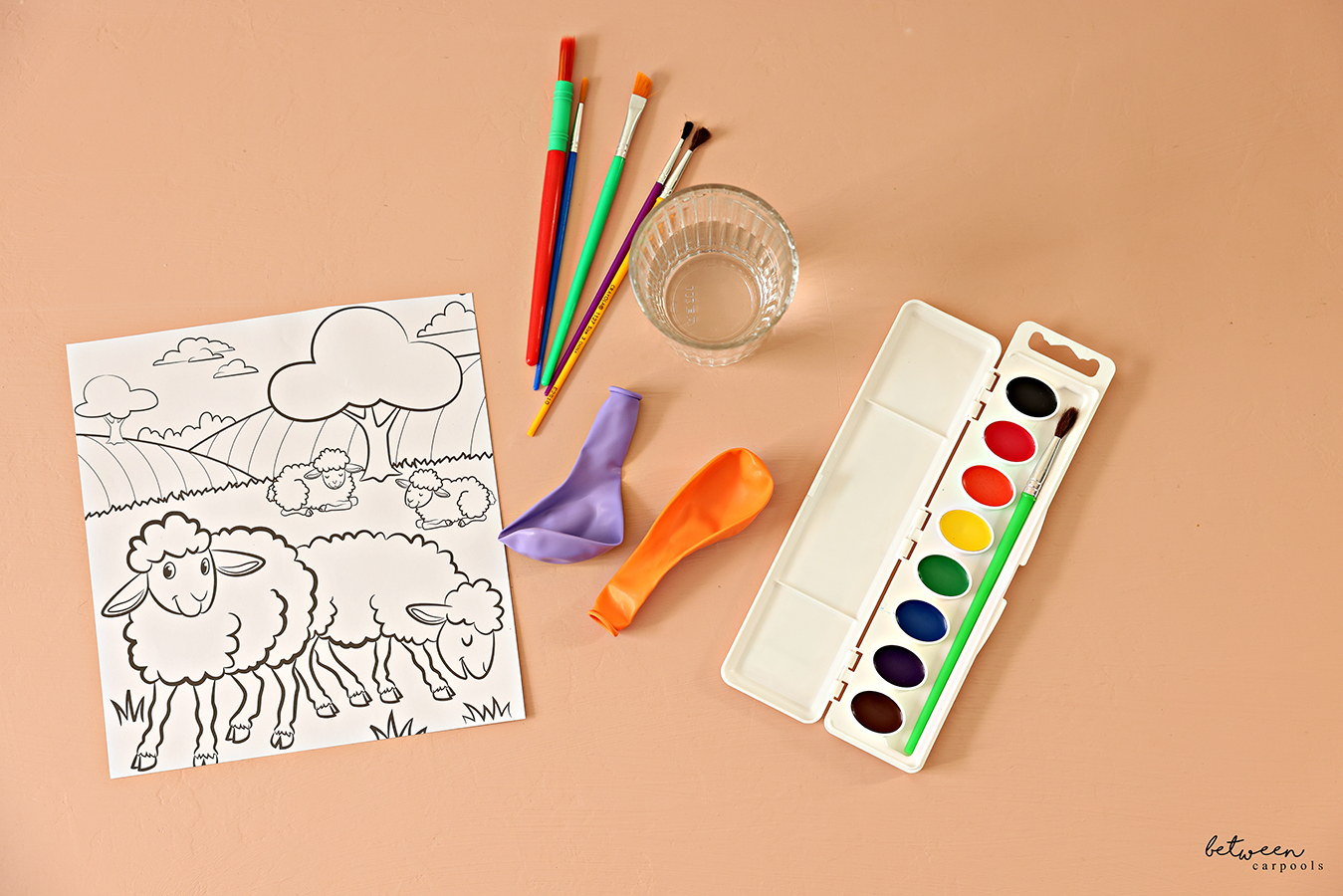 Between Carpools
You can handle a little paint. Especially watercolor paints, which can’t spill, as they’re not liquid until your child dips their brush into a cup of water. And especially washable watercolor paints!
The problem here is that cup of water. The one that always turns into different colors pretty quickly. It inevitably gets knocked off, drenching everything.
Here’s a solution that will make the project all the more fun! You’ll need one balloon per cup. Start by cutting off the top half of the balloon.
Stretch it out.
And place it like a cover over a glass cup.
Press in the mouth of the balloon.
That’s where they’re going to insert their paintbrush to access the water.
Ta-da! Now let that water turn over. No worries, the cup is now spill-proof!
Now it’s time for a project.
Now, mom is going to hesitate for a second when the kids want to paint! It’s a win-win solution for all of us.
The post Watercolor Painting Without the Mess appeared first on Between Carpools.
 Between Carpools
Think Sunday morning. Your daughter wants to look cute and put-together, you want zero stress, and everyone has to be out the door in five minutes.
Think the week before Pesach. Your helper is ready for the chaos ahead and needs an outfit that’s light, fun, and looks right with sneakers.
Think first day of camp. She wants something fun, sporty, and comfy enough to last from breakfast to night activity without any drama.
Fellow moms, meet Loom & Lyric.
This is activewear that works—and everyday basics that do too! Loom & Lyric is made for play, for movement, and for everyday life. Shop skirts with built-in shorts, leggings, matching sets, coordinating tops, and versatile basics. Many pieces are perfect for matching your girls, no matter their sizes: sporty-cute, elevated, and easy, all created for real bodies in a full size range.
Made from delicious Peruvian cotton with stretch, sized 6–18.5, including half sizes that are roomier and wider where your daughter needs it. Follow along for behind-the-scenes fun on Instagram @loomandlyric!
How fun does it sound to shop for well-fitting activewear, cozy basics, and everyday clothes? To make getting dressed a win? Let’s make shopping fun again! Browse the whole collection at www.loomandlyric.com, or browse our top picks, below.
The post Sporty. Cute. Made for Real Bodies. appeared first on Between Carpools.
 Between Carpools
Do you ever wonder how you can have so many amazing statement pieces, with the prettiest colors, fabrics, and patterns but still feel like something in your wardrobe is off? Perhaps it’s that layering piece, the right belt to finish off a dress, or that solid-colored cashmere sweater that’ll go perfectly with that printed skirt you never wear because you don’t know what goes with it!
After doing a bit of a closet audit, it became quite apparent that sometimes we just lack the basics to serve as the foundation for a wardrobe. While we love a bold, unique statement pieces just as much as the next fashion person, there’s something about having easily wearable, versatile pieces ready to go that just hits differently.
We searched H&M, Mango & amazon and some more well-priced spots to hunt for some tops, bottoms, outerwear, and simple staple shoe items to serve as the building blocks of a wardrobe. Scroll below to see some suggestions.
The post 30 Basics That Finish Any Outfit appeared first on Between Carpools.
 Between Carpools
Midwinter brings more time at home — and a need for exciting ways to keep children happy and occupied. The Loop offers families an easy, all-in-one midwinter solution, with stories, games, live shows, and interactive experiences kids love.
To make it easy to try, The Loop is offering one full month free to new subscribers. No commitment. Just fun! It’s a perfect addition to your midwinter routine, whether for quiet afternoons or long winter evenings.
Discover how Loop can transform your family’s midwinter! Call 848-777-8888, text ‘Loop’ to 732-785-4540 or visit www.calltheloop.com to sign up! For customer support email [email protected] or call/WhatsApp/text 732-592-5437.
The post The Loop: Your Midwinter Solution for Family Fun appeared first on Between Carpools.
 Between Carpools
Are you one of the pro sleep training people out there, or is it something you are passionately against? Whichever side you are on, this article is for you, because having a happy, calm baby is something we can all agree on.
There is a big misconception about newborn sleep that should be cleared up, and it’s something I want to shout from the rooftops! Many moms think their newborn will just fall asleep anywhere and everywhere, whenever he needs to sleep. This couldn’t be further from the truth! Newborns need us to give them consistent naps, and they need us to help them fall asleep, at the right times.
Babies are only born with 25% of their brain developed, and they lack the capacity to self-regulate. Sometimes, when you put your newborn to sleep and he is very calm and sleepy, he might drift off by himself. However, you will often have to soothe your newborn to sleep. Now is not the time to be concerned about creating bad habits in your newborn. All you want to focus on now is responding appropriately to his needs and creating a safe and secure attachment.
That being said, you obviously want your baby to sleep, and here is the best way you can PREP your baby for that. This way, even though you will be using a “sleep crutch”—because again, your baby is often NOT going to fall asleep independently—you are still optimizing sleep for your newborn and, by extension, for the entire family:
P-Prevention- Newborns can become deregulated and over-stimulated very easily. Preventing that is a lot easier than dealing with it afterwards. This is the most important part of PREP.
Most of you already know the classic signs of over-stimulation: fussy, crying, and hard to calm. But here is something you might not know. Ever noticed a newborn sleeping through chaos? Picture a newborn at a wedding or even a baby boy at the seuda after the bris. He is just sleeping straight through it all. Is that because noise doesn’t affect newborns? Well, actually it does, but the environment is so over-stimulating to them that they start habituation—shutting down. They appear to be sleeping deeply, but it’s not a refreshing, restorative sleep. In actuality, they are working very hard to shut out their environment. You will know if your baby was habituating if they wake up from this sleep fussy, inconsolable, and exhausted. It can be hard to calm him down; you may need to focus on soothing his nervous system for the next day or two (and sometimes even three).
Remember that the world is a brand new place for these little ones. Even the regular hustle and bustle of your house can be too much for them. Towards the mid afternoon, babies will be even more sensitive to stimulation, so it’s helpful to keep them away from the afternoon chaos as much as possible. Keep them in a calmer, dimmer environment so you can get them to bedtime without them being too over-stimulated.
Initially, in the first two or three weeks after birth, babies will sleep around the clock more or less and wake just to have their physical needs met. After this initial period, their wake time average increases to an hour. The first wake window of the day will be shorter- 30 to 45 minutes– and the last one will be longer- up to 90 minutes. Wake windows also go according to nap length. If your baby is only taking 30-minute naps (yes, that’s considered normal at this age), then their wake window will be shorter. If your baby’s naps are on the longer side, then their wake windows can be longer too. So keep your eye on the clock, but also watch your baby for sleepy cues, and try to get your baby down for a nap before he becomes overtired. He will have an easier time falling asleep, he’ll sleep better, and of course he’ll be happier too.
R-Routines– Start a routine with your newborn, and he will eventually come to learn what it means. When babies know what to expect, they will feel safe and secure, which will help them fall asleep calmly. In addition, their brain will start the process of preparing the body for sleep. Routines are great for naps as well.
An example of a routine would be going into the baby’s room, dimming the lights, diaper changing, swaddling, singing, and holding the baby for a few minutes. When your baby is very calm, put him down. He will still most likely need help falling asleep, but the benefits of the routine mentioned above are still the same.
E-Environment– Set up an ideal sleeping environment to bring on optimal, quality sleep. Think of how you feel when you walk into your bedroom and it’s neat and clean, versus when you didn’t have a chance to make your beds that morning, plus there’s laundry all over the place. It’s a peaceful feeling versus chaos. We want to recreate the peaceful feeling for our newborns too.
The ideal sleep environment is dark (yes, for naps too), quiet, the right temperature- not too hot and not too cold- calm and clean.
The emotional environment is just as important. Use bedtime as a quality bonding time without distractions. Studies show that children who have an emotional connection at bedtime fall asleep faster and stay asleep longer. You can’t get better benefits than that!
P-Proper Feeding– In order to help establish your newborn’s circadian rhythm- their sense of day and night- make sure not to miss a daytime feeding.
Feed at least every three hours. If you let them take a longer stretch by day, they will not take a longer stretch at night.
In addition to this, expose your newborn to sunlight in the morning and keep the afternoons (3pm and on) dimmer and quieter.
Using PREP to help your baby sleep will set your baby on the right track to being a calm, happy baby and a great sleeper. We all know how challenging the postpartum weeks can be and how much there is to deal with during this time period.
A well-rested baby means more time for you to breathe, reset, and keep up with the demands of life.
The post How to PREP Your Newborn (0-8 weeks) for Sleep Success appeared first on Between Carpools.
 Between Carpools
Want pretty gifts, from those lux soaps to beautiful home accents? See the This/That roundup here! For practical gifts, keep reading.
Do you have a friend or family member who recently moved, or is soon to move to a new home? There’s lots of practical items you can gift that will help make that house a home.
While there are a few great under $50 or under $100 picks, most of these items are more significant gifts that they probably aren’t buying for themselves just yet. They’re the items you may purchase to treat someone else to help make this new stage in their life more convenient.
The post Top 26 Practical Housewarming Gifts appeared first on Between Carpools.
 Between Carpools
Each pick here is a favorite for a reason: The perfect gifts, without the endless searching.
There’s something incredibly special about being invited into someone’s new home – even more so when you arrive with a gift that feels thoughtful, elevated, and truly useful. We’re so excited to be featured and to share our tried-and-true favorites for elevated housewarming gifts, curated for every kind of recipient and every price point.
From a friend or host to a daughter buying her first home, these are the gifts we always come back to. Heavenly scented luxury soaps are a favorite – especially when paired with beautiful initial towels for an easy, polished gift. And for a true statement, an olive tree brings warmth, life, and lasting style to any space.
Want more great finds for you? Find more great curated edits, including these focused on you, here on This/That!
Want to see This/That curated edits as soon as they launch? Sign up to our WhatsApp Community here.
The post 32 Elevated Housewarming Gifts We Love appeared first on Between Carpools.
Between CarpoolsEach pick here is a favorite for a reason: The perfect gifts, without the endless searching.
There’s something incredibly special about being invited into someone’s new home – even more so when you arrive with a gift that feels thoughtful, elevated, and truly useful. We’re so excited to be featured and to share our tried-and-true favorites for elevated housewarming gifts, curated for every kind of recipient and every price point.
From a friend or host to a daughter buying her first home, these are the gifts we always come back to. Heavenly scented luxury soaps are a favorite – especially when paired with beautiful initial towels for an easy, polished gift. And for a true statement, an olive tree brings warmth, life, and lasting style to any space.
Want more great finds for you? Find more great curated edits, including these focused on you, here on This/That!
Want to see This/That curated edits as soon as they launch? Sign up to our WhatsApp Community here.
The post 32 Elevated Housewarming Gifts We Love appeared first on Between Carpools.
 Between Carpools
We are blessed and our brains are full. Not in a dramatic way. In a quiet, background kind of way. You’re not overwhelmed because any one thing is hard. You’re overwhelmed because everything needs a tiny decision.
Where does this go?
Should I deal with this now?
Do I need this?
Can this wait?
And our brains are doing that all day long.
What saved me wasn’t a new system.
It was taking thinking out of the equation.
I didn’t get more motivated.
I got more automatic.
Two tiny habits did that for me:
The One-Touch Rule
Habit Stacking (beautifully explain in this article by Esti Waldman)
They sound official. They’re actually very gentle.
And together they let you get things done… without thinking.
What it actually means, in real life: When something comes into your hand, you decide what happens to it — all the way — before you put it down.
Not later.
Not after you rest.
Not when you “have a minute.”
Right then.
Because once you put it down without deciding, your brain now has to carry it. So here’s what that looks like, very practically.
The mail example: The mail comes in. You bring it inside.
Most of us:
We put it on the counter.
Then we move it to the table.
Then we move it again.
One Touch says:
You stand there for one minute and:
• Throw out the junk mail
• Open the bill and either pay it, file it, or photograph it for later
• Sign the permission slip
• Put the check straight into your bag or wallet
Then — and only then — you put the empty envelope in recycling and walk away.
So the mail never becomes a pile.
Baby and home examples:
• You change the baby. The diaper is in your hand.
You walk it to the garbage and drop it in.
You don’t put it “near” the garbage.
• You finish the baby’s bath. The towel is wet and in your hand.
You walk it straight to the hamper and drop it in.
• You open a package. The box is empty.
You break it down and put it into recycling right then.
• You take off your shoes. They are in your hand.
You put them into the closet — not next to the closet.
Same amount of effort.
Just one tiny decision earlier.
Sometimes, it also means finishing the future of things.
This is the part no one teaches.
One Touch doesn’t just mean “put it away.”
It means: finish the responsibility attached to it while it’s already in front of you.
So:
• You finish at the dentist. You are still standing there.
You schedule the next appointment for six months from now before you leave.
Not “I’ll call later.” Later never comes.
• Your new passport arrives. It’s exciting. You open it.
Before you file it, you:
• Put a reminder in your calendar one year and four months from now: “Renew passport.”
• (Optional Between Carpools step Put a tiny label outside that says who it belongs to.)
Habit stacking is what makes this effortless.
It means attaching a tiny action to something you already do. You don’t create new habits.
You just add a micro-habit onto an existing one.
Please read Etsy’s article that delves into this!
For us busy women, each task is an open loop that your brain is quietly tracking:
“Don’t forget that.”
“I still need to deal with this.”
“Ugh, that pile.”
The One-Touch Rule closes loops.
Habit stacking makes it automatic.
Now your brain can finally exhale.
If no one ever showed you how to do this, please hear me:
You are not behind.
You are not messy.
You are not failing.
You were not given the invisible skills.
Now you have them.
Finish the thing.
Close the loop.
Let your empty hand do the next right thing.
That’s it. That’s the whole magic.
The post Getting It Done Without Thinking appeared first on Between Carpools.
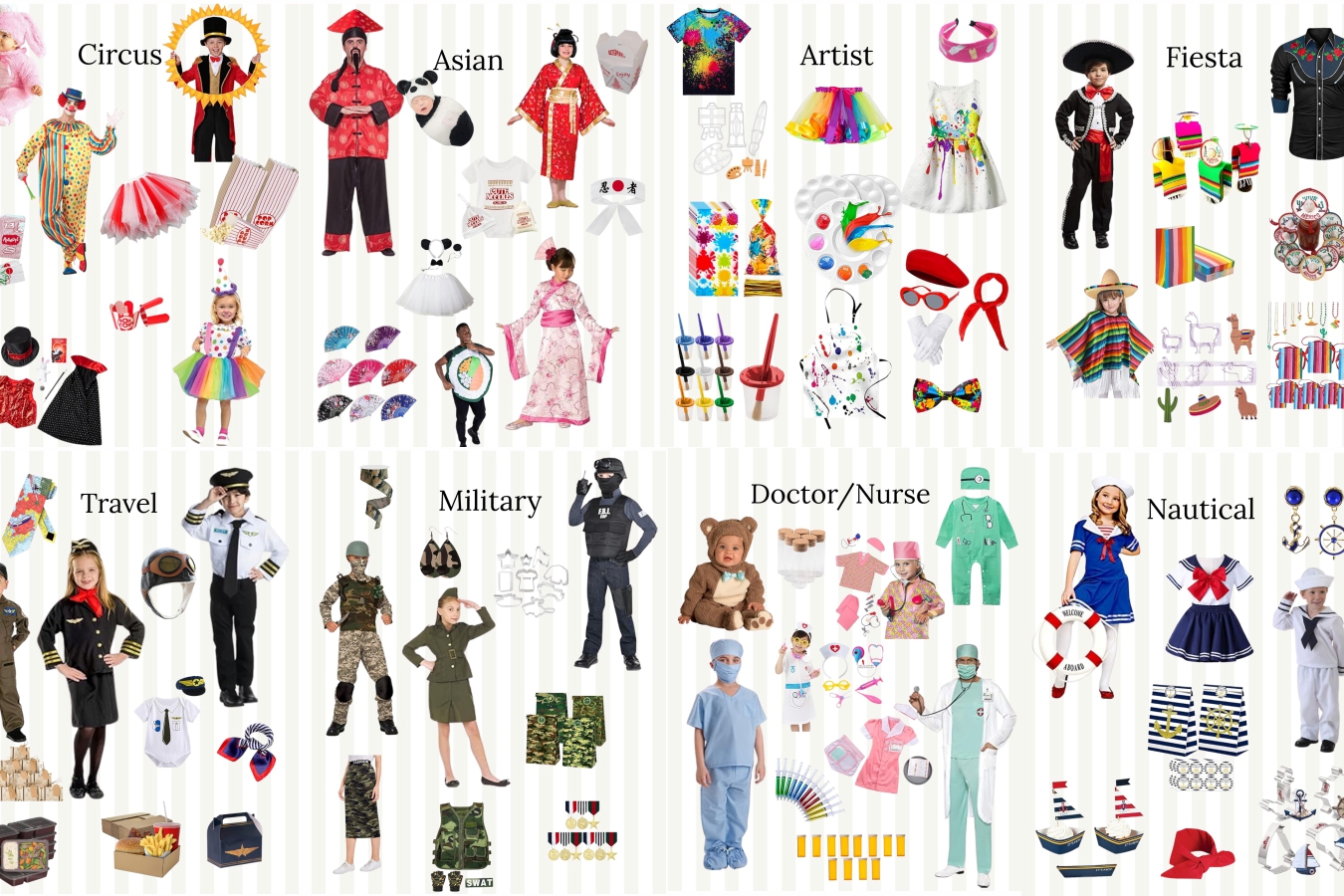 Between Carpools
Does your family love to have fun with themes? Are you or your kids still deciding what to be? These idea boards provide loads of inspiration…you will absolutely love how everything comes together!
The ideas below are not only for costumes but coordinating mishloach manos and containers to go with them – and for the kids too. Click on one of these idea boards and have fun browsing all the coordinating items; everything you need is right there!
To see all our Purim Costume Boards Click Here.
Click here to view the inspiration board.
Click here to view the inspiration board.
Click here to view the inspiration board.
Click here to view the inspiration board.
Click here to view the inspiration board.
Click here to view the inspiration board.
Click here to view the inspiration board.
Click here to view the inspiration board.
Click here to view the inspiration board.
We find the festivals of these regions to be so fun and vibrant so they make great Purim inspiration. Please use sensitivity when celebrating another culture.
Click here to view the inspiration board.
Click here to view the inspiration board.
Click here to see the inspiration board.
We find the festivals of these regions to be so fun and vibrant so they make great Purim inspiration. Please use sensitivity when celebrating another culture.
Click here to see the inspiration board.
The post Everything You Need for Your Purim Theme + Mishloach Manos appeared first on Between Carpools.
 Between Carpools
As the women of Klal Yisrael, Rosh Chodesh is a special Yom Tov for us. It’s a time when Hashem infuses the world with renewed energy, each month with its own special koach.
Just as the feminine luminary, the moon, waxes and wanes every month, we too experience cycles— on various levels. In the spiritual/emotional realm, we have moments when we feel like a mere sliver of light in the sky—dimmed, depleted, and barely visible—but we draw hope from knowing that very soon we will experience renewed fullness and radiance.
Every time the moon completes yet another cycle and the new month arrives, this power of renewal becomes accessible to us—but on the basis of our aspirations. We need to understand and appreciate what each month’s potential is in order to access it. In this special Renewed Radiance series here at Between Carpools with Shiffy Friedman, we draw a short, powerful insight from each chodesh as a guide toward evolving into our most radiant self. Gut Chodesh!
Mazel: bucket (d’li)
After a season of frigid days and long nights, we welcome the month of Shevat with anticipation and relief: the buds of spring are almost on the horizon! But while Shevat is when we celebrate the rising sap in the trees (according to Beis Shammai, this already occurs on the first of Shevat, not the fifteenth), this is not yet the time when the blossoms are visible to the human eye.
This, dear sisters, is the koach of Shevat: to celebrate the buds of geulah even when they’re still in potential form.
As women (dating all the way back to our creation from an internal organ), we have the innate ability to see that which is hidden beneath the surface, deeply internal, concealed from the eye. Emunah, faith in the process, is a uniquely feminine attribute. It is a koach we’ve inherited from Miriam Haneviah, who encouraged the women in Mitzrayim to pack their tambourines while they were still in galus because she deeply believed that very soon they’d have reason to rejoice. When women would complain to Rebbetzin Henny Machlis that they’ve been davening so hard but “nothing has changed,” she’d say to them, “Can you feel the world moving under your feet right now? Big things are happening; you just don’t see it…”
This is the month when we peel away the layers in order to unearth the potential, and celebrate the geulah that is to come. By choosing to see those buds even when the tree still looks so barren and skeletal, we infuse our being with hope.
With this understanding of the spiritual propensity of Shevat, we can appreciate why the mazel of this month is a d’li, a bucket. In times of yore, the bucket was used to draw water from the wells. But what was the way to fill it with this life-sustaining substance? By lowering it down, down below, into the pit. Often, davka when we’re at the cusp of salvation the challenge becomes most intense.
Dovid Hamelech expresses in Tehillim (30:2), “I will exalt You, Hashem, ki dili__sani, for You have drawn me up…” In this passuk we find reference to the word d’li, bucket, and its function, which alludes to the process of salvation: First come the most acute labor pains, and then comes the birth.
This is our time, dear sisters, to tap in to the koach of this month: the power of seeing potential that has not yet blossomed, believing in the buds that are soon to sprout. It is the power of hope.
Here’s how to maximize the potential of this month:
1.
Reflect on an area in your life where you’re in “winter” mode. Whether it’s a child whose challenges seem so overwhelming, our struggles in marriage, with parnassah, shidduchim… The tree looks barren and haggard, with no fruit or buds in sight. Things feel frozen and stuck, like one long stretch of night.
2.
Every morning of this month, take a moment to zoom in on this skeletal tree. True, to the human eye it appears that no change is taking place. You’re investing untold effort into this, all to no avail. Perhaps you’ve even given up trying… See this tree, the hopes and dreams you once had for it. Visualize yourself peeling away the surface layers, layer by stubborn layer, until you spot the sap rising within.
3.
Chazal tell us that tefillah is the fruit of our relationship with Hashem. It’s how we bring it to life. And so, let the relationship bear fruit this month by engaging in heartfelt tefillah regarding this “tree.” “Hashem, I believe there’s a geulah happening under the surface. I know You’re moving worlds from up Above. Help me see change in this area. Please bring the buds to life!”
If this “tree” is a person in your life, such as your child, access your koach as a woman, especially as a mother, to look into their eyes or think about them and see the potential hiding within. What may be the strengths that lie beneath the surface? How can what seems so challenging today turn into their greatest asset tomorrow? The more we see the buds, the more they grow…
This Shevat, let us look at all these barren trees in the landscape of our life, their revival seemingly so unthinkable, and scratch beneath the surface to notice the rising sap. Remember, “Man is like a tree in the field.” As gaunt as the tree looks from the outside, the geulah is on the horizon!
In lashon hakodesh, Shevat is an acronym for simchos and besoros tovos. May it be a month of hope and salvation for us all!
To hear a free, soothing moon meditation on the topic, request it at [email protected].
The post Rosh Chodes Shevat–the Buds Beneath the Surface appeared first on Between Carpools.
 Between Carpools
Here are some of our favorite crafts for kids! All of these projects are self-contained–there’s no other supplies needed. One kit and your activity for the afternoon is set!
We continually update this post to include the tried-and-true crafts that our own children have loved! They’re perfect for those lazy Sundays, vacation days, or the week your child is home sick.
We also love stocking up on creative components, Fun Craft Supplies – that kids can use according to their imagination.
Our Roundup of Crafts and Fun Art Activities for Kids to Do!
The post Crafts That Save the Day appeared first on Between Carpools.
 Between Carpools
As moms, we love this project. There’s not a lot to buy. It’s creative and fun. The results are really cute. And it encourages good reading habits at the same time.
Super bonus: This project doesn’t take up space once it’s done. You don’t need to sneak it into the garbage. Rather, it just lives inside books.
Why not make it a themed day? Pom Pom bookmark project + A trip to the bookstore or library + Hot cocoa + Enjoying your book and marking your spot!
All you need is some scissors and yarn! You can either just get a single color, or a multipack if you have lots of kids who are creating. A tape measure will also be useful. Note that each person will need to have access to the scissors and yarn for most of the time they’re making this project, so it’s helpful to have one pair of scissors and one yarn ball per person if they will all be doing this at the same time.
First, cut a piece of yarn that is 15 inches and another piece that is 8-10 inches. Set them aside for later.
To start making your pom pom, hold the end of your yarn in one hand, and wrap it around your three middle fingers. You want it to be tight, but not too tight–you don’t want to cut off circulation in your fingers!
Keep going, wrapping around about 90 times.
Slide the yarn off your fingers.
Then, carefully, take the 8-10 inch piece that you cut and slide one end through the center.
Tie a tight knot around the middle to secure the loops.
To make the tail of the bookmark, take the longer piece of yarn that you cut in the beginning and tie it around the string that you just knotted. Make a knot at the top.
Now, take your scissors and slice through the two “loops.” Now you have a fluffy ball, but it’s not quite a pom pom yet!
There you go! You can also add some googly eyes to add some cuteness. Make a few to keep in all those books you enjoy reading again and again.
The post How to Make a Pom Pom Bookmark appeared first on Between Carpools.
 Between Carpools
What do wigs, pilates, bubble baths and gorgeous linen have in common? It’s simple: they are all forms of self-care.
We all need to feel good about how we look, take care of our bodies, and carve out some downtime for ourselves in our hectic lives. And as for luxurious linen – that’s my favorite way to feel pampered. It’s basic self-care.
And don’t get me wrong. There’s truth in all of that. I am the first person to advocate for pilates classes (which I really need to sign up for again!). We all need to look after ourselves and all these things are part of that.
But true self-care is so much deeper and sadly, we might find ourselves chasing after all these external forms of self-care rather than turning inwards.
What Does Real Self-Care Look Like?
The Scenario: Didn’t catch the nuances in a conversation and said totally the wrong thing? ● The Inner Critic: I’m so stupid! How could I have said that?! What was I thinking?!
● The Self-Care Voice: It’s true, I did mess up that conversation and I feel bad that I hurt my friend. It’s normal to miss things sometimes. I love myself anyway.
The Scenario: Snapped at your kids and had a fight with your husband? ● The Inner Critic: I am such a mean person; I’m ruining my family! There’s something really wrong with me!
● The Self-Care Voice: I really lost control of myself and that’s a shame. But I’m still worthy of love. I’m giving myself such a big hug.
The Scenario: Blew money you don’t have on a purchase you don’t need? ● The Inner Critic: I can’t make good decisions. It’s all my fault we’re struggling this month. Why can’t I be more sensible?
● The Self-Care Voice: I made a mistake. That’s okay. Human beings make mistakes. I can forgive myself.
The Scenario: Went on a fridge-raid and ate way too much chocolate and chips? ● The Inner Critic: I have no self-control. I feel so fat and stuffed. Why couldn’t I stop myself? I’m such a loser.
● The Self-Care Voice: It’s okay that food is a struggle for me right now. I accept myself exactly where I am on my journey and I can have compassion for myself.
The Core of the Matter
Self-care, at its root, is the recognition that we are precious children of G-d and have innate value that nothing and no-one can ever touch. It doesn’t matter how many mistakes we make or how badly we fall. Nothing can ever make us unworthy of love or compassion. Even in the face of a genuine failure, our essence stays whole, sacred, and infinitely precious.
Self-care matters because we matter.
Self-care is caring for the inner self. Self-care is replacing that inner critic with inner caring. Top Tip: The ‘Self’ in Self-Care
The next time you engage in a “physical” self-care moment, don’t waste the opportunity. Take the moment to give some care to your ‘self’. Sink into that bubble bath and tell yourself whatever you need to hear.
● You can talk to yourself as a friend – I love you, Chana
● You can talk in first person – I love myself so much
● You can say it however you like in whatever way resonates with you – Chana, you are incredible and I really love you with all my heart
You can say it to the mirror.
You can say it in bed.
You can say it in the bathroom.
You can say it every day or every week or even just every month. But are you going to let years go by without ever giving your inner self some love?
Don’t waste those times when you’re already giving to yourself. Boost up that self-care moment with some loving self-talk.
The Ripple Effect
The bonus is that when you start talking to yourself with compassion, when you can always love yourself no matter what, when you accept yourself with all your flaws – you begin to look at your family differently too.
So when your husband screws up and wastes money you don’t have to buy something you don’t need… or when your child messes up something… when people make mistakes and do things wrong (or don’t do them at all)… it doesn’t take away from your ability to love them. You can look at it all with much more kindness. It doesn’t have to ruin the relationship. Instead of criticism, there’s compassion. Instead of anger, there’s acceptance.
Many of us have very strong inner critics. But speaking kindly to yourself is the most basic form of self-care there is.
That, and pilates. (And gorgeous new linen certainly won’t hurt either.)
The post Beyond the Bubble Bath: What’s Real Self-Care appeared first on Between Carpools.
 Between Carpools
Dearest Newlywed,
Shana rishona isn’t a year. It’s a foundation. I heard from Rabbi Tatz that shana rishona is the first ten years — and honestly, that framing changes everything. There’s no rush to “get it right,” but there is value in understanding what this stage is really about. I’d love to pass along three pillars to keep in mind, and I hope you find these helpful.
Money isn’t just numbers. It’s emotion, fear, security, and the way each of you watched money handled growing up.
This stage is about learning how to communicate:
• Do we save or spend?
• What feels stressful?
• What feels worth it?
• What does “being smart” with money actually mean to each of us?
This is where Kayla Levin offers a framing I love: get curious.
Not: Why would you ever do it that way?
But: Interesting…tell me why that feels right to you.
Is it worth saving money each week by cutting out a mini luxury?
Should you take that second side job?
These aren’t arguments. They’re the beginnings of a shared language.
If you want some practical tips, Between Carpools has a thoughtful financial article written specifically on Finance Tips for Newlyweds.
Intimacy is one of those things everyone assumes should come naturally — until it doesn’t. You’re two people bringing different expectations and comfort levels into something deeply personal. Shana rishona is about learning how to communicate and this too, is a language. Like any language, it’s learned slowly, gently, and together.
Often reaching out to your Chosson or Kallah teacher for a little guidance after marriage can be surprisingly helpful. It’s a bit like having taken driving lessons without ever sitting in the car —
and then realizing, once you’re actually behind the wheel, that a little direction can suddenly make things feel steadier.
Not because anything is wrong.
Just because now it’s real. Tending to things when they’re small is often the wisest thing we do.
It’s natural to think — or even say —
“In my parents’ home, this was the norm.”
Stay open-hearted and open-minded to what was done in his home, too. You’re not choosing between right and wrong. You’re coming from two worlds — with different traditions, values, and expectations — and deciding, together, what belongs in the home you are creating now.
When you approach differences this way, they stop feeling personal and start feeling purposeful.
Not: This is how it’s supposed to be.
But: We’re building something new. Together.
And that shift changes everything.
This visual came from my amazing sister, Estee LCSW, who learned it at Touro University from a mentor — and it has stayed with me ever since.
Picture a sophisticated boardroom.
One version looks like this:
You’re on one side of the table. Your husband is on the other. The issue sits between you.
Now flip the picture.
Put the issue on one side of the table — and you and your husband on the same side.
Same problem. Completely different energy.
A united front. A team, moving through this as a single unit.
At the end of the day, the goal of our Jewish homes isn’t perfection. Our main objective and prayer is that the Shechina should want to dwell there. Hold that as your truth and as your compass. You’re building something holy, one thoughtful choice at a time.
And with that intention, and a prayer on your lips, you’re already doing it right !
All my love,
Your big sister
You might look at your mother, or your aunt, or sister, and think, “She makes it look so easy.”
Please remember — you didn’t know her when she was newly married.
You didn’t see her when she was figuring it out.
You didn’t see the questions, the struggle, the learning curve, or the growth.
If it doesn’t feel easy for you yet, that doesn’t mean you’re doing it wrong.
You’re seeing her after years of work and practice.
Iyh by you
The post Shana Rishona: The Three Essentials appeared first on Between Carpools.
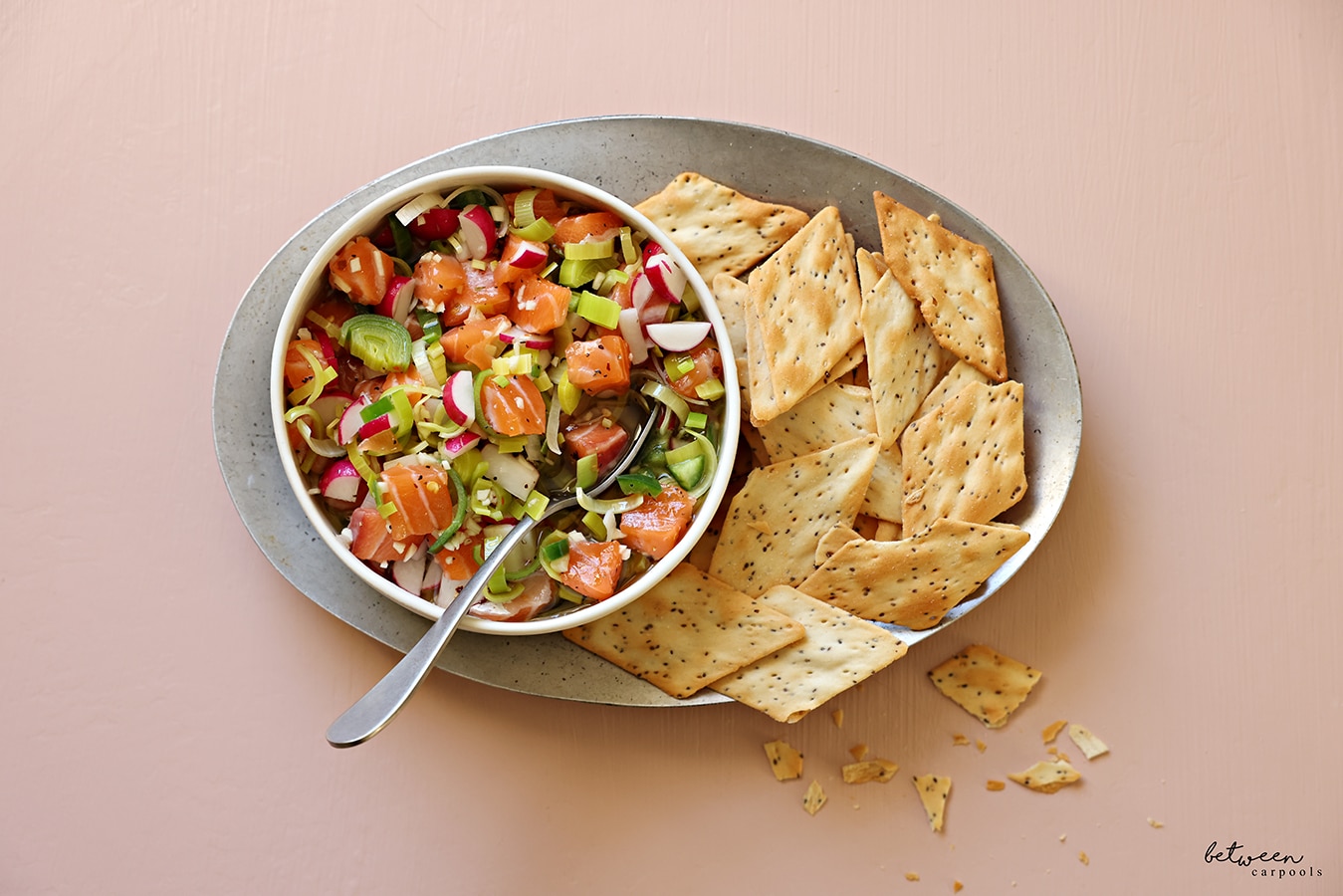 Between Carpools
You don’t need to be a crudo lover to absolutely fall for this salmon. If you are, chances are you already love this Salmon Crudo that’s been such a long time favorite on Between Carpools, it even made it into the original Dinner Done. You may have also tried this Tuna Carpaccio and you can read the inspiration behind it here.
But even if you haven’t been brave enough to try one of our other “raw” fish recipes, this one is different.
This recipe comes from my sister-in-law Chumie and I’ve already given out the recipe to so many and they love it. One of those people who I shared the recipe with was Ruchmy Schwartz, who told me that it must go on Between Carpools.
Somehow, in this recipe, the curing process makes this salmon more of a “herring” (without the smell and the onion thing going on) experience and less of an eating-raw-fish-experience.
The best part?
It all gets prepared in advance and sits well in the refrigerator.
It’s the perfect Shabbos solution.
The quality of the fish is very important! Choosing the right salmon will make-or-break the fish.
Be sure you are using sushi grade salmon that can be eaten raw.
Start by seasoning the fish with the salt and sugar.
You can also do this entirely within the Ziploc bag, just make sure to toss it around to coat evenly. Otherwise, simply transfer the fish to the Ziploc and refrigerate overnight to cure.
The next day, simply rinse it off under cold water and dry well with paper towels.
Your fish is now cured!
Dice it into small pieces.
Dice the rest of the ingredients if you haven’t already.
I also add a red onion sometimes, but we didn’t here.
When it comes to seasoning it, start with just a ½ tsp of salt and taste. Only add more if you feel it needs it.
Finally, add the oil and mix to coat.
Transfer the fish to a container and refrigerate until ready to serve.
Serve with crackers or sourdough bread or challah. This will last a full week in the refrigerator, so if you make it on Friday, you can have it for two Shabboses!
Place the salmon in a Ziploc bag with the salt and the sugar. Toss it around to coat and refrigerate overnight to cure.
The next day, remove from the refrigerator, rinse off the salt and sugar under cold running water and dry the fish in paper towels.
Dice the fish into small pieces. Add to a mixing bowl along with the radishes, jalapeno, leek, garlic, and spices. Start with ½ teaspoon salt and taste to see if you want more. Cover with the oil and mix. Transfer the fish to a container and refrigerate until ready to serve.
Serve with crackers or sourdough bread or challah.
The post Cured Salmon appeared first on Between Carpools.
 Between Carpools
While we might not understand what makes certain trends come and go, what moms do like are new ideas for projects and activities that keep kids entertained and busy.
There’s lots of ideas here on Between Carpools if you want to bring out some fresh projects over Midwinter Break or any winter Sunday. Or, check out our Crafts That Save the Day post for a big list of tried-and-true all inclusive projects.
Bedazzling is a new kids’ favorite activity! It’s great for fine motor skills and is simple in that it only involves using a special glue to affix rhinestones to just about anything.
Sure, kids can simply bedazzle things that you find around the house, but for a special occasion (vacation time or perhaps a birthday party), if you’d like to make it a more formal project, you can choose a new item to bedazzle.
Here are some ideas.
The post What to BeDazzle Now appeared first on Between Carpools.
 Between Carpools
Antibiotics have saved countless children’s lives. I prescribe them often and gratefully when they’re truly needed. But they’re not a magic cure-all. And as frustrating as that can feel when you’re dealing with a miserable, coughing child at bedtime, that reality is actually very good news for your child’s long-term health.
Not long ago, one of my own kids woke up coughing at 2 a.m. You know the kind—the barky, dramatic cough that sounds ten times worse in the dark. By morning, there was a runny nose, low-grade fever, and lots of whining. I did what every parent does: I ran through the mental checklist. Does this need antibiotics? Should I call? What if it turns into something worse?
And then I reminded myself of what I tell parents every single day.
Most childhood illnesses don’t need antibiotics, and giving them “just in case” doesn’t help kids get better faster.
What Antibiotics Actually Do (and Don’t Do)
Antibiotics are designed to kill bacteria. They do nothing against viruses.
That matters because most of what otherwise healthy kids get (think colds, coughs, sore throats, runny noses, flu, RSV, and many ear infections) are caused by viruses. In those cases, antibiotics won’t shorten the illness or make symptoms improve. What they can do is cause side effects like diarrhea, rashes, or yeast infections, which is the last thing a sick kid (or parent) needs. Frequent antibiotics also mess with our gut flora which has lots of negative health consequences.
So when your pediatrician says, “I don’t think an antibiotic will help right now,” what they’re really saying is:
The Problem With “Just in Case”
Every unnecessary antibiotic dose teaches bacteria how to get smarter and tougher. Over time, that leads to antibiotic resistance meaning that when a child truly does need antibiotics, the options may be fewer or less effective.
On a very practical level, overuse can also mean:
For things like mild ear infections, lingering coughs, or uncomplicated colds, watchful waiting is often the safest and healthiest option. Kids’ immune systems are remarkably capable, even when the symptoms look dramatic.
Modern pediatric guidelines actually encourage using antibiotics only when clearly indicated, and for the shortest effective course. The goal is to help kids recover while minimizing unnecessary risk.
If your child is sick, helpful questions to ask your pediatrician include:
And then focus on the basics that truly help:
I know how hard it is to hear “no antibiotic” when your child feels awful and you just want a fix.
But often, that answer means your pediatrician is doing exactly what you want them to do: protecting your child today and preserving lifesaving medicines for the future.
It’s never wrong to have a sick child evaluated. Not everything is viral, and antibiotics absolutely have an important role when they’re needed. Your pediatrician is a trusted partner in helping sort out what’s going on, what your child needs right now, and what can safely be watched at home.
Sometimes the most valuable part of a visit isn’t a prescription, it’s clarity, reassurance, and a plan!
* A school nurse takes you behind the scenes to learn how to read your child’s symptoms…especially on a school day. When Should You Keep Your Kids Home from School?
The post Antibiotics Aren’t Always the Answer and That’s a Good Thing appeared first on Between Carpools.
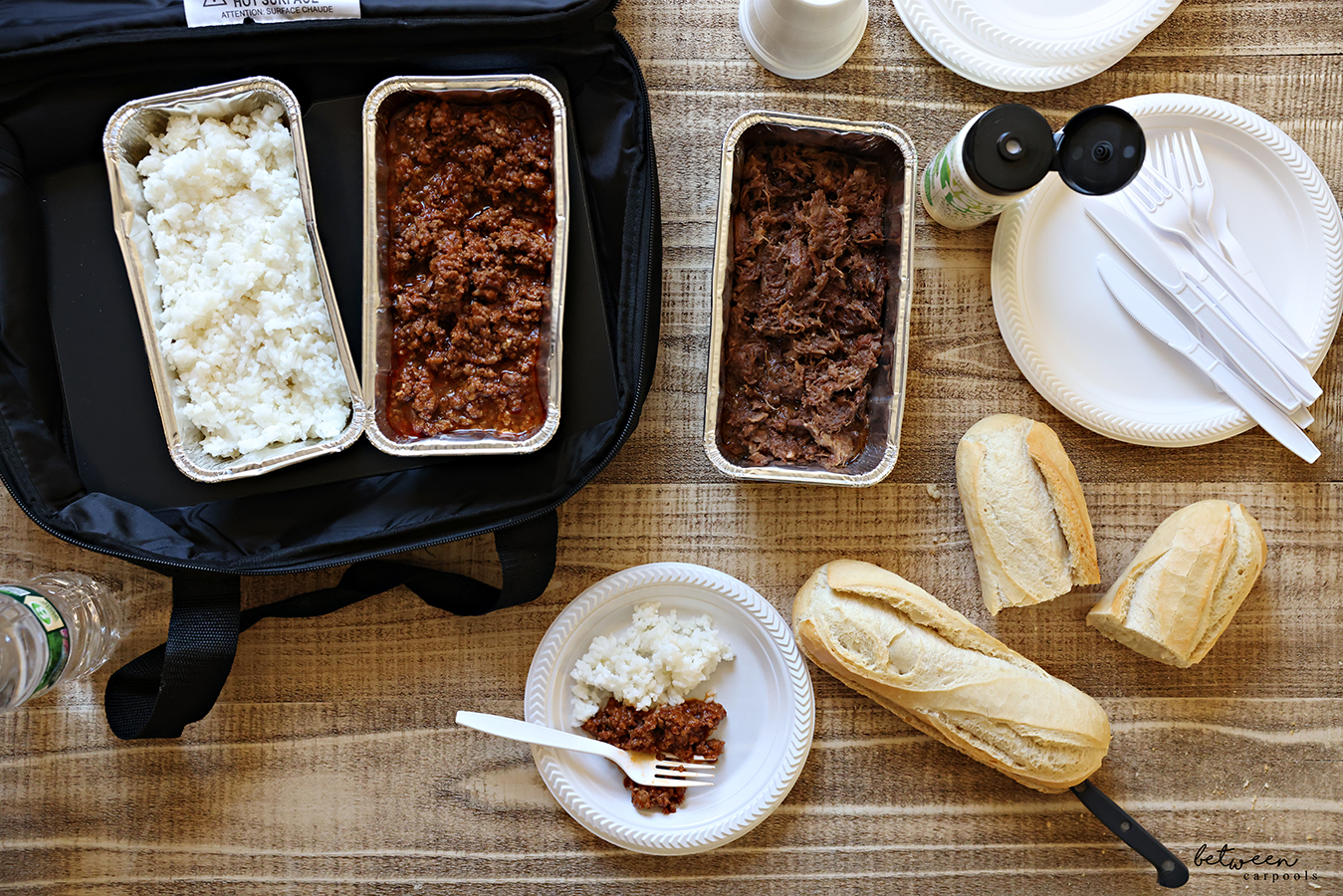 Between Carpools
This past summer, Shiffy Drew mentioned that she was heading on a family trip—and packing a Hot Logic.
A hot what?
Hot Logic is a portable electric food warmer that slowly heats meals over time, keeping food warm and ready to eat without drying it out or overcooking it.
Years ago, we introduced you to one of our favorite travel appliances, the Betty Crocker. While we still love it, the Hot Logic has truly been a game-changer for us.
It lets you heat up food you’ve already prepared at home.
Just place the meal inside.
Then zip it up and plug it in! Come back hours later to a warm, delicious meal—no babysitting required.
Heading out for a day of snow tubing or skiing? Warm up shredded beef, add some baguettes and condiments, and everyone will be nourished, cozy, and happy.
The key difference to know:
The Hot Logic is best for foods that don’t need to be crispy. It gently warms rather than bakes or fries.
It’s perfect for:
Beef chili
Stews and soups
Chicken dishes
Rice
Pasta
Mashed potatoes
Shredded beef
Just keep in mind:
If you’re heating breaded chicken cutlets, they’ll be warm—but not crispy. As a rule of thumb, if it’s something you’d normally reheat covered in the oven, it will work beautifully in the Hot Logic.
What’s the capacity of a Hot Logic?
Capacity:
Half a 9×13 pan plus a loaf pan
Three loaf pans
Easy, reliable, and perfect for travel—Hot Logic has earned a permanent spot in our packing list.
Note there are smaller sizes of Hot Logic available. We ‘ve linked the 9×13 size for travel with families.
The post Would You Love to Have Hot Food on a Family Trip? appeared first on Between Carpools.
 Between Carpools
These maternity clothes options are comfortable, flattering, and affordable. While some of the clothing picks are actual maternity, others aren’t but still work well as maternity. Please bear in mind that everybody carries differently so different things will work for different people in every stage.
My go-to is a more straight cut skirt with an oversized top so here are a bunch of options and the combinations can be endless. For the skirt I like something that’s straight but not too straight so that it’s still comfy to walk in.
The post 30 Great Maternity Clothing Picks appeared first on Between Carpools.
 Between Carpools
Simchaseinu was built on a simple but powerful truth: high school teachers know their girls. They remember their strengths, their middos, and the context behind who they are. And that perspective is invaluable in the shidduch process!
Based in Lakewood, Simchaseinu works hand-in-hand with teachers from local high schools (and they’re expanding!), giving them the tools and support to redt shidduchim for their former students—not as ‘professional’ shadchanim, but as a teacher who loves her student and wants the best for her!
What does the Simchaseinu process look like?
The Simchaseinu results are undeniable!
506 girls set up.
126 engagements.
103 teachers involved.
And over $100,000 given directly to teachers!
But this isn’t only about numbers.
It’s about our girls (and their families!) knowing they’re not on their own.
It’s about teachers using their insight and influence to advocate quietly but powerfully.
Teachers want to help.
They already are helping.
Simchaseinu gives them the structure and chizuk to keep going.
As one teacher shared, ‘I didn’t think this would make a difference—I was already so involved. But Simchaseinu’s chizuk gave me the strength to keep trying.’ Another said that after hours of effort that didn’t work out, the support she received gave her the chiyus to start again.
Simchaseinu is creating a community where teachers take care—and girls know they matter.
Learn more and get involved at www.simchaseinu.org.
The post When Teachers Redt Shidduchim, Everyone Wins. appeared first on Between Carpools.
 Between Carpools
You picture a warm Shabbos table – candles glowing, zemiros and divrei Torah filling the room, everyone laughing and talking together.
Instead, it sometimes feels more like a battlefield: siblings bickering, kids disappearing the second the food is served, parents feeling deflated that what should be bonding time turns into tension.
Shabbos is supposed to be the heartbeat of the Jewish home – it is central to all that we hold dear in our religion and family life. But the gap between what we dream of and what actually happens can feel so painful.
Take Shani, for example.
She’s a devoted mother who loves Shabbos. She poured herself into the preparations. She spends hours cooking, setting a beautiful table, making sure every detail was just right. But by Friday afternoon, she was frazzled and worn thin. Her kids weren’t helping as much as she wanted, so her words came out sharp and clipped.
Instead of anticipating Shabbos with joy, her children began to dread it. To them, Shabbos meant tension, orders, and conflict.
Shani was heartbroken. What was most precious to her – Shabbos itself – was the very thing pushing her children away. She admitted she had been hoping it would get better on its own, but it only got worse. The hardest part? Knowing those negative feelings were sinking into her children’s hearts, shaping their view of Shabbos in ways they wouldn’t even realize, and might carry with them for years.
That realization was heavy.
But there was hope.
Together, we began working on small shifts, we discussed ways to invite her teens into Shabbos instead of pushing them. It didn’t transform things overnight, but slowly the atmosphere began to soften.
Here’s one strategy that helped Shani take the first step:
1. Shift from pressure to appreciation.
Instead of focusing on what her kids weren’t doing, she noticed the little things they did. “Thanks for sweeping the floor, I feel calmer when my surroundings are neat and clean.” At the table, she pointed out their contributions: “I love how you got us laughing,” or “That was such an interesting point you raised.” It seemed simple, but it changed everything. Her kids felt seen, the tension eased, and the table slowly became lighter, warmer, more inviting.
2. Pause and breathe before reacting.
Tension often escalates because parents respond in the moment, snapping, correcting, or lecturing without a pause. Taking even a few seconds to breathe, collect thoughts, or silently choose words makes a huge difference. When children see their parents staying composed in stressful moments, it teaches them how to regulate their own emotions and helps the Shabbos table remain a space of calm and connection.
3. Plan ahead and rotate responsibility.
Make Shabbos more engaging by giving each child a turn to contribute. One week they might come up with a game, the next a story, a song, or another fun activity for the whole family. This builds excitement, pride, and anticipation, lightens the load for parents, and naturally fosters laughter, connection, and shared memories.
Because Shabbos doesn’t have to be perfect to be powerful. What matters is the atmosphere we create, the warmth, belonging, the connection. Those are the memories our children will carry long after the candles are out, and the dishes are cleared.
The post Turning Shabbos Tension into Connection appeared first on Between Carpools.
 Between Carpools
Updated for 2026
When it comes to other cold-weather sports, there’s tons and tons of special clothing and gear that’s needed just to get going. Hockey gear practically needs its own room in the house. Now, what about ski gear? Even though most of the gear is rented at the mountain (including ski boots, skis, poles, and a helmet), there’s still a big list of clothing that’s needed when skiing to stay warm and safe. If you don’t know where to begin, here’s the complete list.
It really pays to get the right items. Although special clothing can add up, skiing isn’t a cheap sport, and if you don’t feel comfortable because you skipped one item from the list below and your face or hands are cold, then your whole day could be a waste (or you might end up spending much more to buy the item at the ski lodge’s shop!).
Note that I mostly included links that are relevant for boys and men, although similar items would be available for any member of the family.
Tops and Bottoms
1. Thermal Base Layer
This is the first thing that should go on, under all your clothing. Even though we call this layer “Hot Chillys” in my house, you really don’t need the brand name version to be warm. Here’s a great option for affordable thermal base layers for boys (they’re also available in 2-packs). Here’s the same thing for men. Also available for women and girls.
2. Standard Athletic Pants
Any type that he already has in his closet is fine. These will be worn over the base layer.
3. Snow Ski Pants
For the next layer, you’ll need ski pants to stay warm and dry. These pants are a comfortable option kids will really like. Read reviews to be able to best determine which size will work for your child, but leave yourself time to buy and exchange in case pants don’t fit. For teens/men, we have been going with these pants and find that they’re a great pick and value.
4. Long-Sleeved Cotton T-Shirt
Also worn over the base layer.
5. Warm Fleece Sweatshirt
6. Your Coat!
If you’re not skiing often, then you’re probably not buying a special “ski coat” and your warm puffer or parka will do. Coats that are made for skiing are actually thin while being really warm. The brand Wantdo has well-priced options for the whole family. This is an excellent pick for kids (there’s two layers and he can wear one or both, so it’s suits a wide range of temperatures). Phibee has more stylish options for kids. Here is a great basic one.
For Your Feet
7. Boots
Be prepared with a good quality snow boot. Although your foot will be in an actual ski boot when you’re skiing, if your foot gets wet when you’re walking around outdoors in the snow, it can ruin the day. Sorel boots are a great choice if you’ll be spending lots of time in the snow, and view our post with a selection of winter boots here.
8. Ski Socks
I ordered these socks and also these last year and the kids loved them so much, they wanted to keep wearing them after the ski trip was done! Ski socks are so super cozy and they help keep the foot warm. You’ll need two pairs per person (per ski day) so there’s a backup available in case one pair does get wet.
On Your Head and Hands
9. Ski Mask or Hat
The head needs a lot of protection while skiing, and that starts with the ski mask. Here’s one for kids and for grownups. Your ski mask will also cover the “hat” category. The hat that’s attached to the mask is thin enough to fit under a ski helmet.
10. Ski Goggles
Another must-have for the head. We have a bunch of these, which fit a range of sizes.
11. Glove Liners
Yes, you need two layers of gloves! Glove liners like these are a thin glove which are the base layer for your hands.
12. Gloves
Don’t just take any winter gloves from your closet. They need to be special for skiing. Your hands will get wet when you’re skiing, and if your gloves don’t resist the wet and cold, you’ll just be miserable. For value picks, these gloves are the most popular for boys and these gloves are highly rated for adults. Gloves, like boots, however, is something that’s worth investing in as when the extremities get cold or wet, your ski day is over. Hestra is the most reliable and recommended brand of gloves if you’re looking for the best. These are excellent for kids and these for adults.
13. Finally, this isn’t an article of clothing but you’ll love having Little Hotties around!
How to Prepare for Your Snow Tubing Trip
The post Going Skiing? Here’s the Complete What-to-Wear Checklist appeared first on Between Carpools.
Between CarpoolsLet’s talk about the mammo.
If you’ve never had one, you’d think—based on the stories—that it’s a medieval contraption dreamed up by someone who definitely never had to use it. And honestly? It kind of is. The machine is real, the angles are questionable, and it has earned a scary reputation.
Here’s the big-sister truth: it’s really not that bad.
Full disclosure—I pushed mine off for a year and a half because I was a total scaredy cat. I built it up in my head, convinced it would be awful. And now, having actually done it, I can say with confidence: it was completely manageable. Before I walk you through what to expect, I need to say thank you to my real-life big sister who prepped me for this—and so many other life milestones. Every woman deserves a Brenda, I’m here to pass on her advice.
Most women begin mammograms around 40 if they’re not pregnant or nursing. But for many of us—especially Ashkenazi Jewish women—family history or carrying the BRCA gene can change that timeline. That’s why being open with your OB and following your doctor’s guidance matters so much.
So let’s take the mystery out of it. Here’s exactly what it’s going to be like:
What to Expect (and how to make it easier)
1. Skip perfume and deodorant that day.
Anything scented or powdery can interfere with the images, so go fragrance-free.
2. Wear something easy.
You’ll be undressing from the waist up, so a dress or jumper is not ideal. A comfy zip-up or button-down makes things much simpler.
3. The setup is the longest part.
You’ll stand at the machine while the technician carefully positions your body. Think dental X-rays—the prep is actually more uncomfortable than the imaging itself.
4. Expect a little awkward posing.
Your hips and head might be angled in a way that feels like you’re about to wake up with a stiff neck, but it’s quick and almost painless.
5. Yes, it’s basically a panini press.
Once everything’s in place, you will feel very flat for a few seconds. That’s the most uncomfortable part. Totally manageable. If it makes you feel better, you can take two Advil about an hour beforehand, but I’ve done it without and was just fine.
Here’s the bottom line: knowledge is empowering. The fear usually comes from not knowing what to expect, and once you do, it feels a lot less daunting. I hope this helps take some of the stress out of your first mammogram and encourages you to book the appointment you may have been putting off.
You’ve got this. And if you’re scared? That’s okay too—channel it into praying for clear results
The Jewish Breast & Ovarian Cancer Community
Sharsheret’s Mission: Support, Education, Information
* Read our very first Big Sister post The 6 Products Only a Big Sister Will Tell You About followed by this Teen Edition.
The post Big Sister Talk: Your First Mammogram Isn’t That Bad appeared first on Between Carpools.
 Between Carpools
Dyeing your roots at home is super quick, cheap, and easy! There’s no need to run to the salon when a quick dye job at home solves the problem.
There are many different box dye brands to choose from, and most of them are quite similar in price (organic ones may be a bit more expensive). Most box dye kits include gloves, developer, colorant, and a conditioner.
We suggest wearing an old sweatshirt so you don’t get any dye on your clothes, as well as using an old towel after you wash your hair as dye sometimes stays on your head.
Once you choose a dye color, you mix the two bottles (developer and colorant) and apply it to your roots as directed, washing off with the conditioner enclosed. Some kits come with a brush and some come with an applicator tip to apply the dye, making it easy to do yourself.
And that’s it!
Some Tips:
* Some brands don’t come with re-usable covers, so you have to use the full amount at once. Look for brands that do. If you just need to dye a small area, you use a small amount and the bottle will last for a few months.
* If the box doesn’t come with a brush, a new toothbrush designated for this purpose makes a GREAT brush to brush on the dye for small areas like the temples. It helps gets to all hairs.
* The smell can be strong. The ammonia-free dyes are much more tolerable and healthier.
* Put it on 15 minutes before you shower and then just rinse off inside the shower using a direct/removable shower head if you have. There’s really no mess if you do it right before showering.
* Use an oil-based makeup remover to remove any excess that remains stuck on the skin and it’ll come off easily.
The post You Can Dye Your Hair Yourself appeared first on Between Carpools.
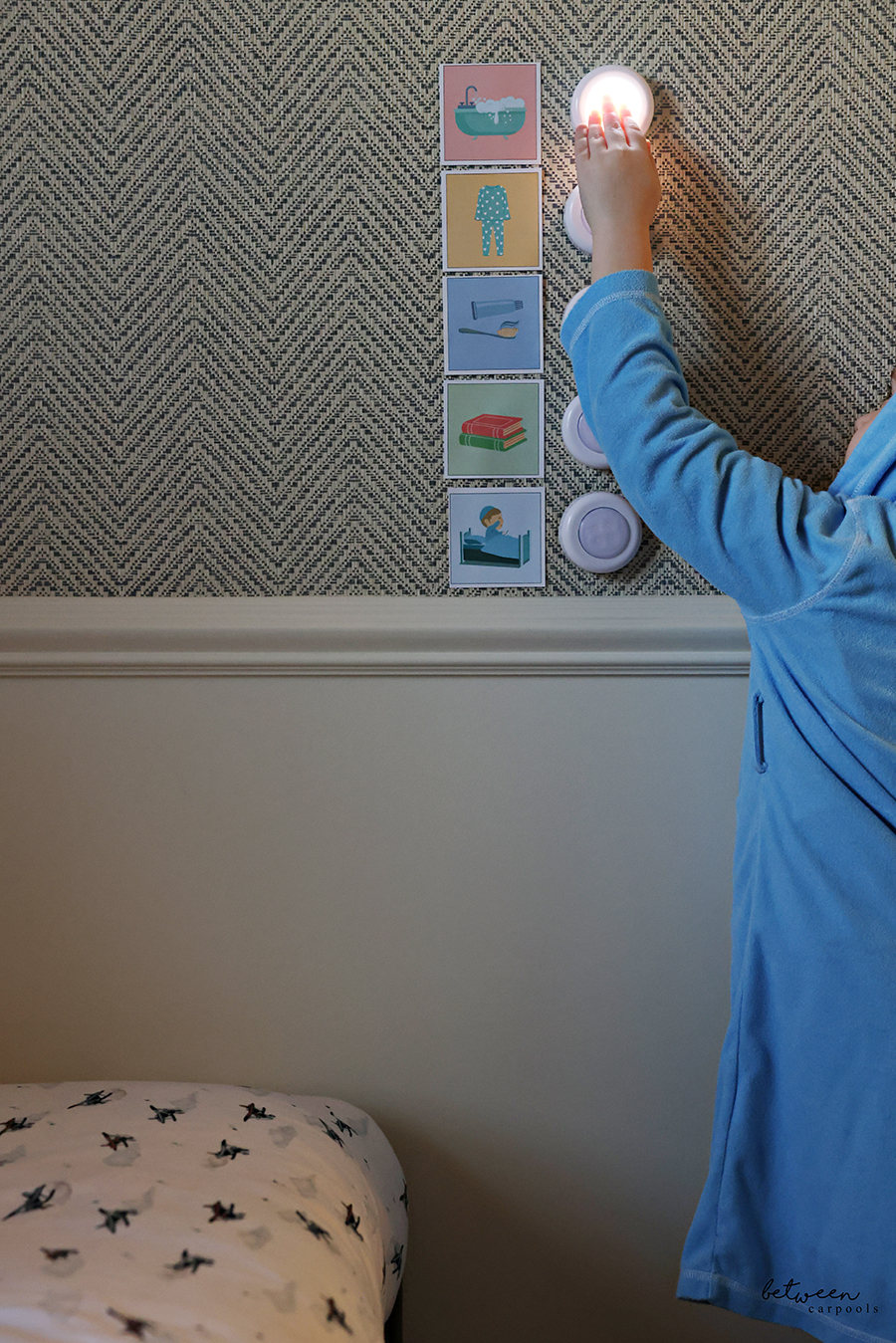 Between Carpools
Even your toddlers can get accustomed to routines and getting things done with this fun incentive.
It makes it fun to cross things off the list, and it’s easy for them to understand. This is perfect for your two-year-olds all the way up to the five year olds who can’t quite read yet.
Your toddler (especially those little ones in the “I can do it myself stage”) will love being able to understand what they need to do on their own. They love feeling independent, and the pictures make it possible!
Once they finish a task, they bop a light to turn it on. That makes it extra fun.
Whether you want to use this chore chart to get ready for school or get to bed, it’s customizable to fit your needs.
You can either download, print and cut out the images you see here. Or, another idea: Take a photo of your own child doing the tasks.
Use painter’s tape to affix the pictures or photos to the wall. Then, place the Tap Lights next to them. (Note that you will need Triple A batteries.) The Tap Lights include adhesive on the back so they’re easy to stick on and easy to remove.
Now that it’s set up, they’ll be so excited to get tapping!
If you want to make it even more exciting, this set of 6 lights has different color options, plus you can set them to turn off after 30 or 60 minutes.
While it’s more fun to turn on the light, an alternative way to do it is to turn on all the lights, and tap them closed as each one is accomplished. When the lights are all closed, it’s time to go to bed!
Download the pictures here, print, and let your kids get tapping as they go off to bed!
The post This Light Up Chore Chart Is Perfect for the Littlest Kids appeared first on Between Carpools.
 Between Carpools
Ponytails are effortless, flattering, and somehow work for everything. Quick errands. Carpool runs. And yes, they are the look for weddings and simchas too!
There’s just something about a pony wig that’s essential. Every woman would love to have at least one in her wig rotation.
That’s what will lead you to the Wunderwig Dream.
Wunderwig Dream may be exactly what you were looking for.
The very first thing you’ll notice is how unbelievably light it feels. Truly light. Dream-light. This is the kind of hair you put on in the morning and forget you’re even wearing. No heaviness or pressure, no counting the minutes until you can take it off. You can wear the Dream all day without that end-of-day headache.
Then comes the real game-changer.
Dream is designed to be worn as a high, medium, or low pony – comfortably. That’s not something you get with most pony wigs. Wunderwig is the only wig company that structures their wigs so ponytails actually work at every height: no pulling, no tension, no awkward fit, and no sacrificing coverage. Just a secure, flattering pony that looks as good as it feels, however you choose to wear it.
And it can be worn down, too, if the day calls for it.
Let’s be honest: who doesn’t want a cute, bouncy pony that stays comfortable all day? Winter comfort or summer heat, you’ll be happy you have your Dream to put on.
And of course, the details matter. The Dream comes with a sleek, branded travel case that’s practical for traveling and easy to toss into your suitcase when traveling, so your pony is always protected and ready on the go. And there’s even more: every wig comes with complimentary matching hair scrunchie that creates the perfect messy bun, zero effort involved.
This isn’t just a pony wig.
It’s the pony wig and the one you’ll reach for again and again. The kind of pony that fits right into real days.
The Dream is sold worldwide at local stylists. For more info you can reach out directly to the headquarters at 514.397.9283, or email them at [email protected], also on instagram at instagram.com/wunderwig.
The post The Ponytail Wig That You’ll Live In appeared first on Between Carpools.
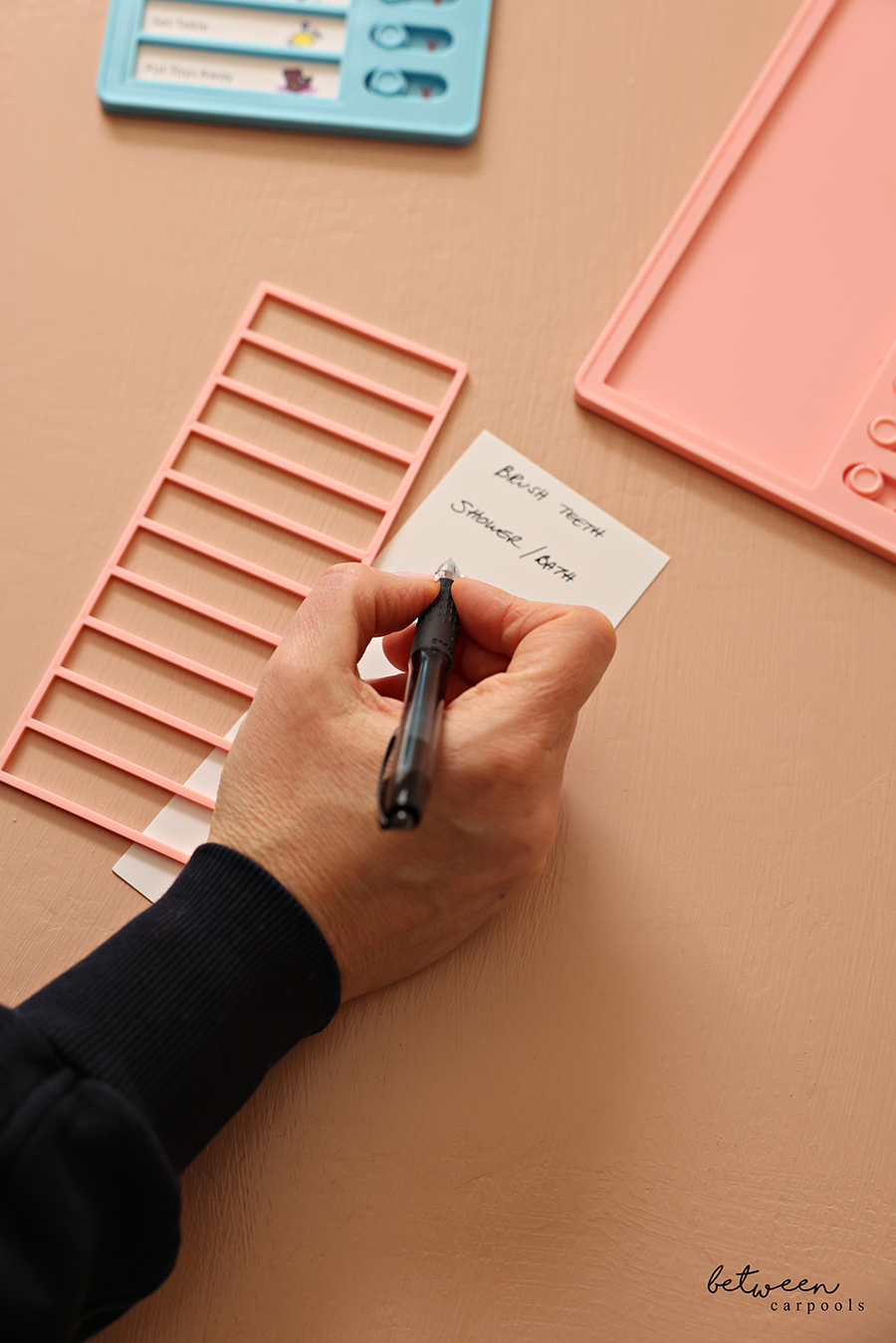 Between Carpools
This great little chore chart really helps one BCP Reader’s family finish their chores after supper.
Because the frames have inserts that can be filled out how you wish, they are completely customizable.
Note that these chore charts are not particularly sturdy or long lasting, but they will do the job of kickstarting a nice routine for a month or so. There are pricier options that may be better quality (more versions are shown below), but it may be smart to test out the concept with the lower-priced option to see if it works in your house first.
This is how she works it:
Starting from Sunday at suppertime, she sits with her kids and fills out a board for each of them. The top slot of each chart gets the name, for example “Sara Sunday” or “Eli Sunday.” Then, she filled in the slots with chores and prep for bed. So it would look like this:
-Eli Sunday
-Clear your place
-Sweep kitchen floor
-Finish HW
-Prepare briefcase
-Take a shower
-Laundry in the hamper
-Bring down hampers to the laundry room
-Brush, Floss
-Prepare clothing
Mixed into his bedtime routine are two jobs (sweep kitchen, bring down hampers). His sister will have 2 other jobs (give toddler a bath, put all shoes on the mat) and the other bedtime items might be in a different order to avoid having everyone brushing at the same time (though she does allow them to go out of order if they prefer, they generally don’t).
She doesn’t have every kid taking a bath/shower every night in the winter, and only includes it on the card for the nights that they do. No need to remind them or argue about it anymore.
On Monday night, she does the same thing, writing each kid a card labeled “Sara Monday,” etc.
She looks around each night to see what needs to be done, and divided up some of those chores among her kids (night after laundry day will include putting out laundry, night before laundry day will include bringing down hampers, Thursday night includes more Shabbos prep, etc)
Because she didn’t write all the cards in advance, it wasn’t overwhelming, and the cards are very on-point with what actually needs to get done.
After one week of doing this each night, she had a complete set of cards set on auto-repeat. Now, she justs put the correct card in the frames, and while she does the younger bedtimes, the older kids do their thing.
This can incentivize as needed on a family or individual level!
The post This Chore Chart Helps Chores Get Done! appeared first on Between Carpools.
 Between Carpools
Mazal tov!
Are you bringing your baby home from the NICU? Or your baby with a specific medical need, like reflux or colic, etc?
Double mazal tov!
Are you bringing home a brand-new set of twins?
If you live in the 5 boroughs (Manhattan, Brooklyn, Queens, Nassau County, Staten Island, or the Bronx), and you’re welcoming home a single baby with a medical need (or who was in the NICU) or twins, you may be eligible for a home health aide, for up to 24 hours a day, for free.
Yup, absolutely free. And whether it’s twins or a baby that requires special accommodations due to even a small medical need, we’re sure you could use the extra hands!
Are you eligible for a free certified home health aide?
If you’re eligible for medicaid, you’re going to be eligible for this too. And if you’re not sure, you can reach out to Aaron at (646) 653-3161 or by email at [email protected] to see what you can qualify for in this medicaid-funded program.
Anchor Health Homecare has serviced thousands of clients over the past several years. Aaron will help you through the process: ask the important questions, gather the documentation necessary, connect you with an evaluating nurse, and set you up with the assistance you need! He’s helped hundreds of pediatric clients and families over the past 6+ years, connecting them with the support they’re eligible for.
If you live in the five boroughs and brought home/are bringing home a baby with reflux, colic, or recovering from a NICU stay, or twins, find out what you qualify for! Reach Aaron at Anchor Health at (646) 653-3161, or by email at [email protected].
The post Bringing Home A Baby With Medical Needs? Twins? Anchor Health Can Help! appeared first on Between Carpools.
Between CarpoolsDo you need to choose a dinner based on the time you have available? This handy Table of Contents, organized by your time crunches, will help you get dinner ready when you need it.
We want to say thank you to all of you for the tremendous support and feedback. We’re humbled and gratified that you’ve been loving Dinner Done 2! So, we thought, what can we give our readers who have been so gracious with their messages, reviews, and feedback?
We had this idea to create a Dinner Done 2 “Time Crunch” Table of Contents.
You’ll be out all day and need to do all or most of your prep the night before.
Or, you’re stopping home midday for a few minutes, and need to get dinner in the oven and then leave…and come home to dinner.
Or, you need to have a complete dinner ready in less than 30 minutes.
Or, you have an hour!
Whatever your time crunch, this “Time Crunch Table of Contents,” where recipes are listed by the time that’s needed, will help solve those cooking challenges that relate to time.
And it’s a FREE GIFT for all of you who have written a review on Amazon! We want to say thank you! Note that it is permitted to write reviews even when you bought your book at a store.
Simply leave a review here, and then download this Free Guide!
Thank you and we hope you continue to enjoy!
The post Download the Dinner Done 2 ‘Time Crunch’ Contents! appeared first on Between Carpools.
Between CarpoolsIf we deem a product worthy of being featured in a post, you know we love it. It means it’s tried and true and we hope it’ll be a great solution for you too.
Because we put a lot of thought into the products we recommend, when we see that you’re enjoying them too, we feel great!
While many items on this list are favorites year after year, it’s also fun to see which newcomers make it up here! These are the top items you loved in the past year.
See the most popular items of past years:
Top 20 Products BCP Readers Loved in 2024
Top 30 Products BCP Readers Loved in 2023
Top 22 Product BCP Readers Loved in 2022
Top 20 Products of 2021
The post The Top 25 Products BCP Readers Loved in 2025 appeared first on Between Carpools.
Between CarpoolsWhich posts get the most traffic on Between Carpools? It’s our recipes, of course. You click on them again and again whenever you want to make your favorites. We feature the Top Recipes of the Year separately and you can view them in this post.
After that, the posts that get the most traffic are the shopping posts. That includes those seasonal shopping posts or the ones that you rely on year after year (and they’re always updated), like the Ultimate Backpack Roundup to our Mishloach Manos Containers.
Those are the ones that don’t surprise us.
But then there’s the new posts, and it’s always interesting to see which resonate most with you! Let’s see what they were for 2025!
The post The Top 15 Most Visited Posts of 2025 appeared first on Between Carpools.
Between CarpoolsWhich are the top Between Carpools that you might have missed?
On this list are not only our newest recipes–it’s simply the recipes that get the most views over the course of the year.
It’s the new, popular recipes– plus the old favorites that you keep going back to, again and again! When a recipe makes the list for consecutive years in a row, we know it’s a bonafide favorite.
See the top 20 most clicked and most cooked recipes of 2025 right here.
For Past Top Recipes
Top Recipes of 2024
Top Recipes of 2023
Top Recipes of 2022
Top recipes of 2021
The post The Top Between Carpools Recipes of 2025 appeared first on Between Carpools.
 Between Carpools
If you plan to visit a kever and want to understand what’s appropriate when visiting a cemetery, here’s a guide that breaks it all down simply and clearly.
How Do I Daven at a Grave?
Tefillos should always be directed to Hashem. You’re not speaking to the person buried there. You can, however, daven that your tefillos be accepted in their merit. Some do allow asking the niftar to intercede on your behalf, but even then, your requests are to Hashem, not to the niftar.
Proper Conduct
Respect and reverence must be maintained when visiting a cemetery. One should not eat or drink while there.
Be careful not to step on graves, or lean or sit on gravestones. If the cemetery is crowded and it’s impossible to avoid, it’s permitted to walk over graves when passing through, to reach another grave.
The Halachah of Lo’eg Larash (Not Mocking the Dead)
Halachah teaches that one should avoid performing mitzvos right next to a grave, so as not to “mock” the niftarim who can no longer do mitzvos themselves. For example, one should tuck in their tzitzis when walking through a cemetery. Learning Mishnayos, saying Tehillim or davening is allowed as it is for the benefit of the niftar.
Some Common Customs:
One should not read the inscription on a tombstone, as it is said to cause forgetfulness in Torah learning. This concern mainly applies when the letters are raised above the surface of the stone. If the letters are engraved into the stone, many poskim permit reading them. The accepted opinion is that this applies specifically to men, and not to women.
Some have the minhag to light a candle at the kever when visiting the cemetery.
There are different minhagim when it comes to which perakim of Tehillim are said. Some of the most commonly recited ones are 16, 17, 23, 91, 121, and 130. Another minhag is to say the pesukim in Perek 119 that spell out the niftar’s name, along with the letters that spell neshamah (נשמה).
Some have a minhag to circle the grave.
Some have the custom of placing a small stone or some grass on the matzeivah. This is a sign of respect to show that you visited. Some have the custom to pick up a bit of earth or grass, toss it over their shoulder, and say “זכור כי עפר אנחנו”. It is not our minhag to place flowers at a grave.
Before leaving the grave, many place their left hand on the grave and say specific pesukim. Some also kiss the matzeivah.
As per the tzava’ah Rav Yehudah Hachassid, we do not visit the same kever twice in one day.
After leaving the cemetery the custom is to wash the hands three times, alternating between the right and left hand,
When sharing a washing cup, don’t pass it. Put it down and let the next person pick it up.
After washing, the minhag is to pour out any leftover water and turn the cup upside down. Even if the cup is empty or someone is waiting to use it, many still turn it over.
Some have the minhag not to dry their hands afterward. If it’s cold or uncomfortable, you may dry them.
Who Should Refrain from Visiting Cemeteries
A man who is tamei keri should ideally go to the mikveh before entering a cemetery, unless he stays four amos (around six feet) away from the graves. Some say that one who is visiting the graves of tzaddikim, or the graves of his parents, does not need to worry about this. If mikveh isn’t possible, one can take a shower as long as nine kav pours over the body.
A woman who is tamei niddah should avoid entering a cemetery unless she stays at least four amos away from the graves. Many poskim allow her to visit during the shivah yemei neki’im. If necessary, for example if she wants to be there on a yahrtzeit, or it would be hard to return another time, she may go. This is also the basis for the practice in girls’ schools to allow all students to join trips to kivrei tzaddikim.
Some say that pregnant women should avoid entering a cemetery unless they keep four amos away from the graves. However, visiting kivrei tzaddikim is generally permitted (if she can avoid getting too close to other graves). Others write that there is no such concern at all, and a pregnant woman may visit a cemetery without any restrictions.
– You may want to read The Best Books for Dealing with Grief by Sarah Rivkah Kohn. The Founder & Director of Links & Shlomie’s Club, an organization serving children & teens who lost a parent.
The post Everything You Need to Know When Visiting a Cemetery appeared first on Between Carpools.