
Orthodox Jewish news website covering breaking news, Israel updates, and community events.
Orthodox Jewish news website covering breaking news, Israel updates, and community events.

 Yeshiva World News13 minutes ago
Western intelligence agencies have detected unusual military activity inside Iran in recent days, prompting heightened monitoring by Israeli and American security officials and consultations between Prime Minister Binyamin Netanyahu and President Donald Trump over the possibility of renewed military action against Tehran.
According to a report Thursday evening by Israel’s Channel 12 News, intelligence officials have identified unusual military movements by the Iranian regime, now led by Mojtaba Khamenei, amid mounting pressure on Tehran and concerns that hostilities with Israel and the United States could resume.
Netanyahu has personally briefed Trump on Israeli intelligence assessments and information gathered regarding the developments, the report said.
Despite the concerning activity, security officials in both countries currently assess that there is no immediate threat requiring urgent military action. Trump has also not made a decision to launch another major operation against Iran.
The latest intelligence follows reports earlier this week that Iran conducted a series of ballistic missile tests as part of efforts to rebuild its missile arsenal following damage sustained during the war.
Israeli defense officials reportedly assessed that Iran’s military rehabilitation remains partial and gradual and does not currently represent a change in the threat level sufficient to justify an immediate military operation.
However, the unusual activity has raised questions about whether Tehran is preparing for renewed confrontation, strengthening its defenses against a possible American or Israeli strike, or attempting to demonstrate military strength as diplomatic pressure intensifies.
U.S. CONSIDERS STRIKES ON NUCLEAR AND ENERGY FACILITIES
Meanwhile, the United States military continues developing operational plans for potential strikes against Iranian targets, including nuclear facilities and energy infrastructure.
According to a CNN report cited Thursday by Reuters, American military planners have examined the possible use of the GBU-43/B Massive Ordnance Air Blast bomb, commonly known as the “Mother of All Bombs,” against targets in Iran.
The enormous conventional weapon is among the most powerful non-nuclear bombs in the American arsenal.
The reported planning does not mean a decision has been made to deploy the weapon or launch an attack. Reuters said it could not independently verify the details of CNN’s report.
Earlier this week, Axios reported that Netanyahu and Trump discussed the possibility of a joint military operation against Iran before Israel’s October 27 elections and the American midterm elections in early November.
According to that report, Netanyahu expressed concern about Iranian efforts to rebuild its nuclear program and presented intelligence supporting those concerns.
American officials reportedly said Trump initially considered the possibility of military action but subsequently expressed reservations about launching strikes before the elections.
The White House denied that Netanyahu and Trump discussed restarting the war in the manner described by Axios, while the Prime Minister’s Office declined to comment on the contents of their conversations.
Netanyahu himself said Wednesday in an interview with Army Radio that he was not interested in initiating an attack against Iran before the elections.
However, he made clear that Israel would respond forcefully if Iran launched an attack.
IRAN PREPARES FOR POSSIBLE RENEWED WAR
Iranian officials have also been publicly discussing the possibility of another confrontation.
Iranian Parliament Speaker Mohammad Bagher Ghalibaf said in remarks broadcast on state television that Iran must strengthen its military readiness even as it continues pursuing diplomatic negotiations.
Recent reports have described additional defensive measures around strategic Iranian facilities and efforts to restore military capabilities damaged during the previous fighting.
Western intelligence agencies are examining whether these developments represent preparations for an offensive operation, defensive precautions against a possible American or Israeli strike, or an attempt to increase Tehran’s leverage in negotiations.
Israeli officials have reportedly emphasized that any future military operation would need to be considered within a broader strategy addressing the full range of threats posed by Iran, rather than focusing exclusively on a single component of its military or nuclear capabilities.
(YWN World Headquarters – NYC)
 Yeshiva World News18 minutes ago
Two cybersecurity research organizations have accused Israeli digital advertising company Discover-Tech of operating an extensive online surveillance network that used internet advertisements to identify and track users and, in some cases, assist in delivering spyware to targeted devices.
The findings were published Thursday by Canadian cybersecurity watchdog Citizen Lab and New York-based advertising security firm Confiant. Researchers said the operation reached more than 120,000 websites and 75,000 mobile applications through advertising networks.
According to the investigators, the advertisements often appeared to promote ordinary consumer products, including smartphones and headphones. However, simply loading the advertisements could expose identifying information about users and their devices, with some advertisements designed to assist in delivering surveillance software associated with the Israeli spyware company Candiru.
Citizen Lab said it identified spyware infections involving 45 Windows devices at the Qatari broadcaster Al Jazeera between 2024 and 2025. Google has removed Discover-Tech from its advertising platforms, while the industry organization IAB Europe suspended the company’s status. Discover-Tech and Candiru did not respond to requests for comment reported in the investigation.
(YWN World Headquarters – NYC)
 Yeshiva World News1 hour ago
Leo Terrell, the senior Justice Department official overseeing the Trump administration’s efforts to combat antisemitism, visited a Michigan shul as the administration expands its outreach to Jewish communities ahead of November’s midterm elections.
Terrell, who chairs the Justice Department’s Task Force to Combat Antisemitism, attended an event Wednesday at Congregation Shaarey Zedek in Southfield, a suburb of Detroit. The gathering was organized with the Michigan chapter of the Zionist Organization of America and several Jewish community organizations.
The Justice Department promoted the event as the opening stop of Terrell’s American Tour Against Hate. The gathering included a discussion with Zionist Organization of America president Morton Klein and was intended to address concerns about antisemitism and Jewish community safety.
The event also drew attention because registration materials offered paid sponsorship opportunities for the Zionist Organization of America while the gathering was promoted through a Justice Department website. The organization’s Michigan executive director, Kobi Erez, said the primary purpose was combating antisemitism rather than fundraising. The visit comes as Michigan prepares for a closely contested Senate race between Republican Mike Rogers and Democrat Abdul El-Sayed.
(YWN World Headquarters – NYC)
 Yeshiva World News2 hours ago
Khan could overtake Smith as the most common surname among babies born in England and Wales by 2027, according to a projection based on recent birth-registration trends.
The figures show that 4,120 babies born in 2025 were registered with the surname Smith, compared with 3,772 with the surname Khan, placing the names first and second, respectively.
Smith’s frequency among newborns has reportedly been declining by an average of 4% annually, while Khan’s has been increasing by approximately 1.9% a year. If those trends continue, Khan would move into first place in 2027.
Smith has historically been England’s most common surname, but its prevalence among newborns has fallen over the past three decades. Khan’s frequency has reportedly more than doubled in recent years.
The projected change concerns surnames registered at birth, rather than the most common surname across the entire population.
The findings come amid wider attention to changing naming patterns, including Muhammad’s rise in popularity among baby boys.
(YWN World Headquarters – NYC)
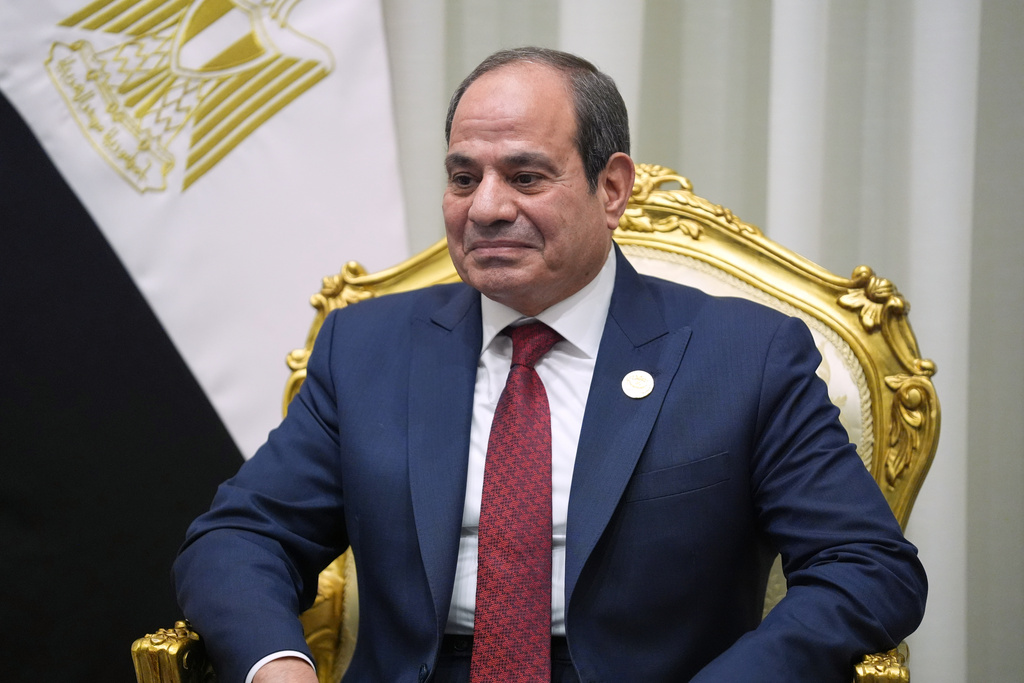 Yeshiva World News2 hours ago
Egyptian President Abdel Fattah el-Sisi said Wednesday that Cairo has no intention of launching a war against Israel, responding to Finance Minister Bezalel Smotrich’s warning that “if Egypt attacks us, there will be no Sinai.”
Speaking at an event marking 53 years since the Yom Kippur War, Sisi denied that Egypt harbors offensive intentions or territorial ambitions toward Israel.
“Who told you that we want to fight?” Sisi asked. “We have no ambitions toward anyone. Our land is in our hands. We fought to recover it, and that is over.”
The Egyptian president also rejected suggestions that Cairo has undisclosed plans, saying, “We have no secret agenda.”
Sisi sought to address Israeli concerns by questioning whether fears rooted in decades of conflict continued to shape perceptions of Egypt’s intentions.
“Are you still holding on to the fears of the past 60 years? Do you still think I have ambitions toward something you possess? No,” he said.
“I have only one ambition: to protect my country, its borders, and its land.”
(YWN World Headquarters – NYC)
 Yeshiva World News2 hours ago
Israel has heightened its readiness for a possible regional escalation, even as the prevailing assessment among Israeli officials is that neither Jerusalem nor Washington will initiate strikes against Iran before the upcoming Israeli and American elections.
With 12 days remaining before Israel’s Knesset election and less than three weeks before the U.S. midterms, officials believe Prime Minister Binyamin Netanyahu and President Donald Trump will seek to avoid the political risks of launching another military campaign.
Nevertheless, Israeli officials consider the possibility of renewed fighting significant, warning that an Iranian attack, action by Tehran’s proxies, or a miscalculation could overturn those expectations.
The possibility of striking Iran was discussed during Netanyahu’s conversation with Trump last week. Netanyahu reportedly fears that a military campaign in the remaining days before the election could damage Likud’s chances of remaining in power.
Israeli concerns include an attack by Iran or the Houthis in Yemen, potentially carried out through proxies or in a manner intended to obscure responsibility, that could trigger an Israeli response.
Officials are also preparing for a scenario in which each side mistakenly believes the other is about to attack and decides to strike first.
Israel has conveyed to Washington that an Iranian “mistake” would draw an exceptionally severe response, potentially unprecedented in scope despite the thousands of Iranian targets already struck during the war.
The security establishment is therefore maintaining heightened readiness for possible surprise attacks by Iran, Hezbollah, or the Houthis.
Israeli security officials said a decision to strike Iran would depend on Trump’s approval. People familiar with the matter claimed the president halted at least two proposed Israeli strikes over the summer that were based on Israeli intelligence indicating Tehran was rebuilding its nuclear program.
IDF Chief of Staff Lt. Gen. Eyal Zamir warned commanders during an assessment at Central Command that “in light of the numerous warnings across all fronts and the sensitivity of the period, the potential for escalation has increased.”
Zamir has also reportedly told senior American administration and military officials that an escalation with Iran could lead to the postponement of Israel’s elections.
Israeli Ambassador to the United Nations Danny Danon delivered a warning Thursday ahead of a Security Council discussion.
“Do not try to exploit Israel’s election period,” he told Iran and Hezbollah. “Anyone who dares attack us will suffer a devastating blow.”
Trump’s recent statements have reflected the uncertainty surrounding Washington’s next move. At a campaign rally in Alaska on Tuesday, he threatened another major strike against Iran, saying, “Wait and see what we do to Iran.”
Last week, however, Trump said he would not launch another attack before the November 3 midterm elections.
(YWN World Headquarters – NYC)
 Yeshiva World News2 hours ago
A British Army chef has been sentenced to 46 months in prison after admitting to possessing explosives and weapons, including a homemade cannon that experts compared to a primitive 14th-century firearm.
Mark Broadhurst, 28, was arrested in September 2024 after police searched his accommodation at Catterick military base in North Yorkshire and his home in Chesterfield.
Officers recovered gunpowder, the homemade cannon, bows and arrows, six large knives, and a baseball bat.
Counterterrorism police identified Broadhurst during an investigation into members of far-right groups. Prosecutor Matthew Donkin said his online posts demonstrated deeply entrenched extremist beliefs and hatred toward Black people, Asians, Muslims, and Jews.
Prosecutors said Broadhurst shared information online about ordering components for gunpowder, expressed support for anarchy, and spoke of wanting to kill police officers and commit terrorist attacks to secure a place in history and criminal records.
Broadhurst denied that his offenses were connected to terrorism. However, the judge found that he manufactured the weapons and explosives to impress other extremists and encourage them to commit violence.
Prosecutors also said he was immersed in extremist material and maintained close, prolonged contact with three convicted terrorists who drew inspiration from the methods of the Nazi SS.
Detective James Dunkerley welcomed the sentence, saying it reflected the danger Broadhurst posed to the public.
Defense attorney Jim Littlehales presented a reference from a senior military officer describing Broadhurst as an excellent mentor who worked to the highest standards. He also argued that the weapons Broadhurst made had never been used to threaten anyone.
(YWN World Headquarters – NYC)
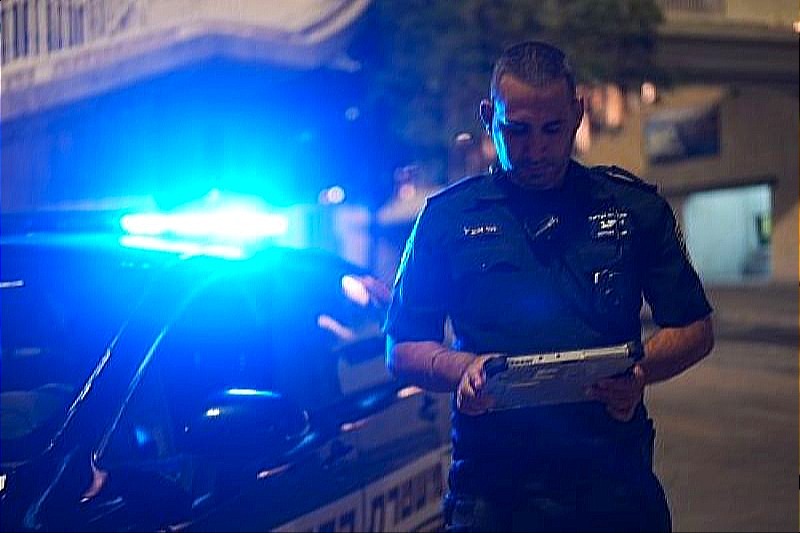 Yeshiva World News3 hours ago
Shin Bet agents and officers from the Yamam counterterrorism unit arrested a 15-year-old Palestinian on Tuesday on suspicion that he was preparing to carry out an imminent terrorist attack in central Israel.
The suspect, who was in Israel illegally, was detained after the Shin Bet received intelligence indicating that he intended to launch an attack in the immediate future.
The intelligence prompted the deployment of a joint Shin Bet–Yamam “Tequila” team to apprehend him.
Security forces arrested the teenager in the middle of a road alongside two other Palestinians who were also in Israel illegally. A search found no weapons in their possession.
All three were transferred to the Shin Bet for questioning.
(YWN World Headquarters – NYC)
 Yeshiva World News4 hours ago
Israel has reportedly withheld permission for contractors and construction equipment to enter Gaza to build an outpost for an international stabilization force under President Donald Trump’s Board of Peace initiative.
The delay could hold up the deployment of international troops and broader reconstruction efforts. However, the peace framework calls for Hamas to surrender its weapons before subsequent stages proceed, a condition the terrorist organization has consistently rejected.
According to a source with direct knowledge of the project, the Board of Peace awarded the construction contract in early August to Louisiana-based Arkel International. More than two months later, work has not begun because the company has not received Israeli authorization to bring personnel and equipment into Gaza.
The planned fortified installation would accommodate approximately 150 heavily armed international troops at a time, rotating from a larger contingent of 500 personnel dispatched from Morocco and Kosovo.
Described as a temporary mission support outpost, the base would cover approximately 100 by 100 meters. The proposed site was previously associated with the Gaza Humanitarian Foundation, the now-defunct U.S.-backed aid initiative that operated in Gaza between May and October 2025.
The source argued that deploying the stabilization force was necessary before reconstruction teams could safely deliver equipment, install utilities, or establish basic facilities.
Representatives of the Board of Peace declined to address the report. The Israeli government and the IDF also declined to comment.
The Trump-chaired body, authorized by the United Nations in 2025, was established following the October 2025 Gaza ceasefire. Twenty-eight countries joined as founding members earlier this year, although numerous Western democracies declined to participate.
On September 23, the board announced a proposed six-month reconstruction program valued at $2.45 billion. That initiative was presented as the first phase of a broader redevelopment effort projected to cost approximately $71 billion over a decade.
Separately, Israel reportedly approved the upcoming entry of an American company working for the board to identify and map locations where Hamas members could surrender weapons for destruction.
Under the framework, Hamas’s disarmament is supposed to precede further steps, including a gradual Israeli withdrawal. Israel would withdraw only from areas cleared of terrorists, which would then be transferred to a technocratic administration.
Hamas has continued to refuse to relinquish its weapons.
(YWN World Headquarters – NYC)
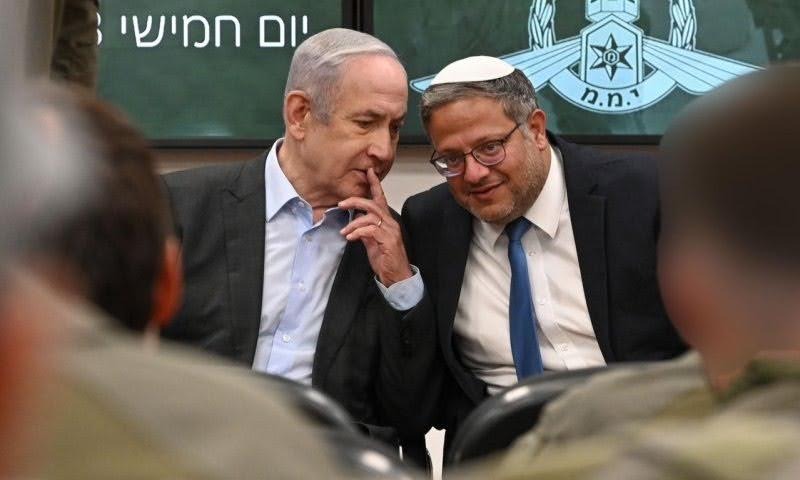 Yeshiva World News4 hours ago
Prime Minister Binyamin Netanyahu sparked a confrontation with Otzma Yehudit after declaring at a campaign event in Akko that Likud would control the National Security and Education ministries in the next government.
The announcement directly challenges Itamar Ben Gvir’s hold on the National Security Ministry and drew an angry response from his party, which claimed Netanyahu intends to exclude it from a future coalition.
“We will ensure the security and education of every boy and girl in Israel, Jews and non-Jews alike,” Netanyahu told the gathering.
Otzma Yehudit responded with the Hebrew expression “The cat is out of the bag,” arguing that Netanyahu’s remarks exposed his intentions for the next government.
The party said his statements about keeping the Defense, National Security, and Justice portfolios in Likud’s hands reinforced its conclusion that a decision had been made to leave Ben Gvir and Otzma Yehudit outside the coalition and bring in Gadi Eisenkot instead.
Otzma Yehudit further accused Netanyahu of preparing to transfer those portfolios to the left. That assertion reflected the party’s interpretation of his remarks; Netanyahu’s quoted comments did not announce an agreement with Eisenkot or explicitly rule out Ben Gvir as a coalition partner.
The party concluded its response with a direct message to Netanyahu: “Dear Prime Minister, only the people will decide. A strong Ben Gvir means a strong Israel!”
(YWN World Headquarters – NYC)
 Yeshiva World News4 hours ago
The IDF on Thursday released a letter it says was written by Yahya Sinwar’s son Ibrahim at the beginning of the war, when he was just 10 years old, expressing a desire to “hold a Kalashnikov and shoot Jews.”
According to the military, Israeli troops recovered the letter in Gaza in 2024. It was published on the IDF’s English-language X account to mark two years since the Hamas leader’s elimination.
In the message, Ibrahim tells his father how much he misses him and describes spending his time making weapons out of paper and cardboard.
“My beloved father, I miss you very much! I want to hug you and see you victorious,” the letter reads, according to the released translation. It then expresses his wish to proclaim Allah’s greatness, hold a Kalashnikov, and shoot Jews.
The boy also asks when his father will return to sleep beside him and writes that he constantly makes paper and cardboard pistols, tanks, and Kalashnikovs.
Elsewhere in the letter, Ibrahim expresses hope that the war will end and that he will see his father safe, asking him to pray for him.
The accompanying drawings depict weapons, tanks near the Gaza-Israel border fence, and missiles being launched toward Israel.
“The letter and drawings illustrate how Sinwar’s murderous ideology is reflected even in the education of his children,” the IDF said, describing the material as evidence of the influence of Hamas’s values of hatred and violence on Gaza’s younger generation.
Separately, the IDF and Shin Bet announced that a strike Wednesday in the Khan Younis area of southern Gaza eliminated Basel Nabil Abd al-Rahman Qishta and Ahmad Raja al-Shaer, whom they identified as terrorists involved in smuggling weapons and military equipment into the Strip.
According to the military, the two were responsible for weapons procurement and trafficking while advancing additional smuggling operations. The strike was intended to remove a threat to Israeli civilians and troops operating along the Yellow Line.
The IDF said it took steps before the strike to minimize civilian harm, including using precision munitions and aerial surveillance.
The military and Shin Bet said they would continue targeting terrorist organizations’ weapons buildup and financing to prevent the restoration of their military capabilities.
(YWN World Headquarters – NYC)
 Yeshiva World News4 hours ago
A second worker has died from injuries sustained in an explosion at Intel’s manufacturing facility in Kiryat Gat, southern Israel, bringing the death toll from Wednesday’s industrial accident to two. Soroka Medical Center announced Thursday that a 49-year-old worker succumbed to his injuries after being hospitalized in serious condition.
The explosion occurred during an operation involving gas cylinders at the semiconductor manufacturing complex. Police suspect that a gas cylinder exploded, sparking a fire and leaving three workers with severe burns.
One worker died from his injuries on Wednesday, several hours after the explosion. A third worker, a man in his 20s, remains hospitalized in serious condition at Soroka Medical Center in Beersheba. Hospital officials said he was sedated and receiving assistance from a ventilator.
Intel expressed condolences to the families of the deceased workers and said it was cooperating with authorities investigating the explosion. The company also said it was providing support to affected families and employees while investigators worked to determine the circumstances surrounding the accident.
(YWN World Headquarters – NYC)
 Yeshiva World News5 hours ago
Approximately NIS 127 million has been spent on security projects at Prime Minister Binyamin Netanyahu’s residences since 2023, according to figures disclosed following a court petition. A legal battle is now underway over whether the government must reveal how much was spent at each property.
The figures show spending rose from NIS 10.9 million in 2023 to NIS 27.8 million in 2024, before reaching NIS 72.5 million in 2025. Another NIS 16.2 million was spent from the beginning of 2026 through October.
The Prime Minister’s Office attributed the increased spending to heightened security threats and the need to strengthen protective measures, including following the 2024 drone strike on Netanyahu’s private home in Caesarea.
The Givat Mordechai community association, which filed the petition, is seeking separate spending figures for the official residence in Jerusalem, the alternate residence on Gaza Street, and the private Caesarea home.
The Prime Minister’s Office opposes releasing that breakdown, arguing that hostile actors could use the information to identify differences in security protection between the properties.
During a court hearing, Alon Haliva, the office’s deputy director-general for security, warned that combining expenditure figures with information from other sources could allow adversaries to draw sensitive conclusions about the residences’ defenses.
Association chairman Kobi Eisen rejected that argument, saying the public is entitled to know how its money was spent.
The dispute has also renewed attention to Netanyahu’s past criticism of security-related spending at former prime minister Naftali Bennett’s private home in Ra’anana. Netanyahu previously accused Bennett of renovating his home at a cost of NIS 50 million to taxpayers.
Judge Arnon Dראל ordered the Prime Minister’s Office to provide additional information, including a breakdown between private and public residences by period or administration.
The next hearing is scheduled for Sunday, when the court is expected to consider whether the more detailed figures must be disclosed.
(YWN World Headquarters – NYC)
 Yeshiva World News6 hours ago
A new Anti-Defamation League report warns that Wikipedia continues to display edits made by banned anti-Israel activists, allowing their influence to persist long after the accounts responsible were removed.
The report, titled “Damage Done” and published by the ADL’s Center for Technology and Society, found that 91% of one permanently banned editor’s changes remained intact across six key articles, including entries on Hamas, the Gaza war, and Zionism.
According to the ADL, restrictions imposed on six editors and complete bans against three others were not followed by a systematic review or reversal of their work. The organization warned that the disputed material continues to reach readers through Wikipedia, search engines, and artificial intelligence tools.
Among the examples cited was the removal of approximately 24,400 characters from the Gaza war article in November 2023. The deleted material included forensic documentation of October 7 atrocities, including victims who were bound and burned, sexual violence, and an attempted beheading. According to the report, the article now contains only a brief reference describing terrorists’ involvement in those acts as reported claims.
In another case, an editor moved much of the Hamas article’s material about human shields and human rights abuses into a separate entry titled “Criticism of Hamas,” the ADL said.
The researchers also identified a network of 19 accounts — eight established accounts and 11 newer ones — using subtler editing methods, including reversing other users’ changes and softening statements. Across 229 Israel-related articles examined, accounts in that group were responsible for the most recent edit on approximately 60% of the pages.
One account made 543 edits to the Zionism article, the second-highest total by an editor in the entry’s 24-year history. The ADL said those changes helped shape language describing Zionism as having achieved its goals “through colonization.”
ADL CEO Jonathan Greenblatt warned that pages read by millions and used by AI systems still bear the marks of what the organization describes as a systematic disinformation campaign. Daniel Kelley, a senior director at the ADL’s technology center, said the findings point to a systemic problem in how Wikimedia allows the platform to operate.
The ADL urged the Wikimedia Foundation to verify the identities of editors working on sensitive subjects, end anonymous editing, and establish a dedicated team to address antisemitic bias. It also called on AI developers to explicitly disclose when their answers rely on Wikipedia.
(YWN World Headquarters – NYC)
 Yeshiva World News6 hours ago
A new Israeli election poll published Thursday shows former IDF Chief of Staff Gadi Eisenkot’s Yashar! party climbing to a record 26 Knesset seats, while Prime Minister Binyamin Netanyahu’s coalition parties have fallen to a combined 49 seats, less than two weeks before Israelis head to the polls.
The survey, conducted October 14–15 by Tatika Research and Media in cooperation with the Adgenda polling panel for Zman Yisrael, indicates significant movement among parties opposed to Netanyahu, although much of Eisenkot’s gains appear to be coming at the expense of other parties in the same political camp.
Eisenkot’s Yashar! party gained two seats compared with the previous week’s poll, reaching 26 mandates. Former Prime Minister Naftali Bennett’s Beyachad party dropped to 11 seats, while Avigdor Lieberman’s Yisrael Beiteinu fell to nine. The Democrats remained unchanged at eight seats.
On the Netanyahu side, Likud received 20 seats, Shas eight, United Torah Judaism eight, Otzma Yehudit seven, and Religious Zionism six, bringing the bloc to 49 mandates.
One significant factor was the failure of former IDF Brigadier General Ofer Winter’s Amcha Yisrael party to cross the electoral threshold. Winter’s party received just 2.8% of the vote, leaving it without Knesset representation in the survey.
Meanwhile, the Reservists–Economic party, headed by Yoaz Hendel and Yaron Zelekha, crossed the electoral threshold with four seats.
The Arab parties received a combined 13 seats, with the Joint List winning eight and Ra’am five.
According to the poll’s bloc calculations, parties opposed to Netanyahu, including the Reservists and Ra’am, received 67 seats, compared with 49 for the Netanyahu-aligned parties. The narrower change bloc was credited with 54 seats.
The survey included 500 Jewish and Arab respondents and had a reported maximum sampling error of 4.4 percentage points.
EISENKOT PROMISES TO END HAMAS RULE IN GAZA
Against the backdrop of his party’s rising poll numbers, Eisenkot delivered a security statement Thursday near the Gaza border, pledging to end Hamas rule in the Gaza Strip within 18 months of taking office.
“I pledge: Within 18 months of entering the Prime Minister’s Office, Hamas will no longer rule the Gaza Strip. We will bring about the destruction of Hamas’s military wing,” Eisenkot declared.
He said the objective would be achieved either through implementation of President Donald Trump’s framework, which was accepted by the Netanyahu government, or through military and operational measures.
Eisenkot sharply criticized Netanyahu’s handling of the war.
“As long as Benjamin Netanyahu remains in power, Hamas will remain in power,” he charged. “The man who hangs signs saying ‘We Will Not Surrender’ is the first to surrender: to draft evaders, to his coalition partners, and to Hamas.”
The former IDF chief added that no Israeli government had ever received so much public and international freedom of action while experiencing what he described as such a profound strategic failure.
“Three years after the October 7 massacre, Hamas remains the sovereign in the Gaza Strip, armed, rearming, and rebuilding its military capabilities,” Eisenkot said.
Likud responded with a brief statement questioning how Eisenkot could carry out his promises without the approval of Arab political leaders Mansour Abbas and Ahmad Tibi.
HAGAON HARAV DOV LANDAU: EVERY VOTE IS CRITICAL
As Election Day approaches, Gedolei Yisroel are issuing urgent calls for the Chareidi community to participate in the election.
HaGaon HaRav Dov Landau, Rosh Yeshivas Slabodka, instructed shochtim employed by kashrus organizations not to travel abroad for shechitah assignments if doing so would prevent them from returning to Eretz Yisroel in time to vote.
The question was presented to the Rosh Yeshiva by HaRav Rafael Menat, Rav of the Osem-Nestlé corporation and a close confidant of HaRav Landau.
Some shochtim were scheduled to travel to distant countries, including South American destinations, and would be unable to return before the election. Remaining in Israel would mean sacrificing significant income.
HaRav Landau was unequivocal.
“Elections are a greater communal necessity. Every vote, every single vote, is extremely, extremely important for Klal Yisroel,” he said.
HAGAON HARAV MOSHE HILLEL HIRSCH WARNS OF THREATS TO CHAREIDI EDUCATION
HaGaon HaRav Moshe Hillel Hirsch, Rosh Yeshivas Slabodka, also addressed the upcoming election during a meeting with rabbonim from Rechasim, warning that the challenges facing the Chareidi community extend far beyond the military draft.
The Rosh Yeshiva described increasing government pressure on Chinuch Atzmai schools, chedarim, seminaries, and other Chareidi educational institutions.
He said measures that had not been enforced in previous years were now being used to create difficulties for Chareidi institutions across numerous areas.
HaRav Hirsch attributed the pressure to concerns among secular policymakers about demographic changes that could eventually make the Chareidi population a much larger share of Israel’s population.
He urged every eligible Chareidi voter to cast a ballot for a Chareidi party, describing electoral participation as an essential means of protecting Torah institutions and the community’s future.
(YWN World Headquarters – NYC)
 Yeshiva World News6 hours ago
A 24-year-old Spring Valley man was arrested Thursday following an incident in which a 9-year-old boy was struck by a projectile believed to have been fired from a BB gun while walking along Hoyt Street in Spring Valley.
According to the Spring Valley Police Department, officers responded Wednesday, October 14, to the area of Hoffman Street and Hoyt Street after receiving a report of a suspicious incident involving a child.
Police said the boy was walking past an occupied vehicle on Hoyt Street when he heard a loud noise and suddenly felt pain near his left hip.
The child returned home and informed his parents, who contacted Chaverim of Rockland for assistance. Upon learning the circumstances of the incident, Chaverim immediately notified the Spring Valley Police Department.
Hatzoloh EMS responded to evaluate the boy and determined that his injuries were not life-threatening.
Spring Valley Police detectives launched an investigation, working with Chaverim of Rockland to identify and locate the vehicle involved.
On Thursday, October 15, the suspect vehicle and all individuals who had been inside at the time of the incident were located with assistance from Chaverim volunteers. All occupants were transported to Spring Valley Police headquarters for further questioning.
Following the investigation, police arrested Marco J. Guanoquiza-Caillagua, 24, of Spring Valley.
He was charged with second-degree assault, two counts of fourth-degree criminal possession of a weapon, and endangering the welfare of a child.
The Spring Valley Police Department publicly thanked Chaverim of Rockland for their assistance in the investigation.
Authorities are asking anyone with additional information to contact Spring Valley Police at 845-356-7400 or email [email protected].
(YWN World Headquarters – NYC)
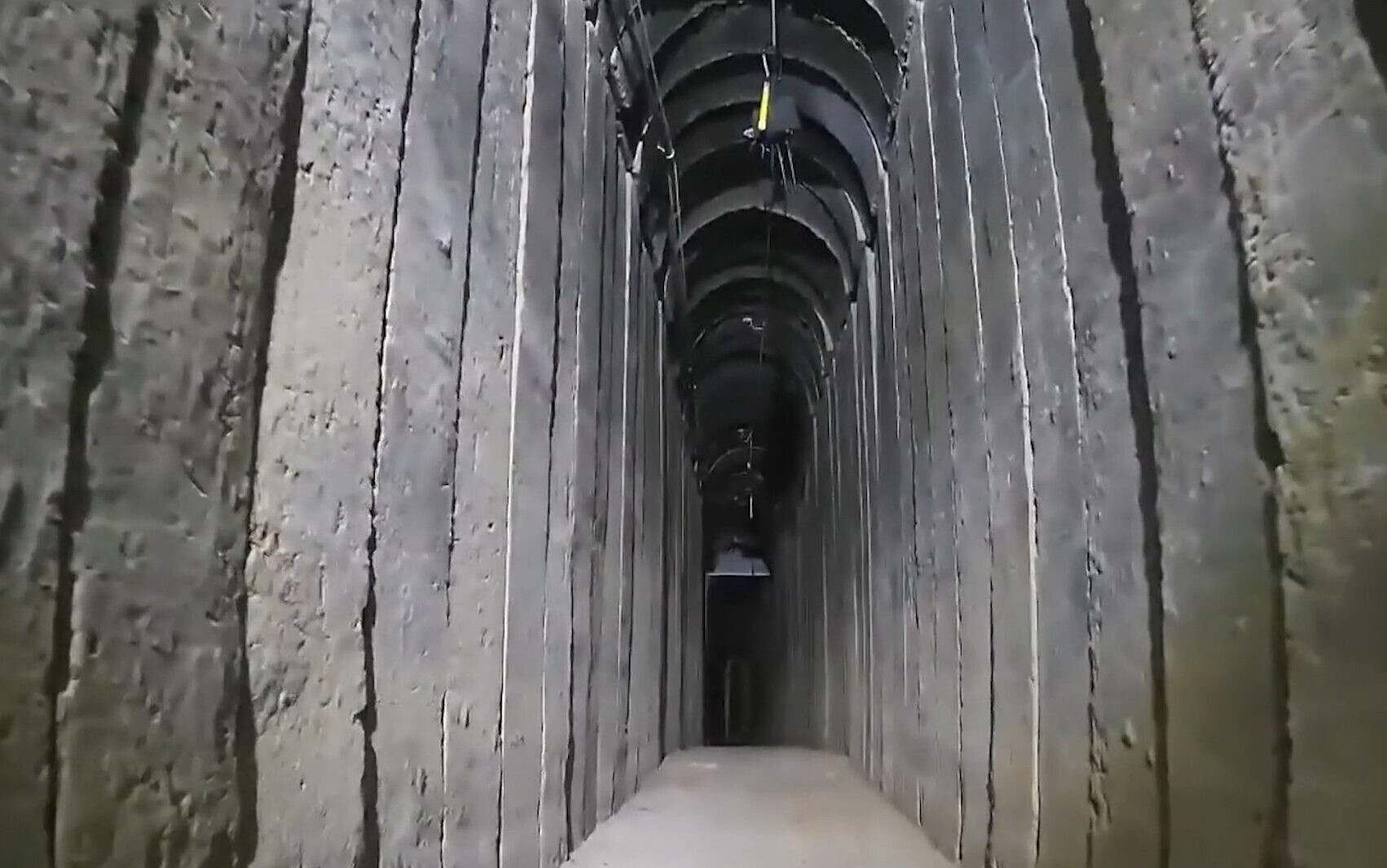 Yeshiva World News6 hours ago
The IDF announced Thursday that combat engineers destroyed a Hamas tunnel stretching approximately 1.5 kilometers beneath southern Gaza, including a section that crossed the Yellow Line into territory under Israeli military control.
The underground passage contained several rooms used by Hamas terrorists and extended across areas where IDF forces continue operating to identify and dismantle terrorist infrastructure.
The operation was conducted by engineering forces from the Gaza Division’s Southern Brigade in cooperation with the IDF’s elite Yahalom combat engineering unit. Soldiers worked to locate, seal and destroy the underground passage.
The IDF said its forces are continuing operations in southern Gaza to clear areas around the Yellow Line of remaining terrorist infrastructure. The latest tunnel was destroyed as part of those operations, with engineering units continuing to identify underground passages in the area.
(YWN World Headquarters – NYC)
 Yeshiva World News7 hours ago
Hezbollah has reportedly resumed sending surveillance drones into the security zone in southern Lebanon to gather intelligence on IDF operations, with two of three confirmed Hezbollah aircraft evading Israeli interception attempts.
The activity has increased since late September and comes amid an unusual incident near the Lebanese border involving what was described as an “unidentified flying object.”
At least five incidents have been recorded in recent weeks in which the Israeli Air Force launched interceptors toward suspected aerial targets over southern Lebanon.
In three cases, the aircraft were subsequently confirmed to belong to Hezbollah. Only one was successfully intercepted, while attempts to intercept the other two failed.
In a fourth incident, an IDF aircraft was mistakenly identified as hostile. In another, the identity of the aerial target could not be conclusively determined.
The interceptor launches were visible to residents of northern Israel, and the military issued statements describing engagements with “suspicious targets.” However, it reportedly did not subsequently inform the public that three of the incidents involved confirmed Hezbollah aircraft.
The disclosures also drew attention to two incidents in late July, when three drones were intercepted near the Jordanian border. The IDF announced those interceptions but did not identify where the drones had been launched.
Nearly three months later, the military continues to withhold their launch locations, citing information security considerations.
Responding to the report, the IDF said its detection and air defense systems operate with heightened sensitivity to protect Israeli civilians against a range of threats.
“The IDF Spokesperson’s Unit operates in accordance with the findings in order to convey information to the public,” the military added.
(YWN World Headquarters – NYC)
 Yeshiva World News8 hours ago
A German court sentenced two men to prison Thursday after convicting them of planning attacks against prominent Jewish and pro-Israel figures while carrying out surveillance activities on behalf of Iranian intelligence.
The court in Hamburg sentenced a Danish national identified as Ali S. to eight and a half years in prison for preparing attacks against individuals including Volker Beck, president of the German-Israeli Society, and Josef Schuster, president of the Central Council of Jews in Germany.
An Afghan accomplice identified as Tawab M. received a four-and-a-half-year sentence. Prosecutors said he had agreed to recruit another individual and provide him with a weapon for a planned attack on Beck.
According to German prosecutors, Ali S. received instructions from the Quds Force, the foreign operations branch of Iran’s Islamic Revolutionary Guard Corps, in early 2025. The defendants were arrested in Denmark and subsequently extradited to Germany. Iranian officials previously rejected the accusations when charges were announced, while the German Foreign Ministry summoned Iran’s ambassador following one of the arrests.
(YWN World Headquarters – NYC)
 Yeshiva World News8 hours ago
An investigation has found that Iran and its allied forces carried out at least 135 missile and drone strikes against 84 infrastructure facilities across seven Gulf countries since the war began on February 28, targeting equipment at airports, oil terminals, gas facilities and pipelines, according to Reuters.
The investigation examined satellite imagery, video evidence, official records and information from people familiar with the attacks. It found that Iranian forces repeatedly struck specialized equipment, sometimes measuring only a few meters across, whose destruction could prevent entire facilities from operating.
Among the facilities targeted was the Fujairah oil port in the United Arab Emirates, which was struck at least 19 times. Iranian strikes also damaged cooling equipment at Qatar’s Ras Laffan liquefied natural gas complex and pumping stations along Saudi Arabia’s East-West Pipeline, disrupting alternative routes for energy exports around the Strait of Hormuz.
The investigation also found that Gulf governments frequently attributed damage to debris from intercepted missiles and drones, despite evidence suggesting direct strikes against sensitive equipment. Some facilities face lengthy repair operations, with several major industrial sites expected to require a year or longer before full restoration.
(YWN World Headquarters – NYC)
 Yeshiva World News8 hours ago
Israel’s Civil Service Commission has instructed government ministries to strictly enforce regulations barring individuals who have not resolved their military conscription status from obtaining government employment, in the latest measure affecting Chareidi men amid the ongoing battle over the drafting of yeshiva bochurim.
According to a report published Thursday by Channel 12 News, the commission distributed a directive this week clarifying that candidates legally required to enlist in the IDF cannot be hired for civil service positions unless their military status has been properly arranged.
The directive follows instructions issued by Attorney General Gali Baharav-Miara concerning sanctions against Chareidi draft evaders and comes after existing civil service regulations on the matter were reportedly not consistently enforced.
The letter was signed by Nissim Mizrahi, a senior Civil Service Commission official responsible for government ministries and auxiliary units and head of the commission’s senior personnel administration.
It was distributed to human resources directors across government ministries, including those overseeing the health, defense, and foreign affairs sectors.
Mizrahi emphasized that the directive does not introduce a new employment restriction but instead requires strict enforcement of an existing regulation.
“This is not a change to the Civil Service Regulations or the creation of a new condition,” he wrote, describing the measure as “enforcement and clarification of an existing provision.”
Under the updated enforcement procedures, the government’s computerized recruitment system will automatically cross-reference applicants’ military status with IDF records.
Candidates who have not regularized their status with the military will be prevented from completing the hiring process.
“From now on, the recruitment system will permit completion of the hiring process only for candidates who have regularized their status with the IDF,” the directive states.
Applicants will also be informed when submitting their applications that employment is conditional upon resolving any outstanding military service requirements.
If a candidate is selected for a government position but has not properly arranged his military status, he will be summoned to a written hearing and given five days to resolve the matter or submit documentation establishing his eligibility.
Failure to meet that deadline could result in the cancellation of the job offer.
The measure is expected to affect Chareidi men whose military deferments are no longer recognized under current conscription arrangements, potentially preventing them from securing employment in government ministries and other public-sector positions covered by civil service regulations.
(YWN World Headquarters – NYC)
 Yeshiva World News8 hours ago
Prime Minister Benjamin Netanyahu visited Israel’s border with Jordan on Thursday, inspecting construction of a new security barrier and announcing that the IDF has developed plans to address the growing threat of drones crossing into Israeli territory.
Netanyahu was accompanied by Defense Minister Israel Katz, Border and Security Fence Directorate chief Maj. Gen. Eran Ofir and 96th Division commander Brig. Gen. Oren Simha. The visit included a briefing on construction, military deployments and defensive preparations along the border.
Netanyahu said the barrier is part of a broader security effort involving engineering projects, logistical preparations, regular military forces and reservists. He confirmed that specific plans are being developed to counter drone threats but declined to disclose operational details.
Defense Minister Katz said the border defenses are intended to complement Israel’s offensive military posture against threats originating from Iran and nearby hostile organizations. Israeli forces are continuing construction and deployment work along the border as part of the security program.
(YWN World Headquarters – NYC)
 Yeshiva World News9 hours ago
President Isaac Herzog addressed the CICA summit in Baku, Azerbaijan, on Thursday, calling for broader peace across the Middle East while warning that terrorism and boycotts undermine regional cooperation.
“Peace cannot coexist with terror, and cooperation cannot flourish alongside boycotts,” Herzog told the gathering. “Every sovereign state participating in this framework has the right to live in freedom and peace, without its very existence being under constant threat.”
Herzog expressed hope that future peace efforts would reach Lebanon, Syria, Gaza, and Israel’s other neighbors, alongside a shared commitment to fighting terrorism.
“I hope and pray that we can see a vision of peace in the Middle East, with Lebanon, Syria, Gaza, and our neighbors, and that together we can fight terrorism in all its forms,” he said.
The president pointed to the Abraham Accords as evidence that cooperation can transform political realities. He also welcomed the announcement of U.S. Secretary of State Marco Rubio’s planned visit to Uzbekistan in the coming days for meetings with Central Asian leaders.
Herzog noted that Israel’s involvement in the CICA framework dates back to Shimon Peres’s efforts in the 1990s. He stressed that international cooperation against shared threats, including terrorism, disease, and pollution, is a necessity in an interconnected world.
“Israel has much to contribute to Asia in the 21st century in technology, water, agriculture, energy, and artificial intelligence,” Herzog said, urging participants to choose dialogue over division.
(YWN World Headquarters – NYC)
 Yeshiva World News10 hours ago
Yisrael Beiteinu chairman Avigdor Lieberman is drawing firm lines for a future coalition, ruling out any government with Prime Minister Binyamin Netanyahu, the Chareidi parties, Ra’am, or the Joint List.
“We will establish a coalition made up exclusively of Zionist parties,” Lieberman said. “Without Ra’am, without the Joint List, without Shas, and without United Torah Judaism.”
Lieberman left the door open to Likud joining such a government, but insisted that Netanyahu could not be part of the arrangement.
“With Netanyahu — even if the world turns upside down, we will not sit together under any circumstances,” he declared.
He also rejected forming a minority government, including as a temporary arrangement, and expressed confidence that his preferred coalition could secure a parliamentary majority despite current polling.
“I believe we will achieve a solid majority, despite what the polls are saying,” Lieberman said.
Separately, an unnamed political source claimed that some Likud lawmakers could be willing to join an alternative coalition, arguing that frustration with the party’s dependence on its Chareidi partners could prompt defections.
“I know several MKs within Likud who understand the gravity of the moment,” the source said. “They understand that Bibi has turned them into subcontractors for Goldknopf and Deri, and therefore they would be willing to provide the numbers needed and join a Zionist coalition.”
No lawmakers were named, and the remarks did not establish that any Likud MK had committed to breaking ranks.
(YWN World Headquarters – NYC)
 Yeshiva World News10 hours ago
Online antisemitism remains at its highest recorded levels three years after the October 7 Hamas massacre, with a new international study finding that anti-Jewish content continues to circulate at rates substantially above those documented before the attacks.
The Australian-based Online Hate Prevention Institute found that the most recent three-month monitoring period recorded more antisemitic content than any comparable period since the organization began tracking online hate in 2022.
Researchers examined antisemitic material across major social media platforms and found that none had returned to pre-October 7 levels. Instagram, TikTok and YouTube experienced further increases beyond the initial surge following the massacre, while several other platforms maintained elevated levels.
The study also documented the continued circulation of traditional antisemitic conspiracy theories, accusations of Jewish control and influence, and material glorifying the October 7 attacks. Researchers found that traditional forms of antisemitism remained dominant across most platforms, even as the methods used to distribute the content continued to change.
(YWN World Headquarters – NYC)
 Yeshiva World News10 hours ago
Hezbollah has reportedly heightened its military readiness following instructions from Iran, as Tehran assesses that a broader regional confrontation could be approaching, according to Lebanese security and military sources.
The terrorist organization has begun implementing a new combat system that gives field units greater independence in conducting operations. The changes are intended to reduce the impact of targeted Israeli strikes against Hezbollah’s central leadership.
According to the sources, the instructions were conveyed through ongoing coordination between Iran’s Islamic Revolutionary Guard Corps and its regional allies.
That coordination includes preparations for expanded fighting against Israel and the United States, as well as plans for simultaneous military responses should war erupt.
The Lebanese sources stressed that Hezbollah views the directives as operational preparations for a scenario that could unfold in the near term. They said the heightened readiness does not indicate that a final decision to launch a war has been made.
(YWN World Headquarters – NYC)
 Yeshiva World News10 hours ago
Former Israeli prime ministers Naftali Bennett and Yair Lapid have introduced a policy proposal aimed at changing Israel’s relationship with Jewish communities worldwide, including plans to restructure government responsibilities for Diaspora affairs and establish new channels of representation.
The proposal, advanced by their B’Yachad party ahead of the October 27 Knesset election, calls for incorporating the Diaspora Affairs Ministry into the Foreign Ministry and establishing a dedicated council representing Jewish communities outside Israel.
The plan would also establish an observer-level representative for Diaspora Jewry within the Knesset, allowing participation in selected parliamentary committee discussions concerning issues affecting Jewish communities abroad. Additional proposals include educational initiatives, expanded Hebrew-language programs and the creation of a national authority dedicated to combating antisemitism.
The party also addressed religious arrangements at the Kosel, pledging to respect existing prayer arrangements at the main Kosel Plaza while maintaining Robinson’s Arch as an area for alternative religious gatherings. Bennett and Lapid presented the proposals as part of their party’s platform for the upcoming election.
(YWN World Headquarters – NYC)
 Yeshiva World News11 hours ago
Israel ranks first among developed nations in a new OECD economic growth forecast, with projected growth of 4.5%, ahead of Denmark at 3.7%.
The report also highlighted a historically low deficit and an increase in foreign investment in Israel, alongside the country’s leading growth projection.
Finance Minister Bezalel Smotrich welcomed the findings, calling them a reflection of the strength of Israel’s economy and its citizens.
“The OECD growth forecast is a badge of honor for Israel’s economy and the citizens of Israel,” Smotrich said. “Even in the face of complex challenges, we have demonstrated that the Israeli economy is powerful, dynamic, and leads the developed world.”
Smotrich credited the figures to the government’s economic policies, saying the combination of strong projected growth, a low deficit, and foreign investment reflected international confidence in Israel.
“This historic figure, alongside the low deficit and the international confidence reflected in foreign investment, is no coincidence — it is the result of responsible, measured, and determined economic policy,” he said.
The finance minister pledged to continue pursuing economic growth, strengthening Israeli households, and securing the country’s financial future.
(YWN World Headquarters – NYC)
 Yeshiva World News12 hours ago
Voting in Israel’s October 27 Knesset election has begun at diplomatic missions around the world, allowing Israeli diplomats, government representatives and eligible family members stationed overseas to cast their ballots before Election Day.
The Central Elections Committee established 101 polling stations at 99 Israeli diplomatic missions, with approximately 4,800 eligible voters. Voting is taking place over approximately 30 hours as polling stations open according to local time zones.
The first polling station opened at Israel’s embassy in Wellington, New Zealand, followed by the embassy in Fiji. The largest overseas polling station is located at the Israeli Consulate in New York City, where more than 700 people are eligible to vote.
Under Israeli election law, most citizens living or traveling abroad cannot vote overseas and must return to Israel to participate. The IDF is preparing early voting arrangements for military personnel stationed at bases and deployed abroad. Ballots cast at diplomatic missions will be transported to Israel for counting under Central Elections Committee procedures.
(YWN World Headquarters – NYC)
 Yeshiva World News12 hours ago
Police said Thursday that an explosion that killed nine-year-old Eliyahu Azriel, z”l, in Beitar Illit was apparently caused by a fire inside a recycling container, ruling out a deliberately planted explosive device or a criminal or terrorist motive.
Investigators worked through the night to establish the circumstances of the tragedy. The investigation involved officers from the Yehuda and Shomron Police District, bomb disposal experts, forensic specialists, and Fire and Rescue Service investigators.
The findings raised strong suspicions that the blast was connected to a dangerous practice in which children and teenagers set garbage containers on fire and remain nearby to watch emergency crews arrive.
According to investigators, the fire inside the recycling container created pressure that triggered an internal explosion while dozens of children were standing close by.
A fragment propelled by the blast struck Eliyahu, causing fatal injuries. Emergency medical personnel fought to save his life, but he was pronounced dead at the hospital.
Police did not indicate that Eliyahu had been involved in starting the fire.
Eliyahu, the eighth of ten children in his family, was brought to kevurah Wednesday night. His levayah took place at 11:30 p.m. at the Sephardic funeral home at Har Hamenuchos in Yerushalayim.
Following the findings, Etzion Police Station commander Chief Superintendent Rafi Vaknin held an urgent meeting Wednesday night with Beitar Illit’s mayor.
They agreed to immediately launch an educational and deterrence campaign in the city’s schools to stop the dangerous practice before it claims additional lives.
(YWN World Headquarters – NYC)
 Yeshiva World News13 hours ago
The Trump administration is reportedly working to encourage the formation of a broad Israeli unity government that would allow Prime Minister Benjamin Netanyahu to remain in office for up to two years before retiring from political life, as part of an American-backed effort to secure regional diplomatic agreements and reshape the Middle East, according to a report Thursday in Israel Hayom.
The proposed framework would bring together Netanyahu’s Likud party and former IDF Chief of Staff Gadi Eisenkot’s Yashar party, creating a coalition capable of making significant diplomatic and security decisions. Under the reported arrangement, Netanyahu would continue serving as prime minister for a limited period, during which the government would work to end ongoing regional conflicts and advance normalization agreements with Arab countries, particularly Saudi Arabia. Netanyahu would then retire from politics.
A senior American official said the administration’s preference for a broad Israeli government has been communicated to senior Israeli political figures, both directly and through diplomatic channels. U.S. Ambassador to Israel Mike Huckabee has also met with senior political leaders, including Eisenkot. Although American officials are reportedly taking care not to appear to interfere in Israel’s upcoming October 27 election, they have expressed support for establishing a stable government without extremist elements.
The reported initiative is closely connected to President Donald Trump’s efforts to expand the Abraham Accords. Washington has been offering Saudi Arabia additional security cooperation, including potential F-35 fighter jet sales and assistance with a civilian nuclear program, in an effort to secure normalization with Israel. However, Saudi officials have reportedly indicated that progress toward such an agreement would require changes to the composition of Israel’s government.
Eisenkot’s political bloc would reportedly impose several conditions before agreeing to join such a coalition. These include binding guarantees that Netanyahu would retire after the agreed period, the repeal of legislation associated with the government’s judicial overhaul, changes to Israel’s judicial and constitutional framework, and the establishment of a state commission of inquiry into the October 7 Hamas massacre.
The report also addressed possible involvement by President Isaac Herzog in discussions surrounding a future unity government, although the President’s Residence has denied reports that he is participating in such negotiations. Herzog has recently expressed his intention to work toward preventing another round of elections after October 27.
No formal coalition agreement has been announced, and the reported framework remains a proposal under discussion among American, Israeli and international political figures. Any agreement would depend on the election results, negotiations between the participating parties and acceptance of the conditions proposed by Eisenkot’s bloc
(YWN World Headquarters – NYC)
 Yeshiva World News16 hours ago
The United States is considering deploying one of the most powerful conventional weapons in its military arsenal, the GBU-43/B Massive Ordnance Air Blast bomb, widely known as the “Mother of All Bombs,” in potential new strikes against Iran.
The extraordinary military option comes amid escalating tensions between Washington and Tehran, as American military planners evaluate possible renewed operations against the Islamic Republic, according to CNN.
The massive weapon weighs approximately 21,600 pounds and carries nearly 19,000 pounds of explosives, making it one of the most powerful conventional bombs ever deployed in combat. Designed to deliver an enormous blast across a wide area, the bomb can devastate military installations, fortified positions, and concentrations of enemy forces.
The United States has used the weapon in combat only once. On April 13, 2017, during President Donald Trump’s first administration, American forces dropped the bomb on an ISIS-K tunnel and cave complex in Afghanistan’s Nangarhar province. The strike marked the first operational deployment of the weapon, which had originally been developed ahead of the 2003 Iraq War.
The MOAB differs significantly from the GBU-57 Massive Ordnance Penetrator, the approximately 30,000-pound bunker-busting weapon used by American B-2 stealth bombers against Iranian nuclear facilities during Operation Midnight Hammer in June 2025. While the GBU-57 is specifically designed to penetrate deeply buried and heavily fortified underground facilities, the MOAB is engineered to unleash an exceptionally powerful blast over a broad area.
(YWN World Headquarters – NYC)
 Yeshiva World News16 hours ago
Former President Barack Obama is facing criticism over remarks about the Israeli-Palestinian conflict during an interview in Belfast, Northern Ireland, while on a speaking tour in Britain.
Obama said that Jewish efforts to find refuge were understandable after the persecution Jews faced in Europe, but added that “it is undeniable that they took land from people and acted excessively.”
He called on Israel to find a “just, ethical and moral way” to defend itself rather than “walling itself off,” arguing that the government’s reliance on military force without making concessions is costing Israel its moral standing. Obama also urged Palestinians to abandon violent strategies, saying Hamas’s October 7 attack proved futile. He listed easing suffering, ending the violence, halting expansion in the West Bank and rebuilding Gaza as immediate goals.
The remarks drew sharp criticism from pro-Israel voices. The Daily Wire and HonestReporting accused Obama of historical revisionism, arguing that he portrayed Israel’s founding solely as a response to the Holocaust while ignoring the Jewish people’s thousands-of-years connection to the land. Critics also said he omitted the extensive legal land purchases made by Jews in Eretz Yisroel before the establishment of the state.
(YWN Israel Desk – Jerusalem)
Yeshiva World News16 hours agoLebanese security and military sources say Iran has instructed Hezbollah to raise its military readiness, as Tehran assesses that a regional confrontation may be imminent.
The sources told the Emirati outlet Erem News that Hezbollah is developing a more decentralized command structure, allowing units in the field to operate independently if they lose contact with senior leaders. The changes are intended to limit the impact of potential Israeli strikes targeting the group’s leadership.
The reported Iranian instructions are part of ongoing coordination between the Islamic Revolutionary Guard Corps and its regional terror proxies. The sources said the preparations could enable simultaneous military responses if a new war breaks out involving Israel and the United States.
They stressed that Hezbollah views the instructions as preparation for a possible near-term scenario, not as a final decision to enter a war. The preparations, they said, go beyond the group’s traditional mobilization.
(YWN Israel Desk – Jerusalem)
 Yeshiva World News16 hours ago
Former IDF chief and Yashar party chairman Gadi Eisenkot pledged Thursday that Hamas would no longer rule Gaza within 18 months of his taking office as prime minister. He made the pledge in a security statement near the Gaza border, 12 days before the election.
“I commit: Within 18 months of entering the Prime Minister’s Office, Hamas will no longer rule the Gaza Strip. We will destroy Hamas’s military wing,” Eisenkot said. He said the goal could be achieved either through the framework proposed by President Donald Trump and accepted by the Netanyahu government, or through military and operational action.
Eisenkot sharply criticized Prime Minister Binyamin Netanyahu, saying, “As long as Binyamin Netanyahu is in power, Hamas will remain in power. The man who hangs signs saying ‘We will not surrender’ is the first to surrender: to draft evaders, to his coalition partners and to Hamas.”
He said that three years after the October 7 massacre, Hamas remains in control of Gaza, armed and rebuilding its military capabilities. Eisenkot also said there is a gap between the achievements of Israeli troops in Iran, Lebanon and Gaza and the government’s failure to meet its own objectives.
Eisenkot called for a national strategy, a state commission of inquiry into October 7 and implementation of its findings. He said he has the knowledge and experience to lead the IDF, Mossad and Shin Bet.
The Likud responded by asking, “How will you topple Hamas without getting permission from your partners Mansour and Tibi?”
Eisenkot’s party replied: “For 17 years, Netanyahu and the Likud have been misleading Israel’s citizens and strengthening Hamas. If you had focused a little more on your job and less on drafting talking points, perhaps October 7 would have been prevented. In 12 days, you’re going home.”
(YWN Israel Desk – Jerusalem)
 Yeshiva World News17 hours ago
President Isaac Herzog addressed the CICA summit in Baku, Azerbaijan, on Thursday, as representatives from Iran, Turkey, Pakistan, Kuwait and the Palestinian Authority left the hall before his speech. Qatar’s emir remained in the room.
Herzog is attending the conference alongside senior officials from countries with which Israel has no diplomatic relations, including Iran, Qatar, Saudi Arabia, Pakistan and Iraq. During his day-and-a-half visit, he is also meeting with Azerbaijan’s President Ilham Aliyev to discuss security, energy, technology and regional developments.
Herzog traveled to Baku on a commercial Azerbaijan Airlines flight that crossed Turkish airspace, despite Turkey’s ban on Israeli government aircraft. The flight reportedly avoided the Black Sea route and Ankara was not informed in advance of Herzog’s identity as a passenger.
Herzog also met with Bahrain’s foreign minister, Abdullatif bin Rashid Al Zayani, and the two discussed strengthening the Abraham Accords. His schedule includes meeting members of Azerbaijan’s Jewish community and visiting the Israeli Embassy, where voting opened for Israelis living abroad.
President Isaac Herzog arrives in Baku, Azerbaijan. (Maayan Toaf/GPO)
The visit also comes amid tensions between Turkey and Azerbaijan following Azerbaijani legislation restricting the wearing of hijabs in the education system. Members of Turkish President Recep Tayyip Erdogan’s party protested outside Azerbaijan’s embassy in Ankara.
(YWN Israel Desk – Jerusalem)
 Yeshiva World News17 hours ago
The government approved extending the special state of emergency on the Home Front across Israel until November 3, after the scheduled election date. The decision was based on security officials’ assessment that there remains a high likelihood of an attack on civilians, particularly amid uncertainty surrounding Iran and Lebanon.
A document presented to ministers said that, despite the ceasefire with Iran and the announced ceasefire on the northern front, security officials believe fighting could resume. The existing emergency declaration was set to expire on October 20; the extension also requires approval from the Knesset Foreign Affairs and Defense Committee.
The declaration gives security officials authority to issue civil defense instructions, restrict gatherings and set guidelines for institutions and services. Extending it does not automatically change the public’s current instructions; any measures depend on the security assessment.
Separately, CNN reported that the U.S. military has prepared new strike plans against Iran in case President Donald Trump orders a resumption of hostilities. The reported plans include strikes on energy infrastructure and nuclear sites, with the possible use of the nearly 10-ton GBU-43/B, known as the MOAB or “Mother of All Bombs.” The report said there are questions about whether the bomb could achieve strategic objectives or change the course of the conflict.
(YWN Israel Desk – Jerusalem)
 Yeshiva World News17 hours ago
Degel HaTorah is seeking to ease tensions with the Gur community ahead of the 26th Knesset elections. United Torah Judaism chairman Yaakov Asher is expected to meet with MK Yitzchak Goldknopf on Thursday in an effort to resolve the dispute and secure Gur’s support in the campaign.
The tensions center on the draft law. Gur had pushed for stronger pressure on the government, while Degel HaTorah opposed the approach. Gur representatives say earlier commitments by the Lithuanian representatives regarding the legislative timetable and sanctions against the government were not fulfilled, leaving Gur to pay the political price while its partners gained time.
The divide deepened after Goldknopf left the government and disagreements grew within Agudas Yisroel. The dispute pits Goldknopf and Yaakov Tessler against the camp of Meir Porush and Elikim Stark, whose alliance formed the Chomas Torah faction. Degel HaTorah has drawn closer to the Porush-Shter camp, while Gur believes it has been increasingly pushed out of the decision-making process within United Torah Judaism.
The dispute has now raised concerns about the election campaign. Gur’s organized political network can mobilize voters beyond the community’s own base, and a lack of full cooperation could hurt the party’s turnout.
Gur has not publicly committed to supporting United Torah Judaism. Party officials are also concerned that even if Gur voters go to the polls, the community may not provide the intensive campaign work and mobilization seen in previous elections.
(YWN Israel Desk – Jerusalem)
 Yeshiva World News22 hours ago
HaGaon HaRav Moshe Hillel Hirsch, Rosh Yeshivas Slabodka, issued a warning Wednesday evening about what he described as growing government pressure on the Chareidi community, saying the challenges extend far beyond the military draft controversy and threaten nearly every aspect of Chareidi education and communal life.
The remarks were delivered during a meeting with Rabbonim and community representatives from Rechasim, who visited the homes of HaRav Hirsch and HaGaon HaRav Dov Landau for guidance and brachos ahead of Israel’s upcoming Knesset elections.
HaRav Hirsch told the delegation that the public may not fully appreciate the scope of the difficulties confronting Chareidi institutions.
“I don’t know if you are aware of the policies of the current government,” the Rosh Yeshiva said. “Everyone knows about the problems with the army, but there are problems in every single area. In Chinuch Atzmai, in the chedarim, in the seminaries. Everywhere they can create difficulties for us, they do so.”
According to HaRav Hirsch, government policies have changed significantly from previous years, with restrictions and administrative obstacles now affecting institutions that previously operated without such interference.
“Things that for all these years they did nothing about, today they are taking action in every area, putting everything in danger,” he said.
The Rosh Yeshiva went on to express concern that the pressure on Chareidi institutions reflects a broader effort to influence the community’s future identity.
He suggested that some policymakers are motivated by concerns about Israel’s changing demographics and the possibility that the Chareidi population will become a much larger share of the country in the coming decades.
“They are openly afraid of what will happen in 20 years, when they will become a minority,” HaRav Hirsch said.
“What is their solution? To change us, so that by then we will not be so Chareidi, and consequently they will not lose their power in the country.”
HaRav Hirsch characterized the situation as an existential struggle from the perspective of those he believes are seeking to reshape Chareidi society.
“We have to understand that for them, this is a war of survival. And when someone is fighting for survival, he fights with tremendous determination,” he explained.
The Rosh Yeshiva emphasized that confronting these challenges requires not only political and organizational efforts, but also extraordinary Siyata Dishmaya.
“The only way we can fight this through natural means, before the Ribono Shel Olam, is if we ourselves do something truly extraordinary,” he said.
“We need extraordinary, extraordinary, extraordinary Siyata Dishmaya to succeed in every area. And for the Ribono Shel Olam to grant us that special Siyata Dishmaya, He must see that we want Him.”
HaRav Hirsch continued by explaining the connection between spiritual commitment and Divine assistance.
“If the Ribono Shel Olam sees that we want Him, there will be Giluy Shechinah. If He sees that we do not care about the Ribono Shel Olam, there will be Hester Panim. This is what the Gemara teaches.”
Turning to the upcoming elections, HaRav Hirsch stressed that the present political circumstances require an exceptional level of effort from those involved in United Torah Judaism’s election campaign.
“This coming term is something very, very unusual, and the Siyata Dishmaya required must also be extraordinary,” he said.
He then called for maximum participation among the party’s potential voters.
“Every single person must do his part and achieve 100%. One hundred percent of those who are eligible to vote for us must vote,” HaRav Hirsch declared.
He concluded by reiterating that, in his view, the community’s efforts during the election campaign must be accompanied by spiritual strengthening and a recognition of its dependence on Siyata Dishmaya.
“If in every location we achieve 100% participation among those eligible to vote for us, then we will have Siyata Dishmaya, through natural means, to prevail,” he said.
(YWN World Headquarters – NYC)
 Yeshiva World News1 day ago
A new Channel 14 poll released Wednesday found that 40% of Israeli respondents favor forming a right-wing government with the participation of an opposition party if neither political bloc secures a majority in the upcoming Knesset elections.
The survey, conducted by NEXT DATA, examined which type of coalition Israelis would prefer in the event of a political deadlock following the elections.
According to the findings, a right-wing government joined by a party currently in the opposition received the highest level of support among the options presented, at 40%.
A national unity government was the second most popular option, receiving support from 23% of respondents.
Another 18% favored establishing a minority government with the support of Arab parties, while 16% preferred a left-wing government that includes a party associated with the political right.
Just 3% of respondents said they had no opinion on the issue.
The results show a 17-percentage-point gap between support for a right-wing government incorporating an opposition party and the next most popular option, a national unity government.
The findings come as Israeli political parties prepare for elections in less than two weeks, with recent surveys offering sharply conflicting projections of the next Knesset’s composition.
A separate Channel 14 poll released Wednesday projected 62 seats for Netanyahu’s right-wing bloc, while a Channel 13 survey projected just 51 seats for the same bloc.
(YWN World Headquarters – NYC)
 Yeshiva World News1 day ago
Former White House chief strategist Steve Bannon engaged in a heated confrontation with NewsNation host Chris Cuomo during a televised town hall Tuesday night, repeatedly declining to commit to accepting the results of the upcoming midterm elections if Republicans suffer significant losses.
The exchange unfolded during NewsNation’s “Decision Desk 2026 Have Your Say” town hall, co-hosted by Cuomo and Stephen A. Smith, as the discussion turned to election integrity, President Donald Trump’s 2020 defeat, and the possibility of federal immigration agents being stationed at polling locations.
Cuomo pressed Bannon to state unequivocally whether he would recognize Republican defeats in states where election officials certify the results.
“I heard you say something the other day, and it made you very popular with people who don’t believe that MAGA will accept losing the election. And I want to ask you straight, here on the record, if you lose in the state of Texas, the state of North Carolina, wherever you lose certifies that you lose, will you accept the results of the election?” Cuomo asked.
“We have to, first off, let’s have the election first,” Bannon responded.
“No, no, no. You don’t have to have it first,” Cuomo shot back.
The discussion quickly escalated, with both men speaking over one another as Bannon accused Cuomo of playing word games rather than focusing on the upcoming election.
Bannon then revisited his longstanding contention that the 2020 presidential election had been improperly decided.
“They certified an illegitimate election in 2020,” Bannon declared, drawing boos from members of the audience.
“Says who?” Cuomo demanded.
“I went to prison for that. I’m proud I went to prison for that,” Bannon responded.
Bannon served four months in federal prison in 2024 after being convicted of contempt of Congress for refusing to comply with a subpoena issued by the House committee investigating the January 6, 2021, Capitol riot.
During the town hall, Bannon characterized his imprisonment as a consequence of refusing to submit to former House Speaker Nancy Pelosi.
“You wouldn’t bend the knee to democracy,” Cuomo countered.
Despite repeated questioning, Bannon refused to provide the commitment Cuomo was seeking, insisting that Republicans should concentrate on winning the November elections rather than discussing potential defeats.
“Chris, you can play all the word games you want,” Bannon said.
The confrontation also turned to immigration enforcement and election security after Bannon expressed support for deploying Immigration and Customs Enforcement agents to polling locations to ensure that only American citizens cast ballots.
Cuomo challenged that position, arguing that aggressive immigration enforcement practices had already generated fear among some Americans.
“If you guys grabbed the right people at ICE the right way on a regular basis You wouldn’t have the American people afraid if you’d be in there in the first place,” Cuomo said.
The exchange comes as lawmakers from both parties are expressing concerns about potential disputes over the certification and seating of winners following the November elections.
A bipartisan initiative led by Republican Rep. Don Bacon of Nebraska and Democratic Rep. Josh Gottheimer of New Jersey is seeking commitments from members of Congress to recognize certified election outcomes and oppose efforts to prevent duly elected lawmakers from taking office.
Bannon, who remains an influential voice in Trump’s political movement, has repeatedly emphasized the importance of Republicans retaining control of Congress.
In a separate CBS News interview published Sunday, Bannon warned that losing the House would expose Trump administration officials to investigations, subpoenas, and potential impeachment proceedings.
The former Trump adviser has also continued to dispute the legitimacy of the 2020 presidential election, despite Joe Biden’s certified victory and the absence of evidence establishing widespread fraud sufficient to change the outcome.
(YWN World Headquarters – NYC)
 Yeshiva World News1 day ago
Police arrested two protesters Wednesday evening after a group of Chareidi demonstrators attempted to force their way into an IDF facility housing a military unit designated for Chareidi soldiers on the outskirts of Bnei Brak.
The incident occurred at a building on Masada Street, where dozens of protesters gathered and attempted to breach the facility. Police officers were dispatched to prevent the demonstrators from entering the premises.
According to police, two individuals were arrested for attempting to break into the building and were taken to a police station for questioning.
Officers remained at the scene until the disturbance ended.
The incident marked the second attempted breach of the facility in recent days. Last week, protesters also attempted to enter the compound following demonstrations organized by the Peleg Yerushalmi faction against the drafting of yeshiva bochurim into the IDF.
Wednesday’s confrontation quickly sparked sharp political reactions, with Yisrael Beiteinu chairman Avigdor Lieberman issuing a particularly harsh condemnation of the demonstrators.
“At this very moment, dozens of draft dodgers are attempting to forcibly break into a military base,” Lieberman declared.
“Anyone who tries to break into an IDF base is simply a terrorist. They must all be arrested immediately and thrown into prison.”
Former Prime Minister Naftali Bennett, chairman of the Beyachad party, also condemned the incident, blaming Prime Minister Binyamin Netanyahu and Shas chairman Aryeh Deri for what he described as the government’s failure to protect those serving in the military.
“This is the Netanyahu-Deri legacy — the government abandons those who serve for the sake of draft dodgers,” Bennett said.
“It is happening on the battlefield, and now also on the streets of Bnei Brak. The Chareidi rioters feel they own the place because they hear Deri promising a draft exemption law after the elections and see Netanyahu backing him.”
(YWN World Headquarters – NYC)
 Yeshiva World News1 day ago
MK Ahmad Tibi announced Wednesday that the Joint List would support the establishment of a state commission of inquiry into the October 7, 2023, Hamas massacre, adding a new position to the political debate surrounding accountability for the security failures that preceded the attack.
Tibi made the remarks during an appearance at a conference organized by Israel’s Manufacturers Association.
The proposal for a state commission of inquiry has become a major political issue in Israel, with opposition parties demanding an independent investigation into the government, military, and intelligence agencies’ conduct before and during the massacre.
Prime Minister Benjamin Netanyahu and his political allies have faced repeated questions about the appropriate structure and timing of such an inquiry.
Tibi said representatives of the Joint List would vote in favor of establishing a state commission. His comments came less than two weeks before Israel’s scheduled Knesset elections.
(YWN World Headquarters – NYC)
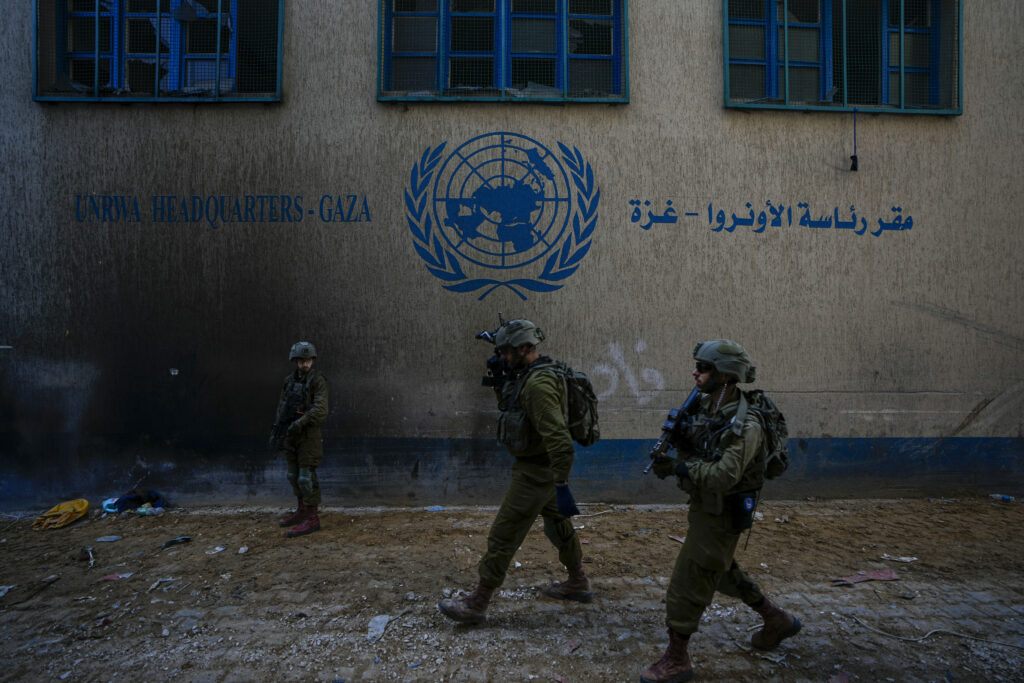 Yeshiva World News1 day ago
The Jerusalem District Court on Wednesday ordered Bank Leumi to transfer approximately NIS 11 million, or $3 million, from UNRWA’s bank account to the Jerusalem Municipality to cover unpaid municipal property taxes, rejecting the agency’s claim that diplomatic immunity shields its funds from collection.
Judge Haya Zandberg ruled that the legal protections granted to UNRWA under a 1967 agreement with Israel had expired following Knesset legislation terminating the arrangement and banning the agency’s operations within Israeli territory.
The dispute concerns two properties UNRWA maintained in Jerusalem for decades: an office and logistics compound in Ma’alot Dafna and an educational campus in Tsur Baher. The agency previously received full municipal property tax exemptions based on its recognized diplomatic status.
Bank Leumi froze UNRWA’s account in February 2024 over compliance concerns that funds could be used for terror financing. The agency did not initiate legal proceedings to lift the freeze.
Following the legislation ending UNRWA’s activities in Israel, the Jerusalem Municipality began collection proceedings for unpaid property taxes for 2024 and 2025.
UNRWA did not file a formal objection, administrative appeal or court petition challenging the assessments, leaving the debts legally final and binding. In August 2025, an administrative attachment order was issued against its bank account for NIS 11,056,426.94.
Bank Leumi subsequently asked the court for instructions on handling the frozen funds.
Zandberg upheld the municipality’s position, ruling that UNRWA could not use the bank’s proceedings to challenge tax assessments after failing to pursue the established appeal process. Informal diplomatic correspondence with Israel’s Foreign Ministry did not substitute for a formal appeal or court filing, she determined.
The judge also rejected UNRWA’s argument that its status as a United Nations body automatically grants it blanket immunity. She held that its protections under the 1967 arrangement ended when that agreement was terminated, and that international commitments do not override explicit Knesset legislation.
The court noted that the attorney general did not intervene in the proceedings to assert immunity on UNRWA’s behalf.
Addressing the concerns that originally prompted the account freeze, Zandberg ruled that transferring money directly to the municipality to satisfy tax debts would not place the funds in UNRWA’s operational control.
She also determined that the prohibition on UNRWA’s activities in Israel does not relieve it of its obligation to pay for municipal services it received.
The court instructed Bank Leumi to formally register the attachment and transfer the funds directly to the Jerusalem Municipality.
Shai Glick, CEO of the advocacy organization Btsalmo, welcomed the ruling as a legal and moral victory for Israel and Jerusalem residents, saying it demonstrated that UNRWA must comply with Israeli law and meet its obligations to taxpayers.
(YWN World Headquarters – NYC)
 Yeshiva World News1 day ago
The IDF has postponed an operation to arrest Chareidi men classified as deserters after senior police officials declined to provide security, warning that the arrests could ignite protests lasting through Election Day.
The operation had been scheduled for Sunday through Tuesday of next week. According to a report Wednesday evening, police leadership refused to allocate Tel Aviv District forces to secure the activity, leading the military to delay it.
Police officials reportedly feared that arrests so close to the elections would trigger widespread demonstrations in the Chareidi community and intensify tensions ahead of the vote.
During an internal discussion involving senior police officials, concerns were raised that protests could continue beyond the days immediately following the arrests and disrupt Election Day itself. Officials feared disturbances on a scale that available forces would struggle to manage.
The IDF confirmed that the operation had been postponed.
“In light of considerations raised by the Israel Police, the arrest activity planned for next week is being postponed,” the military said. “Activity in civilian areas requires coordination and cooperation with the Israel Police.”
Police had not issued a response to the report.
Meanwhile, a separate report said the state must inform the High Court of Justice on Thursday what steps it is taking to arrest Chareidi deserters.
According to police figures cited in that report, officers encountered 143 Chareidi deserters since July but released them at the scene because military police did not arrive in time to take custody.
The report also claimed that military police arrested only 15 Chareidi deserters during that period, alongside 14 non-Chareidi deserters. It cited an estimate of approximately 50,000 Chareidi men classified as deserters in Israel.
The IDF disputed the figures and rejected the suggestion that its enforcement efforts had stalled.
“The figure presented is unsubstantiated and does not correspond to the information held by the IDF,” the military said. “Contrary to the claims, proactive enforcement activity by military police soldiers continues and takes place regularly through a variety of methods.”
(YWN World Headquarters – NYC)
 Yeshiva World News1 day ago
HaGaon HaRav Dov Landau, Rosh Yeshivas Slabodka, issued a sharp response Wednesday to controversial remarks made by Finance Minister Bezalel Smotrich against the Chareidi community, describing the statements as a “deliberate public Chillul Hashem” and declaring that the obligation to protect Torah and its lomdim has become more urgent than ever.
The remarks were delivered during a visit by Rabbonim from Rechasim to the homes of HaRav Landau and HaGaon HaRav Moshe Hillel Hirsch, where they sought guidance and brachos ahead of Israel’s upcoming elections.
During the meeting, HaRav Landau addressed recent comments by Smotrich, who had questioned how anyone could remain Chareidi in Israel today and accused the Chareidi community of being ungrateful to Hashem.
“People who call themselves Torah-observant come and publicly declare that, chas v’shalom, there is no justification for being Chareidi in Eretz Yisroel,” HaRav Landau said. “This is a deliberate Chillul Hashem in public.”
The Rosh Yeshiva added that there was no need to respond directly to Smotrich, but stressed the importance of responding to what he characterized as a grave affront to Torah.
HaRav Landau also invoked the longstanding instructions of the Chazon Ish regarding participation in Israeli elections.
“The Chazon Ish zt”l clearly instructed that it is obligatory to vote in government elections,” he said. “The Chazon Ish’s instruction has not changed. On the contrary, today the obligation to vote is doubled and redoubled, because, Rachmana litzlan, the Torah itself is being subjected to attack, and those who learn Torah are being treated as plunder, Hashem yishmereinu.”
Referring to support for United Torah Judaism, whose ballot designation is the Hebrew letter Gimmel, HaRav Landau declared that casting a ballot represented a public affirmation of the centrality of Torah.
“When voting Gimmel, we proclaim loudly, ‘We have nothing remaining except this Torah!’ Only Torah! Only Torah! Hakadosh Baruch Hu has nothing in His world except the four amos of halacha. Only Torah! Only Torah!”
He further emphasized that voters should make every effort to participate, even when doing so involves considerable inconvenience or personal sacrifice.
The Rosh Yeshiva said that each person should vote in their own place of residence and should not seek exemptions based on distance or other logistical difficulties.
The remarks followed two appearances by Smotrich earlier this week, including an election event organized by Arutz Sheva and another gathering in Ofra, where the finance minister made unusually sharp comments about the Chareidi community.
Asked why he had not publicly responded to criticism directed at him by HaRav Landau, Smotrich initially said he was reluctant to engage in a public dispute with a talmid chacham.
“Let there not be, chas v’shalom, silence interpreted as agreement, because ‘beware of their burning coals,’” Smotrich said, referencing the traditional warning about showing respect to Torah scholars.
“If I thought responding would help, I would not respond to a talmid chacham,” he continued. “Incidentally, it pains me, and I daven to Hakadosh Baruch Hu that He should bring him, too, to teshuvah, but there is no need to respond.”
Smotrich then made additional remarks that drew criticism in Chareidi circles.
“The Chareidim are ungrateful to Hakadosh Baruch Hu. They are completely blind. I do not understand how anyone can be Chareidi today,” he said.
The comments generated widespread criticism within the Chareidi community, particularly because they were directed in part at HaRav Landau, one of the leading Gedolei HaDor.
Wednesday’s remarks marked HaRav Landau’s first public response to the controversy.
(YWN World Headquarters – NYC)
 Yeshiva World News1 day ago
Senior Iranian officials believe a U.S. military strike against Iran is approaching, warning regional diplomats that Tehran is preparing for renewed hostilities as tensions escalate in the Strait of Hormuz.
According to a report published Wednesday evening, Iranian officials have told diplomats in the region that they are operating under the assumption that Washington is preparing to launch an attack.
“Our working assumption is that the United States will attack. There is an atmosphere of war in Tehran,” the officials reportedly said.
The warnings come amid a sharp escalation in the Strait of Hormuz, where Iranian forces have reportedly intensified attacks against commercial vessels in recent days. Several ships struck during the latest incidents have reportedly sunk, further raising concerns about the security of one of the world’s most critical shipping routes.
Meanwhile, IDF Chief of Staff Lt. Gen. Eyal Zamir warned Wednesday that the potential for a broader military confrontation is increasing, announcing that the IDF is reinforcing its forces in response to the deteriorating security situation.
Zamir said the military is prepared for a rapid return to combat should hostilities resume.
Israeli assessments reportedly indicate that any new military operation against Iran would likely be coordinated between Israel and the United States rather than carried out independently by either country.
The possibility of Saudi Arabia participating in such an operation has also been raised, although no decision or formal commitment has been reported.
Despite the heightened military preparations, officials who participated in discussions with Prime Minister Binyamin Netanyahu say he is not interested in initiating military action before Israel’s upcoming elections, scheduled to take place in less than two weeks.
However, the growing military readiness on both sides has intensified concerns that a miscalculation could trigger a major confrontation even if neither side initially intends to launch a full-scale war.
Israeli officials reportedly believe Iran has an interest in increasing regional tensions ahead of the elections in both Israel and the United States, which are scheduled just days apart.
The concern is that Tehran could attempt to exploit the politically sensitive period to strengthen its negotiating position or exert additional pressure on Washington and Yerushalayim.
At the same time, Israeli assessments suggest that even if another round of fighting erupts, it may not produce a decisive military outcome.
Instead, officials believe another confrontation could eventually end with both sides returning to negotiations, as has occurred following previous escalations.
For now, the combination of Iranian attacks in the Strait of Hormuz, American military preparations, and Israel’s increased readiness has created an increasingly volatile situation, with officials warning that even a limited incident could ignite a much broader conflict.
(YWN World Headquarters – NYC)
 Yeshiva World News1 day ago
Israeli security forces arrested five Palestinian teenagers overnight on suspicion of establishing and belonging to a terror militia known as the “Sa’ir Brigades,” which authorities say carried out firebomb attacks, stone-throwing and arson in the Yehuda region.
The suspects, all approximately 15 years old and residents of Sa’ir, recently organized themselves into an illegal military group, according to investigators.
Authorities suspect the group’s members hurled Molotov cocktails and rocks at Israeli vehicles, roads and communities. They are also suspected of setting wooded areas near Israeli communities on fire with the intention of having the flames spread into the communities, and tearing down Israeli flags along roadsides.
The five were taken for questioning, and police are expected to seek an extension of their detention.
In a separate intelligence-directed operation in Beit Ula, security forces searched the home of a local resident in his 60s and seized weapons, ammunition and tens of thousands of shekels in cash.
The items recovered included an Egyptian-made Star pistol, Glock pistol parts, dozens of 9mm rounds and fireworks batteries. The resident was arrested and taken for questioning.
Police also arrested a suspect accused of driving a vehicle stolen from Kiryat Malachi through several roadblocks near Gush Etzion Junction over the weekend.
During his escape, the suspect reportedly rammed police vehicles, drove over spike strips and attempted to run over officers before abandoning the vehicle and fleeing on foot into a nearby village.
He was subsequently located and arrested at the Lachish crossing, also known as Tarqumiyah, and is due to appear in court for a detention-extension hearing.
(YWN World Headquarters – NYC)
 Yeshiva World News1 day ago
Israel Aerospace Industries has received two supplier awards from Lockheed Martin Aeronautics, recognizing its performance in manufacturing critical components for the F-35 and F-16 fighter jet programs.
The awards honor IAI’s quality, delivery and operational performance during 2025. Senior Lockheed Martin representatives presented them to IAI executives at a ceremony at the Israeli company’s facilities.
IAI received the Mission Focused Award for its work producing F-16 wings, vertical fins and conformal fuel tanks, and the Ahead of Ready Award for its F-35 wings program.
Lockheed Martin Aeronautics works with more than 1,400 active suppliers worldwide, with only a limited number selected for its annual awards. Suppliers must meet demanding standards for manufacturing quality, delivery schedules, operational performance and customer support.
IAI President and CEO Guy Bar Lev said the recognition reflects a partnership spanning nearly four decades.
“The partnership between IAI and Lockheed Martin spans nearly four decades and is built on mutual trust, technological cooperation and a shared commitment to supporting critical aerospace and defense programs,” Bar Lev said.
He added that the companies have worked together to meet changing operational needs and deliver advanced capabilities to customers worldwide.
Yaacov Berkovitz, executive vice president and general manager of IAI’s Aviation Group, said consistent quality, reliability and on-time delivery have been central to the relationship.
Lockheed Martin Aeronautics Vice President of Global Supply Chain Kyle Franklin praised IAI’s receipt of both awards, describing it as a testament to the professionalism, dedication and hard work of its team.
The companies have maintained a strategic partnership since the late 1980s, cooperating on aircraft structures for major aerospace and defense programs.
IAI has participated in the F-35 program since 2014, manufacturing wings at a dedicated assembly line. In February 2026, it delivered its 350th F-35 wing to Lockheed Martin.
The Israeli company has also supplied major F-16 components for more than 30 years. Those include wings, vertical fins and conformal fuel tanks, which carry additional fuel while fitting closely against the aircraft’s body. The fuel tank system was jointly developed by IAI and Lockheed Martin.
Beyond those fighter programs, IAI produces aircraft structures for commercial and military customers worldwide, including complex composite and metallic components.
(YWN World Headquarters – NYC)
 Yeshiva World News1 day ago
Nearly 39 years after the petirah of the Chernobyl Rebbe zt”l, members of the illustrious Chassidic dynasty are preparing to finalize the division of a substantial family inheritance that includes priceless seforim, historic religious artifacts, and valuable real estate in Eretz Yisroel.
According to a report by Kikar HaShabbat, the longstanding inheritance matter is expected to be resolved before the Rebbe’s upcoming yahrtzeit on 17 Cheshvan, following an initiative by the current Chernobyl Rebbe to bring the decades-old arrangements to a conclusion.
During Chol Hamoed Sukkos, the Rebbe reportedly expressed his desire for the inheritance to be divided before the yahrtzeit, prompting the family to move forward with a comprehensive appraisal of the estate.
Professional appraisers have begun examining the extensive collection of assets, which reportedly includes antique seforim of considerable historical and monetary value, a rare Shas printed in Slavita, ornaments used for sifrei Torah, and real estate holdings in Bnei Brak and Mevaseret Tzion.
The Slavita Shas is considered particularly significant because of its connection to the famed Jewish printing house established by descendants of the Noam Elimelech’s contemporary, Harav Pinchas of Koretz zy”a. Seforim produced by the historic Slavita press are highly prized by collectors, particularly within Chassidic communities, where they are treasured for both their rarity and their spiritual and historical significance.
The inheritance involves descendants of the late Rebbe, including sons who subsequently established or led branches of the Chernobyl dynasty in Eretz Yisroel and the United States.
Although discussions concerning the division of the estate have taken place over the years, the family had not previously completed a comprehensive distribution of the properties and religious treasures.
One issue reportedly complicating the appraisal process is the whereabouts of several rare seforim that were historically listed among the family’s possessions but can no longer be accounted for. It remains unclear whether those volumes were transferred, distributed, or otherwise removed from the collection over the intervening decades.
The appraisers are now working to establish the value of the remaining assets as the family seeks to complete the division before 17 Cheshvan.
The late Rebbe was HaRav Meshulam Zusia Twersky zt”l, who was niftar on 17 Cheshvan 5748, November 9, 1987. His Rebbetzin passed away in Sivan 5772, and according to the report, the children had refrained from discussing a formal division during her lifetime out of respect for her.
The inheritance includes an antique Shas associated with Harav Aharon of Chernobyl zy”a, a kittel inherited from earlier generations, the Rebbe’s yarmulke and clothing, sifrei Torah and their crowns. One shelf of seforim was divided shortly after the Rebbe’s petirah, with each heir receiving an antique siddur.
The report also identifies major properties on Raavad Street and Ohr Hachaim Street in Bnei Brak. It describes a previous real estate transaction in Herzliya in which the Rebbe’s daughters reportedly waived their shares in favor of their brothers. Whether that earlier arrangement will affect the current distribution remains unclear.
The family includes five sons, among them Rebbes associated with Chernobyl in Eretz Yisroel, the United States, Loyev-Chernobyl and Ashdod, as well as HaRav Yaakov Mordechai Twersky of Elad. The late Rebbe’s sons-in-law include the Vizhnitzer Rebbe and the Kretchnifer Rebbe of Yerushalayim.
(YWN World Headquarters – NYC)
 Yeshiva World News1 day ago
Iran has adopted new tactics for attacking commercial vessels in the Strait of Hormuz, deliberately seeking to keep global oil prices elevated and influence the upcoming U.S. midterm elections. Two senior Iranian officials described the strategy, approved at the highest levels of the regime, to Reuters.
The officials said Tehran began changing the frequency and methods of its attacks approximately 10 days ago, targeting ships it considers to be violating restrictions on passage through the strategic waterway.
The Revolutionary Guard has increasingly relied on smaller vessels and reconnaissance operations to identify potential targets as American military pressure has weakened portions of Iran’s conventional maritime capabilities.
Iran also intends to expand operations beyond the Strait of Hormuz into the Gulf of Oman and surrounding waters near Qatar and the United Arab Emirates.
One Iranian official said Tehran’s objective is to prevent President Donald Trump from reducing oil prices ahead of the November elections. American naval authorities continue warning commercial shipping operators about the severe threat posed by Iranian forces in the region.
(YWN World Headquarters – NYC)
 Yeshiva World News1 day ago
Rep. Ilhan Omar (D-Minn.) is facing federal investigations in Washington, D.C., and Minnesota involving allegations of immigration fraud and discrepancies in her financial disclosures, according to a New York Post report published Wednesday, just two days after federal agents searched her Washington residence.
The investigations are examining separate issues involving the Minnesota congresswoman’s immigration history and the dramatic changes in her reported family wealth, which previously included business interests valued at as much as $30 million.
According to the Post, the U.S. Attorney’s Office in Washington, led by Jeanine Pirro, is examining Omar’s financial disclosures, while federal investigators in Minnesota are reviewing allegations concerning her immigration records and eligibility for citizenship.
On Monday, Homeland Security Investigations agents executed a court-authorized search warrant at Omar’s Washington home, removing materials believed to be relevant to the immigration investigation.
Investigators are reportedly examining whether Omar or her late father provided inaccurate information on immigration documents decades ago, including questions surrounding her birth date and her father’s naturalization.
Federal grand jury subpoenas have also reportedly been issued to members of Omar’s family, including her sister, Sahra Noor.
The financial investigation centers on disclosures involving two businesses connected to Omar’s husband, Tim Mynett: Rose Lake Capital, a venture capital firm, and eStCru, a California-based wine business.
Earlier congressional filings placed the combined value of the businesses between $6 million and $30 million in 2024, a substantial increase from their reported values the previous year.
However, Omar subsequently amended her financial disclosures, reducing the couple’s reported assets to a range of approximately $18,000 to $95,000.
Her office has maintained that the original figures incorrectly reflected the businesses’ total equity without properly accounting for liabilities and Mynett’s ownership interests.
The Office of Congressional Conduct previously reviewed allegations involving the disclosures and recommended dismissal in September, finding insufficient reason to believe Omar had violated federal law or House rules.
Meanwhile, Mynett broke his silence Wednesday when confronted by Fox News Digital outside the couple’s Washington residence.
“My wife came here when she was 12 years old as a child war refugee. No concerns,” Mynett said when asked about the federal investigation.
His remarks came as President Donald Trump continued publicly questioning Omar’s financial history and the circumstances surrounding her immigration to the United States.
Omar has denied wrongdoing and accused the Trump administration of using federal law enforcement to target political opponents.
(YWN World Headquarters – NYC)
 Yeshiva World News1 day ago
Supreme Court Justice Noam Sohlberg, chairman of Israel’s Central Elections Committee, sought to reassure voters Wednesday that the upcoming Knesset elections would be conducted securely, declaring that the country’s voting system cannot simply be manipulated to produce fraudulent results.
Sohlberg made the remarks during a visit to the Elections Committee’s logistics center, where officials are preparing materials for the October 27 election.
More than 7.3 million Israelis are eligible to participate in the election, with 12,018 polling stations scheduled to operate throughout the country. Election officials have prepared approximately 450 million ballot slips.
During his visit, Sohlberg reviewed the extensive logistical preparations and addressed concerns about attempted interference, including cyberattacks, the misuse of artificial intelligence, and security threats.
The committee has been examining emergency scenarios that could affect Election Day, including missile attacks and disruptions at polling stations. Preparations are being coordinated with relevant security authorities ahead of the nationwide vote.
(YWN World Headquarters – NYC)
 Yeshiva World News1 day ago
Colombia officially inaugurated its embassy in Yerushalayim on Wednesday, becoming the tenth country to establish its diplomatic mission in Israel’s capital. Israeli Foreign Minister Gideon Sa’ar and Colombian Foreign Minister Omar Bula Escobar attended the opening ceremony.
During the inauguration, the two ministers unveiled the embassy’s sign, marking the formal establishment of the Colombian diplomatic mission in Yerushalayim.
Sa’ar affixed a mezuzah to the entrance of the embassy before addressing those attending the ceremony. He described the opening as an important milestone in relations between Israel and Colombia.
The foreign minister noted that when he took office less than two years ago, only five foreign embassies were located in Yerushalayim. Colombia’s decision brings that number to ten.
Colombia’s foreign minister said diplomatic relations between the countries should never have been interrupted and described Israel as a strategic partner. Following the ceremony, the ministers continued their discussions during a diplomatic meeting at Israel’s Foreign Ministry.
(YWN World Headquarters – NYC)
 Yeshiva World News1 day ago
Israeli security forces arrested five wanted suspects during two targeted raids in Yehuda and Shomron against organizations that authorities say operated under the guise of charitable work while serving as financial and organizational arms of Hamas and the Popular Front for the Liberation of Palestine.
The joint IDF and Shin Bet operations targeted offices in Ramallah and Yatta. Forces confiscated computers, documents and checkbooks connected to funds used to finance hostile activity, according to security officials.
Earlier this week, troops raided the offices of Addameer in Ramallah. Israeli security authorities said the organization receives terror funding and provides legal assistance to PFLP terrorists imprisoned in Israel.
Officials also said some of the organization’s employees participated in the August 2019 terrorist attack at Danni Spring in which Rina Shnerb, HY”D, was murdered.
In a separate operation conducted in recent weeks under Shin Bet direction, IDF troops raided the offices of the Islamic Association for the Care of Orphans in Yatta, within the Yehuda Brigade’s area of operations.
According to security officials, the association serves as a financial arm funneling money to Hamas and supporting the families of terrorists and prisoners.
Authorities said the association’s director and other senior figures are Hamas operatives who previously served prison sentences. They said those officials use the organization’s civilian cover to strengthen Hamas’s influence in the area.
The IDF and Shin Bet said both organizations targeted in the raids had been declared unlawful associations.
Security forces said they would continue proactive operations to dismantle terror infrastructure throughout Yehuda and Shomron and bring terrorists operating against Israeli civilians to justice.
(YWN World Headquarters – NYC)
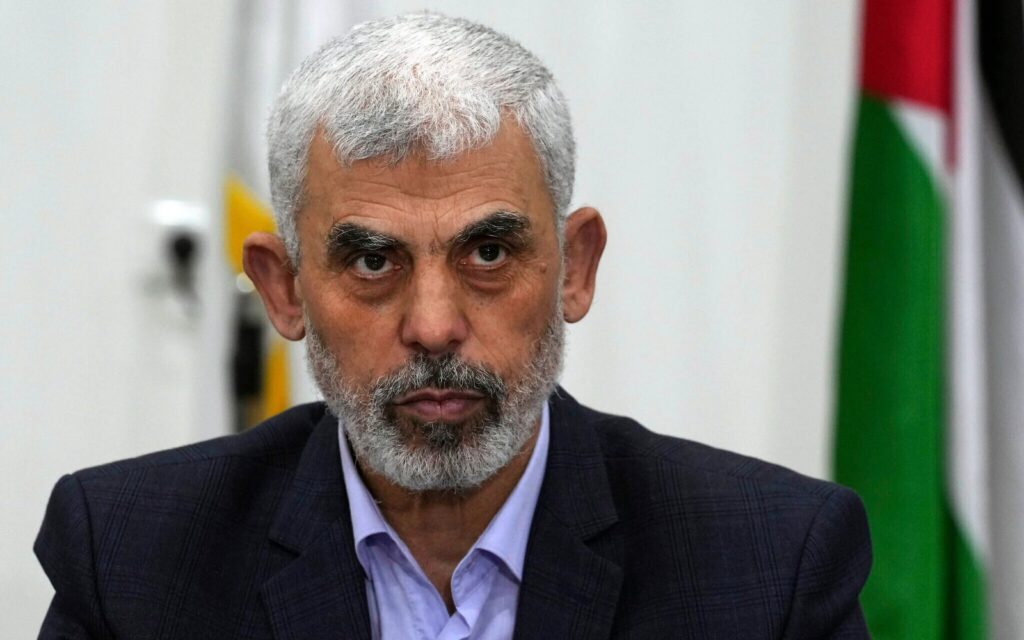 Yeshiva World News1 day ago
Former Shin Bet chief Ronen Bar has filed a NIS 3 million defamation lawsuit against Prime Minister Binyamin Netanyahu, alleging that he repeatedly warned of growing threats from Hamas and recommended eliminating senior terrorist leaders in Gaza in the months preceding the October 7 massacre, but that his recommendations were never implemented.
The lawsuit, filed Wednesday, presents a detailed account of security discussions throughout 2022 and 2023, including proposals to eliminate Hamas leader Yahya Sinwar and other senior commanders, warnings about deteriorating Israeli deterrence, and disagreements over the government’s approach to Gaza.
Among the most significant allegations is Bar’s claim that Netanyahu expressed concern that expanding Israel’s targeted assassination policy could provoke retaliatory attacks against him personally.
According to the lawsuit, Bar raised the possibility of eliminating Sinwar during a November 7, 2022, meeting with Netanyahu, before Netanyahu returned to the premiership.
Bar said the Shin Bet had previously prepared an operational plan to eliminate Sinwar, but that his recommendation to carry out the operation during 2022 had not been advanced.
He argued that Sinwar was exploiting Hamas’s ability to direct terrorist attacks from Gaza into Yehuda and Shomron without facing significant consequences inside the Gaza Strip.
On January 8, 2023, following additional terrorist activity directed from Gaza, Bar says he again recommended retaliatory action against Hamas. According to his lawsuit, that recommendation was also not implemented.
The warnings reportedly intensified over the following months.
On February 13, Bar sent Netanyahu a letter warning about the dangerous combination of weakening Israeli deterrence, instability in the Palestinian arena, and growing internal divisions within Israel.
According to Bar, Netanyahu responded by emphasizing the Shin Bet’s responsibility for protecting elected officials, including the prime minister and his family.
During an April 19 security assessment, Bar warned that terrorist organizations viewed Israel’s internal divisions and weakened deterrence as opportunities to intensify attacks.
He recommended targeting Hamas operatives directing terrorism from Gaza, arguing that they were operating with a sense of immunity.
Another significant discussion took place on May 21, 2023, following Israel’s military operation against Palestinian Islamic Jihad.
Bar reportedly urged Netanyahu to expand the use of targeted assassinations beyond Islamic Jihad and presented intelligence indicating that Sinwar’s ideology and strategic approach were becoming increasingly extreme.
According to the lawsuit, Bar argued that precise offensive action at the beginning of a confrontation could shorten fighting and reduce casualties.
However, Bar alleges that Netanyahu raised concerns about possible personal retaliation against him if Israel expanded its targeted assassination policy.
The former Shin Bet chief claims he continued warning about the situation throughout the summer.
On August 20, he presented a security assessment warning about possible escalation during the upcoming Yomim Tovim. The following day, he again warned Netanyahu about increasing terrorist activity directed from Gaza.
Bar alleges that although Netanyahu acknowledged the need to address Hamas’s terrorist command infrastructure, the proposed measures were not advanced.
During a September 12 Cabinet discussion, Bar reportedly warned that Israel was confronting an unusually high number of attempted terrorist attacks and that defensive operations alone would not fundamentally change the security situation.
According to the lawsuit, Netanyahu emphasized the importance of maintaining relative calm throughout the Yom Tov period.
On September 21, the Shin Bet submitted a professional assessment recommending consideration of a preemptive offensive operation, although Bar acknowledged that the proposed action was intended for after the Yomim Tovim.
During another discussion on September 27, Netanyahu reportedly instructed security officials to exercise restraint and avoid an escalation with Gaza.
The final major discussion cited in the lawsuit occurred on October 1, just six days before the Hamas massacre.
Bar claims he warned that terrorist activity originating in Gaza had reached an exceptional level and that Israel could be drawn into a confrontation even before the conclusion of the Yomim Tovim.
He recommended accelerating preparations to eliminate senior Hamas operatives responsible for directing terrorist activity.
According to Bar, Netanyahu authorized preparations for targeted assassinations, but no follow-up operational discussion was convened and the proposed actions were not carried out.
Previous reports concerning the pre-October 7 security discussions indicated that Shin Bet officials had sought to revive plans for the simultaneous elimination of Sinwar and Hamas military commander Mohammed Deif, followed by strikes against additional commanders.
However, records released by Netanyahu’s office have also included instructions to advance operational readiness for targeted assassinations, raising questions about which measures were authorized, whether the plans were operationally ready, and why no strikes ultimately took place.
Authorization to prepare an operation does not necessarily constitute approval to execute it, and the lawsuit does not establish that eliminating Hamas leaders before October 7 would have prevented the massacre.
The dispute also extends to the critical hours immediately preceding the attack.
Netanyahu has repeatedly accused Bar of failing to personally notify him after the Shin Bet detected suspicious Hamas activity overnight.
Bar rejects allegations that he deliberately withheld information, maintaining that an alert about signs of possible offensive activity was distributed at 3:03 a.m. on October 7 and that instructions were issued to notify the prime minister’s military secretary.
Bar has acknowledged his responsibility for the Shin Bet’s failure to identify the scale and timing of the Hamas attack, citing that failure as a reason for his resignation.
Netanyahu, responding Wednesday to the lawsuit, sharply criticized Bar’s explanation for not contacting him directly.
“Ronen Bar, who saw the warning signs on the night of October 7 and did not call me, says today that he did not have my phone number. Ronen, are you serious?” Netanyahu said.
“You had my secure red-phone number and could have called me immediately, as all the heads of the security establishment do. The Shin Bet security guards, your subordinates, who are with me 24/7, could have reached me within minutes. How many lives could we have saved if only you had called in time?”
(YWN World Headquarters – NYC)
 Yeshiva World News1 day ago
Two major Israeli election polls released Wednesday evening, less than two weeks before Israelis head to the polls, paint sharply conflicting pictures of the political landscape, with one showing Prime Minister Binyamin Netanyahu’s coalition falling well short of a majority and the other projecting a narrow 62-seat majority for the right-wing bloc.
The surveys, conducted for Channel 13 and Channel 14, differ dramatically in their projections for Netanyahu’s Likud party, the Chareidi parties, and several smaller political factions, highlighting the uncertainty surrounding the upcoming Knesset elections.
According to the Channel 13 poll, former IDF Chief of Staff Gadi Eisenkot’s Yashar party emerges as the largest faction with 20 seats, while Netanyahu’s Likud trails with just 18 seats.
Former Prime Minister Naftali Bennett’s Beyachad party receives 12 seats, followed by Yair Golan’s Democrats and Avigdor Lieberman’s Yisrael Beiteinu, each with nine.
Among the Chareidi parties, United Torah Judaism, led by Yaakov Asher, receives eight seats, while Shas, led by Aryeh Deri, receives seven.
Itamar Ben-Gvir’s Otzma Yehudit receives eight seats, while the Religious Zionism-Zehut alliance led by Bezalel Smotrich and Moshe Feiglin wins six.
The Joint Arab List receives nine seats, while Mansour Abbas’s Ra’am receives six.
Two smaller parties also cross the electoral threshold in the Channel 13 survey. Ofer Winter’s Amcha Yisrael receives four seats, while the combined Reservists and Economic Party headed by Yoaz Hendel and Yaron Zelekha also receives four.
Under that scenario, Netanyahu’s bloc receives just 51 seats, compared to 50 seats for the non-Arab opposition parties, 15 for the Arab parties, and four for Hendel and Zelekha.
However, a separate Channel 14 poll released the same evening presents a dramatically different picture.
In that survey, Likud emerges as the largest party with 29 seats, an 11-seat difference from the Channel 13 projection.
Eisenkot’s Yashar remains at 20 seats, while Bennett’s party receives 11 seats, a four-seat increase from Channel 14’s previous survey.
Shas receives 10 seats, three more than in the Channel 13 poll, while United Torah Judaism receives eight seats in both surveys.
Ben-Gvir’s Otzma Yehudit also receives eight seats in both polls, while the Religious Zionism-Zehut alliance receives seven seats in Channel 14.
The Democrats receive eight seats, Yisrael Beiteinu receives five, the Joint Arab List receives nine, and Ra’am receives five.
Unlike Channel 13, Channel 14 projects that neither Winter’s party nor the Hendel-Zelekha alliance would cross the electoral threshold. Hendel and Zelekha receive 3.1% of the vote, while Winter receives 2.7%, both below Israel’s 3.25% threshold.
The resulting bloc breakdown gives Netanyahu and his allies 62 seats, compared to 44 for the opposition and 14 for the Arab parties.
The surveys also reveal notable differences in voter attitudes toward Netanyahu and potential coalition arrangements.
Channel 14 asked respondents who they considered most suitable to serve as prime minister. Netanyahu received 52%, Eisenkot 32%, Bennett 11%, and Lieberman 5%.
In a separate head-to-head comparison between Netanyahu and Eisenkot, Netanyahu received 52% compared to Eisenkot’s 48%.
Channel 13 examined attitudes toward forming a government with the support of Arab parties. According to the survey, 43% opposed such an arrangement, 40% supported it, and 17% were undecided.
Among respondents who identified as coalition voters, 60% supported forming a government with Chareidi parties in exchange for military draft exemptions, while 21% opposed the arrangement and 19% were undecided.
The Channel 14 poll was conducted Wednesday by NEXT DATA among 568 adults, with data analyzed by pollster Shlomo Filber.
The Channel 13 survey included 1,018 respondents and reported a sampling margin of error of 3.1 percentage points.
(YWN World Headquarters – NYC)
 Yeshiva World News1 day ago
Israeli police arrested a foreign national suspected of supporting terrorism after investigators discovered social media material showing her wearing clothing featuring Prime Minister Benjamin Netanyahu’s face marked with a targeting symbol. Authorities announced Wednesday that the woman had been transferred for possible deportation.
The investigation began following a confrontation near Mitzpe Yair in the Chevron Hills several days earlier. Police officers responding to the incident identified one of the individuals involved as a foreign anti-Israel activist.
Investigators subsequently examined her activities and publications, discovering material they believed indicated support for extremist organizations, including Addameer, which Israel designated a terrorist organization in 2021.
Among the materials examined was an image depicting the prime minister with what appeared to be a crosshair over his head. Police detained the woman and questioned her regarding the publications and her activities in Israel.
Following the investigation, she was placed in custody and transferred Wednesday morning to the Population and Immigration Authority for a hearing ahead of possible removal from the country.
(YWN World Headquarters – NYC)
 Yeshiva World News1 day ago
Israel has accused Hamas of threatening merchants in Gaza and demanding approximately NIS 10,000 for each truck carrying commercial goods into the territory, warning that the terrorist organization is attempting to interfere with civilian supply deliveries.
According to information released by COGAT, merchants reported that Hamas also requires them to sell approximately 30 percent of their goods in cash, violating arrangements that require approved traders to conduct transactions through banking channels.
Israeli authorities said the threats extended beyond financial demands. The terrorist organization reportedly carried out arrests connected to the dispute, including the detention of a merchant’s son.
COGAT sent an urgent communication to international organizations warning that Hamas was threatening the continued operation of Gaza’s private commercial supply system, which accounts for approximately half of incoming truck deliveries.
Israeli officials said the United Nations, international aid organizations, and donor countries would continue to coordinate humanitarian shipments separately. COGAT also warned that Hamas could attempt to blame Israel for shortages resulting from interference with private merchants.
(YWN World Headquarters – NYC)
 Yeshiva World News1 day ago
Jewish residents and community advocates in Somerville, Massachusetts, are challenging a proposed municipal ordinance that would restrict the city from doing business with companies accused of supporting Israeli violations of international law. The opposition was presented during proceedings before city council members.
The proposed ordinance would affect municipal business relationships with companies deemed to be involved in activities covered by the measure. Supporters have framed the proposal as a way to align city spending with their understanding of international legal obligations.
Opponents argue that the proposal unfairly singles out Israel and could create a hostile atmosphere for Jewish residents who identify strongly with the Jewish state.
The head of a local organization opposing the measure told council members that the proposal was making Jewish residents feel unwelcome in their own community.
The dispute is unfolding as American municipalities and universities continue debating divestment initiatives involving Israel. Somerville officials heard petitions and public testimony as part of their consideration of the proposed ordinance.
(YWN World Headquarters – NYC)
 Yeshiva World News1 day ago
Israeli Prime Minister Binyamin Netanyahu issued a stern warning to Iran on Wednesday, declaring that any Iranian attack on Israel on Election Day would be met with devastating consequences, while insisting that Israel must ultimately eliminate the Iranian threat once and for all.
Speaking in an interview with Galei Israel Radio, Netanyahu said Israel was prepared for any scenario and warned Tehran against miscalculating Israel’s determination.
“If Iran makes that mistake, it will be the last mistake they ever make. Literally,” Netanyahu declared. “And I warn our enemies: Do not misjudge us. Whether they attack or not, we must eliminate this threat once and for all.”
The prime minister said Israel had already achieved significant victories in confronting its security threats.
“We have done a tremendous amount. We have brought about a historic transformation here,” he said.
Netanyahu also addressed the security situation in Yehuda and Shomron, particularly the possibility of allowing displaced Palestinians to return to a refugee camp following proceedings before Israel’s Supreme Court.
“No, we will not bring them back. These were not residents but collaborators with terrorism,” Netanyahu said.
He further claimed that terrorist activity across Yehuda and Shomron had declined dramatically, stating that terrorism had fallen by 80%.
In the second half of the interview, Netanyahu turned his attention to Israel’s judicial and law enforcement establishment, launching a blistering attack on senior officials involved in the criminal investigations and prosecution against him.
The prime minister called for criminal investigations into former Attorney General Avichai Mandelblit, former State Attorney Shai Nitzan, former Tel Aviv District Prosecutor Liat Ben-Ari, prosecutor Yehudit Tirosh, and senior police investigators.
Netanyahu revisited his longstanding declaration from the beginning of the investigations against him that “there will be nothing because there was nothing,” arguing that subsequent developments had vindicated his position.
“Remember when I said, ‘There will be nothing because there was nothing’? Well, it turns out there was nothing on my side. But there were many, many offenses on their side,” Netanyahu said.
He accused investigators and prosecutors of conducting a politically motivated campaign that caused enormous suffering to him and his family.
“This was a vicious political witch hunt that caused unimaginable suffering to me, my family, and those around me,” he charged.
Netanyahu also raised allegations concerning the authorization of the indictments against him and the investigative methods employed by law enforcement.
“They used the most advanced spyware in the world,” he alleged.
The prime minister claimed that Mandelblit had failed to properly review the evidence and had not signed the indictment as required.
“He didn’t read the letter. He didn’t examine the evidence. So why did you do it?” Netanyahu asked.
Netanyahu further argued that the investigations and prosecution contributed directly to Israel’s prolonged political instability, which resulted in five national elections within several years.
“Today people understand that this is a political trial, and it led us to five election campaigns, billions spent on unnecessary elections and unnecessary investigations,” he said.
The prime minister insisted that the matter extended far beyond his personal legal battles.
“This is not just a personal injury to me. This is a danger to democracy. Clear reform is necessary, and we will carry it out,” Netanyahu declared.
Netanyahu concluded by renewing his demand for investigations into the former senior judicial and law enforcement officials involved in his cases.
(YWN World Headquarters – NYC)
 Yeshiva World News1 day ago
A new investigation has cast serious doubt on widely reported claims that Egypt’s intelligence chief secretly flew to Israel just 11 days before the October 7, 2023 Hamas massacre to deliver an urgent warning about an impending attack. The Egyptian private jet that landed at Ben Gurion Airport on September 26, 2023, was actually carrying two businessmen, not Abbas Kamel, who headed Egypt’s intelligence services at the time, Kan News reported Wednesday.
The revelation directly challenges earlier investigations, including a September report by The Atlantic, which claimed that Kamel personally traveled to Israel aboard the aircraft to warn senior Israeli officials that Hamas was preparing a significant attack. That investigation, based on information from officials in multiple countries and aviation records, generated widespread controversy over what warnings Israel may have received before October 7.
Similar allegations had previously appeared in Israeli media, including Israel Hayom, which reported that Egyptian intelligence officials had attempted to warn Israel about growing threats from Gaza. The reports intensified public debate over the intelligence failures preceding the massacre and whether senior Israeli officials had received advance warnings.
However, Wednesday’s findings present a sharply different account of the flight that became central to those allegations.
According to multiple sources familiar with the incident, the aircraft belonged to Egyptian charter company Smart Aviation and landed at Ben Gurion Airport shortly before 10 a.m. on September 26, 2023.
Two businessmen disembarked and entered Israel through the private Fattal Terminal. Approximately one hour later, the aircraft departed for Cairo without any passengers.
The plane received routine ground services from QAS, and the flight was classified as an ordinary civilian business operation rather than an official diplomatic or security-related mission.
The identities of the two businessmen are known to the relevant Israeli authorities, including the Transportation Ministry, the Fattal Terminal, and the Population and Immigration Authority, as well as the Egyptian charter company. However, their names have not been publicly disclosed due to confidentiality practices surrounding private aviation.
The new findings are particularly significant because previous reports had pointed to the aircraft’s brief visit as evidence of an urgent intelligence mission. The Atlantic’s investigation had described Kamel’s purported arrival as an extraordinary attempt by Egypt to alert Israeli officials to the possibility of a major Hamas attack.
Prime Minister Benjamin Netanyahu has denied receiving an advance warning from Kamel and has maintained that he neither met nor spoke with the Egyptian intelligence chief before the massacre. Netanyahu’s statements came amid mounting questions over the allegations published by Israeli and international media outlets.
The latest investigation does not establish that Kamel never visited Israel during that period. It specifically disputes claims that he was aboard the September 26 aircraft. It also does not determine whether Egyptian intelligence conveyed warnings to Israeli security officials through other channels.
Last week, former military secretary to Netanyahu Maj. Gen. Avi Gil stated in media interviews that there was no doubt an Egyptian aircraft had landed in Israel approximately a week and a half before October 7. The newly disclosed findings confirm the aircraft’s arrival while identifying its passengers as two businessmen rather than the Egyptian intelligence chief.
(YWN World Headquarters – NYC)
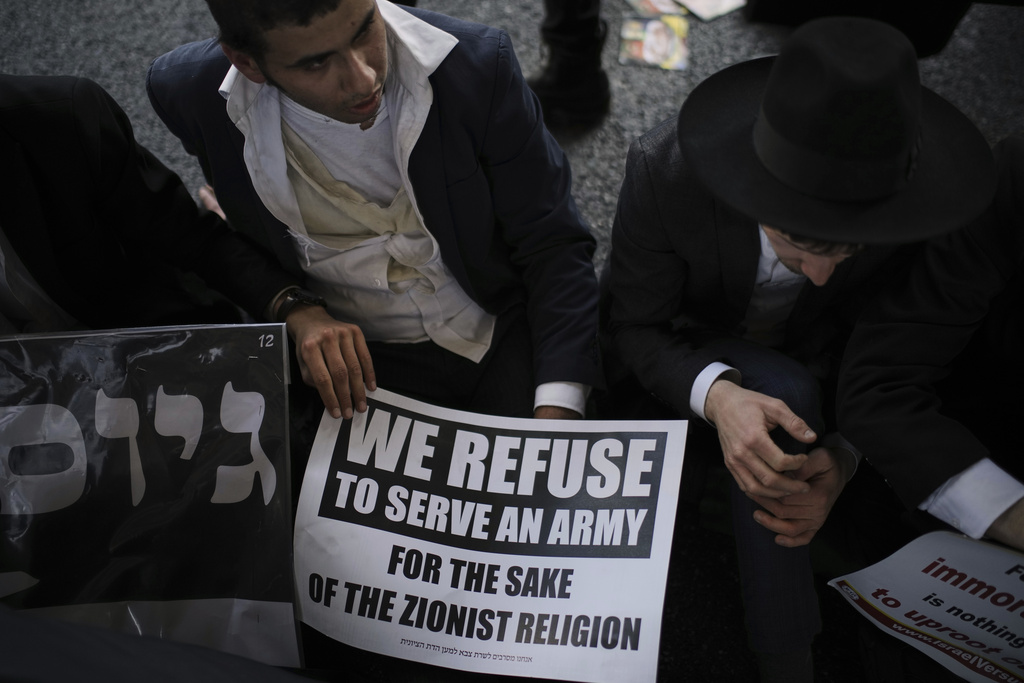 Yeshiva World News1 day ago
Growing frustration among Chareidi voters over the unresolved yeshiva draft crisis is creating unusual tensions within Agudas Yisrael ahead of Israel’s October 27 election, with some longtime supporters openly questioning whether they will vote for the party.
The dissatisfaction centers on the failure of Chareidi political representatives to secure legal protections for yeshiva bochurim despite years of participation in the governing coalition.
At recent demonstrations, some participants expressed intentions to abstain from voting, while others made particularly sharp statements about supporting parties outside the traditional Chareidi political framework. Those comments do not necessarily represent the broader electorate.
Unusual silence has also been reported among activists associated with the central faction of Agudas Yisrael, particularly within the Ger community, as internal disagreements persist between different Chassidic political factions.
Tensions involving Belz and Shlomei Emunim have also become visible in Chareidi publications and campaign gatherings. At a recent meeting, incoming Belz representative Elyakim Stark emphasized the faction’s political independence and its determination to assert its influence.
(YWN World Headquarters – NYC)
 Yeshiva World News1 day ago
Ukraine accused Elon Musk’s SpaceX of imposing new restrictions on Starlink satellite communications that have disrupted military drone operations and forced Ukrainian forces to cancel missions. Ukrainian military officials said the limitations were introduced without sufficient warning.
Starlink terminals have become essential to Ukraine’s military communications, particularly for controlling drones operating in areas where Russian electronic warfare makes traditional communication systems unreliable.
Ukrainian presidential adviser Serhiy Beskrestnov said SpaceX had restricted the military-grade service at speeds exceeding approximately 100 miles per hour, or 160 kilometers per hour.
Ukraine’s 7th Rapid Reaction Corps reported that some drones experienced communication interruptions lasting between 10 and 20 seconds at considerably lower speeds. The interruptions made the aircraft difficult to control and forced the cancellation of several operations.
A Ukrainian Defense Ministry source said the restrictions also complicated military logistics. SpaceX did not immediately respond to a request for comment, and the reason for the new limitations remained unclear.
(YWN World Headquarters – NYC)
 Yeshiva World News1 day ago
The Knesset Finance Committee approved a series of transfers within Israel’s 2026 state budget Wednesday, including funding for protective shelters, an artificial intelligence headquarters, road safety and legal representation abroad.
Under the changes, NIS 81 million will be transferred from the Defense Ministry’s budget to civilian emergency spending. The money will fund the purchase and deployment of protective shelters nationwide, implementing a government decision based on lessons learned from Operation Lion’s Roar.
The committee also approved an internal transfer of approximately NIS 67 million within the Prime Minister’s Office to fund an artificial intelligence headquarters.
For infrastructure and land development, lawmakers approved a NIS 30 million transfer and authorization to commit approximately NIS 852 million for Israel Land Authority development activities. The funding will also support long-term land rehabilitation projects, including the treatment of former industrial sites.
An additional NIS 30 million will be allocated to the National Road Safety Program.
The Justice Ministry’s budget allocations will be adjusted through internal transfers totaling NIS 74 million. Part of the funding will support the government’s legal representation abroad amid increased activity by the Universal Jurisdiction Unit since the outbreak of the Swords of Iron war.
Allocations for the Public Defender’s Office and legal aid will also be adjusted to reflect the pace of implementation.
(YWN World Headquarters – NYC)
 Yeshiva World News1 day ago
A 10-year-old boy was tragically killed Wednesday afternoon after an explosion erupted from a burning garbage container in the Chareidi city of Beitar Illit.
The horrific incident occurred on Rebbe of Nadvorna Street, where a garbage recycling container had caught fire under circumstances that remain unclear. During the blaze, an explosion sent an unidentified object flying from the burning container, striking the child and causing devastating injuries.
Magen David Adom received an emergency call at approximately 4:56 p.m. Paramedics arriving at the scene found the boy unconscious and suffering from severe injuries throughout his body.
Emergency responders immediately began resuscitation efforts before rushing the child to Hadassah Ein Kerem Hospital in Yerushalayim in critical condition. Despite efforts to save his life, his death was subsequently confirmed.
Firefighters and volunteers from the Yehuda Regional Fire Station responded to the scene and worked to extinguish the burning garbage.
Israel Police said the cause of the fire remains unknown and that investigators are working to determine precisely what exploded.
According to the police, an unidentified object was propelled from the burning recycling container and struck the child, who had been standing nearby.
(YWN World Headquarters – NYC)
 Yeshiva World News1 day ago
The IDF announced Wednesday that it eliminated a Hamas military commander who participated in holding Israeli hostages captive in Gaza during the war. The terrorist was killed in an Israeli airstrike carried out Tuesday in Gaza City.
The military identified the commander as Mumen Ahmad Salameh al-Ay, who served in Hamas’s Gaza City Brigade and worked alongside senior commanders in the terrorist organization.
According to the IDF, al-Ay was involved in holding hostages in the Gaza City area, although the military did not identify the individuals who had been held under his control.
In recent months, the commander had reportedly been involved in planning attacks against IDF soldiers and Israeli civilians while attempting to rebuild Hamas’s military capabilities.
The IDF said the terrorist’s activities represented a systematic violation of the ceasefire arrangements. Israeli forces carried out the strike after identifying his continued involvement in terrorist operations.
(YWN World Headquarters – NYC)
 Yeshiva World News1 day ago
Iran’s central bank governor rejected American claims that the Iranian economy is collapsing, insisting that the country’s financial system remains functional despite an extensive U.S. naval blockade and growing economic pressure. The remarks were delivered during an International Monetary Fund meeting in Bangkok.
The United States reinstated its blockade of Iranian ports in July and launched Operation Economic Outcast on August 24, targeting Tehran’s remaining financial and commercial connections to the international economy.
According to energy intelligence firm Vortexa, Iran’s seaborne crude oil exports fell to zero during the second week of September, compared with a 14-day average of approximately 230,000 barrels per day at the beginning of that month. Exports remained at zero as of October 5.
The economic pressure has also severely weakened Iran’s currency. Exchange-rate data indicate that the Iranian rial has lost nearly 35 percent of its value against the U.S. dollar since July, while annual inflation reached 73.6 percent in September.
Central Bank Governor Abdolnasser Hemmati said his institution is prioritizing inflation control, financial stability, and the continued operation of banking and payment services. He also emphasized efforts to secure foreign currency for medicine and essential goods. Iran’s central bank launched a program in late September to sell up to $2 billion through state banks to support the rial.
(YWN World Headquarters – NYC)
 Yeshiva World News1 day ago
A troubling security failure has emerged following the deadly school trip explosion in northern Israel, with new information revealing that Maalot-Tarshiha had been operating without a security officer responsible for educational institutions when a student was killed by unexploded military ordnance.
The municipality had reportedly been without an education security officer since the beginning of October, following the resignation of the previous official amid concerns about deficiencies in school security procedures.
The disclosure comes after Elazar Yair Vilensky z”l, a student at ORT Maalot, was killed Monday when unexploded ordnance detonated during a school outing in the Ramim Ridge area near Israel’s northern border.
The preliminary findings indicate that a security inspection of the planned hiking route may not have been conducted before the students entered the area. Investigators are examining the procedures used to approve the outing and determine whether the route had been adequately inspected.
Authorities are also investigating the presence of unexploded military ordnance near the hiking trail. The explosion injured several additional students and prompted calls for stronger security inspections of school trip routes in areas where military operations have taken place.
(YWN World Headquarters – NYC)
 Yeshiva World News1 day ago
Central Elections Committee chairman Justice Noam Solberg sought to reassure the public Wednesday that Israel’s election safeguards will protect the integrity of the vote, despite concerns about security threats, cyberattacks and attempts to use artificial intelligence to disrupt the process.
Solberg made the remarks during a tour of the committee’s logistics center ahead of elections for the 26th Knesset, where preparations are underway for a nationwide operation involving millions of voters.
“There are concerns and threats, but elections cannot be stolen. There are dozens of oversight and control measures to ensure that the results are accurate,” Solberg said.
The committee is preparing to accommodate 7,331,981 eligible voters at 12,018 polling stations across the country. Some 450 million ballot slips have been printed, and 38 party lists are expected to compete.
The logistical preparations include making voting accessible, transporting election materials and overseeing polling station operations and the counting of ballots.
Alongside those preparations, the committee is addressing potential security and technological disruptions, with oversight mechanisms intended to protect the accuracy of the results and maintain public confidence in the electoral process.
(YWN World Headquarters – NYC)
 Yeshiva World News1 day ago
A Dublin hotel canceled a block booking of 70 rooms for delegates attending an international conference on combating antisemitism after learning the purpose of their visit, according to Irish Jewish community leader Maurice Cohen.
Cohen, chairman of the Jewish Representative Council of Ireland, disclosed the incident during a reception at Ireland’s Foreign Ministry marking the opening of the conference.
According to Cohen, the Herbert Park Hotel in Dublin’s Ballsbridge neighborhood initially approved the booking for representatives from all 27 European Union countries, but reversed its decision once staff understood the nature of the gathering.
Hotel management also asked whether the conference had any connection to the IDF, despite it being an entirely civilian and diplomatic event with no military affiliation.
The delegates traveled to Ireland for the 15th meeting of the Special Envoys and Coordinators Combating Antisemitism network, known as SECCA, which is supported by the World Jewish Congress and the European Commission.
The gathering is taking place during Ireland’s presidency of the Council of the European Union. Hosting the conference in Dublin was intended to underscore Ireland’s commitment to the International Holocaust Remembrance Alliance’s definition of antisemitism.
The cancellation comes amid mounting concerns within Ireland’s Jewish community over anti-Israel boycotts and antisemitic harassment.
Other incidents have included the cancellation of a play about the October 7 attacks and decisions by public broadcaster RTÉ to withhold participation in Eurovision and decline coverage of a soccer match because of Israeli involvement.
Irish national soccer players also reportedly disrespected Israel’s national anthem and refused to shake hands with Israeli players.
Jewish community members have meanwhile warned of increasing violence and harassment, including assaults and incidents in which Jews were spat at in public places and aboard buses across Ireland.
(YWN World Headquarters – NYC)
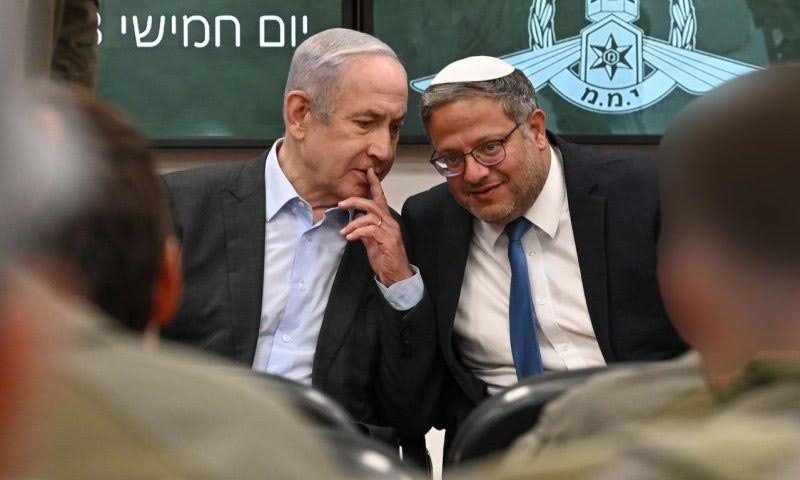 Yeshiva World News1 day ago
Prime Minister Benjamin Netanyahu rejected National Security Minister Itamar Ben Gvir’s demand to become defense minister in the next government, declaring Wednesday that the powerful portfolio must remain under Likud control.
Speaking during an interview with Army Radio, Netanyahu acknowledged Ben Gvir’s interest in the position but made clear that the Otzma Yehudit chairman would not determine the appointment.
Ben Gvir responded by presenting two possible political scenarios. He argued that the Defense Ministry could go to former IDF Chief of Staff Gadi Eisenkot in a broad unity government or to himself under a right-wing coalition.
The national security minister also outlined changes he would seek to implement if given the position, including dismantling the Palestinian Authority, encouraging voluntary emigration from Gaza and Judea and Samaria, and revising the IDF’s ethical code.
The exchange comes less than two weeks before Israel’s scheduled elections, as political parties begin positioning themselves for negotiations over the composition of the next coalition government.
(YWN World Headquarters – NYC)
 Yeshiva World News1 day ago
Iran’s Islamic Revolutionary Guard Corps has reportedly reorganized its overseas assassination network, appointing a new commander and changing the unit’s designation following a series of Israeli intelligence operations and targeted eliminations. The former Unit 840 has been renamed Unit 600, according to an investigation by Iran International.
According to the report, the Quds Force appointed 64-year-old Mojtaba Haq-Lesan to lead the organization. He previously headed the unit’s intelligence department.
Haq-Lesan replaces Yazdan Mir, also known as Hajj Asghar Bagheri, who was eliminated in an Israeli strike on April 6. The organization reportedly operated without a permanent commander during the intervening months.
Mohammad Reza Ansari has been appointed deputy commander and placed directly in charge of operations involving Israel. Mohsen Boroujeni oversees operations in the United States and Europe, while Morteza Babaei is responsible for the Middle East and Africa, and Javad Sharafai oversees activities in Asia.
The network has previously been linked to assassination plots targeting American officials, Israeli businesspeople, Iranian opposition figures, and Jewish institutions. The investigation also described Iranian efforts to recruit criminal organizations in European countries to carry out attacks on behalf of the regime.
(YWN World Headquarters – NYC)
 Yeshiva World News1 day ago
Yemen’s Houthi terrorists are reportedly working to develop medium-range ballistic missiles capable of reaching Israel and Saudi Arabia, using components purchased from a Chinese supplier and assistance from Iran.
The findings, detailed in a new report by Conflict Armament Research, indicate that the Houthis are seeking to manufacture a locally produced version of Iran’s Kheibar Shekan guided missile.
The planned weapon is expected to have a range of approximately 2,000 kilometers, potentially allowing the terrorist group to strike targets throughout Israel and Saudi Arabia.
The assessment is based on information collected by Yemeni government authorities in July, after they intercepted two shipments containing equipment intended for missile production.
The seized materials reportedly included rocket structural components, rocket engines and dual-use items that can serve both civilian and military purposes.
However, the report does not confirm that the Houthis have successfully produced or deployed such a missile.
It also remains unclear whether the Chinese government has any direct involvement in the project or control over the final destination of the components supplied by the Chinese company.
(YWN World Headquarters – NYC)
 Yeshiva World News1 day ago
Lebanese President Joseph Aoun has reportedly received assurances from the United States that Washington will not support an expansion of Israel’s security zone in southern Lebanon, provided Hezbollah refrains from actions that could justify a broader Israeli military operation.
The account, published Tuesday, cited a Lebanese political source involved in direct contacts between Israel and Lebanon.
According to the report, Aoun has been pressing senior American officials to use Washington’s influence with Prime Minister Binyamin Netanyahu to prevent Israel from expanding the zone.
Lebanese officials reportedly fear Netanyahu could pursue such a move ahead of Israel’s Knesset elections, viewing it as a potential way to strengthen his chances of victory. That assessment reflects concerns voiced on the Lebanese side.
The source emphasized that the American assurances depend on Hezbollah’s conduct on the ground. The terrorist group must avoid actions that could give Israel justification to extend its military operations toward the ridges between the Iqlim al-Tuffah area and Jabal al-Rihan in southern Lebanon.
Meanwhile, Hezbollah reportedly sent Aoun a message through Lebanese Parliament Speaker Nabih Berri asserting that it remains committed to the ceasefire.
According to the report, the group said it was currently refraining from responding to what it described as “Israeli strikes.”
(YWN World Headquarters – NYC)
 Yeshiva World News1 day ago
An explosion and fire were reported Wednesday at an Intel plant in Kiryat Gat’s Rabin Industrial Park. Three workers were injured with burns. Magen David Adom said its teams were treating three conscious patients at the scene. United Hatzalah reported that two men, approximately 40 to 50 years old, were evacuated while CPR was being performed and were in critical condition.
Eight firefighting and rescue teams, including hazardous materials units, are operating at the scene. Crews are searching for anyone who may be trapped, working to contain the fire and monitoring for hazardous substances. Police are investigating whether the fire was caused by a gas cylinder explosion and are also checking for a possible hazardous materials leak.
The Environmental Protection Ministry and the Ashkelon Environmental Association sent teams to assess the incident and its potential environmental impact. The public is asked to stay away from the area, avoid gathering there and follow the instructions of emergency forces.
(YWN Israel Desk – Jerusalem)
 Yeshiva World News1 day ago
Defense Minister Israel Katz warned Wednesday that Hezbollah would face a major Israeli military response if it joins Iran in an attack on Israel.
“If Hezbollah joins Iran in an attack on Israel, it will suffer a severe blow and lose additional territory in southern Lebanon,” Katz said. He named the Nabatieh and Litani areas as territory that would become part of Israel’s permanent security zone.
Katz said the IDF is prepared to carry out the maneuver. He also warned that Beirut’s Dahiyeh district would be evacuated and its terror infrastructure struck, displacing more than a million Shiites within Lebanon.
Katz toured frontline villages alongside Northern Command chief Maj. Gen. Rafi Milo and 91st Division commander Brig. Gen. Yuval Gaz.
(YWN Israel Desk – Jerusalem)
 Yeshiva World News1 day ago
The Israeli government approved a transfer of nearly NIS 1 billion to the Defense Ministry for an urgent, classified procurement, with the funds set to help purchase a squadron of 12 Apache helicopters for the Israeli Air Force.
Israel has sought the helicopters for several years. In January, the United States approved a potential sale of the Apaches to Israel valued at $3.8 billion.
The funding will be taken from the five-year plan for investment in Israel’s Arab communities. The proposed cuts include NIS 169 million in 2027, NIS 342 million in 2028 and NIS 453 million in 2029.
The approval comes amid reported budget disputes between the Defense and Finance ministries. Recent reports said Israel had missed the deadline to complete the Boeing deal, which could delay delivery by several years as another customer takes Israel’s place.
Defense spending has risen sharply amid the wars in Gaza, Lebanon and Iran, as well as operations in Yemen, since the Hamas-led October 7, 2023, attack. The military is also seeking to significantly expand its forces following the failures exposed by the attack and the subsequent wars.
The state budget passed in March allocated a record NIS 143 billion to the Defense Ministry, about 17 percent of total government spending. In July, the Finance Ministry said it had agreed to immediately transfer an additional NIS 15 billion to the military, following IDF claims that units were at risk of being grounded.
(YWN Israel Desk – Jerusalem)
 Yeshiva World News1 day ago
Israel’s Central Elections Committee is preparing for the possibility of Iranian missile fire on the morning of October 27, when polls are scheduled to open for the 26th Knesset. One extreme scenario under review involves an attack intended to frighten voters and disrupt the democratic process.
The report comes amid growing assessments that Iran may try to interfere with Israel’s elections. Committee chairman Justice Noam Solberg has held discussions on the matter, while Prime Minister Binyamin Netanyahu has warned twice in recent weeks that Israel’s enemies may try to attack ahead of or during the election period.
Netanyahu said during a visit to the Shomron yesterday, “There are signs that our enemies will try to attack us ahead of the elections. I send you a message: Don’t mess with us. Our long arm will reach you anywhere and anytime.”
The committee has spent recent months preparing for a range of emergency scenarios through exercises, simulations and joint discussions with security agencies. The scenarios include a security escalation, natural disasters, cyberattacks and attempts to influence the election through false information. Officials have also examined less likely situations, including a Capitol-style assault, an earthquake and doctored recordings.
Defense Minister Yisrael Katz said Israel has identified efforts by its enemies, led by Iran and its proxies, to advance attacks that could affect the election results. “We must respond to these attempts with unity and a clear message that political disagreements will not weaken our common stand against our enemies,” Katz said.
The Central Elections Committee said it is prepared for all contingencies and has plans in place to ensure the election proceeds according to law. It added that, with the country currently under a special home-front situation, it is mapping protected spaces and security arrangements in each area.
(YWN Israel Desk – Jerusalem)
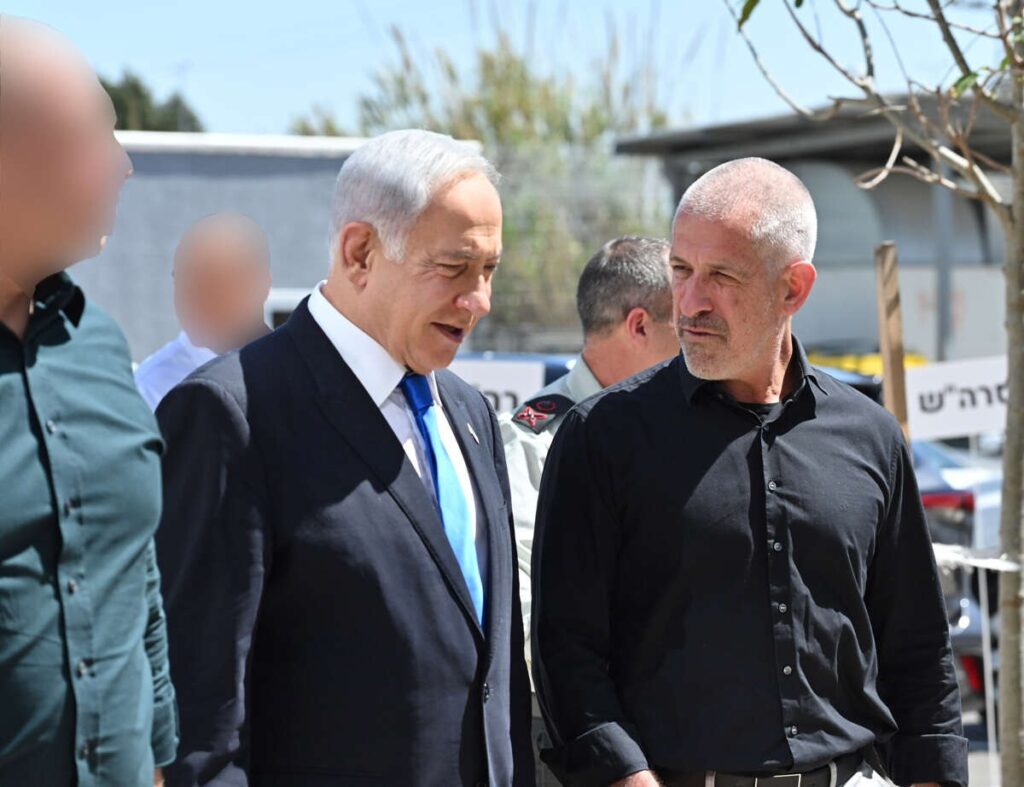 Yeshiva World News1 day ago
Former Shin Bet chief Ronen Bar filed a multi-million-shekel defamation lawsuit against Prime Minister Binyamin Netanyahu in the Central District Court on Wednesday. The complaint presents documents and testimony that Bar says contradict Netanyahu’s claims that he was not warned about the October 7 attack and that information had been withheld from him.
According to the complaint, Bar warned Netanyahu repeatedly in the months before the attack about the possibility of an imminent, multi-front escalation, with particular concern about Gaza and the Tishrei Yamim Tovim. Bar also proposed steps to thwart senior Hamas officials, but the complaint says his warnings and proposals were dismissed or ignored.
The filing accuses Netanyahu of pursuing a policy of “quiet at any cost” in Gaza: delaying confrontation, treating Gaza as a secondary arena and preserving Hamas as its governing authority. It says the policy included allowing Qatari funds to strengthen Hamas despite the Shin Bet’s objections and relying on the assessment that Hamas was deterred.
The lawsuit also challenges the claim that the Shin Bet withheld information on the night of October 7. It says the Shin Bet began sending an alert to security agencies at 3:03 a.m. and that the Prime Minister’s Military Secretariat was updated. Bar also instructed that Netanyahu’s military secretary be notified before the attack, in keeping with communication procedures Netanyahu had established, the complaint says. The instructions were recorded in Shin Bet operations logs. Bar’s filing further says Netanyahu did not respond or intervene after the attack began.
The complaint argues that Netanyahu knew the Shin Bet was not responsible for deploying military forces or overseeing civilian events, and calls his repeated accusations against Bar false and defamatory. Bar says he filed the suit after a prolonged public campaign against him, the lack of a state commission of inquiry and reports of alleged attempts to falsify protocols.
Bar said he accepts responsibility for the Shin Bet’s failures. “As the head of the service, I bear responsibility for the Shin Bet’s failure in its part in providing the intelligence required regarding the October 7 attack and its timing. Accordingly, bowing my head before the bereaved families, I resigned from my position,” he said.
He said he had waited for a state commission of inquiry to examine both the Shin Bet’s work and its failures, but decided to sue after Netanyahu’s recent statements. “In light of the Prime Minister’s unrestrained outburst, I decided not to remain silent and to show the public the motives behind such improper behavior,” Bar said.
(YWN Israel Desk – Jerusalem)
 Yeshiva World News1 day ago
A 6-month-old baby who was not vaccinated according to the routine schedule is being treated in the pediatric intensive care unit at Shaare Zedek Medical Center in Yerushalayim after being diagnosed with bacterial meningitis caused by Haemophilus influenzae type B (Hib).
The baby arrived at the pediatric emergency department with a high fever and feeling generally unwell. A medical evaluation found that he had contracted Hib, a bacterium covered by the routine vaccination program. He was transferred to the ICU under the care of Dr. Jacques Brown. His condition is stable, he is fully conscious, and he is expected to continue his hospitalization in the children’s ward, headed by Prof. Orly Magad.
Dr. Amir Zilka, a senior physician in the pediatric ICU, said: “As soon as it was diagnosed that the baby was suffering from bacterial meningitis, he began receiving antibiotic treatment, and his condition was closely monitored.”
“Unfortunately, we encounter cases of potentially life-threatening illness that can be prevented with an effective and safe vaccine,” Dr. Zilka said. He explained that Hib can cause meningitis, bloodstream infection, including sepsis, and pneumonia. Symptoms can include fever, headaches, vomiting and confusion.
Dr. Zilka warned that “beyond the immediate and even life-threatening health risks, bacterial meningitis can have long-term effects on children’s health and neurological functioning.”
(YWN Israel Desk – Jerusalem)
 Yeshiva World News1 day ago
A bus and a truck collided Wednesday afternoon on Route 91, between the Mahanayim Junction and Kibbutz Gadot. Magen David Adom teams were called to the scene and found the 61-year-old bus driver trapped in the wreckage, unconscious and without a pulse or signs of breathing. After he was freed, medics pronounced him dead at the scene.
The truck driver, about 50, was seriously injured, with severe injuries to his lower limbs. He was unconscious when he was airlifted by MDA Rescue Air to a hospital for treatment. Eighteen bus passengers, young men around 20 years old, were lightly injured and taken by ambulance to Ziv Medical Center in Tzfas.
MDA emergency medical technician Gil Ad Ben Hamo described the scene: “It was a horrific traffic accident. The vehicles had very severe damage to their front ends. The bus driver was trapped and unconscious. While complex rescue operations were underway, we provided him with medical care, but unfortunately had to pronounce him dead at the scene. At the same time, we treated the truck driver and the 18 passengers who were on the bus.”
Police officers and traffic accident investigators are investigating the circumstances of the crash. Route 91 was closed in both directions. Police urged drivers to avoid the area, take alternate routes and follow officers instructions.
(YWN Israel Desk – Jerusalem)
 Yeshiva World News1 day ago
Part of a building undergoing renovation collapsed Wednesday morning on Nachlat Binyamin Street in southern Tel Aviv, near Rothschild Boulevard. Magen David Adom received the initial report at 9:37 a.m., and rescue and medical teams were quickly dispatched to the scene.
Yarkon District police officers also arrived, closing off and securing the area while assisting emergency crews. Rescue teams are conducting extensive searches through the rubble to rule out anyone being trapped. No one had been found injured at the time of the report, and emergency personnel continued working at the scene.
Nearby security cameras captured the panic as the building collapsed Wednesday morning in Tel Aviv. The footage shows a man sitting on a nearby bench getting up and running for his life as the structure came down, while other passersby fled the scene in panic.
(YWN Israel Desk – Jerusalem)
 Yeshiva World News1 day ago
The IDF has implemented its new “Netz” command-and-control system in more than 1,300 community defense teams across Israel, connecting tens of thousands of personnel as part of efforts to address failures exposed during the October 7 attack.
The system enables rapid deployment of forces during emergencies, provides an operational picture in real time and coordinates activity between local defense teams, IDF units, Israel Police and other security agencies.
Built on data infrastructure and artificial intelligence, Netz is designed to improve command and control during large-scale incidents and shorten response times for forces in the field.
Development began at the outbreak of the war as an initiative by reservists. The project is now led by the Alumot unit within the Data and Artificial Intelligence Division of the IDF’s Communications and Cyber Defense Directorate.
The IDF said the system forms part of a broader effort to strengthen coordination between local security teams and national security forces, drawing on lessons from the breakdowns during the October 7 massacre.
(YWN World Headquarters – NYC)
 Yeshiva World News1 day ago
A new survey of Lebanon’s Shiite community found that nearly two-thirds support some form of agreement with Israel, while a similar majority favor transferring Hezbollah’s weapons to the Lebanese state under some arrangement.
The poll, conducted in September by Statistics Lebanon among 800 Shiite respondents, found that 63.3% support an agreement with Israel and 66.4% back placing Hezbollah’s arsenal under state control.
The findings present a complicated picture for the terrorist organization, with continued support for Hezbollah alongside substantial backing for changes to its military role and Lebanon’s relationship with Israel.
Asked about the outcome of the war, 67.4% said Hezbollah had either failed to achieve its objectives or achieved only some of them. Another 42.1% expressed disappointment, anger or concern over the conduct of its leadership.
The Lebanese Army received considerably stronger support as the institution responsible for the country’s security. Overall, 78.5% expressed confidence in the army, and 51.1% viewed it as the principal guarantor of Lebanon’s long-term security.
Only 16.5% assigned that central security role to Hezbollah.
The survey also found that 71.1% believe decisions concerning war and peace should be made exclusively by Lebanon’s national leadership, rather than independently by Hezbollah.
However, the results do not indicate a wholesale rejection of the organization within the Shiite community. Some 37.1% still expressed a high degree of trust in Hezbollah, while another 22.4% expressed some trust.
The findings suggest that confidence in Hezbollah can coexist with support for state authority over its weapons and decisions on war, as well as openness to an arrangement with Israel.
(YWN World Headquarters – NYC)
 Yeshiva World News2 days ago
Republican gubernatorial candidate Bruce Blakeman delivered a sharp attack on New York Gov. Kathy Hochul and New York City Mayor Zohran Mamdani during Tuesday night’s only scheduled gubernatorial debate, accusing the Democratic governor of failing to adequately protect Jewish New Yorkers amid rising antisemitism and warning that Mamdani’s leadership is making the situation worse.
Blakeman, the Jewish Nassau County executive, repeatedly challenged Hochul over her political alliance with Mamdani, whom he directly accused of antisemitism, while pointing to anti-Israel demonstrations, campus unrest, and threats against Jewish institutions.
The confrontation came during the hourlong debate hosted by Spectrum News NY1, just three weeks before the November 3 election.
Moderators questioned Blakeman about remarks he reportedly made during a private meeting with Chassidic community leaders in Williamsburg, where he warned about the possibility of violent antisemitic riots targeting Jewish neighborhoods and institutions.
During that meeting, Blakeman reportedly asked community leaders, “If there is rioting here, if they’re burning down the yeshivas and your shuls, and burning down your house and raping your women, you think Zohran Mamdani is going to stop them?”
Pressed during the debate to identify whom he believed might carry out such violence, Blakeman pointed to the radical demonstrators who have disrupted New York City streets and college campuses.
“They are the professional protesters that took over Columbia University, that blocked our bridges and our roadways, and the lawlessness that took place while Kathy Hochul wouldn’t protect Jewish students,” he said.
Blakeman then turned his criticism directly toward Mamdani.
“Zohran Mamdani is an antisemite,” he declared, citing the mayor’s decision to eliminate New York City’s adoption of the International Holocaust Remembrance Alliance’s definition of antisemitism on his first day in office.
The IHRA definition, which has been widely adopted by governments and institutions, recognizes certain forms of anti-Israel rhetoric as antisemitic. Mamdani’s decision to reverse the city’s use of the definition drew criticism from Jewish organizations concerned about the protection of Jewish residents.
Blakeman challenged Hochul over her willingness to maintain a political partnership with the mayor despite those concerns.
“If you want to campaign with him, that’s fine, but I will tell you right now — I think Zohran Mamdani is an antisemite,” Blakeman told the governor. “Antisemitism is on the rise and it’s occurred under your watch and Zohran Mamdani is fueling it.”
Hochul responded by criticizing Blakeman’s warnings about potential violence, suggesting that his comments reflected a lack of confidence in the NYPD’s ability to protect New Yorkers.
“I stand with the men and women in blue every day of the week,” Hochul said.
Both candidates expressed support for NYPD Commissioner Jessica Tisch, who has faced mounting criticism from far-left activists and organizations, including groups associated with the Democratic Socialists of America, Mamdani’s political base.
Some of those groups have demanded Tisch’s removal following a recent confrontation involving federal immigration agents in New York City.
Blakeman has made protecting Jewish communities a central issue in his campaign, frequently contrasting his administration’s approach in Nassau County with policies in New York City and Albany.
(YWN World Headquarters – NYC)
 Yeshiva World News2 days ago
Israel’s Water Authority has spent more than NIS 50 million supplying privately operated desalination plants with specialized filtration equipment as the country continues dealing with disruptions caused by microalgae contamination. The emergency expenditure was disclosed Tuesday as officials worked to restore the affected facilities.
The problems began last month when microalgae contamination interfered with the operation of desalination facilities, reducing the ability of certain plants to produce water at their normal capacity.
The Water Authority purchased filtration membranes for the facilities to help address the disruption. Officials emphasized that the equipment was intended for emergency use rather than as a permanent replacement for existing treatment systems.
The disruption coincides with significant pressure on Israel’s natural water supplies following consecutive years of insufficient rainfall in the country’s northern watersheds. The Water Authority continues overseeing restoration efforts at the affected desalination facilities.
(YWN World Headquarters – NYC)
 Yeshiva World News2 days ago
Senior Hamas terrorist Ali al-Amoudi, the acting head of the organization’s political bureau in Gaza, reportedly survived an attempted elimination earlier this month after leaving the building where he was staying approximately three hours before it was struck and destroyed.
According to Hamas sources, his departure followed a warning from members of the terrorist organization’s military wing who had observed unusual Israeli drone activity over western Gaza City.
Two operatives in Hamas’s aerial unit reportedly spotted two drones circling above the building and the nearby harbor area. The sources claimed the aircraft were models known to Hamas for their advanced intelligence-gathering capabilities, including artificial intelligence used to identify targets.
After monitoring the drones for several hours, the operatives concluded that their movements could indicate preparations for an imminent strike against a senior figure in the area.
They relayed their assessment to Hamas personnel responsible for protecting the organization’s leadership, including al-Amoudi’s security team.
His security chief then informed him of the warning. Although they reportedly had no verified information confirming that al-Amoudi himself was the intended target, he took the alert seriously and immediately left the apartment for another location.
The building was bombed roughly three hours later, according to the Hamas sources, who attributed his survival to the warning and his decision to relocate.
(YWN World Headquarters – NYC)
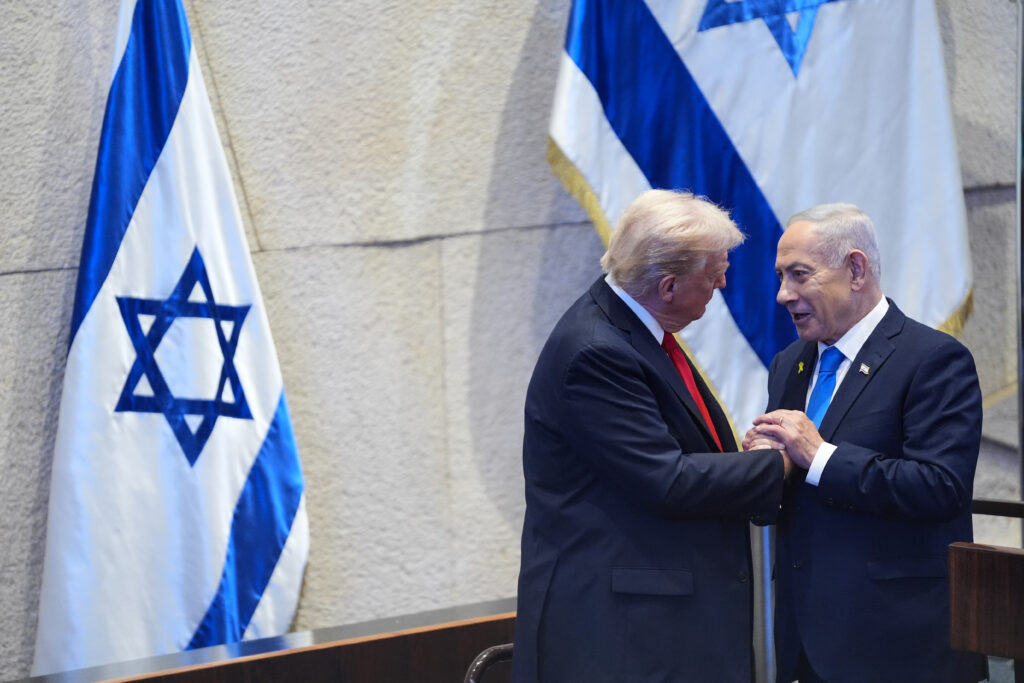 Yeshiva World News2 days ago
Prime Minister Benjamin Netanyahu held several discussions with President Donald Trump over the past two weeks about the possibility of launching a renewed, large-scale military campaign against Iran, potentially before Israel’s October 27 elections. Senior American officials said they came away with the impression that Netanyahu wanted to resume strikes before Israelis head to the polls, citing alarming new Iranian nuclear activities as a central justification.
According to the report, Netanyahu and Trump discussed the possibility of a major joint American-Israeli military operation targeting Iranian military installations and nuclear facilities. Netanyahu expressed concern over steps Tehran is taking to restart activities across various components of its nuclear program, warning that the developments could require a renewed military response.
A senior American official revealed that Netanyahu raised the possibility of renewed military action with Trump on multiple occasions. During those conversations, Trump reportedly told Netanyahu to proceed with preparations but stopped short of authorizing an attack. The official explained that Trump’s encouragement to prepare did not constitute a commitment to launch an operation, whether immediately, at a later date, or at all.
A senior Israeli official said Trump initially appeared inclined to give Netanyahu the green light, but his enthusiasm subsequently cooled. Another senior American official described the president as repeatedly shifting his position on the question of renewed military action against Iran.
Despite Trump’s public declaration that he would not attack Iran before the November 3 U.S. midterm elections, the IDF and U.S. Central Command remain on heightened alert and are completing operational preparations in case the president changes his mind.
Within the Trump administration, Defense Secretary Pete Hegseth and U.S. Central Command are reportedly among the strongest supporters of resuming large-scale military operations against Iran. However, most of Trump’s advisers currently favor maintaining sanctions and economic pressure, arguing that the mounting financial strain on Tehran is proving increasingly effective.
The possibility of renewed fighting carries significant implications for Israel’s upcoming elections. According to the report, Israeli defense officials expect Iran to retaliate against a major military operation by launching hundreds of ballistic missiles toward Israel, potentially disrupting the electoral process.
IDF Chief of Staff LTG Eyal Zamir discussed the possibility of renewed military action against Iran within the next three weeks during a conversation last week with Chairman of the U.S. Joint Chiefs of Staff General Dan Caine. According to a source briefed on the discussion, Zamir warned that launching an operation during that period could force Israel to postpone its elections because of the anticipated Iranian missile response.
The report also described concerns within Israel’s security establishment about the domestic political implications of military action immediately before the elections. Zamir faces the possibility that an operation launched during the election campaign could be perceived by significant portions of the Israeli public as a political maneuver by Netanyahu, potentially damaging public confidence in the IDF as an institution widely regarded as nonpolitical.
American officials also acknowledged awareness of Netanyahu’s domestic political considerations. One senior official suggested that Netanyahu believes his political strength is enhanced by serving as prime minister during wartime.
However, a senior Israeli official offered a different account of the discussions. According to that official, Netanyahu told senior Israeli defense officials in recent meetings that Trump, rather than Netanyahu, initiated the conversation about restarting the broader war against Iran before the elections. Netanyahu reportedly said Trump had asked whether Israel would participate in such an operation.
Meanwhile, diplomatic efforts involving Iran remain unresolved. Qatari mediators are still awaiting Tehran’s response to the latest American proposals. A senior American official described negotiations as neither completely dead nor genuinely active, saying Washington continues increasing pressure while hoping more pragmatic figures within Iran’s leadership eventually prevail.
(YWN World Headquarters – NYC)
 Yeshiva World News2 days ago
Prime Minister Binyamin Netanyahu warned Tuesday that Israel is prepared for attempts by its enemies to exploit the upcoming elections, including a scenario in which Palestinian Authority security forces turn their weapons against Israel.
Speaking during a visit to the security barrier in Shomron, Netanyahu said the IDF had presented him and the defense minister with a plan to respond with overwhelming force.
“There are security alerts here, that is true. Our enemies are thinking of testing us in these days leading up to the elections,” Netanyahu said. “I warn them that we are prepared for every scenario, including what is known as a ‘turning of the guns.’”
Netanyahu was accompanied by the defense minister, the head of the National Security Council and the commander of the IDF Central Command.
Commanders from the IDF, Shin Bet and Border Police briefed him on efforts to protect communities along the security barrier, as well as counterterrorism operations in Palestinian villages. Those operations include arrests of terrorists, confiscation of weapons and measures to address security threats.
Pointing to the nearby Tulkarm refugee camp, Netanyahu praised the military’s operations there.
“Behind me is the former Tulkarm refugee camp. It was a terrorist stronghold. The IDF entered, cleared it out on our instructions, and did an excellent job, not just here,” he said.
Netanyahu also sharply challenged calls raised in Supreme Court proceedings to allow residents to return to the area.
“I heard that someone in the Supreme Court says the residents should be brought back here. These are not residents; they are terrorists,” he said.
He insisted that the IDF would retain control of the territory and rejected the deployment of an Arab military force west of the Jordan River.
“The force that will control this territory and remain here is the Israel Defense Forces,” Netanyahu declared. “There will be no Arab army west of the Jordan River.”
Highlighting the area’s proximity to Israel’s population centers, Netanyahu noted that Netanya and the Mediterranean coastline were only minutes away.
Returning to the possibility of an attack, he said the military had prepared a “powerful and forceful plan.”
“In such a case, I would not advise our enemies to test us. You will encounter a level of force here that you have never dreamed of,” he warned.
Netanyahu concluded by pledging continued security operations and pointing to the establishment of more than 104 communities and numerous farms.
“We will continue to safeguard Israel’s security here, along the seam line, everywhere,” he said.
(YWN World Headquarters – NYC)
 Yeshiva World News2 days ago
Former Communications Minister Yoaz Hendel said Tuesday that his political alliance could support either Benjamin Netanyahu or Gadi Eisenkot in forming Israel’s next government, depending on the outcome of the election and the balance of parties in the next Knesset.
Hendel, whose Reservists party has joined forces with economist Yaron Zelekha’s Economic Party, predicted that the alliance would win at least five Knesset seats.
He described his party as an alternative for voters dissatisfied with the major political factions and warned that voting exclusively for larger parties could contribute to another period of political deadlock.
Hendel indicated that his faction would examine potential coalition arrangements after the election rather than committing in advance to either major candidate. Israeli parties must secure sufficient parliamentary support to establish a government, with 61 seats constituting a majority in the Knesset.
(YWN World Headquarters – NYC)
 Yeshiva World News2 days ago
An 18-year-old from Ofakim who suffered for years from severe scoliosis is now walking upright following a complex operation at Hadassah Ein Kerem using a new robotic system that incorporates artificial intelligence.
The patient, identified as Shani, was the first in Israel to undergo surgery with the Stealth Axis robot, according to the hospital. She was discharged home less than a week after the procedure and is continuing her recovery with physiotherapy and follow-up care.
Hadassah said the system combines AI capabilities, advanced surgical planning and precise navigation to assist surgeons operating on the spine. It offers a broader working range and greater accuracy than earlier generations of robotic systems, according to the hospital, and had previously been used only a handful of times worldwide.
Before the first operation, a dedicated Hadassah team traveled to the manufacturer’s training center in Switzerland for extensive practical instruction. The delegation included Prof. Josh Schroeder, director of spine surgery at Hadassah Ein Kerem, along with operating room nurses. They practiced using the system in a laboratory designed to simulate operating room conditions.
For Shani and her mother, the surgery marked a major turning point after years of treatment and limitations.
Her mother first noticed something unusual when Shani was in seventh grade. While touching her back, she felt a pronounced asymmetry beside the spine and noticed that her shoulders were uneven. Initially fearing a tumor, she took her daughter for an examination, where doctors diagnosed scoliosis.
Shani described how the condition interfered with everyday activities, including dance classes, where she was unable to perform certain movements because of her back.
She underwent physiotherapy, periodically used a back brace and received ongoing orthopedic monitoring. After being referred to Schroeder in Yerushalayim, the family was advised to continue conservative treatment while she was still growing and consider surgery later.
When the operation was scheduled, her mother said the family was initially apprehensive about being the first in Israel to use the new robot. Learning about the team’s specialized training and the system’s potential benefits helped reassure them.
The surgery lasted more than five hours and involved a multidisciplinary team of surgeons, anesthesiologists, an X-ray technician and operating room nurses.
Schroeder said the robot provided substantial assistance during the complex procedure, which proceeded smoothly without technical problems. He described Shani’s postoperative condition as excellent and said Hadassah’s integration of advanced robotics places it at the forefront of spine surgery.
Shani also recalled the personal support she received from Chen Uri, the team member responsible for neural monitoring. Before surgery, Uri held her hand, spoke with her and helped her feel secure. She later visited Shani during her hospitalization.
Her mother praised both the medical care and the staff’s kindness, saying the family felt supported throughout the process.
Shani is now able to stand steadily and walk slowly with her back upright. Further rehabilitation lies ahead, with follow-up planned at Hadassah’s facility in Netivot, closer to her home.
Schroeder said another operation using the robot is already being planned, with additional patients expected to benefit from the technology.
(YWN World Headquarters – NYC)
 Yeshiva World News2 days ago
A 15-year-old Magen David Adom youth volunteer injured in Monday’s deadly school trip explosion in the Upper Galilee immediately began treating his friends, performing CPR on a critically injured boy and helping his younger brother despite sustaining shrapnel wounds himself.
Yair Frankenthal, a resident of Ma’alot, was among students from ORT Ma’alot Yeshiva High School hiking on the Ramim Ridge when unexploded ordnance detonated near Mitzpe Pe’er.
The explosion killed 14-year-old Elazar Yair Wilensky, the youngest of five siblings, and injured another 24 people. Four were seriously injured, seven moderately and 13 lightly.
“After hearing the huge explosion, I realized that I had been injured too, but I immediately began checking who needed medical assistance so I could help using the knowledge I had gained in my first aid course,” Frankenthal recalled.
While other students called MDA’s emergency hotline, Frankenthal approached one of the most severely injured boys.
“I noticed that he had no pulse and was not breathing, so I performed CPR on him until the first responder arrived,” he said.
His younger brother had also been wounded by shrapnel. Frankenthal checked on him and instructed a nearby friend who was helping control the bleeding, allowing him to return to those with more serious injuries.
“My younger brother, who was also on the trip, was injured by shrapnel, and I went to check on his condition,” he said. “A friend who was next to him helped stop the bleeding, and I instructed him on what to do so that I could go help those who were more seriously injured.”
Frankenthal suffered minor injuries from two pieces of shrapnel that penetrated his leg and shoulder. He was expected to be discharged home Tuesday.
“Baruch Hashem, I was only lightly injured,” he said, adding that he felt well and was happy to be returning home.
The first emergency responder to reach the scene was David Radko, 29, an MDA emergency medical technician and motorcycle unit volunteer from Kiryat Shmona.
Radko, who also works as a tenth-grade homeroom teacher, was returning from work when MDA’s dispatch center sent him to the incident. He said the difficult terrain complicated access to the injured.
Upon arrival, he found casualties scattered along the trail, with students holding wounded friends and trying to help them.
“Even at first glance, it was clear that this was an extremely difficult scene,” he recalled.
As a teacher of students around the same age, Radko said the incident struck him particularly deeply. He found himself thinking of the wounded teenagers as though they were his own students and identifying with the teachers accompanying the trip.
He immediately began assessing the casualties and controlling bleeding while helping additional rescue teams reach the scene.
Radko praised the students’ resourcefulness, saying that despite their own injuries and fear, they worked together to assist their friends. Some had applied tourniquets to control bleeding.
“I gave them instructions on how to help, and they listened and acted accordingly,” he said. “We did everything we could to provide them with the best possible treatment.”
(YWN World Headquarters – NYC)
 Yeshiva World News2 days ago
A prominent rabbi from Iran’s Jewish community has claimed that shuls in the Islamic Republic do not require special security arrangements, while sharply criticizing Israel and accusing it of using allegations of antisemitism against its opponents.
Chacham Younes Lazar Hamami, a rabbi serving Iran’s Jewish community, made the remarks during an interview with Iranian media, according to a report by B’Chadrei Chareidim.
Unlike Jewish communities in other countries, Hamami claimed, Jewish institutions in Iran do not require dedicated security personnel or protective systems.
“Our communities have no security system, no guards, nothing,” he said.
Hamami maintained that Iranian police provide security for all citizens, suggesting that the Jewish community does not face the same security concerns experienced by Jewish communities elsewhere.
During the interview, Hamami also criticized Israel, referring to the Jewish state as the “Zionist regime.”
He accused Israel of using allegations of antisemitism to discredit those who oppose its policies.
Hamami pointed to demonstrations by Jews in Britain, the United States, and other countries against Israeli government policies, arguing that the protests demonstrate that some Jews oppose Israel’s actions.
“There are Jews who oppose this way of operating,” he said.
The remarks were made in an interview with Iranian media, where public criticism of the Islamic Republic is heavily restricted.
(YWN World Headquarters – NYC)
 Yeshiva World News2 days ago
National Security Minister Itamar Ben Gvir is demanding expedited legal proceedings and the death penalty for Kadri Samara, the terrorist who murdered Netanel Shakron in a shooting attack in Binyamin on Erev Yom Kippur.
In a letter to Military Advocate General Maj. Gen. Itai Ofir, Ben Gvir questioned why an indictment had not been filed approximately three weeks after the attack. He argued that the circumstances did not justify the delay and requested a prompt explanation.
According to the letter, Samara carried out the September 20 attack near the Ein Raya spring, close to Neve Tzuf, murdering Shakron, a resident of Alei Zahav.
Shakron was sitting in his vehicle with his eldest son, 16, who managed to escape unharmed. He is survived by his wife and six children.
The terrorist fled the scene but was captured later that day by soldiers from the IDF’s Duvdevan unit at a hospital in Ramallah, where he was receiving treatment for gunshot wounds sustained during the attack.
Ben Gvir contended that there was no factual dispute or legal complexity that would justify the time taken to bring charges.
“Every delay constitutes a reward for terrorism and undermines the State of Israel’s deterrence,” he wrote.
The minister argued that a swift and efficient trial is an important means of strengthening deterrence against future terrorist attacks.
He further demanded that Samara become the first terrorist prosecuted under the death penalty law and the order enacted pursuant to it.
According to Ben Gvir, the order requires the death penalty for a Palestinian Authority resident who commits a murderous terrorist attack, even if prosecutors do not request that sentence.
His letter called on the Military Advocate General to explain the delay and advance the case without further postponement.
(YWN World Headquarters – NYC)
 Yeshiva World News2 days ago
The Jewish People Policy Institute (JPPI) has launched a database tracking sanctions and restrictive measures against Israel worldwide, documenting 121 actions across 62 countries. Of those, 93 are classified as active and in effect.
The findings highlight mounting international pressure that the institute warns could develop into a broader strategic threat to Israel’s economy, affecting financial relationships, trade and access to critical defense technology.
The financial sector accounts for the largest share of the documented restrictions, with 40 measures—approximately one-third of the total. Trade and defense follow with 24 measures each, alongside 14 diplomatic measures and 12 legal measures.
Spain tops the list with nine actions against Israel, followed by Turkey with seven, Britain with six and Belgium with five. The database records measures across nearly every continent. In the United States, the boycott decisions documented by the project are currently confined to academia.
JPPI Director-General Dr. Shuki Friedman warned that the cumulative impact could extend far beyond the individuals, officials or products directly targeted.
He said it would be a mistake to assume that sanctions against Israeli ministers, individuals in Yehuda and Shomron, or products from those areas would stop at the Green Line. Foreign banks, investors and commercial partners facing potential legal or regulatory risks from their ties to Israel could choose to reduce their exposure to the country more broadly.
The combination of trade and defense restrictions presents a particular concern for Israeli industry, which relies heavily on imported dual-use components and technologies, as well as access to international export markets.
Friedman warned that the central danger is a shift from narrowly targeted sanctions to restrictions affecting the systems on which Israel’s economy and security depend.
He called on the government to treat the issue as a strategic threat and establish a coordinated national mechanism to address it, rather than relying on individual diplomatic responses to each new restriction.
(YWN World Headquarters – NYC)
 Yeshiva World News2 days ago
Israel’s Water Authority reported Tuesday that the amount of water available to the Kinneret over the past two years had fallen to its lowest cumulative level in approximately a century of measurements. The alarming figures were included in the authority’s assessment of the 2025–2026 rainfall season. Channel 12 News reports.
According to the report, approximately 208 million cubic meters of available water entered the Kinneret over the two-year period, an exceptionally low amount compared with historical records.
The shortage was attributed primarily to consecutive years of insufficient rainfall in northern Israel and the watersheds supplying the lake. Although rainfall across the country reached approximately 95 percent of the national average during the most recent season, northern areas experienced significantly weaker precipitation.
The findings were released as the Water Authority continued addressing disruptions at desalination plants and managing the country’s natural water resources. Officials also reported significant regional differences in rainfall, with parts of southern Israel experiencing unusually heavy flooding despite shortages in the north.
(YWN World Headquarters – NYC)
 Yeshiva World News2 days ago
President Donald Trump rejected claims that Russia and China are providing significant assistance to Iran amid the ongoing regional conflict, declaring that he does not believe either country is meaningfully supporting Tehran’s military campaign. The president addressed the allegations in a social media statement.
Trump acknowledged the possibility that limited assistance could exist but dismissed suggestions that Moscow and Beijing were playing a major role in helping Iran confront the United States and Israel.
The comments come amid continuing scrutiny of Iran’s relationships with Russia and China, both of which have maintained diplomatic and economic ties with Tehran despite Western sanctions and military tensions.
Washington has been examining reports concerning potential military assistance, intelligence sharing and sanctions evasion involving Iran and foreign governments. Trump did not announce new sanctions or identify a specific intelligence assessment supporting his remarks.
(YWN World Headquarters – NYC)
Yeshiva World News2 days agoPrime Minister Binyamin Netanyahu accused Israeli media outlets of concealing his government’s achievements during a live social media broadcast Tuesday, claiming that fair coverage would translate into an overwhelming electoral victory.
Responding to a viewer who asked why the public does not hear about the government’s accomplishments, Netanyahu described the outlets as “propaganda channels that brainwash citizens.”
“If we had a free press here, we would get 80 seats,” he said.
Netanyahu also addressed his opposition to Ofer Winter running independently in the upcoming elections, rejecting suggestions that the dispute was personal.
“I wanted him to join Likud. He refused. I told him, okay, then merge with one of the right-wing parties. He refused,” Netanyahu said.
The prime minister argued that Winter has not committed to supporting him after the elections and could instead back Gadi Eisenkot. Netanyahu claimed that supporting Eisenkot would effectively mean supporting Mansour Abbas.
“It’s not personal; it’s national. We need to ensure that the right wins,” he said.
Netanyahu also took aim at Avigdor Lieberman, accusing him of favoring the deployment of an Arab military force in Yehuda and Shomron. Mocking the name of Lieberman’s Yisrael Beiteinu party, Netanyahu suggested calling it “Jordan Beiteinu.”
Asked by an 18-year-old viewer to explain why he should vote for Likud, Netanyahu pointed to his handling of the Iranian threat.
“I’ll give you 10 million reasons—all the citizens of the State of Israel,” he replied.
Netanyahu said he had decided to launch an independent Israeli operation against Iran, which President Donald Trump subsequently joined. He warned that Tehran would again attempt to obtain nuclear weapons and challenged the positions of Eisenkot and Yair Golan.
“So who will stop them again?” he asked.
Turning to the cost of living, Netanyahu claimed that his government had reduced inflation from 5% to 1.5%. He also said housing prices had declined approximately 1.5%, contrasting that with what he described as a roughly 20% increase under the Bennett-Lapid government.
Netanyahu added that the government had allocated NIS 25 billion to reservists and their families.
During the broadcast, he also spoke with an 18-year-old preparing to enlist in the Golani Brigade and wished him success.
Toward the end of the session, Netanyahu returned to his criticism of the media, pointing to extensive construction around him as evidence of economic activity.
“Open the window. Go out into the street,” he said, citing an assessment by The Economist that he said ranked Israel among the world’s three most dynamic economies.
(YWN World Headquarters – NYC)
 Yeshiva World News2 days ago
The British government has announced a public inquiry into the deadly terrorist attack at Heaton Park Hebrew Congregation in Manchester on Yom Kippur 2025, when two Jewish mispallelim were killed. Home Secretary Shabana Mahmood said the inquiry would examine the circumstances of the attack and allow relevant evidence to be considered.
The victims, Adrian Daulby and Melvin Cravitz, were killed during the attack carried out by Jihad Al-Shamie, a British citizen of Syrian descent. The terrorist drove toward people outside the shul before attacking individuals with a knife.
Police shot and killed the terrorist during the confrontation. Subsequent investigations established that one of the Jewish victims had been fatally struck by police gunfire during the emergency response.
The public inquiry will examine the events surrounding the attack, including information held by security agencies and police. British authorities have said the inquiry will have procedures allowing it to review sensitive national security evidence.
(YWN World Headquarters – NYC)



